 PledgeBox
International Compliance: A Creator's Guide for 2026
Navigate global crowdfunding with ease. Our guide to international compliance covers VAT, customs, data privacy, and shipping for Kickstarter creators in 2026.
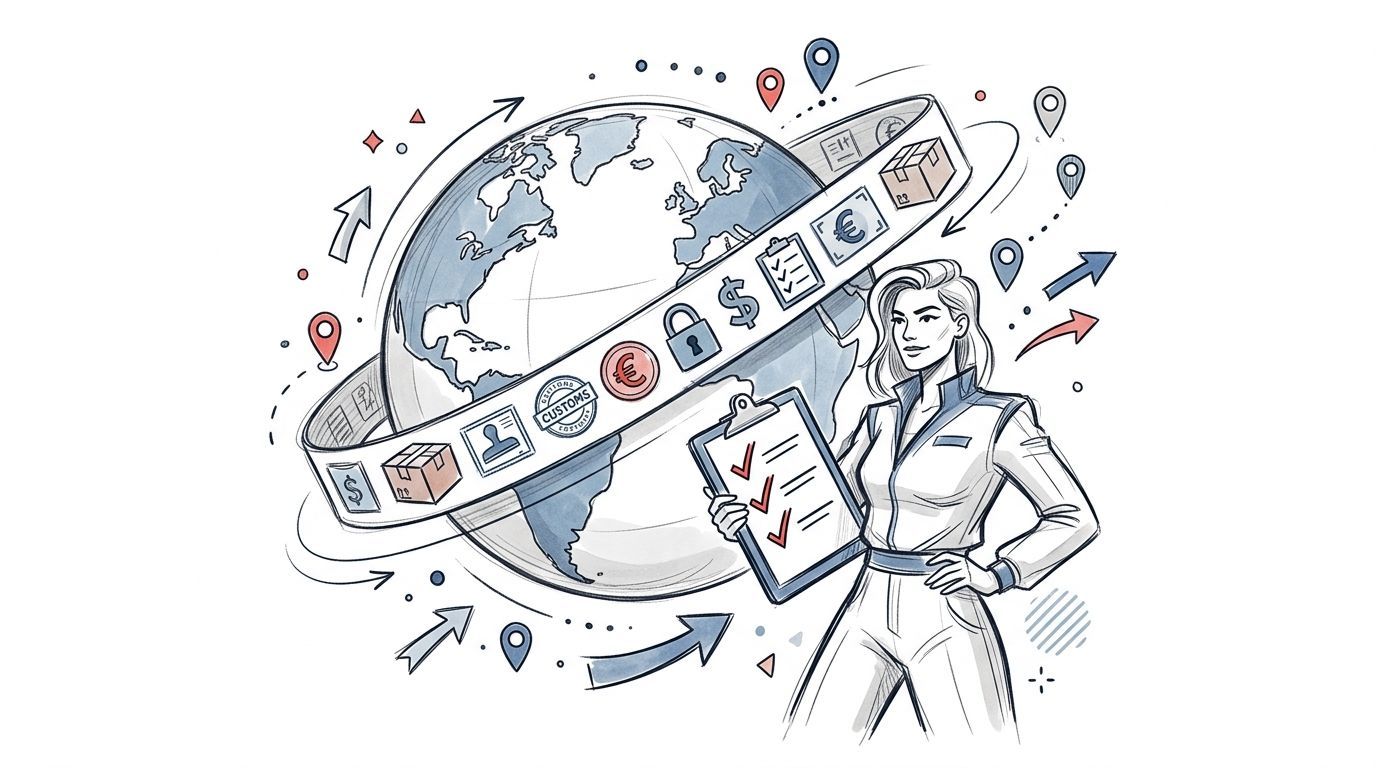
Navigate global crowdfunding with ease. Our guide to international compliance covers VAT, customs, data privacy, and shipping for Kickstarter creators in 2026.
You've closed your campaign. Funding cleared. Backers are celebrating.
Then the true work starts.
You open the export and see addresses from the UK, Germany, Australia, Canada, Singapore, and a few countries you didn't expect to ship to at all. At that moment, international compliance stops sounding like corporate jargon and starts looking like customs holds, unpaid VAT, missing declarations, and backers asking why they owe money before delivery.
For a first-time creator, good campaigns can go sideways. Not because the product is bad, but because post-campaign operations were treated like admin work instead of regulated commerce. If you're shipping physical rewards across borders, you're dealing with tax rules, product rules, data rules, and shipping documentation. You don't need a law degree to handle it. You do need a process.
A campaign can look healthy right up to the handoff into fulfillment. Funds are in. Manufacturing is underway. Then the first international orders hit your pledge manager, and simple questions start carrying real cost. Did you collect the right tax. Can the product clear customs. Are you storing backer data in a way you can defend later if something goes wrong.
That is why international compliance matters to crowdfunding creators. The moment you accept money for a physical reward and send it across a border, you are operating like a cross-border seller. Regulators do not care that the sale started on Kickstarter or Indiegogo.
By 2025, privacy laws covered most of the world's population. For a creator, the practical takeaway is straightforward. Tax, import rules, product restrictions, and data handling are not side tasks for after the campaign. They are part of fulfillment setup.
For crowdfunding, international compliance usually turns into five operating checks:
Miss one, and the failure usually shows up after the campaign, when fixes are slower and more expensive.
Practical rule: If a reward crosses a border, treat it like a retail shipment with audit trails, not a casual fan perk.
Creators get into trouble when they treat compliance as legal theory instead of operational design. The fix is usually boring and effective. Set country rules before surveys go out. Use a pledge manager that can separate item value from shipping, apply taxes by destination, and keep a clean export of what each backer paid. If you need a workable framework, this guide to international tax compliance for crowdfunding creators is a good starting point.
Backers judge the whole experience, not just the product. A surprise charge at delivery feels like your mistake, even if the courier collected it. A held parcel looks like poor planning. A bad address export that exposes personal data creates support issues you do not want.
The cost usually arrives in smaller hits before it ever becomes a legal problem. Re-billed VAT. Returned parcels. Manual customs corrections. Refund requests from backers who refuse delivery. Hours of support work for a team that already moved on to production issues.
I tell first-time creators to look at compliance the same way they look at freight quotes. It is part of unit economics. If you skip it, you do not save money. You push costs later, where they are harder to predict and much harder to recover.
That is also why region-specific tax advice matters once revenue starts crossing borders. For example, founders with Australian tax exposure should review Understanding foreign income tax in Australia before they assume overseas campaign income is handled the same way as domestic sales.
Good compliance work is usually invisible to backers. That is the point. Orders clear, taxes are charged correctly, records stay organized, and your team spends its time shipping rewards instead of cleaning up preventable mistakes.
The most common compliance failure in crowdfunding is simple. Creators ship internationally without collecting the right tax at the right moment.
Taxes and customs charges aren't the same thing, and mixing them together leads to bad decisions.

For reward-based crowdfunding, tax authorities generally treat rewards as goods for sale, not donations. That matters because VAT or GST may need to be charged based on where the backer lives, not where you created the campaign.
A practical rule from cross-border crowdfunding is straightforward: identify the backer's location, apply the correct local VAT rate, and register for VAT where sales exceed thresholds. The example most creators run into first is the EU threshold, which is often €10,000 annually, with local rates such as 20% in the UK and 19% in Germany. When creators skip this, 90% of non-compliant shipments face customs delays (LenderKit guidance on crowdfunding regulations).
That's why “I'll sort tax out later” rarely works. By the time parcels are packed, it's too late to recover missing VAT cleanly.
If you need a plain-language example of how cross-border tax treatment differs by jurisdiction, Understanding foreign income tax in Australia is a useful reminder that international tax obligations change based on location, classification, and reporting context. Crowdfunding taxes aren't identical to income tax, but the lesson is the same. Cross-border money always attracts local rules.
VAT/GST is what you may need to collect or remit as seller. Customs duties are import charges assessed when goods enter the destination country. Whether the backer pays them, you prepay them, or they're bundled into your delivery model depends on how you've structured fulfillment.
The mistake I see most often is creators focusing only on shipping price while ignoring import treatment. Low shipping fees can look attractive on campaign day, but if the parcel arrives with unpaid duties and poor paperwork, the backer experiences that as a broken promise.
A better workflow looks like this:
For creators handling many countries, manual spreadsheets usually fail because they separate address collection, tax logic, and shipping charges into different systems. That's where operational tooling matters. A practical walkthrough of survey-stage tax handling appears in this guide to international tax compliance for crowdfunding.
Later in your process, the educational video below is worth reviewing with your fulfillment partner before lock-in:
| Issue | What it affects | When to solve it |
|---|---|---|
| VAT/GST | What the backer must be charged | During survey or checkout |
| Customs declaration | Whether the parcel clears import review | Before label generation |
| Duties | Final landed cost on import | Before shipment method is chosen |
If a backer first learns about tax from a courier email, the process already failed upstream.
A compliant tax flow won't save a product that shouldn't have been shipped into that market in the first place. Physical rewards bring their own rules, and those rules depend on category.
Electronics, toys, cosmetics, food products, battery-powered items, and anything marketed for children usually need extra scrutiny. Even a simple accessory can become complicated if it includes magnets, lithium batteries, wireless functions, or skin-contact materials.
Start with the product itself.
Creators often make the mistake of asking these questions after manufacturing. Ask them during production planning instead. If your supplier can't produce documentation or testing records, customs won't care that you're “just a Kickstarter.”
Packaging causes problems in quieter ways. Country-of-origin labels, material descriptions, declared values, and product naming all affect how smoothly goods move through customs.
Use a short pre-flight check for every SKU:
| Check | Why it matters |
|---|---|
| Clear product description | Vague labels trigger inspection |
| Country of origin marked | Many destinations expect it |
| Matching declared value | Inconsistent paperwork creates holds |
| Accurate contents listed | “Gift” or “sample” language causes trouble |
Don't describe a reward loosely to make it sound less commercial. A customs officer needs a truthful, specific description, not marketing copy. “Game accessory set” is better than “collector gift.” “Bluetooth speaker” is better than “audio item.”
Customs teams don't evaluate intent. They evaluate declarations, labels, and whether the shipment matches the paperwork.
If your reward bundle includes multiple components, decide in advance how you'll describe the set on shipping documents. Inconsistent naming between your survey, invoice, and parcel file creates unnecessary review.
A campaign can clear customs and still create a compliance mess if backer data is handled badly.
The risky part usually starts after funding. Addresses get collected in one survey tool, add-ons in another, support changes arrive by email, and someone exports a CSV to “clean it up later.” At that point, the problem is no longer legal theory. It is day-to-day control over who can see backer data, where it sits, and how fast you can correct or delete it when asked.

By 2025, privacy rules existed across a large share of the markets crowdfunding creators ship into, and software spending around governance, risk, and compliance had grown accordingly. The practical takeaway is simple. If you collect names, addresses, phone numbers, email addresses, or tax-related details from backers in multiple countries, privacy compliance is part of fulfillment operations.
Creators do not need to become privacy specialists. They do need a practical process they can follow under campaign pressure.
Use these as operating defaults after the campaign ends:
This is one of the clearest trade-offs in global fulfillment. Wider access makes customer service and ops handoffs faster. Tighter access reduces exposure if a file is mishandled. For first-time creators, the safer choice is usually fewer tools, fewer exports, and fewer people with full-data access.
If you work with logistics providers that use automation or AI in routing and shipment workflows, it helps to review how they handle data processing terms and vendor responsibilities. For example, AI solutions for freight forwarders gives a useful reference point for the operational and privacy questions to ask before sharing backer information.
For platform-level handling, data security practices for crowdfunding workflows shows what controlled collection, permission settings, and secure storage should look like in a post-campaign system.
The riskiest data setup in crowdfunding is the one assembled for convenience. One form tool, one spreadsheet, one VA inbox, one shipping export, and no clear deletion path.
Do not email raw backer lists to contractors. Do not ask backers to re-enter personal data through ad hoc forms because the first collection process was incomplete. Do not keep old exports indefinitely “just in case.”
Every duplicate file creates a practical problem. You lose confidence in which record is current, increase the chance of sharing more data than needed, and make privacy requests slower and more expensive to handle.
Most international compliance problems in crowdfunding are workflow problems disguised as legal problems.
Creators often know they need taxes, shipping charges, and addresses. What they don't have is a single system that captures the data in the right order and turns it into usable fulfillment records. That gap creates manual cleanup, support tickets, and accounting confusion.
Kickstarter's native pledge manager is like Amazon. It's centralized, convenient, and shaped around the platform's own environment. A dedicated pledge manager is different. PledgeBox's pledge manager is like Shopify, meaning it gives creators a standalone, branded portal with more control over surveys, add-ons, and checkout flow (PledgeBook comparison).
That difference matters because compliance work lives in details:

The strongest post-campaign setups do three things in one flow.
First, they collect the final delivery address before calculating anything that depends on location.
Second, they apply shipping, tax, and optional add-ons inside the same survey session. That prevents the common failure where the backer confirms an order but still owes money elsewhere.
Third, they export a clean operational record that finance, support, and fulfillment can all use without rebuilding the order by hand.
Here's the practical trade-off:
| Approach | What usually happens |
|---|---|
| Spreadsheet plus email follow-up | Missing fields, manual tax checks, slow support |
| Separate survey tool plus separate checkout | Payment gaps and duplicate records |
| Centralized pledge manager | One order record, cleaner payment collection, easier audit trail |
This is the rare case where the pricing model matters operationally, not just commercially. PledgeBox is free to send the backer survey. You can import Kickstarter or Indiegogo backers, build the survey, and dispatch it without setup fees or per-backer fees. It only charges 3% of upsell if there's any, which means the survey distribution itself doesn't add upfront risk (PledgeBox survey pricing details).
For a creator managing uncertainty around freight, taxes, and manufacturing, that matters. You don't want another fixed software cost just to collect addresses correctly.
A dedicated pledge manager also helps with the operational nuance many creators miss: compliance isn't finished at funding. Post-campaign pre-orders, late backers, and add-on sales can all affect what you need to collect and how you report it. A system that handles those transactions in the same branded environment is much easier to govern than stitching together storefront apps after the campaign ends.
The right pledge manager isn't a marketing extra. It's the control layer between your campaign and your warehouse.
Shipping compliance doesn't end when you print labels. It ends when the parcel clears, arrives, and any exceptions are handled without guesswork.
That's why your documentation process and your returns policy need to be decided before fulfillment starts, not after support volume spikes.
For most international shipments, you'll need a commercial invoice or postal customs form such as CN22 or CN23, depending on carrier and service. The exact document varies, but the underlying requirements don't:
If those fields come from one structured survey record, your exports stay clean. If they come from edited spreadsheets and support inbox corrections, errors creep in.
For creators setting up their workflow, customs documentation guidance for crowdfunding shipments is useful because it ties the paperwork back to the order data you already collected.
Use a plain policy your support team can apply consistently:
That policy isn't about being strict. It's about removing ambiguity before disputes start.
One operational feature matters more than people think. Backers must pay any increased shipping fee differences directly during the survey process, which means shipping adjustments and VAT can be collected at the point of survey completion instead of through separate follow-up requests (survey payment flow explanation).
That saves time, but critically, it closes a compliance loop. The final order, final shipping charge, and final tax collection live in the same transaction record.
A creator usually feels the compliance failure at the worst point in the campaign. Surveys are closed, stock is paid for, labels are queued, and then the problems show up all at once. A battery declaration is missing for one country, VAT was not collected where it should have been, and support is now answering angry backers who thought delivery charges were already settled.
That is why this work needs a checklist you can run before money turns into parcels.

For crowdfunding creators, international compliance is not a legal memo. It is an operating routine tied to your survey, your shipping rules, and your order data. If those systems are disconnected, mistakes get expensive fast.
Bottom line: Compliance costs less when it is built into the order flow from the start than when it is repaired after parcels begin failing.
As noted earlier, the financial hit from non-compliance is often much larger than teams expect. For a crowdfunding creator, the damage usually shows up as reshipments, customs delays, refund requests, charge disputes, and manual support work that could have been prevented.
If you treat taxes, shipping documents, product checks, and data handling as one connected post-campaign system, international fulfillment stays manageable. A pledge manager is often the practical control point because it can collect addresses, apply country-specific charges, block unsupported orders, and preserve a clean transaction record in one place.
If you want one place to collect addresses, shipping fees, VAT, add-ons, and post-campaign orders without adding upfront survey costs, PledgeBox is a practical option to evaluate. It's free to send the backer survey, and it only charges 3% on upsell revenue if there's any. For creators moving from campaign excitement into fulfillment reality, that kind of centralized workflow reduces manual handling and makes international compliance easier to control.
PledgeBox
The All-in-One Toolkit to Launch, Manage & Scale Your Kickstarter / Indiegogo Campaign