 PledgeBox
Mastering The Pledge Book for Crowdfunding Success
Transform your post-campaign chaos into revenue. This guide to the pledge book shows you how to use a pledge manager to streamline fulfillment and boost profit.
Transform your post-campaign chaos into revenue. This guide to the pledge book shows you how to use a pledge manager to streamline fulfillment and boost profit.
Forget that dusty image of a physical binder full of scribbled notes. In today's crowdfunding world, the pledge book is the digital command center for your entire post-campaign operation. It's the crucial bridge between a successful funding round and actually getting rewards into the hands of your happy backers.

Think of your Kickstarter or Indiegogo page as the storefront. It’s where you attract your audience, sell your vision, and collect initial pledges. But once that campaign clock hits zero and you're officially funded, the real work begins. This is where your modern pledge book, powered by a dedicated pledge manager tool, becomes your mission control.
This digital system is your back-office, fulfillment hub, and post-campaign checkout all rolled into one. Honestly, getting this digital "book" right is probably the single biggest factor in whether your delivery process is a smooth ride or a total headache.
One of the best ways to grasp the difference between a platform's built-in tools and a proper pledge manager is to think in e-commerce terms. The Kickstarter pledge manager is like selling on Amazon—it’s a closed, one-size-fits-all marketplace. It's simple, but you have to play by their rigid rules.
A dedicated pledge manager like PledgeBox, on the other hand, is like running your own Shopify store. You get a far greater degree of control.
A dedicated pledge manager gives you full ownership over the post-campaign experience, from branding and backer communication to offering upsells and managing complex, real-world shipping scenarios.
To put it in perspective, let's compare the two models side-by-side.
| Functionality | Kickstarter's System (The 'Amazon' Model) | Pledge Manager Like PledgeBox (The 'Shopify' Model) |
|---|---|---|
| Backer Surveys | Basic, one-time survey. No changes allowed once submitted. | Dynamic surveys. Backers can update addresses and add items later. |
| Upsells & Add-ons | Not supported. You only get what was pledged during the campaign. | Fully supported. Set up a post-campaign "store" for backers to buy more. |
| Shipping Fees | Collected upfront during the campaign, based on estimates. | Collected after the campaign, based on actual weight, items, and location. |
| Fixing Pledges | Limited options for failed payments. | Tools to help backers fix dropped pledges and complete their orders. |
| Flexibility | Rigid. What you see is what you get. | Highly flexible. Customize surveys, branding, and shipping rules. |
| Data Management | Basic data export. Requires manual processing and spreadsheet work. | Integrated system to manage, segment, and export backer data for fulfillment. |
As you can see, the "Shopify" model allows you to create a branded, professional, and often more profitable post-campaign phase. You’re no longer just passively collecting data; you’re actively managing your relationship with your community.
So, what does this look like in practice? A modern pledge book isn't a static list. It's an active system that automates what would otherwise be a logistical nightmare for any creator.
Key functions include:
This is where a tool like PledgeBox really shines. It's free to send the backer survey, which takes away any upfront financial risk. A 3% fee is only charged on the extra funds you raise through upsells, if there's any. In other words, the tool can pay for itself by generating new revenue after your campaign has already ended.

It’s a feeling every creator knows: the pure adrenaline of hitting your campaign goal. But then comes a different feeling—a wave of dread as you open the backer export file. Suddenly, you’re staring at a spreadsheet with thousands of rows, a tangled web of names, pledge levels, and partial information.
This is the exact moment when your digital pledge book transforms from an asset into an absolute fulfillment nightmare.
For first-time creators especially, that spreadsheet becomes a maze of manual data entry. You’re wrestling with VLOOKUPs just to match backers to rewards, all while a flood of emails pours in with special requests, address changes, and questions about add-ons you didn't even formally offer. It’s a recipe for pure chaos.
A single copy-paste error can send a reward to the wrong country. A misread note might mean a backer gets the wrong product variant. These aren't just minor hiccups; they are costly mistakes that snowball into shipping losses, wasted inventory, and—worst of all—angry backers who feel completely let down.
Trying to manage a complex campaign on a spreadsheet is like trying to build a modern car with just a hammer and a wrench. Sure, you might get there eventually, but it’s going to be inefficient, full of errors, and you’ll be ignoring the specialized tools literally designed for the job. You can learn more about the challenges of post-campaign logistics in our detailed guide on crowdfunding order fulfillment.
The modern crowdfunding world is just too complex for such a manual approach. Kickstarter, a giant that has hosted over 200,000 projects, sees an average donation of $52 per backer. A successful campaign can easily bring in thousands of individual pledges, each one a unique order needing perfect handling. For rewards like board games or hardware, fulfillment mistakes can lead to 20-30% backer dissatisfaction—a number that can cripple a new brand before it even gets started.
The core problem with spreadsheets is that they are static. They can’t adapt to changing addresses, calculate real-time shipping costs for add-ons, or automate the hundreds of communications needed to keep backers informed.
The result is a brittle system held together by sheer manual effort. You spend countless hours verifying addresses, cross-referencing orders, and responding to individual backer emails instead of focusing on what really matters: production and delivery. If your current spreadsheet feels like a mess, this guide on organizing research data from chaos to a crystal clear system might offer some valuable perspective.
Ultimately, this manual pledge book becomes your campaign’s biggest bottleneck. It introduces huge risks at every step:
For too many creators, the story ends the same way: with delayed shipments, blown budgets, and a tarnished reputation. That initial joy of getting funded gets lost in a sea of logistical errors, all stemming from a tool that was never built for the job.
If you've ever tried to manage backer data with a giant spreadsheet, you know the headache. The modern answer to that chaos is a smart pledge manager—the digital evolution of the pledge book. Think of it as your campaign's mission control, designed to automate the entire post-campaign process and turn what could be a messy experience into a professional, smooth one for your backers.
A pledge manager does so much more than a simple data export from Kickstarter. It gives you the power to send out branded, user-friendly surveys, accurately calculate and charge for shipping and taxes, and even open up post-campaign upsells to boost your total funding.
To really get the difference, let's use an e-commerce analogy. Relying on Kickstarter's built-in survey tool is like being a third-party seller on Amazon. You're working within a rigid marketplace that gives you very little control over branding or the customer experience. It gets the job done, but that’s about it.
Using a dedicated pledge manager like PledgeBox, on the other hand, is like setting up your own beautiful storefront on Shopify. All of a sudden, you're in the driver's seat. You can design surveys that match your brand, talk directly with your backers, and create new revenue opportunities with add-ons and late pledges.
The whole point of a modern pledge manager is to give you a clean, centralized dashboard for your entire backer community. This organized system completely replaces the tangled web of spreadsheets for managing pledges, surveys, and those all-important upsells.
At its core, a smart pledge manager pulls all your backer information and reward choices into one place, creating the single source of truth for your entire project. This breaks down data silos and ensures every decision you make is based on accurate, real-time information.
This shift from a static spreadsheet to a dynamic command center is huge. You're no longer just passively collecting data; you're actively managing your campaign's success after the clock runs out. If you're trying to figure out which tool is right for you, our guide on how to select the right pledge manager offers a much deeper dive.
Perhaps the best part about using a dedicated tool like PledgeBox is the pricing. It’s built to be completely risk-free for creators, which is a game-changer.
Here’s the simple breakdown:
This model means the pledge manager's success is tied directly to yours. It gives you every reason to offer cool add-ons because any new revenue you generate is a win for everyone. For you as a creator, it means you get a powerful, professional system without any upfront cost, making it a no-brainer for any campaign, big or small.
This is where the real post-campaign magic happens—turning that static list of backers into a dynamic machine that not only fulfills rewards smoothly but also drives extra revenue for your next big idea. A smart setup is everything.
It all starts with getting your data in cleanly. The first step is to import your campaign information from Kickstarter or Indiegogo. A modern pledge manager connects directly to these platforms, so you can pull in every backer’s name, pledge level, and pledge amount without ever having to risk a copy-paste error. This simple action turns a jumbled spreadsheet into an organized command center, ready for what comes next.
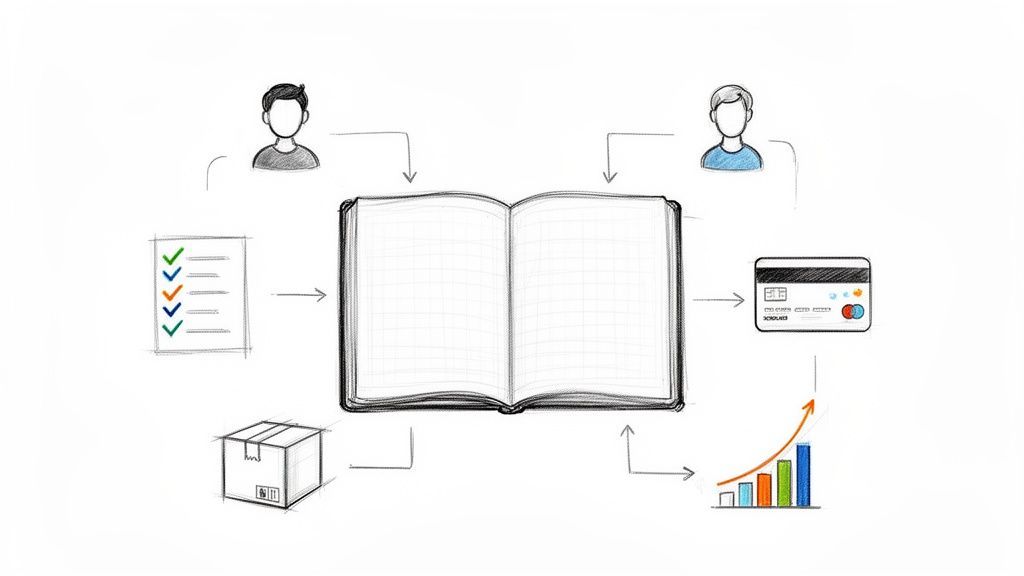
This diagram perfectly captures the journey from post-campaign chaos to having everything under control.

You can literally see how automation transforms those operational headaches into a streamlined, profitable process.
With your data locked and loaded, it’s time to build your backer survey. Think of this as your first real, interactive conversation with backers after the campaign ends. You have to make it count. The goal is to create a branded, easy-to-use experience that walks them through confirming their reward, giving you their shipping address, and—most importantly—shopping in your add-on store.
Your add-ons are a massive opportunity. Creating compelling offers here is what will drive your upsells. Use high-quality photos, write clear descriptions, and group related items together to make browsing feel natural and encourage more sales. You can even segment backers by their pledge level to show them exclusive items, a great way to make them feel special. We've got more tips on this in our guide on how to increase average order value.
The crowdfunding world is booming. Platforms like Indiegogo see campaigns raise an average of $17,000, but all that hard work can be undone by bad logistics. This is where a full-featured pledge manager like PledgeBox changes the game. It’s free to send the backer survey and only charges a 3% fee on upsells, if there's any, helping you earn more while cutting down on manual work.
The last pieces of the puzzle are shipping and taxes. These can get complicated, fast. A smart system will calculate these costs for you automatically based on each backer’s location and the total weight of their order. This alone can save you from losing a huge chunk of your profits on fulfillment.
Remember the Kickstarter vs. Shopify analogy? The Kickstarter pledge manager is like Amazon—it’s powerful but rigid. PledgeBox is your own Shopify—it’s customizable, powerful, and all yours. This setup phase is where you build out that personalized "store" just for your backers.
Once everything is configured, you're ready to send out your surveys. But the job isn't quite done. A good pledge manager will keep working for you by sending automated reminder emails to anyone who hasn’t filled out their survey yet, pushing your completion rate as high as possible. After all the surveys are in and the orders are locked, you get a clean, exportable file that’s ready to send straight to your fulfillment partner. Just like that, you've closed the loop from funding to delivery.
Theory is great, but let's talk about what really happens in the trenches. The most successful creators don't see a pledge manager as just a tool for collecting addresses. They treat it as their pledge book—a powerful asset for solving tricky problems and giving backers a smooth, professional experience.
Let's look at a few real-world scenarios to see how mastering the pledge book can make or break a campaign. These examples show the power of a flexible tool like PledgeBox, which lets you send surveys for free and only charges a 3% fee on upsells, if there's any. Think of it like the "Shopify" of crowdfunding—you get total control to build the post-campaign experience your project deserves.
Picture a board game company that just funded their latest epic. They’re dealing with over 5,000 backers worldwide, a half-dozen pledge levels, and a ton of tempting add-ons like miniature packs and deluxe tokens. Trying to manage this with a spreadsheet would be an absolute nightmare.
Instead, they turn to their pledge manager to:
Now, let's think about a startup launching a new smart device. The product has two color options and needs different power adapters for North America, Europe, and Asia. On top of that, they have a six-month manufacturing timeline, and they know a lot of their backers will probably move during that time.
Here's how they use their pledge book to handle it:
The core idea is simple: a pledge manager allows you to treat your campaign like an e-commerce business. Just as Shopify gives you the tools to customize your store, a tool like PledgeBox gives you the power to tailor the post-campaign experience.
Finally, imagine a creative agency that runs crowdfunding campaigns for several clients at once. They can't afford to be bogged down in a mess of different spreadsheets and login details for every single project.
For them, the pledge manager serves as a central command center. They can seamlessly switch between client projects, check survey completion rates, see how upsells are performing, and export fulfillment-ready data tailored to each campaign's specific shipping partner. This creates a consistent, professional workflow that makes the agency more efficient and ready to scale.
As crowdfunding keeps growing, mastering the pledge book isn’t just a nice-to-have skill anymore—it’s your secret weapon. The game is shifting. It's no longer about just shipping rewards for one project. The real win is turning that one successful campaign into a brand that lasts, with a community that comes back again and again.
This change is happening for a few big reasons. First, backers are smarter than ever about data privacy and security. They want to know their information is safe. Modern pledge managers are built for this, keeping your campaign data secure and giving you the tools to handle it responsibly. That’s how you build trust right from the start.
Another huge shift is the move away from a messy toolbox. Juggling separate platforms for surveys, shipping, and marketing is a recipe for headaches and missed opportunities.
Think about it like this: The Kickstarter pledge manager can feel like a closed-off marketplace, similar to Amazon. It's rigid. But modern tools like PledgeBox are more like Shopify—they give you a flexible, customizable platform where you have full control over your brand and how you interact with your backers.
This is why having everything in one place matters so much. With the crowdfunding market expected to hit an incredible $44.75 billion by 2030, creators can't afford to be inefficient. For anyone in major markets like North America, which already accounts for a 39.60% market share, a single system that handles everything from pre-launch pages to analytics and pledge management is the only way to get real ROI. It’s how you turn one-time backers into loyal fans. You can dig deeper into these numbers in this in-depth crowdfunding market report.
Finally, the future is all about using your data wisely. Your pledge manager is sitting on a goldmine of information. By looking at which add-ons were a hit, where your backers live, or how many people completed your survey, you get real, actionable insights.
This data from your pledge book becomes the blueprint for your next campaign. It can help you design better reward tiers, fine-tune your marketing, and set smarter stretch goals. It creates a powerful cycle where every project gets better than the last.
PledgeBox makes it easy to get started. It’s free to send your backer survey, and the platform only takes a 3% commission on any revenue you make from upsells, if there's any. This model lets you try out these powerful features without risk, turning your post-campaign phase into a new engine for growth and community.
Once the campaign confetti settles, a whole new set of questions pops up. Let's tackle some of the most common ones creators have about managing their digital pledge book so you can navigate the post-campaign phase like a pro.
The sweet spot for sending out your backer surveys is roughly two weeks after your campaign officially wraps up. This waiting period is crucial because it gives platforms like Kickstarter or Indiegogo enough time to process every backer's payment and sort out any failed pledges.
Jump the gun and send surveys too early, and you'll create a headache for yourself, manually tracking down backers whose payments are still in limbo. But if you wait too long, backers might get anxious, and your project can start to feel disorganized. A good pledge manager helps you nail this timing perfectly by letting you schedule everything in advance.
Yes, you can get everything set up without spending a dime. You can import all your backers from Kickstarter or Indiegogo, build your surveys to collect addresses and reward choices, and send them out for $0. There are no hidden setup fees or per-backer charges.
The model is incredibly straightforward: PledgeBox is free for sending the backer survey. We only charge a 3% commission on upsell revenue, if you generate any. It's a performance-based system, meaning the platform only makes money when you make money from add-ons.
This makes it a completely risk-free tool for any creator, big or small.
A great way to think about it is by comparing e-commerce platforms. The Kickstarter pledge manager is a bit like selling on the Amazon marketplace—it's a closed ecosystem with limited features. It handles the absolute basics, but you don't get much control or flexibility.
The PledgeBox pledge manager, on the other hand, is like your own Shopify store. It’s a powerful, independent hub where you have full command over your post-campaign world. You can customize your survey's branding, offer a catalog of add-ons, and manage complex shipping rules, turning your fulfillment process into a truly professional operation.
Absolutely. The best pledge managers are built to integrate smoothly with both Kickstarter and Indiegogo. The process couldn't be simpler: you just import your campaign data with a few clicks, and you're all set to build surveys, create upsells, and manage your entire pledge book from one central dashboard.
Ready to take control of your post-campaign fulfillment and boost your revenue? With PledgeBox, you can send beautiful, branded surveys for free and unlock powerful upsell features. Get started today and see how easy it is to master your pledge book!
PledgeBox
The All-in-One Toolkit to Launch, Manage & Scale Your Kickstarter / Indiegogo Campaign