 PledgeBox
Collectible Enamel Pins: Kickstarter Guide 2026
Launch your collectible enamel pins on Kickstarter in 2026! Master design, sourcing, pricing, fulfillment & upselling for campaign success.
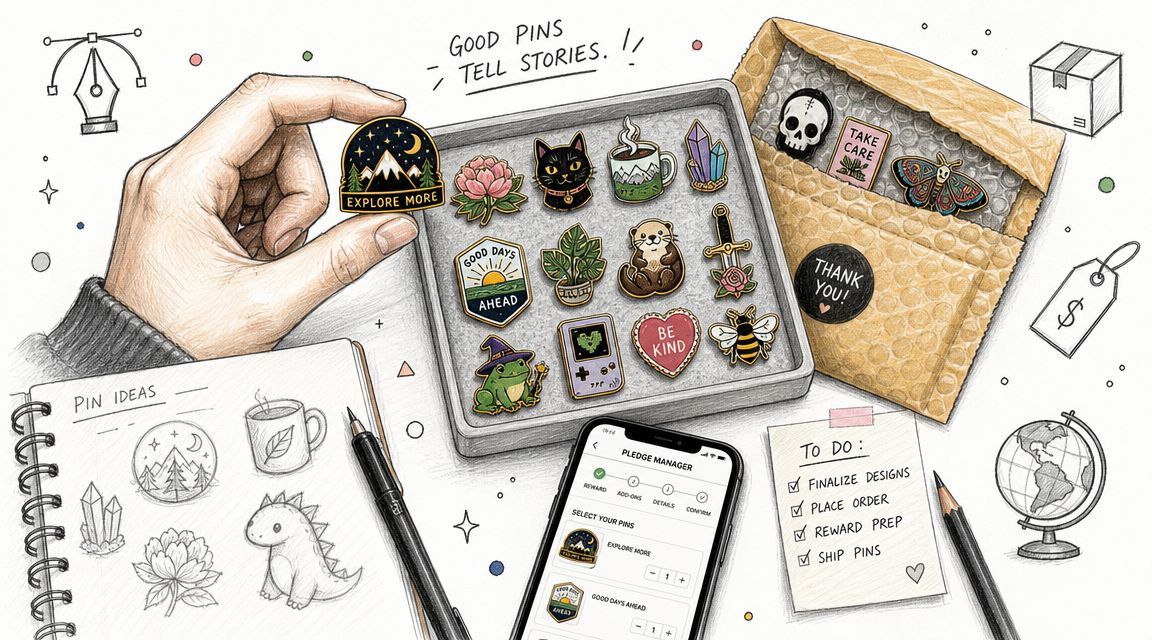
Launch your collectible enamel pins on Kickstarter in 2026! Master design, sourcing, pricing, fulfillment & upselling for campaign success.
You're probably in the same spot most pin creators hit before launch. The art is done, the campaign page is half-written, and the reward list still feels shaky. Prints are easy but familiar. Shirts create sizing headaches. Acrylic charms are fine, but they rarely carry the same collector energy.
That's where collectible enamel pins keep winning. They're compact, visually strong on a campaign page, and flexible enough to work as a core reward, an add-on, a stretch goal, or the foundation of a whole series. For crowdfunding, that mix matters. A reward has to sell the idea and survive production and fulfillment.
Pins also sit in a useful middle ground. Backers treat them as keepsakes, not disposable merch. Creators can build a release around a single design or a set with variants, stretch goals, and exclusives. That gives you room to shape pledge behavior instead of just listing products and hoping people choose well.
The strongest Kickstarter rewards do three things well. They feel special, they fit the project's theme, and they don't create fulfillment chaos. Collectible enamel pins check all three when they're planned as collectibles rather than generic merch.
The category has shifted away from simple logo pins toward artist collections, layered effects, moving parts, and narrative-driven sets that encourage repeat purchases, according to WizardPins' enamel pin guide. That change matters for crowdfunding because Kickstarter backers don't just buy objects. They buy into a world, a style, and the feeling of getting something tied to a specific campaign moment.
Pins work because they're easy to understand at a glance. A backer sees the design and immediately knows whether it fits their taste. You don't need to explain sizing like apparel or utility like a gadget.
They also let you create clean reward architecture:
Practical rule: If the pin only works as a souvenir of your campaign, it's weaker. If it works as part of a collection, it's easier to sell.
A lot of creators miss that distinction. They design one attractive pin, then stop there. A better approach is to think in terms of a mini line. Even two or three connected designs create more momentum than one isolated product.
Pins carry a strong perceived value without forcing you into bulky fulfillment. That's why they show up so often in art, fandom, tabletop, and creator-led campaigns. They also fit collector psychology well. Once a backer wants one design, they're more likely to want the matching variant, the achieved stretch pin, or the limited campaign edition.
That collector behavior is visible across fandom niches. If you want a quick example of how themed collecting works in practice, this piece on collecting Haunted Mansion pins is useful because it shows how a pin theme becomes a long-term hobby rather than a one-off purchase.
A few patterns hold up consistently.
| Approach | What usually happens |
|---|---|
| Single standalone pin with no collection logic | Looks fine, but gives people little reason to increase their pledge |
| Small coordinated series | Creates natural bundle tiers |
| Exclusive colorway or event-only version | Adds urgency if handled carefully |
| Too many variants at launch | Confuses backers and complicates fulfillment |
Pins are a strong reward because they're visual, collectible, and operationally manageable. But they only outperform other merch when the campaign treats them like a collection with structure.
Most enamel pin problems start long before the factory touches metal. They start in the art file. If the design isn't built for manufacturing, the proof stage becomes a cycle of fixes, and the final product drifts away from what you promised on the campaign page.

The standard workflow begins with vector artwork, then moves to a CNC-engraved steel mold, metal stamping, trimming, polishing, plating, enamel fill, and baking, as described in WizardPins' manufacturing breakdown. The same guide also calls out three common failure points: non-vector art, weak line separation, and poor tolerance control.
That's the practical takeaway. Your file can't just look good on screen. It has to survive conversion into metal borders and recessed enamel areas.
Use this checklist before you send anything out:
Thin borders and tiny isolated color pockets are where attractive art turns into factory trouble.
This decision should follow the design, not your mood. If you want a flush, polished surface, hard enamel is usually the cleaner fit. If your design depends on more visible metal ridges and that classic recessed look, soft enamel often reads better.
Either way, keep your proof review disciplined. Manufacturer guidance notes that hard enamel pin production commonly takes about 2 to 3 weeks from design approval to production completion, and mold creation may take 1 to 2 days, while proof review is the main checkpoint for catching color, spelling, size, and plating errors before full production in Hesank's guide to hard enamel lapel pins. The same source notes that small errors in pressure, temperature, or timing can ruin a batch.
I'd break the workflow into six creator-side decisions:
Lock the design Don't launch with “close enough” art. If the campaign image changes after backers have pledged, trust drops fast.
Choose a manufacturer carefully Communication matters as much as sample quality. If you're comparing overseas options, this article on vetting jewelry suppliers in China is a useful framework for checking responsiveness, process clarity, and consistency.
Review the proof like it's final packaging Check color callouts, pin size, plating, backing choice, and any text. Don't skim.
Ask where the detail risk sits The factory usually knows which lines are too thin or which enamel pockets are risky. Invite that feedback early.
Expect revisions A clean proof cycle saves far more pain than rushing to production.
Build schedule slack Proofing takes time, and every tweak can echo downstream.
A surprising number of failed pins come from the same handful of issues:
If your Kickstarter page promises intricate collectible enamel pins, your production file has to respect the medium. The best-looking campaigns usually come from creators who design for manufacturing from day one, not from creators who hope the factory will solve the design for them.
Most first-time pin campaigns underprice in one of two ways. They either look only at the factory unit quote, or they inflate the public price without giving backers a reason to move up tiers. Both approaches create problems. One kills margin. The other kills conversion.
The right number to care about is your landed cost per fulfilled pin. That includes more than the pin itself. It includes mold charges, inbound freight, packaging, defect allowance, sorting time, and postage materials.
Creators who skip this step usually think a pin is profitable because the factory quote looks low. Then they discover that backing cards, bubble mailers, replacement units, and reshipments have eaten the margin.
A workable pricing model usually starts with these buckets:
Pin campaigns work best when pricing doesn't just cover cost. It nudges people toward better baskets. That means your reward list should have a visible ladder.
A simple structure often looks like this:
| Tier type | Purpose | Common mistake |
|---|---|---|
| Single pin | Entry point | Pricing it so low that it attracts many low-margin orders |
| Two-pin bundle | Raises average pledge | Making the second pin feel random instead of curated |
| Full set | Collector tier | Including too many options that require manual tracking |
| Add-on menu | Captures extra demand | Listing everything separately and creating decision fatigue |
If you sell collectible enamel pins as isolated SKUs, you're asking backers to make too many micro-decisions. If you sell them as a designed set, you make the choice easier and the order value higher.
Bundles outperform loose menus when the items feel intentionally grouped.
Limited variants can help, but only if the campaign explains the logic. A campaign-exclusive finish, alternate colorway, or reward tied to a clear milestone can increase interest. Randomly labeling something “rare” usually doesn't.
Collectors respond to understandable scarcity. They want to know why this version is different and why it belongs in the set. That's also why display and presentation matter more than many creators expect. Even if most of your sales happen online, a physical merchandising mindset helps. This guide to craft fair display strategies is useful because it shows how grouping, hierarchy, and visual framing change how people perceive value.
Cost-plus is fine as a floor. It's weak as a campaign strategy. Better pricing asks:
A profitable enamel pin campaign doesn't come from squeezing the highest possible price out of one design. It comes from building a clean offer stack where the entry tier converts, the bundle tier appeals, and the premium tier feels worth it.
The campaign ending isn't the finish line. It's when operational risk shows up. You still need addresses, shipping payments, add-on selections, and a clean export for fulfillment. If you try to manage that through scattered messages, spreadsheet edits, and manual payment chasing, mistakes pile up fast.

A basic post-campaign survey can collect preferences. It struggles when your campaign has shipping upgrades, late add-ons, address changes, failed payments, region-specific tax handling, or multiple collectible variants.
That's why I use a simple analogy. Kickstarter's pledge manager is like Amazon. A dedicated pledge manager is like Shopify. Amazon is fine for a straightforward transaction in a controlled system. Shopify gives you a customizable storefront, more control over the buyer journey, and far better support for post-purchase merchandising. For a pin campaign with bundles and collector options, that difference matters.
A pledge manager becomes the campaign's command center because it handles tasks that aren't practical in a plain survey:
| Feature | Kickstarter Survey | PledgeBox |
|---|---|---|
| Backer info collection | Basic survey collection | Survey collection with add-on and post-campaign commerce workflow |
| Shipping fee handling | Limited flexibility | Designed to collect shipping fees after campaign funding |
| Add-on sales | More constrained | Built to support post-campaign upsells |
| Address management | Simpler workflow | Includes address validation and fulfillment-oriented exports |
| Late pledge support | Not the main use case | Supports continuing post-campaign sales flow |
For creators evaluating options, this overview of a crowdfunding pledge manager is worth reading because it frames the post-campaign phase as an operational system, not just a form.
A lot of creators avoid dedicated tools because they assume every added platform becomes another fixed cost. That's not always how it works. PledgeBox is free to send the backer survey and only charges 3% of upsell if there's any. That's a very different model from paying upfront just to collect information.
That fee structure changes the decision. If a creator only needs survey collection, there isn't an added survey charge. If the creator makes more through post-campaign add-ons, the platform takes a share of that additional revenue. That's why the Amazon versus Shopify analogy sticks. One system is closer to a contained transaction flow. The other is built for merchandising and post-campaign selling.
Manual workflows look cheap until the campaign gets messy. Then every exception becomes custom labor.
A pin campaign with variants, exclusives, and add-ons stops being “simple merch” the moment people start changing addresses and upgrading pledges.
The creators who save the most stress usually make three decisions early:
Keep reward logic clean If you offer too many overlapping variants, no software will fully save you.
Collect shipping after the campaign when needed That gives you more flexibility, especially if rates or package combinations vary.
Design the post-campaign store intentionally Don't dump every leftover item into the survey. Curate it like a checkout flow.
It becomes close to mandatory when you have:
For collectible enamel pins, the post-campaign system isn't back-office admin. It's part of the revenue model. If the reward structure is built around collecting behavior, your survey and upsell flow should support that behavior instead of flattening it.
Packing day is where creators discover whether their campaign was designed for fulfillment or just for the campaign page. Pins are small, but they still create real shipping decisions. Packaging affects damage rates. Data quality affects returns. International orders add customs friction.

A pin on a backing card inside a soft mailer can work for many domestic shipments. It can also get bent, crushed, or scuffed if the packaging is too light. Rigid mailers protect better but can change postage classification depending on the route and carrier.
That means your packaging choice should follow the order profile:
The easiest way to lose time is to improvise every order. Build a station and a sequence. Sort orders by package type, not alphabetically by backer name.
A simple workflow looks like this:
The most expensive shipping error usually isn't postage. It's sending the wrong collectible to the right person.
Domestic shipping is mostly a packaging and rate problem. International shipping adds form and classification issues. If you wait until packing week to learn how your carrier handles customs declarations, you'll burn days.
A practical primer on how to calculate shipping costs helps creators map package weight, dimensions, destination zones, and extra handling into a usable estimate before surveys go out.
For physical shipping day, this walkthrough is useful to have on in the background or to share with a team member handling fulfillment:
Don't wait until orders are locked to buy supplies. Have a checklist.
Address quality matters more than most first-time creators expect. If your survey data is messy, the shipping day gets slower and the returns pile up. That's where pledge managers earn their keep. Address validation, downloadable labels, and organized exports reduce the amount of hand-fixing that usually happens right before dispatch.
That's the goal. Boring fulfillment means the system is doing the work. Orders are grouped well, addresses are clean, package types are standardized, and nobody is opening sealed envelopes to swap a variant because the spreadsheet was unclear.
For collectible enamel pins, good shipping isn't flashy. It's precise. If the campaign promised collector-quality rewards, the package has to arrive looking like a collectible, not like loose merchandise dropped into a mailer at the last minute.
A lot of creators treat fulfillment as the end of the relationship. For collectible enamel pins, that's usually a mistake. The campaigns that keep growing tend to use the first project as the opening release in a longer collecting arc.
The category supports that approach well because pin trading and collecting already operate as a real secondary market. Organized trading grew through major events and fandom ecosystems, and Disney helped turn pin trading into a mainstream collectible culture. In that market, limited-edition runs such as LE 100 or LE 250 are especially sought after, and retired pins often become more desirable as availability drops, as summarized in Wikipedia's overview of pin trading and collecting.
That doesn't mean every creator should chase resale hype. It does mean you should understand what collector-minded backers look for:
A creator doesn't need a massive catalog to use this well. Even a three-pin sequence can create anticipation if each release feels connected.
The post-campaign period often brings a second wave of attention. Someone sees social proof after the campaign ends. Another backer shares photos when rewards arrive. A fan discovers the project through a community thread weeks later.
Late pledges help capture that demand, but they also do something more important. They keep your campaign from turning into a dead page. If your collectible enamel pins are organized as a set, the late-pledge window becomes a soft continuation of the launch, not just a cleanup tool.
Pins do well when each release answers one of these questions:
| Community lever | What it does |
|---|---|
| Ongoing theme | Gives collectors a reason to follow the next drop |
| Variant logic | Lets dedicated backers go deeper without confusing casual buyers |
| Behind-the-scenes updates | Makes production feel like part of the collecting experience |
| Retirement policy | Creates trust around scarcity |
Backers return when they feel they understand the rules. They know what counts as exclusive, what might come back, and what belongs to a specific campaign era.
If people can explain your release structure to each other in a fan group, your community is getting stronger.
A lot of creators focus only on the next launch asset. The stronger move is to build a repeatable collector rhythm. That can mean seasonal sets, lore-based releases, campaign-only variants, or matching accessories that extend the original pin line.
If you're thinking beyond one project, this article on building strong bonds with your backers is useful because it treats communication, trust, and follow-up as part of long-term retention rather than customer service cleanup.
The creator advantage is simple. You don't need to outscale big brands. You need clear themes, reliable delivery, and a release style that makes existing backers want to come back. When that happens, each campaign starts with a warmer audience and a stronger collector base than the one before.
If you want one system to handle surveys, post-campaign add-ons, shipping-fee collection, and late pledges for your next enamel pin campaign, take a look at PledgeBox.
PledgeBox
The All-in-One Toolkit to Launch, Manage & Scale Your Kickstarter / Indiegogo Campaign