 PledgeBox
What Makes a Good Elevator Pitch: Master Your Message
Discover what makes a good elevator pitch for your Kickstarter or Indiegogo campaign. Get core elements, templates, & expert tips for 2026 success.
Discover what makes a good elevator pitch for your Kickstarter or Indiegogo campaign. Get core elements, templates, & expert tips for 2026 success.
You're probably sitting on a campaign idea that makes perfect sense in your head. Then someone asks, “So what is it?” and your answer turns into a long explanation about features, your origin story, manufacturing, stretch goals, and maybe your logo. By the time you finish, the listener looks polite, not excited.
That's why creators need to learn what makes a good elevator pitch. It's not a corporate exercise. It's a filtering tool. If you can explain your project clearly in about a minute, you can usually sharpen your campaign page, your video script, your outreach message, and your pre-launch signup copy too.
For Kickstarter and Indiegogo creators, a pitch has one job. It should make a stranger care fast enough to take the next step.
You're at a meetup, someone asks what you're launching, and you have about 20 seconds before their attention drifts to the next table. The same thing happens in a campaign video intro, in a cold DM to a niche creator, or in the first lines of your project page. Crowdfunding rarely gives you a long runway. It gives you a brief window to make the project feel clear, relevant, and worth another click.
That pressure is why a strong pitch matters so much for Kickstarter and Indiegogo creators. A regular networking intro only has to make you sound credible. A crowdfunding pitch has a heavier job. It needs to help a stranger grasp the problem, understand your solution, trust that you can deliver it, and feel interested enough to keep going.
A good way to think about it is this. Your pitch works like the front door to your campaign. If the door is hard to find or hard to open, fewer people step inside. If the first message is sharp and easy to follow, more visitors make it to your video, your reward section, your email list, or your preorder button.
Creators often treat each channel as a separate writing task. The result is messy fast. The campaign page leads with one promise. The video opens with your personal backstory. Social posts talk about features. Outreach messages sound formal and distant.
A clear pitch fixes that. It gives your campaign one central idea you can repeat in different formats without sounding robotic. That consistency helps backers recognize what you're making and why it matters, whether they find you through a preview page, a creator partnership, or a direct message. If you are still shaping the bigger message around your launch, this guide on building brand awareness before launch connects audience attention with clearer positioning.
Here is the practical test I use with clients. If your project page disappeared tomorrow, could you still explain the campaign in a minute, in a way that made the right person want to know more? If not, the campaign probably needs sharper messaging before it needs more traffic.
The problem usually is not enthusiasm. It is compression.
Creators are close to their product, so they try to carry the whole campaign into one explanation. They mention the origin story, every feature, the manufacturing process, future accessories, stretch goals, and the mission behind the brand. That is like trying to show someone the entire blueprint when all they need first is a clear sketch.
Good pitching means choosing the lead idea. What frustration does this solve? Who is it for? Why is your version worth attention right now? Answer those well, and the listener will ask for the rest.
This skill also matters outside the campaign page. If you want press coverage, podcast invites, or creator collaborations, you need a concise angle that helps other people get your news stories noticed and understand why your launch is worth sharing.
Aim for four qualities:
When a pitch gets better, the whole campaign usually gets better with it.
Good pitches aren't improvised. They're built.
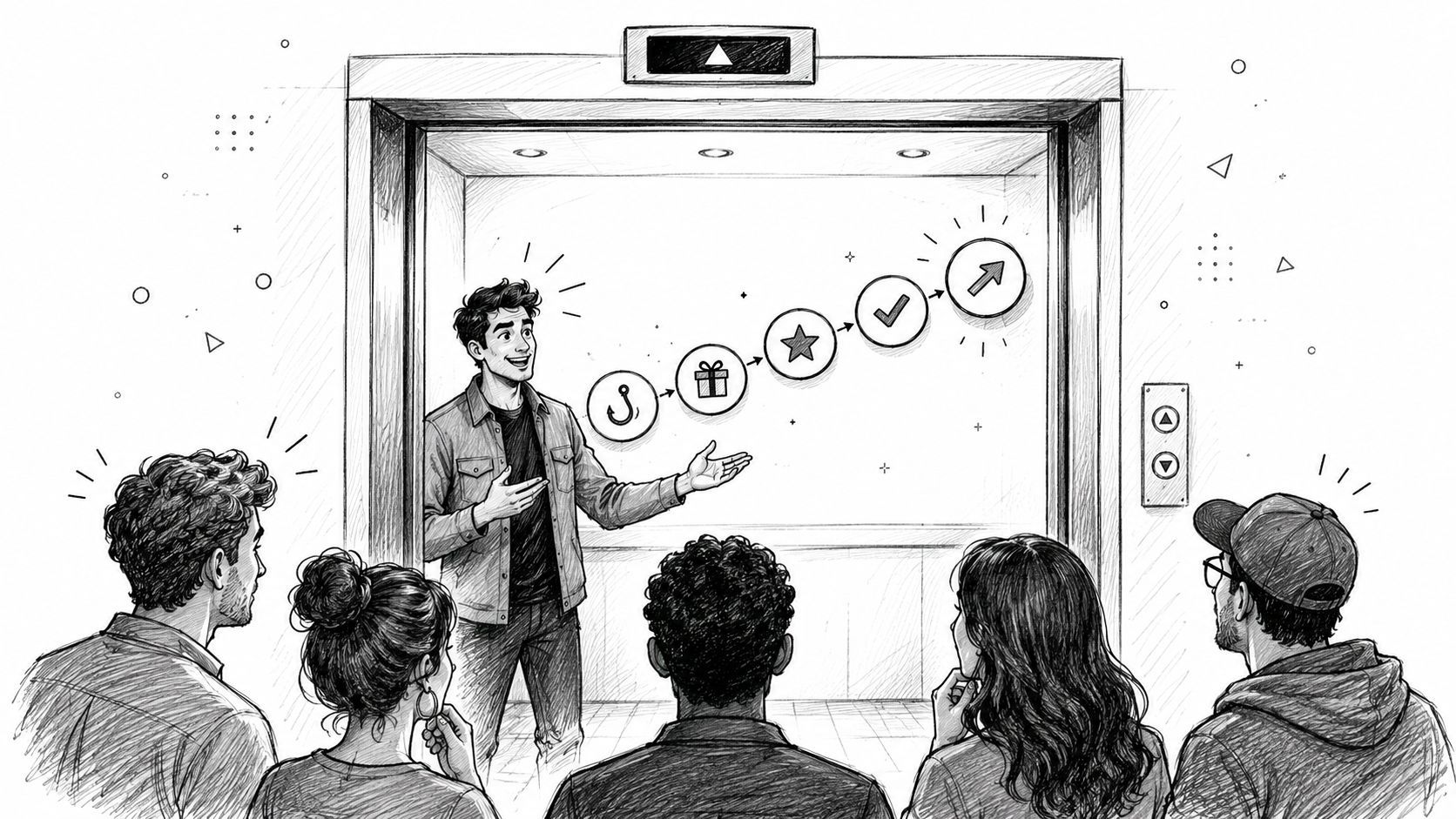
The Neeley School of Business recommends that an effective pitch clearly state the problem, solution, market, competition, and competitive advantage in its overview of winning elevator pitches. For crowdfunding, I like to translate that into five creator-friendly pieces: hook, problem, solution, benefit, and call to action.

Your first line should earn attention. Not with hype, but with relevance.
A weak hook sounds like this: “Hi, we created a modular product for modern lifestyles.”
A stronger hook sounds like this: “Most wallets are either bulky, easy to lose, or annoying to track.”
The second version creates tension immediately. It gives the listener a reason to stay with you.
Backers don't fund products just because they exist. They fund products that solve a clear frustration, enable a specific experience, or improve something they already care about.
State the problem in plain language, then introduce the solution without overloading the listener with specs. If you cram in materials, dimensions, technical terms, app workflows, and manufacturing details too early, the pitch loses shape.
Use this sequence:
At this stage, many creators drift into feature lists. Don't.
A feature is “includes NFC blocking and GPS integration.” A benefit is “helps you carry less and find your wallet fast.” One is technical. The other is human.
Differentiation matters too. If your project sounds interchangeable with products already on Amazon or Etsy, the listener won't remember it. Give them one memorable reason you're different. Better materials. A smarter form factor. A stronger theme. Easier setup. Faster table play. Pick one.
If you need help shaping that kind of message into content that people want to read, PledgeBox's article on crafting compelling campaign content is a practical companion.
Practical rule: Give people one sharp reason to remember you, not five reasons to forget you.
A pitch that ends without an ask often dies on the spot. Tell the listener what to do next. Join the pre-launch list. Watch the campaign video. Follow the project. Request a preview link.
Creators who also want media coverage should study how journalists respond to concise angles and strong hooks. Carlos Alba Media has a useful primer on how to get your news stories noticed, and the same principle applies here. Lead with what's interesting, not with filler.
You meet someone who could help your campaign. Maybe it is a potential backer at a local event, a creator friend who knows press contacts, or an influencer replying to your DM. They ask, “What are you launching?” If your answer rambles, the moment slips. If your answer is clear, they can picture the project and decide whether to care.
That is why a template helps.
A good crowdfunding pitch is less like a speech and more like a trailer. It gives people the shape of the story fast. What are you making? Who is it for? Why does it matter now? What should they do next? If you can answer those four questions in under a minute, you have something you can use in a conversation, on your campaign page, in a video script, or in a short outreach message.
Start with this framework:
“We're creating [project name], a [product type] for [specific audience] who struggle with [clear problem]. It helps them [main benefit] through [key mechanism or differentiator]. We're launching on [platform or timing], and I'd love for you to [specific next step].”
Each slot has a job.
If your draft feels crowded, the usual problem is that you are trying to explain the whole campaign at once. Do less. A pitch is the label on the box, not everything packed inside it.
Here is a version for a tech creator:
“We're creating ArcFold, a slim smart wallet for commuters and travelers who want to carry less without worrying about losing essentials. It helps them keep everyday carry simple through a minimalist design with built-in location tracking. We're launching on Kickstarter this spring, and I'd love for you to join our pre-launch list.”
Notice why this works. You can picture the user. You can feel the problem. You also get one clear reason the product is different.
The pitch does not wander into battery life, materials, or app settings. Those details matter later, after someone wants to know more.
Now a tabletop version:
“We're launching Ember Siege, a fantasy strategy board game for groups who want meaningful choices without a long rules hurdle. It gives players an epic campaign feel through fast setup and a rules system that is easier to teach. We're getting ready for launch on Kickstarter, and we'd love you to follow the campaign and share it with your game group.”
Board game creators often fall into a trap here. They start listing miniatures, cards, boards, stretch goals, and lore. Backers care about those things, but first they want to know what playing the game feels like. The pitch should sell the table experience before it explains the box contents.
Use this checklist after you draft your pitch:
| Question | Keep it if the answer is yes |
|---|---|
| Can a stranger repeat the idea back in one sentence? | Your pitch is clear |
| Does it point to a real frustration, desire, or use case? | Your pitch feels relevant |
| Is there one memorable reason this project stands apart? | Your pitch has focus |
| Could someone act on it right away? | Your pitch can convert |
One more tip. Read your pitch aloud and time it. If it sounds stiff, it will feel stiff on camera too. If you want help turning the same core message into posts and short social copy, PledgeBox's guide to using social media effectively as a Kickstarter creator is a useful next read.
For creators polishing bios and short profile copy, it also helps to study how concise identity statements work in social spaces. SuperX's guide to Twitter bios is useful because a good bio and a good pitch solve a similar problem. They both need to say who you are and why someone should care, fast.
A strong core pitch shouldn't stay frozen in one format. It needs to stretch.
Most advice about elevator pitches stays generic and leans toward job-seeker scenarios. That misses how creators use pitches. For crowdfunding, the message has to shift by channel and goal, especially when you need to communicate traction, urgency, and a concrete next action, as discussed in Indeed's overview of elevator pitch examples and guidance.

Your spoken pitch is not your campaign page headline. It's the source material for it.
Here's how I'd break it down:
The core idea stays fixed. The framing changes.
A board game creator might say the full spoken pitch at a convention booth, then turn it into a page headline like: “A fantasy strategy game with deep choices and faster table time.” Same project. Different format. Better fit.
A gadget creator might use a direct DM version such as: “We're launching a slim trackable wallet for everyday carry fans who hate bulk.” That's not the whole story. It's the right slice of the story.
Your audience doesn't need a different product story on every channel. They need the same story translated into the right shape.
If you're pushing awareness across social platforms, this guide on using social media for Kickstarter impact helps connect message consistency with channel-specific execution.
Most weak pitches don't fail because the idea is bad. They fail because the creator is trying to prove too much, too soon.
The University of Pennsylvania notes that a strong elevator pitch should fit a 30-90 second delivery window and focus on a clear problem-solution story in its guidance on timing the perfect pitch. That's useful because it gives creators permission to cut hard. You don't need completeness. You need clarity.

Try these before you publish your page or record your video:
| Test | What it reveals |
|---|---|
| Ask a friend to repeat your pitch back | Whether your message is actually clear |
| Remove every technical term you can | Whether the idea still works in plain English |
| Time yourself saying it out loud | Whether it fits natural conversation |
| End with one direct ask | Whether the pitch can move someone forward |
If your pitch makes sense only after you explain it twice, it isn't ready yet.
Another useful screen is the “eyebrow test.” After hearing your pitch, does the person lean in and ask a question? Or do they just nod? Curiosity is the signal you want.
A pitch isn't finished until the listener knows what to do next. LivePlan's guidance on pitch components emphasizes a structure built around a problem definition, a concise solution, and a specific call to action in its article on key pitch components. For creators, that ask should be concrete. Join the waitlist. Back on day one. Request a preview. Share with a friend who'd care.

A weak CTA sounds passive. “Check it out sometime.” A stronger CTA sounds specific. “Join the pre-launch page so you'll know when we go live.” That kind of ending gives the energy somewhere to go.
Creators often spend weeks refining the front-end pitch and almost no time thinking about what happens after funding. But the post-campaign experience affects revenue, fulfillment, and backer trust.
That's where your systems matter. The native Kickstarter pledge manager is like Amazon. It's functional, broad, and standardized. A dedicated pledge manager like PledgeBox is more like Shopify. It gives creators a more branded and flexible place to handle surveys, collect shipping details, manage add-ons, and organize post-campaign follow-up. It's free to send the backer survey and only charges 3% of upsell if there's any.
One short walkthrough can make that handoff easier to picture:
If you want a clean ending for your pitch, use this:
What makes a good elevator pitch is simple in principle and hard in practice. It needs focus, plain language, a real problem, a distinct promise, and a next step. When you get those pieces right, your pitch stops sounding like an explanation and starts working like an invitation.
If you need a way to carry that momentum past the campaign itself, PledgeBox gives creators a practical post-campaign workflow for surveys, shipping data, add-ons, and late orders. It's free to send the backer survey, and it only charges 3% on upsell revenue if any upsells happen.
PledgeBox
The All-in-One Toolkit to Launch, Manage & Scale Your Kickstarter / Indiegogo Campaign