 PledgeBox
10 Best Practices for Data Security in Crowdfunding
Protect your backers and your brand. Our guide to the best practices for data security helps crowdfunding creators secure data from surveys to fulfillment.
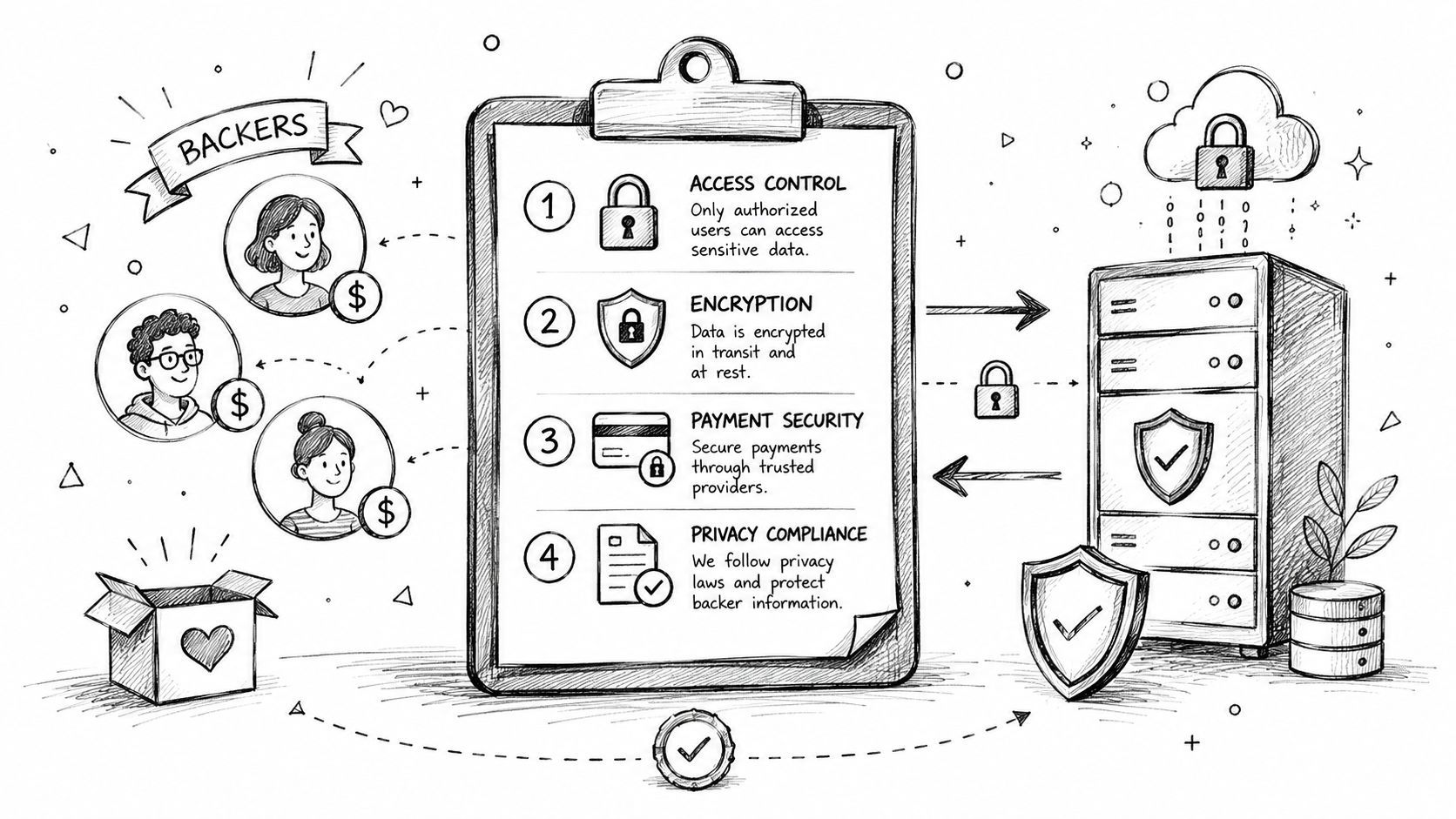
Protect your backers and your brand. Our guide to the best practices for data security helps crowdfunding creators secure data from surveys to fulfillment.
Your campaign succeeded. Is your backer data safe?
Congratulations, your crowdfunding campaign is a hit. The pledges are rolling in, surveys are next, and fulfillment suddenly feels very real. That's the moment many creators realize they're no longer just building a product. They're responsible for a live database of names, addresses, emails, tax details, and order preferences that backers trusted them to handle carefully.
A security mistake at this stage doesn't just create technical trouble. It creates reputation damage, support headaches, refund disputes, and long-term distrust. For hardware startups, board game publishers, and first-time Kickstarter creators, the risky part often starts after funding ends, when data moves between pledge managers, payment tools, fulfillment partners, and spreadsheets.
The best practices for data security aren't only for large companies with in-house IT teams. They matter even more when a small campaign team is juggling shipping, add-ons, VAT, and last-minute vendor decisions. If you collect backer information, you need a simple system that limits exposure and keeps sensitive data under control from survey to delivery.
This checklist focuses on what works in the crowdfunding lifecycle. It covers the ten security habits that matter when you're sending surveys, assigning team access, exporting vendor files, and deciding how long to keep backer data. The goal is straightforward. Protect your backers, protect your campaign, and avoid turning post-campaign operations into your biggest risk.

A crowdfunding campaign gets risky the moment backers start entering addresses, phone numbers, tax information, or add-on choices into your survey. At that point, you are handling a live customer database, not just collecting pledges. Encrypt that data in transit and at rest from day one.
The reason is simple. Breaches still happen, but encryption can limit how useful stolen data is to an attacker and reduce the financial damage that follows. IBM found that organizations using security AI, automation, and encryption had lower breach costs than those that did not, in its Cost of a Data Breach report.
For campaign creators, this is less about buying enterprise security tooling and more about choosing systems that already protect backer data properly. Survey pages and admin logins should use TLS. Stored backer records should be encrypted. Export files should be password-protected or shared through controlled portals, not dropped into an open Drive folder that a freelancer, fulfillment partner, and former contractor can all still access six months later.
I have seen the weak point show up after funding ends. A creator runs a clean campaign, then exports backer data into spreadsheets for address fixes, late pledges, VAT checks, and warehouse handoff. That is where sensitive information starts spreading across inboxes and laptops. Encryption only helps if the workflow keeps the data inside tools that support it.
Practical rule: If a file is intercepted, a laptop is stolen, or a storage bucket is exposed, the backer data inside should still be unreadable.
Use a pledge manager that supports secure collection and storage instead of rebuilding the process with forms and manual exports. If you want a plain-English baseline for what to check, PledgeBox's guide to data encryption standards covers the transport and storage protections creators should understand before sending surveys.
PledgeBox also fits the campaign lifecycle in a practical way. The backer survey is free to send, and the platform charges 3% of upsell revenue only when upsells happen. That matters because creators under budget pressure often move post-campaign data collection into cheaper ad hoc tools, which is usually where security controls get weaker.
Passwords fail in predictable ways. Team members reuse them, store them badly, or get tricked into entering them on fake login pages. MFA gives you another layer when that happens, which is why it belongs on every account that can reach backer data, shipping settings, or financial dashboards.
For crowdfunding teams, this includes more than the founder's account. Anyone who can edit surveys, export address files, issue refunds, or connect fulfillment tools should have MFA turned on.
The weak point is often the “temporary helper” account. An agency contractor needs access for a week. A co-founder logs in from a trade show. A fulfillment assistant gets added during crunch time. Those are exactly the moments when one password stops being enough.
The broader security direction here is clear. MFA has become a core best practice, and the same security trend report that highlights MFA also points to the value of combining identity checks with behavioral signals inside a Zero Trust model, rather than trusting a login by default, as noted in Storware's review of data security trends.
Use app-based authenticators where possible. SMS is better than password-only access, but it's not the strongest option. Also make MFA mandatory before launch week gets busy, because teams rarely improve account security in the middle of a fulfillment rush.
PledgeBox's access controls are most useful when you pair them with role-based permissions and MFA, not when you treat one shared login as “good enough for the team.”
Most creators only look at access records after something feels wrong. That's backwards. Logs are useful because they show quiet problems early, before a vendor gets more data than needed or a former teammate still has access weeks after leaving.
If you run a campaign with multiple collaborators, agencies, or fulfillment partners, audit logs tell you who accessed what, when they did it, and whether that access makes sense. That's especially important for address exports, survey edits, and downloads of backer contact lists.
A simple weekly review catches a lot. Check for logins from unexpected locations, repeated failed login attempts, unusual export activity, and access at odd times that doesn't match your team's workflow. You don't need enterprise security tooling to do useful monitoring. You need discipline.
A common crowdfunding scenario is straightforward. A hardware startup shares data with a logistics vendor for shipping quotes. Someone on the vendor side requests a broader export than necessary, or accesses files outside the agreed handoff window. If you're reviewing logs consistently, that stands out.
Review logs on a schedule, not on intuition. Intuition usually notices problems after the damage is done.
PledgeBox's downloadable reports can support this kind of review, particularly when you want to confirm who accessed campaign data and when exports were created. Keep a written record of those reviews. If a backer asks how their data was handled, documented oversight is much stronger than “we think only the right people saw it.”
A practical retention habit helps too. Keep logs long enough to reconstruct what happened if an issue appears months later. Even small teams benefit from that paper trail.
The safest personal data is the data you never collect. Creators often overbuild surveys because they're trying to “learn more” about backers, future products, or demographics. That creates extra risk with little operational value.
For most campaigns, you need a narrow set of fields. Name, shipping address, email, pledge selections, tax or VAT details where required, and maybe a phone number if a specific carrier needs it. You usually don't need birthdays, employment details, or unrelated profile questions.
Go field by field and ask one question. Will we use this to fulfill rewards, handle support, or meet a legal requirement? If the answer is no, cut it.
This matters beyond compliance language. Every extra field increases the impact if data leaks, gets exported carelessly, or sits too long in a tool you stop using later. It also improves backer trust when your survey feels focused instead of invasive.
A good survey builder helps because it lets you keep the form lean. PledgeBox's privacy policy is worth reviewing while you decide what data belongs in your workflow and what doesn't.
PledgeBox's survey builder is flexible enough to keep forms focused, and it's free to send the survey. You only pay 3% on upsells if any are collected. That's useful because it lets you design around necessity, not around avoiding extra software fees.
Crowdfunding data rarely stays in one system. It moves from your pledge manager to payment processors, shipping tools, tax workflows, email platforms, and fulfillment partners. Every integration creates another path that needs to be secured.
Small teams are particularly vulnerable. They may choose solid primary tools, then connect them with hastily generated API keys, broad permissions, and no review of what the vendor can access.
A secure connection isn't only about whether the vendor is reputable. It's about whether your specific configuration limits access appropriately. Use scoped credentials where possible. Disable integrations you no longer use. Validate incoming webhooks instead of accepting data blindly.
For crowdfunding creators, third-party risk is especially relevant because operations often depend on vendors. A U.S. Department of Labor report notes that 42% of cybersecurity incidents in non-tech SMEs occur during third-party vendor onboarding. That should change how you approach every shipping partner, survey add-on, and fulfillment connector.
A creator moving from campaign close to global shipping might connect Stripe, a warehouse platform, and an address validation tool in a single week. That's exactly when teams need to slow down and check what data each system receives.
If you're handling payment connections, PledgeBox's payment gateway security guidance is a practical reference for reducing exposure around payment-adjacent workflows.
A secure vendor with a sloppy integration still creates a security problem. Configuration matters as much as vendor reputation.
Many campaign teams keep backer data forever because deleting it feels risky. In practice, holding data indefinitely is usually the bigger risk. Old address files, support exports, and survey backups become hard to track, easy to forget, and attractive to attackers.
Retention policies solve that by deciding in advance what stays, for how long, and who deletes it. For crowdfunding, that usually means treating shipping addresses differently from accounting records, and survey comments differently from payment evidence.
A board game publisher may need addresses long enough to handle delivery problems and replacements. A hardware startup may need survey feedback only until product decisions are recorded elsewhere. Those are different retention clocks, and they shouldn't live in one vague “keep everything” rule.
Use deletion workflows you can execute under pressure. Test them before you need them. If a backer asks for data erasure, your team shouldn't have to guess which files, exports, or vendor systems still hold their information.
PledgeBox's one-click data erasure feature is useful here because it turns policy into action. For disposal standards beyond ordinary deletion, review Beyond Surplus on NIST SP 800-88 data disposal methods.
A clean retention policy should cover:
Backers rarely ask how long you'll keep their information before they pledge. They care a lot once they suspect you've kept it without reason.
Security tools don't matter much if your team forwards a fake invoice, uploads a backer export to the wrong drive, or clicks a spoofed login page the night before survey launch. Human error remains the most consistent weakness. Approximately 82% of all data breaches involve human error, according to Cloudian's data security best practices guide.
For crowdfunding teams, that finding feels familiar. Campaign operations move fast, support inboxes are full, and messages from vendors, freight forwarders, and backers all look urgent. That's the perfect environment for a bad click.
Generic annual awareness slides won't help much. Your team needs short, repeatable training tied to real campaign tasks: approving vendor requests, handling address changes, reviewing payment notices, and logging into dashboard tools safely.
The same Cloudian guidance also notes that organizations with thorough ongoing security awareness programs report a 70% reduction in successful phishing attempts and a 50% decrease in insider threat incidents. That's a strong case for treating training as a recurring operation, not a one-time checkbox.
A practical training rhythm might include onboarding before anyone gets access, refreshers before survey launch, and a quick review before fulfillment files go to vendors. Show examples that resemble your real workflow, such as fake shipping partner emails or fraudulent requests for full backer exports.
Field note: The most useful security training for campaign teams is boringly specific. Teach people what a fake fulfillment request looks like, what never belongs in email, and who to ask before exporting anything.
Create a culture where people report mistakes quickly. Silence after a suspicious click is usually worse than the click itself.
Shared passwords are still common in crowdfunding teams, especially when a founder wants to “keep things simple.” In practice, shared credentials make incident response messy. You can't tell who did what, you can't revoke access cleanly, and people end up storing logins in chat threads or spreadsheets.
A better system is straightforward. Every user gets their own account when possible. Every password is unique. Every shared secret that must exist goes into a password manager, not an email chain.
You don't need the most complicated password policy on earth. You need a policy people will follow without workarounds. Long, unique passwords stored in a manager are more useful than short passwords with forced complexity that users keep forgetting.
For campaign teams, this matters across PledgeBox, Stripe, email tools, cloud storage, design platforms, and shipping software. It's normal for a launch team to juggle many logins. That's exactly why password managers like 1Password or Bitwarden help. They reduce reuse and make offboarding cleaner.
When managing your PledgeBox account, use a strong unique password and combine it with role-based access instead of passing one login around the team. If you want security training that reinforces why credential hygiene matters, Mindmesh Academy's Security+ prep resources can help non-specialists build the right baseline.
Creators often vet manufacturers carefully and vet software vendors casually. That's backwards. A weak survey platform, fulfillment partner, or data export process can expose every backer you worked so hard to earn.
Vendor management means asking security questions before you hand over data, not after a problem appears. How is data isolated? Who can access it? How are deletion requests handled? What happens if the vendor has an incident?
This is one area where general best practices for data security often fail creators. Crowdfunding teams rely heavily on outside tools for surveys, tax collection, shipping, and support, but they rarely have internal security staff to assess those providers thoroughly.
That gap matters because third-party workflows are a major exposure point for smaller operators. It's also why your vendor list should be short, deliberate, and reviewed regularly. If a tool no longer needs access to backer data, disconnect it.
A useful comparison here is platform design. Kickstarter's integrated pledge manager is like Amazon. It sits inside a closed ecosystem. PledgeBox's pledge manager is more like Shopify. It gives creators more control over product logic, branding, data export, and fulfillment integrations, as explained in PledgeBox's comparison of pledge manager models. More control is valuable, but it also means you need stronger operational discipline.
PledgeBox is also free to send backer surveys and only charges 3% of upsell revenue if there's any. That pricing model makes it easier to standardize on one vetted workflow rather than stitching together cheaper but less controlled tools.
For teams exploring specialized technical partners, even outside crowdfunding software, it helps to review how vendors talk about architecture and security scope. A firm like Blocsys, a blockchain development company, for example, signals how much detail a vendor is willing to provide about technical implementation. That same scrutiny should apply to any partner touching backer data.
It's 9:10 p.m., your campaign is in late pledge mode, and someone on the team notices a fulfillment export sitting in the wrong shared folder. In crowdfunding, incidents rarely arrive at a convenient time. They show up during survey collection, address lock deadlines, or the week rewards start shipping.
A breach response plan gives your team a usable playbook for those hours. It should spell out who owns triage, who checks affected systems, who contacts vendors, who handles legal review, and who speaks to backers. If those decisions wait until after exposure is discovered, response slows down and evidence gets harder to preserve.
Keep the document short and specific. Name roles, not departments. List the tools that hold backer data, including your pledge manager, survey system, cloud storage, email platform, and fulfillment portal. For a PledgeBox-based workflow, that means documenting who can suspend exports, revoke user access, and confirm what data was synced to shipping partners.
Include clear first steps:
Regulatory timing matters too. If you collect data from EU backers, your team may face strict notification obligations under GDPR. The exact legal trigger depends on what happened, what data was exposed, and where your backers are located. That is why incident response cannot live only in someone's head.
One problem I see often in campaigns is that teams secure the live dashboard but forget the copies created around it. CSV exports sent to a freight partner, sample survey files used for testing, and old address sheets saved before fulfillment can all become part of the incident. Concentric AI notes that non-production environments often expose sensitive data when organizations fail to mask or tokenize it. Your plan should cover those files and systems explicitly.
Run one tabletop exercise before surveys go out and another before fulfillment peaks. Use a realistic scenario, such as a stolen admin login or an exposed shipping export. The goal is not perfect performance. The goal is to find the gaps while the stakes are still low.
Decide now who talks to backers, what gets paused, and how you document every action. Teams that recover well usually do not have the biggest security stack. They have a plan people can follow under pressure.
| Item | 🔄 Implementation Complexity | ⚡ Resource Requirements | ⭐ Expected Outcomes | 📊 Ideal Use Cases | 💡 Key Advantages & Tips |
|---|---|---|---|---|---|
| Implement End-to-End Encryption for Backer Data | High, crypto, key management, audits | Medium–High, infrastructure & skilled staff | Strong confidentiality and compliance | Large campaigns handling payment/shipping data | Protects sensitive data; use TLS1.2+, AES‑256, audit keys regularly |
| Enforce Multi-Factor Authentication (MFA) for Campaign Access | Low–Medium, integration & policy rollout | Low, auth tools, user support | Great reduction in unauthorized access | All campaign admin accounts and collaborators | Use TOTP over SMS; require MFA for moderators; monitor failed logins |
| Regularly Audit and Monitor Data Access Logs | Medium, log tooling and analysis workflows | Medium, storage, SIEM/alerts, analyst time | Faster breach detection and forensic evidence | High-risk projects, agencies, large teams | Review weekly, set alerts for anomalous access, retain logs ≥12 months |
| Implement Data Minimization and Purpose Limitation | Low, form/design and policy changes | Low, configuration and process controls | Lower breach surface and simpler compliance | All campaigns, especially high-volume backers | Collect only necessary fields; state purpose; offer removal options |
| Secure All Integrations and Third-Party Connections | High, API security, vendor vetting | Medium–High, assessments, rotation, monitoring | Reduced supply-chain and third-party risk | Campaigns using payments, shipping, analytics vendors | Use OAuth2, rotate keys, validate webhooks, request SOC2/ISO docs |
| Establish Clear Data Retention and Deletion Policies | Medium, policy + automation | Low–Medium, deletion scripts, legal review | Reduced long-term storage risk; regulatory alignment | Fulfillment-heavy campaigns, returns-prone projects | Define retention by data type, automate deletions, log deletions for audits |
| Conduct Regular Security Training for All Team Members | Low–Medium, curriculum and scheduling | Low, training tools, time investment | Fewer human-error incidents; stronger security culture | Distributed teams, agencies, onboarding new staff | Mandatory training before access, use phishing sims, update annually |
| Use Strong Password Policies and Centralized Credential Management | Low, policy + tool rollout | Low, password manager subscription & training | Fewer credential-based breaches; easier recovery | Teams sharing accounts, agencies, cross-platform access | Enforce 14+ chars, use team password manager, prefer passwordless where possible |
| Implement Vendor Management and Security Assessments | Medium–High, questionnaires, contracts | Medium, legal/review time, vendor audits | Lower vendor-related breach and legal exposure | Campaigns relying on multiple third parties | Require DPAs and SOC2, maintain vendor risk register, review annually |
| Implement Data Breach Response and Incident Management Plans | High, playbooks, roles, legal prep | Medium–High, simulations, external experts | Faster containment, compliant notifications | All campaigns as contingency planning | Write a plan, designate incident commander, practice tabletop exercises |
Data security isn't separate from campaign operations. It is campaign operations once you start collecting backer details, processing surveys, exporting fulfillment files, and coordinating with vendors. Backers don't distinguish between your product quality and your data handling. If you mishandle one, they'll question the other.
That's why the best practices for data security work best when you apply them across the full post-campaign lifecycle, not as isolated fixes. Encrypt the data you collect. Turn on MFA before you add more collaborators. Review access logs regularly. Keep surveys lean. Vet every integration. Delete what you no longer need. Train your team to spot the mistakes attackers count on. Use proper credential management. Assess vendors before connecting them. And have a written breach plan before you ever need one.
For crowdfunding creators, the practical challenge is that you're balancing all this against manufacturing delays, support tickets, tax issues, and shipping deadlines. Simplicity matters. So does using tools that support secure workflows instead of pushing you toward manual exports, shared passwords, and scattered spreadsheets.
That's one reason the pledge manager you choose affects security more than many creators realize. Kickstarter's native pledge manager is like Amazon. It keeps you inside a closed system. PledgeBox's pledge manager is like Shopify. It gives you more control over branding, product logic, data export, and fulfillment setup. That flexibility can make operations smoother, provided you use it with clear permissions, sound retention rules, and careful vendor oversight.
PledgeBox also fits the financial reality of smaller teams. It's free to send backer surveys, and it only charges 3% on upsell revenue you generate if there's any. That means creators can use a dedicated workflow for post-campaign data collection without adding setup fees, per-backer charges, or monthly subscription pressure to a busy fulfillment phase.
Security builds trust. Most backers will never send you a thank-you note for encrypted data, limited access, or proper deletion policies. They will notice immediately if you get those things wrong. The creators who treat security as part of delivery, not as an afterthought, give themselves a better chance of protecting both their community and the brand they want to keep building after the campaign ends.
If you want a pledge manager that supports secure post-campaign workflows, PledgeBox is worth a look. You can send backer surveys for free, manage add-ons and fulfillment data in one place, and only pay 3% on upsell revenue if there's any.
PledgeBox
The All-in-One Toolkit to Launch, Manage & Scale Your Kickstarter / Indiegogo Campaign