 PledgeBox
Why Email Marketing Is Important for Revenue and Retention
Why email marketing is important: it reaches billions of people, returns about $36 per $1 and keeps customers engaged. See the data and examples.
Why email marketing is important: it reaches billions of people, returns about $36 per $1 and keeps customers engaged. See the data and examples.
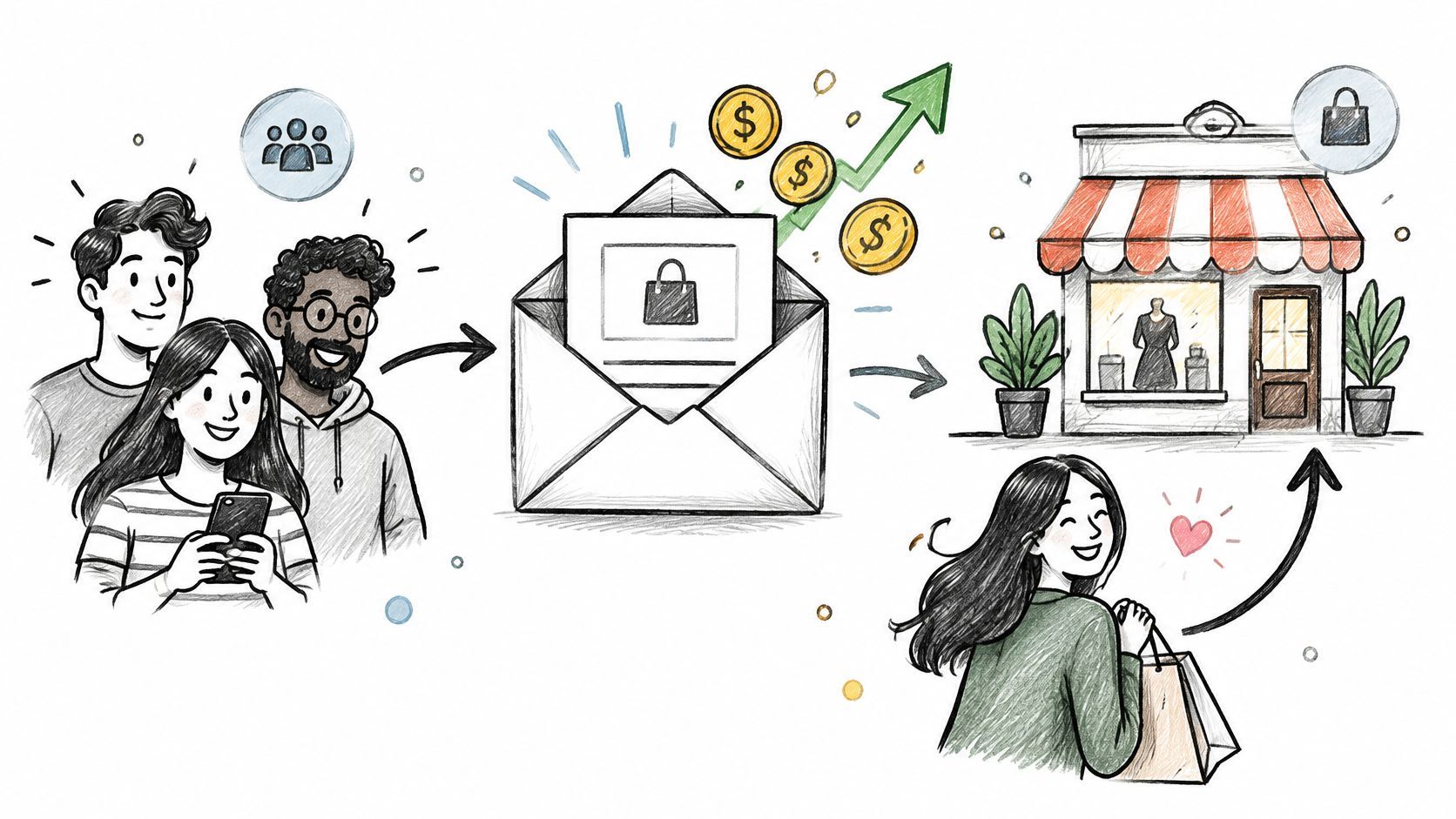
$36 back for every $1 spent. That is the average return Litmus's 2023 State of Email research reported, equal to about a 3,500% return. For a Kickstarter or Indiegogo creator, that figure is the clearest answer to why email marketing is important: it is a revenue and retention channel, not a newsletter you send when the campaign feels quiet. The same research found 41% of surveyed marketers called email the most effective channel, against 16% for social media and 16% for paid search, and 87% of marketing leaders viewed email as critical to their organization's success.
Treat the $36 as a benchmark, not a promise you can paste onto your own list. What you can copy is the method: a permission-based list, messages tied to a backer's next action, and a scorecard built from clicks, completed surveys, and money collected.
Scan the table first. Audience size, return, channel rank, and buyer preference all sit in one place, and each row is a check you can make against a named publisher.
| Metric | Value | Source |
|---|---|---|
| Worldwide email users, 2020 to 2024 | 4.037 billion to 4.481 billion (about 11% growth) | Radicati Group |
| Daily email traffic, 2020 to 2024 | 306.4 billion to 361.6 billion messages | Radicati Group |
| Average return per $1 spent on email | $36 (about 3,500% ROI) | Litmus 2023 State of Email |
| Marketers rating email most effective channel | 41% (social media 16%, paid search 16%) | Litmus 2023 State of Email |
| Consumers ranking email top three brand channel | 54% in 2023 to 68% in 2024 | Twilio 2024 Global Messaging Engagement Report |
| Consumers buying from an email offer in past year | 50% (social media ads 48%) | Marigold and Econsultancy 2024 |
The audience row is infrastructure, not a niche. Daily traffic was projected to rise across the same four years, so the inbox is busier, not emptier. On the buyer side, Twilio's 2024 Global Messaging Engagement Report found 68% of respondents ranked email among their top three preferred channels for brand communication in 2024, up from 54% in 2023. Marigold and Econsultancy reported that 50% of surveyed consumers worldwide had purchased an email offer during the previous year, ahead of social media ads at 48%.
Litmus's 2024 State of Email Innovations survey, based on nearly 1,000 marketers, still treats email as a major investment and ROI channel, while noting that widely cited returns near $36 per $1 vary by sector, attribution model, and campaign quality. A board-game publisher with a warm pre-launch list will not match a cold hardware list on the first send. I would not budget as if every dollar returns thirty-six. I would budget as if the channel can be measured tightly enough to keep or kill a sequence.
The takeaway is simple. Email is a measurable revenue channel, not only a newsletter. The rest of this piece shows how to prove that on your own list, including how retained backers affect the customer retention rate you can defend.
A social feed is a shop on rented floor space. The landlord can move your stand overnight, shrink the aisle, or charge more for the same spot. An email list is a mailing address the customer handed you. You still have to earn the next reply, but nobody else decides whether the envelope exists.
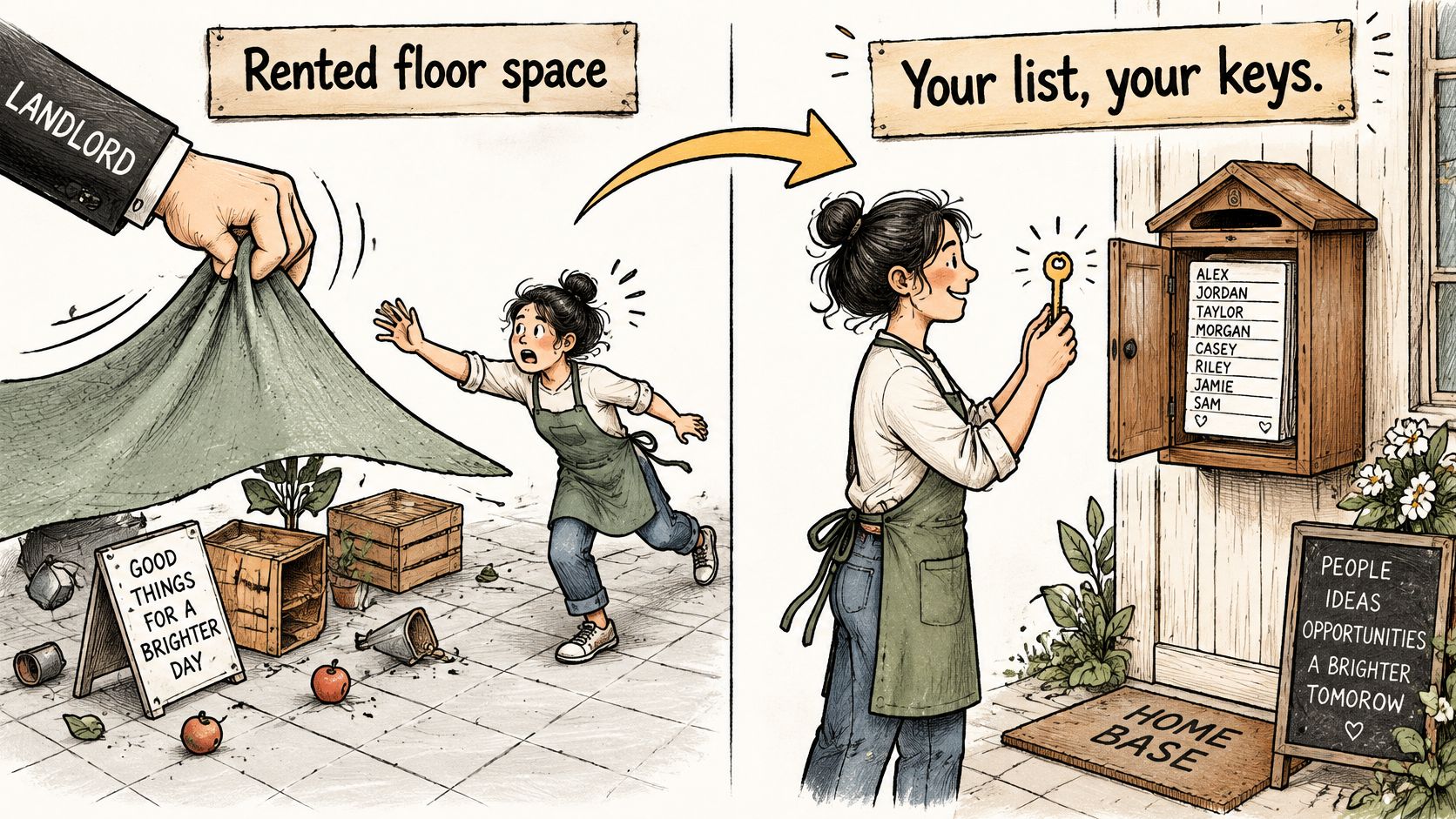
Three properties make the channel different from a post, an ad, or a platform notification.
Permission. The subscriber opted in. A pre-launch visitor who types an address expects a launch note. That expectation is the whole advantage over an interruptive ad.
Ownership. If a feed ranking changes, the list stays on your side of the relationship. You can export it, segment it, and keep writing after the campaign page stops being the main storefront.
Direct delivery. No ranking step decides whether the message appears. Delivery can still fail, and spam filters still exist, but there is no second algorithm between a live campaign and the person who asked to hear about it.
Say you have 500 subscribers who asked for a launch note. On go-live morning you send one email. You can count who was addressed, who clicked the campaign, and who pledged. A post with the same copy may reach only a fraction of followers, and you will not know which fraction until the platform tells you. The email does not guarantee 500 pledges. It guarantees an audience you can count on your own schedule.
The Radicati Group estimated worldwide email users would rise from 4.037 billion in 2020 to 4.481 billion by the end of 2024, about 444 million more people, or 11%, while daily traffic was projected from 306.4 billion messages to 361.6 billion, about 18% growth. That scale is why an international tabletop or hardware project can write to backers in several markets without living inside one discovery system.
Practical rule: If you cannot name the people who already said yes, you are renting attention. If you can email them on launch morning, you own a schedule.
The question this answers is blunt. Can you reach the people who already care, on the day you choose?
A broadcast that goes to everyone is a notice. Revenue shows up when a message fires because a person did, or did not do, a specific thing. Merge tags are not that system.
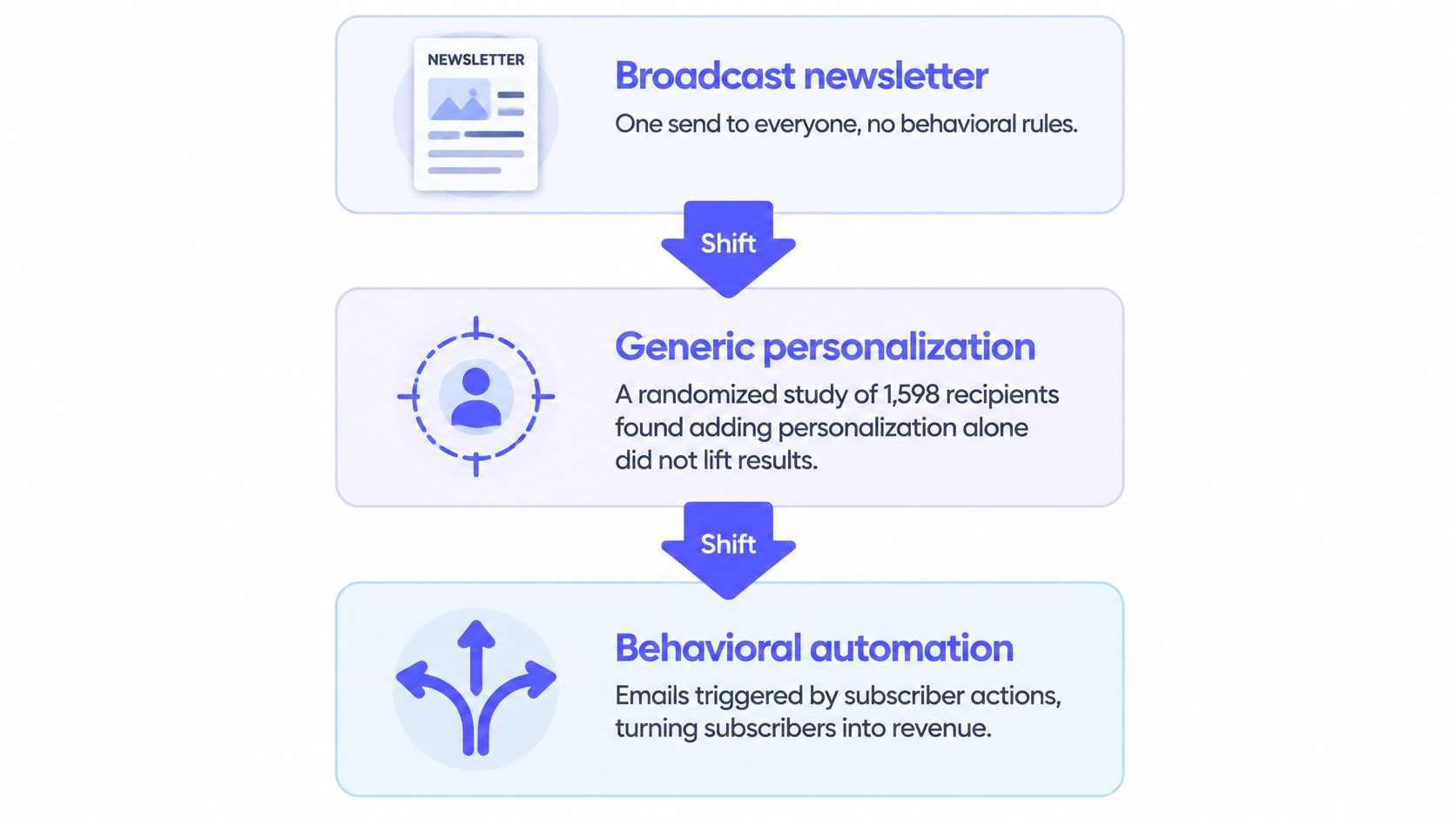
Alpaca Relay's summary of email personalization research is a useful brake on clever templates. One randomized study of 1,598 recipients found that adding multiple personalization fields did not improve survey response or completion. A separate field experiment across three companies reported sales leads rising from 0.39% to 0.51% when the content matched the recipient's situation. The lift is small, and it came from relevance, not from stuffing a first name into a generic blast. Triggers beat merge tags.
Hold out a control group that receives nothing for each trigger. The revenue difference between the two groups is the only number that tells you the email earned its place. If the triggered group does not beat the control on completed actions, kill the sequence instead of rewriting the subject line five times.
Cap frequency. A backer in the middle of fulfillment should not get a survey chase and a late-pledge promo on the same afternoon.
Suppress after conversion. Once the survey is complete, or the add-on is paid, that person leaves the sequence.
Track the click, not the vibe. Use UTM parameters or the equivalent event in your sender so a pledge, a paid shipping line, or a finished survey ties back to the message.
Privacy tools can prefetch images and inflate opens, so the score you defend is the click and the completed action. A welcome note earns its place by producing a later click. A survey chase earns its place by finished surveys and add-on revenue. A late-backer note earns its place by revenue per recipient against the silent control.
This short walkthrough shows the same idea in a live sending tool, from trigger to tracked action.
Open rate is the wrong trophy. Apple Mail Privacy Protection downloads tracking pixels automatically, so a healthy open rate can appear while nobody read the message. If you optimize for that number, you will congratulate yourself for a prefetch.
Flexmail's international email benchmark puts a number on the shift. In 2024, global email click-through rate declined to 2.9% and click-to-open rate to 7.6%, even as volumes expanded. Large-batch campaigns did worse, with click-through rate falling to 0.8%. A modest click rate is still useful when the people who click are previewing a product, choosing a reward, confirming an address, paying shipping, or buying an add-on. A high open rate on a blast to everyone is not.
Omeda's Q4 2025 email engagement report recorded a 99.18% delivery rate and only a 1.09% unique click rate. Messages arrived. Almost nobody acted. The same benchmark set found unsubscribe rates more than doubled year over year to 0.22%. More sends can fatigue a list even when the mail reaches the inbox. Hardware and tabletop projects feel this hardest, because a backer may stay subscribed through months of production updates.
A near-perfect delivery rate with a 1% click rate means the inbox accepted you. It does not mean the backer cared.
Set one outcome metric before you send, then read the six rows below. A deeper pass on definitions sits in this guide to email marketing KPIs.
| Metric | What It Tells You | Benchmark or Warning |
|---|---|---|
| Delivered emails | Messages that reached inboxes | Near 99% is normal and does not prove interest |
| Unique click rate | Subscribers who showed real interest | Omeda recorded 1.09% in Q4 2025 |
| Click-to-pledge rate | Clicks that became backers or paid actions | Compare across segments, not against all subscribers |
| Revenue per recipient | Money each subscriber brings in | Use to compare sequences and offers |
| Unsubscribe rate | Signs of audience fatigue | Benchmarks rose to 0.22% in 2025, so watch the trend |
| Incremental revenue per sequence | Revenue the email caused beyond the control group | Requires a control group to measure |
Consent by message type. Ask separately for launch news, survey mail, and post-campaign offers. A person who wanted a launch date did not agree to a weekly catalog.
A preference center. Let backers pick survey reminders and shipping notices, and drop promotions, without a full unsubscribe.
Suppression, then one re-engagement note. Long-inactive contacts should stop receiving promos. Send one plain “still want these?” message before you remove them.
Mobile-first templates. Most pledge decisions happen on a phone. One column, one button, a readable price.
Segment pre-launch leads, backers, late buyers, and fulfillment respondents. Judge each segment by clicks, finished surveys, paid shipping, and add-on revenue. The question to answer after every send is which subscribers acted, and what that email earned.
One list can carry a project from the first landing-page signup to a delivered reward, if each phase has one job. The table is the job description. Success is the last column, not a vague sense that “people seemed happy.”
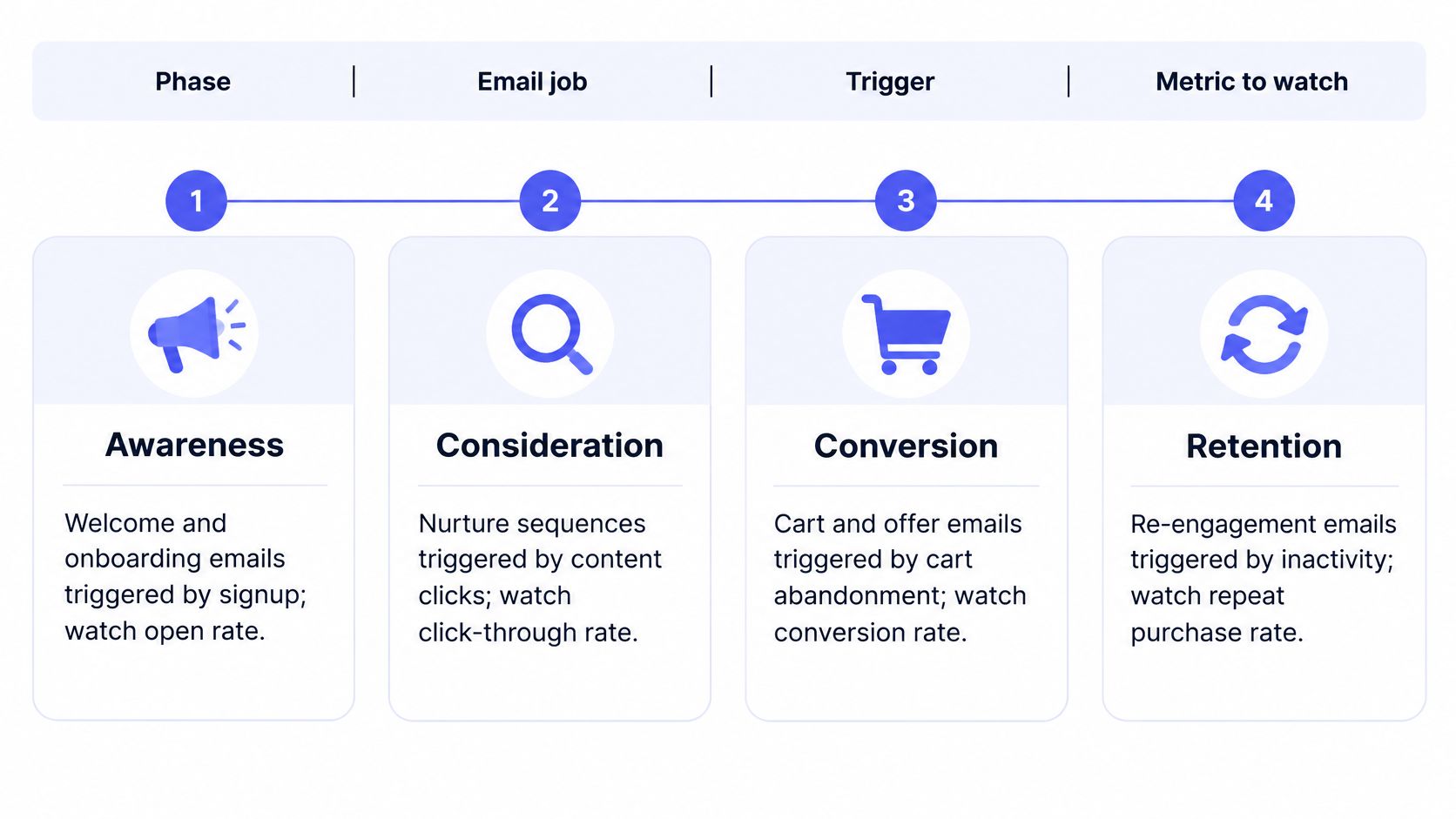
| Phase | Email Job | Trigger | Metric to Watch |
|---|---|---|---|
| Pre-launch | Build the list and announce the launch date | Visitor signs up on the landing page | Sign-up to click rate |
| Launch day | Tell subscribers the campaign is live | Campaign goes live | Click-to-pledge rate |
| Mid-campaign | Remind about deadlines and stretch goals | Days before a deadline | Pledges per send |
| Post-campaign survey | Collect shipping, tax and add-on payments | Backer survey sent | Survey completion and add-on revenue |
| Fulfillment | Share shipping updates and delay notices | Order shipped or delayed | Reply rate and unsubscribe rate |
| Late-backer sales | Sell to people who missed the campaign | Campaign closes | Revenue per recipient |
Walk a tabletop campaign through that order. Pre-launch, a visitor signs up on the landing page and gets the date, nothing else. Success is the share of those signups who later click. On launch morning the live link goes out, and you watch click-to-pledge rate, not applause in the comments.
Mid-campaign, a deadline or stretch goal is the only reason to write. Pledges per send tell you whether the reminder paid for the interruption. After close, the survey invite collects shipping, tax, and add-on payment. Send the reminder only to backers who have not finished. A finished backer does not need a nudge, and a short note to the unfinished group beats a blast to the whole list. Survey completion plus add-on revenue is the score.
Fulfillment mail is where support load drops. A delay notice that states the new window stops the “where is my game?” replies. Watch reply rate and unsubscribes together. A spike in either means the update was late or vague. Late-backer sales go only to people who missed the campaign. Revenue per recipient, against a holdout, decides whether that store stays open.
Survey and shipping notes prevent the tickets backers would otherwise send you. Promotional notes do not get that free pass.
The same addresses do all six jobs. That is why one channel can run from first signup to a reward on the doorstep, as long as you do not make every phase sound like a launch.
Pick a narrow test before you design a brand system.
InBox is the campaign builder for that test, and it processes over 10 million emails per month. Its drag-and-drop editor needs no HTML, and it tracks clicks, conversions, and engagement on every send. It connects to your own Amazon SES account, so there are no per-email fees and no sending limits once survey reminders and shipping notices stack up for months. A practical build of this kind of sequence is laid out in our guide to automated email workflows.
PledgeBox charges no setup fee, no campaign fee, and no per-backer fee to send the backer survey, and it takes nothing from the original Kickstarter or Indiegogo raise. The platform charge is 3% on add-on sales collected during the survey, and nothing else. A backer who finishes the survey without buying an add-on costs you nothing. On PledgeBox pricing, a $100 add-on purchase produces a $3 platform fee before payment-provider charges.
Kickstarter's native Pledge Manager works like Amazon: a familiar checkout with the platform's rules wrapped around it. Kickstarter's help center states there is no upfront cost, then a 5% platform fee on applicable Pledge Manager funds. The PledgeBox pledge manager works like Shopify: a branded, configurable storefront and fulfillment workflow for add-ons, upgrades, shipping, tax, VAT, late backers, and pre-orders. The PledgeBox pledge manager applies the same 3% charge to add-on sales during the survey, with payment-provider charges on top.
Choose the unfinished-survey segment and send the first reminder this week. Hold out a control group, and keep the version that beats it.
PledgeBox sends the backer survey at no charge and takes 3% only on add-on sales collected during it, so the email you send for surveys and add-ons stays tied to real revenue instead of a flat platform tax. When you are ready to run that sequence against a control group, start with the survey segment on PledgeBox.
PledgeBox
The All-in-One Toolkit to Launch, Manage & Scale Your Kickstarter / Indiegogo Campaign