 PledgeBox
Email Workflow Automation for Crowdfunding Success
Master email workflow automation for crowdfunding. Plan, build & optimize sequences to boost upsells & delight backers with PledgeBox.
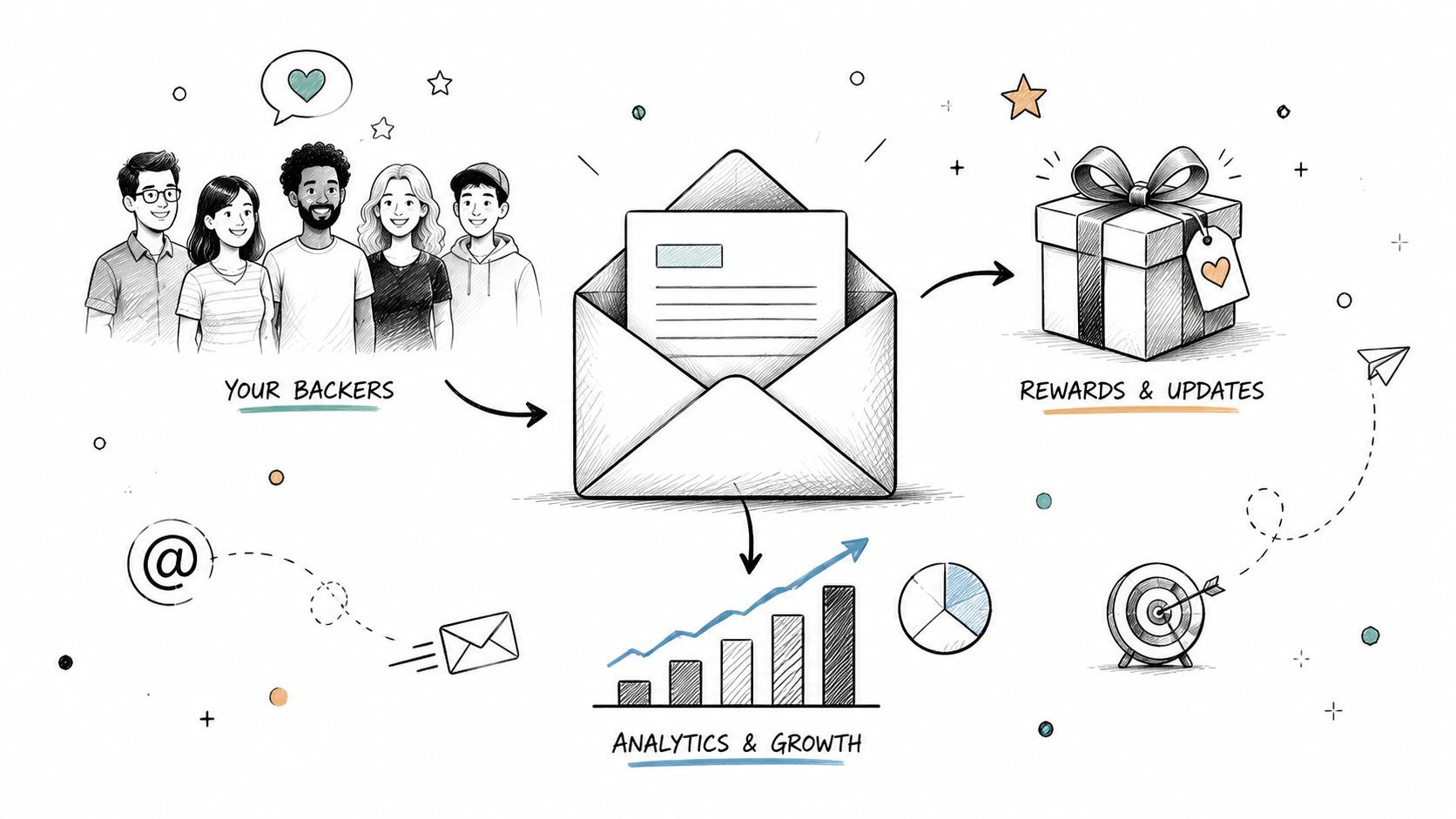
Master email workflow automation for crowdfunding. Plan, build & optimize sequences to boost upsells & delight backers with PledgeBox.
Your campaign just funded. The comments are still active, late backers are asking what happens next, and your inbox is already filling with shipping questions, reward change requests, and add-on interest.
This is the part many creators underestimate.
The campaign page did its job. Now you have to turn a winning launch into a clean post-campaign operation. That means collecting survey data, handling shipping charges, managing VAT or customs where needed, offering relevant add-ons without annoying people, and keeping backers informed long enough to deliver. If you try to run that manually, the quality drops fast. Messages go out late. Segments blur together. Support tickets multiply.
The fix is Email Workflow Automation built around the backer journey, not generic newsletter logic. In crowdfunding, the best automations don't feel robotic. They feel timely, relevant, and clear. They answer the question a backer has right now, then move them to the next step.
The first mistake creators make after funding is treating post-campaign communication like a series of one-off announcements. That works for a small test project. It breaks when you have different pledge tiers, physical and digital rewards, country-specific shipping issues, and a mix of responsive and non-responsive backers.
Email workflow automation solves that by turning reactive communication into a system. A backer completes one step, and the next message is ready. A survey stays incomplete, and a reminder goes out. A shipping milestone changes, and the right group gets updated without dragging the whole list into another broad email.
The business case is already clear beyond crowdfunding. The market for email marketing automation was valued at $6.5 billion in 2024 and is projected to reach $15.58 billion by 2030, while companies see an average $5.44 ROI for every dollar invested. Automated workflows also post a 4.67% click-through rate compared with 1.29% for manual campaigns according to email marketing automation statistics compiled by GTM 80/20.
That matters because post-campaign email isn't just about updates. It's tied directly to revenue collection, fulfillment readiness, and backer confidence.
When creators switch from manual follow-ups to workflow-based communication, three things improve:
Practical rule: If a message depends on a backer's status, it belongs in a workflow, not in a one-time blast.
Crowdfunding has a very specific pressure point after funding. You need to stay personal at scale. Backers still expect creator-level attention, but the work now looks more like commerce operations. That's why I think of automation as the bridge between community management and fulfillment execution.
A native system can handle basic communication. But if you're serious about post-campaign control, the difference becomes obvious. Kickstarter pledge manager is like Amazon and PledgeBox pledge manager is like Shopify. One gives you a marketplace-style environment. The other is closer to owning the customer journey and shaping it around your brand and operational needs.
Before writing a subject line, map the path a backer takes after the campaign closes. Most workflow problems start earlier than the software. They start when creators haven't decided what each email is supposed to do.
Use a simple journey map first.

A good post-campaign map usually runs through six communication moments: campaign close, welcome and expectation-setting, progress updates, survey collection, fulfillment notifications, and post-delivery follow-up. Each stage should have a clear goal. If an email doesn't move the backer toward a specific action or reduce a specific uncertainty, it probably doesn't belong.
Poor planning has a cost. Poorly planned workflows suffer unsubscribe rates 20 to 35 percent higher than optimized sequences, and the biggest failures come from not simulating the customer journey and not segmenting audiences before launch, according to workflow best practices from Insider One.
Most creators draft emails in the order they think of them. That creates duplication and gaps. Build from milestones instead:
Campaign ended
Confirm the project funded, explain what happens next, and set expectations for survey timing.
Survey live
Move the backer from passive excitement to action. This email needs one job. Complete the survey.
Reminder branch
Separate people who finished from people who didn't. Never send the same reminder to both groups.
Production and fulfillment updates
Keep updates tied to meaningful changes, not creator anxiety.
Shipping notification
Send only when there's a real fulfillment event to report.
Delivery and follow-up
Thank backers, handle support routing, and open the door to future launches.
The cleanest workflows are built around outcomes. For each touchpoint, decide:
That last point is where many campaigns fail. A backer doesn't complete a survey. Then what? A physical reward backer in one region owes shipping or VAT. Then what? A late backer buys an add-on. Then what? Good workflow mapping answers those questions before launch.
The walkthrough below is a useful visual companion when you're planning sequence logic and timing.
A backer journey is never one straight line. Build branches around actual friction points:
The email itself is not the workflow. The decision tree behind it is the workflow.
If you map those branches before building, your automation starts feeling intentional. If you skip them, you'll spend the post-campaign phase cleaning up avoidable confusion.
Once the journey map is done, build the few sequences that carry most of the load. You don't need dozens. You need the right triggers, the right delays, and language that matches where the backer is.
For crowdfunding, I keep the core stack narrow: survey sequence, late-backer welcome sequence, upsell sequence, and fulfillment status updates. Everything else is optional.
This is the highest-priority workflow because it enables fulfillment. Your survey process should feel mechanical and easy. Backers move through four steps: confirm their original reward, optionally buy add-ons, enter a shipping address, and confirm plus pay any shipping or upsell charges if applicable, as outlined in PledgeBox's backer survey process guide.
Here's a practical sequence structure.
| Purpose | Trigger | Timing | |
|---|---|---|---|
| Survey launch | Announce that the survey is live and explain why completion matters | Survey opens | Immediately |
| Reminder one | Catch backers who missed the first email | Survey incomplete | After a short delay |
| Reminder two | Add urgency and answer common objections | Survey still incomplete | After another delay |
| Final notice | Make the consequence of non-response clear | Survey still incomplete | Before fulfillment cutoff |
The first email should be plain. Tell backers what they need to confirm, whether shipping or taxes may be collected, and how long the survey should take.
The reminder emails should change angle, not just timing. One can focus on reward confirmation. Another can highlight shipping readiness. The final notice should state that incomplete surveys can delay delivery.
Field note: Reminder sequences work best when each email removes a different point of hesitation.
If you want a deeper breakdown of campaign-specific messaging, this complete guide to Kickstarter email marketing is a useful reference.
Late backers behave differently from original supporters. They didn't experience the live campaign the same way, so they need orientation. This sequence should introduce the project, restate the expected timeline at a high level, and confirm what happens after purchase or sign-up.
Keep it short. The point isn't to retell your whole campaign story. The point is to reduce uncertainty and move them cleanly toward survey completion or order confirmation.
Upsells only work when they're tied to what the backer already wants. Don't blast the whole audience with every add-on. Offer complements, not clutter. If someone backed a physical collector tier, a related accessory or expansion makes sense. If they chose digital-only, shipping-heavy add-ons usually don't.
This is also where platform structure matters. Kickstarter pledge manager is like Amazon and PledgeBox pledge manager is like Shopify. One is more constrained and marketplace-shaped. The other gives creators more room to control branding, data, and post-campaign selling logic.
The economics are straightforward. PledgeBox is free to send the backer survey and only charge 3% of upsell if there's any. More specifically, it charges no fee to send backer surveys and only applies a 3% commission on upsell revenue generated during the survey process, including add-ons, shipping fees, or taxes and VAT, according to PledgeBox's reward-based crowdfunding explanation.
Fulfillment emails should be event-based, not calendar-based. Good triggers include locked address windows, production milestones worth announcing, shipment creation, and delivery support follow-up.
Avoid using updates as reassurance theater. Backers can tell when an email exists just to fill silence. Send when there is something operationally useful to say, or when silence would increase support burden.
The fastest way to make a workflow underperform is to send one message to everyone. Crowdfunding lists look unified in a dashboard, but they behave like multiple audiences with different priorities, risks, and purchase intent.
That matters because relevance is what makes workflows perform. Automated workflows can generate up to 30 times more revenue per recipient than manual campaigns, and flow-based emails produce 13 times higher order rates because they're triggered by user actions and segments, according to marketing automation statistics summarized by SHNO.

You don't need advanced data science to personalize well. In post-campaign crowdfunding, the most useful segments are operational:
By pledge tier
Higher-tier backers often need different thank-yous, different reward confirmation details, and sometimes different production updates.
By geography
Country-level segmentation matters when shipping timelines, VAT collection, or customs instructions differ.
By survey status
Completed and incomplete backers should almost never receive the same email.
By reward type
Digital-only backers don't need the same logistics messaging as physical-goods backers.
By add-on behavior
People who already bought extras can receive accessory-specific updates or cross-sell exclusions.
Generic emails don't just reduce engagement. They create operational noise. A digital backer gets a shipping warning and writes support. A completed backer receives a reminder and assumes your system is broken. A backer in one region gets irrelevant tax messaging and stops reading future emails.
That's why I treat segmentation as support prevention, not just marketing optimization.
Send fewer emails to each person. Make each one more specific.
If you want to sharpen your thinking on tailoring offers and experiences around user behavior, this overview of ecommerce personalization software is worth reading because the underlying logic carries over cleanly into backer communication.
If you're starting from a messy list, segment in this order:
That order keeps your automation grounded in delivery, not just monetization.
A lot of creators jump straight to personalization for upsells. That's backwards. Segment first to remove friction. Then use those same groups to present better offers. When you do it in that order, personalization feels useful instead of aggressive.
Most creators still look at open rates first. That used to be a reasonable habit. It isn't anymore.
Privacy protections changed what an open means. If you judge a crowdfunding workflow by opens, you can end up "improving" the wrong thing while survey completion and add-on conversion instead stall.
CTR and conversion rate are the only valid metrics for revenue-driving workflows in the post-privacy era, and many marketers still overvalue open rates even though they can be inflated, according to Prospeo's analysis of email automation workflows.
For post-campaign email workflow automation, I care about a short list:
Open rate can still be a secondary directional clue inside one system. It just shouldn't drive your decisions.
When a workflow underperforms, don't rewrite every email at once. Look for the point where behavior breaks.
If clicks are weak from the first email, your value proposition or call to action is probably unclear. If first-email clicks are fine but reminder clicks collapse, the issue may be timing, message repetition, or poor segmentation. If clicks are healthy but survey completion lags, the bottleneck may be on the landing experience rather than in the email itself.
A strong measurement habit is less about dashboards and more about asking the next useful question. This practical marketing measurement guide is a good companion if you want a cleaner framework for tying campaign activity back to business outcomes.
Keep tests narrow and operational.
Subject line angle
Test clarity against urgency. In crowdfunding, clarity usually wins unless the backer is already overdue.
Call to action wording
"Complete your survey" often works differently from "Confirm your reward details."
Send timing
Reminder timing can matter more than subject line tweaks.
Email order
Sometimes moving a reassurance point higher in the sequence improves action more than changing copy.
Optimization habit: Change one meaningful variable, then watch clicks and conversions, not vanity movement.
If your platform gives you deeper reporting, use it to spot branch-level issues rather than just campaign-wide totals. This PledgeBox reporting functionality overview is useful for understanding the kind of post-campaign visibility creators should expect from a serious workflow tool.
The goal isn't to make every chart go up. The goal is to remove friction from the exact step backers are avoiding.
At some point, theory has to become execution. In crowdfunding, that means using a system built for the mechanics of backer follow-up, not trying to force a generic email stack to behave like a pledge manager.
PledgeBox fits the post-campaign workflow because the survey is tied directly to fulfillment data collection. Backers can provide shipping addresses, reward preferences, and special instructions, while creators can also collect shipping fees, VAT, or customs charges inside the same process, as described in PledgeBox's guide to backer surveys.

A dedicated pledge manager matters most when your project has multiple moving parts. Physical rewards, country-specific logistics, incomplete surveys, and add-on opportunities all need to live in one operational flow.
PledgeBox also keeps the economics creator-friendly. PledgeBox is free to send the backer survey and only charge 3% of upsell if there's any. The 3% platform fee applies only to additional revenue collected through surveys, which means if there's no added revenue beyond the original pledge, the core survey function stays free. You can also see that model reflected in PledgeBox email marketing and post-campaign tools.
The earlier analogy is particularly relevant. Kickstarter pledge manager is like Amazon and PledgeBox pledge manager is like Shopify. If you want a more branded, more controllable post-campaign experience, the tool choice shapes what's possible in your automation.
That includes how you present upsells, how clearly you collect fulfillment data, and how smoothly you follow up with non-responders. In practice, the best workflow is the one your team can run consistently without creating a support mess for backers.
PledgeBox gives creators a practical way to run post-campaign email workflow automation without paying upfront to send surveys. If you want a system that collects fulfillment data, supports branded backer journeys, and only charges 3% on upsell revenue when there is any, explore PledgeBox.
PledgeBox
The All-in-One Toolkit to Launch, Manage & Scale Your Kickstarter / Indiegogo Campaign