Crowdfunding Campaign Communication Plan: A Practical Guide
Build a winning crowdfunding campaign communication plan with proven steps, channel tactics, timelines, and KPIs. Boost backer trust and raise more funds.


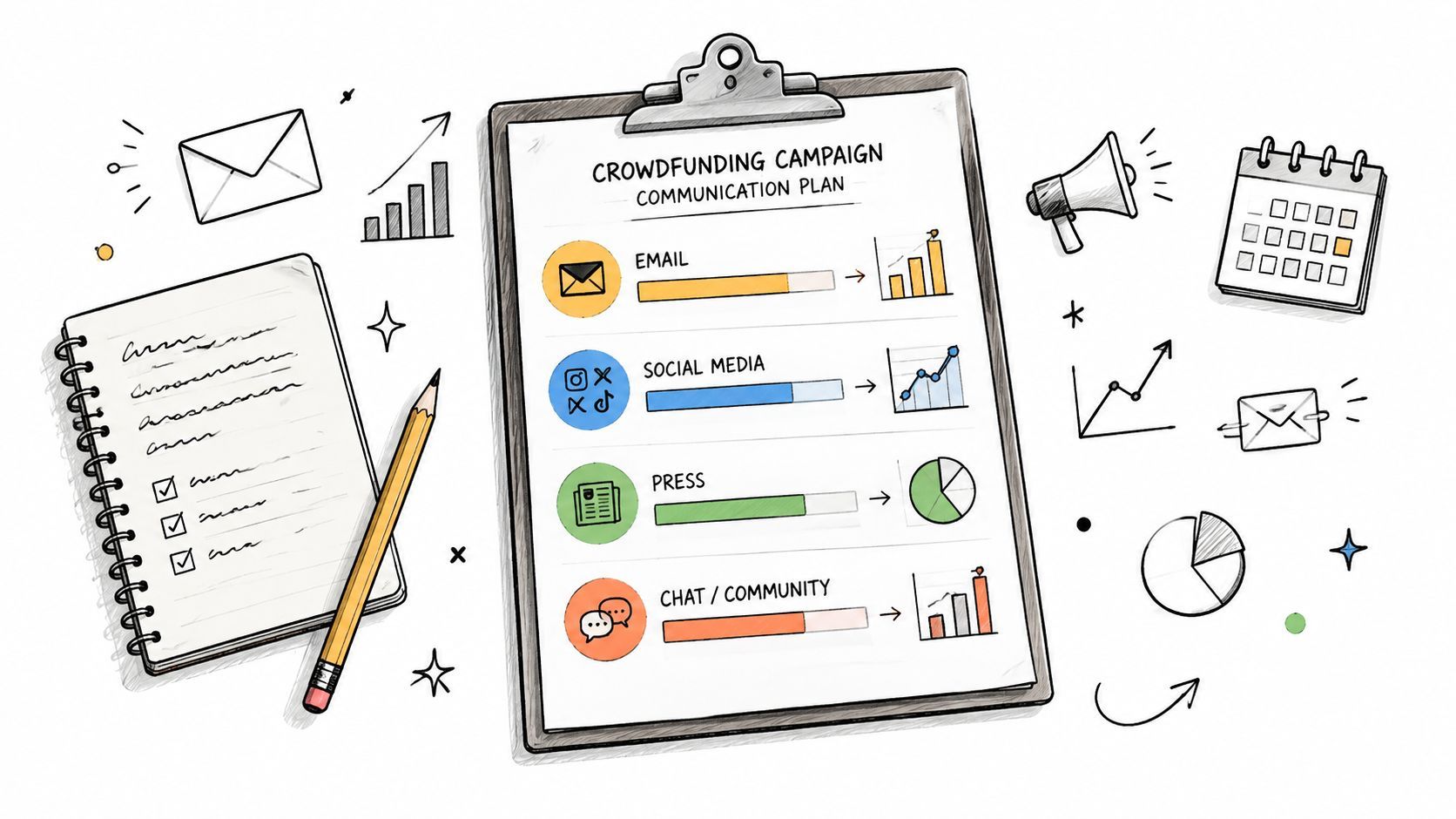
Build a winning crowdfunding campaign communication plan with proven steps, channel tactics, timelines, and KPIs. Boost backer trust and raise more funds.
A campaign communication plan isn't a content calendar with nicer formatting. In crowdfunding, 42% of total funds are raised during the first and last three days of an average campaign (WESCI crowdfunding guidance). If your team treats launch communication as an occasional announcement, you're leaving the most time-sensitive parts of fundraising to chance.
The practical alternative is an operating system for attention. It assigns each audience, channel, message, owner, trigger, and measurement rule a job. That system keeps a campaign page from sitting still while the team waits for organic traffic, and it gives creators a repeatable way to build anticipation, activate supporters, recover attention, and hand the audience into fulfillment.
Communication activity has a direct role in campaign execution. A study of more than 7,500 Kickstarter projects found that projects using more updates, Facebook shares, and comments were more likely to succeed, while a related summary reported an average of 7.26 updates per campaign, with a median of 5 and a maximum of 48 in its sample (crowdfunding communication study). The same evidence base reported average comment activity of 224.22 in one dataset, reinforcing a practical point: backers respond to visible activity, not only to a static launch page.
That doesn't mean posting constantly. It means planning communication as part of the campaign's delivery work. A campaign communication plan tells the founder when to send an email, when to publish a platform update, when to answer public questions, and when to stop adding noise. It also connects every message to an outcome, such as a pledge, a referral, a survey completion, or a fulfillment decision.

A written plan should produce three visible improvements:
The framework is straightforward: define one objective, segment the audience, map the phases, prepare templates, automate repeatable actions, measure leading indicators, and roll out the system with contingency rules. Campaigns that communicate actively have a stronger operating rhythm than passive campaigns, but the advantage comes from structured cadence, not volume for its own sake.
Start with one communication objective. “Grow awareness” is too broad to guide a send. “Move qualified pre-launch subscribers into launch-day pledges” gives the team a decision rule for channel selection, copy, timing, and reporting.
Choose three to five KPIs that prove whether that objective is working. Group them by the outcome they influence:
Every KPI needs a baseline, a target, and an owner. Without those fields, the metric is merely something someone might look at later.
A hardware creator targeting $50K on Kickstarter might weight funding velocity at 50%, list growth at 25%, and fulfillment readiness at 25%. Those figures are a planning example, not a universal benchmark. A comic creator on Indiegogo might put more weight on list growth and referral conversions because repeat discovery and community sharing may matter more to that campaign's acquisition model.
| Primary Objective | Lead KPIs | Supporting KPIs | Target Benchmark |
|---|---|---|---|
| Convert the warm audience at launch | Launch-day pledge rate, email clicks | Replies, referral conversions | Written target based on the pre-launch baseline |
| Expand qualified reach | New email signups, SMS opt-ins | Landing-page conversion, referral source | Target owned by the audience lead |
| Build backer confidence | Update opens, comment sentiment | Press mentions, support-ticket themes | Target reviewed after each major update |
| Prepare fulfillment | Survey completion, address capture | Reward selections, shipping exceptions | Target tied to the fulfillment handoff |
Use a baseline, target, and owner format in the working plan. A useful performance reference is the campaign performance metrics guide, but don't copy a metric into the dashboard unless someone can explain what decision it will change.
A single broadcast list hides the reasons people act. A subscriber who joined through a founder email has a different level of trust from someone who encountered a short social video. A high-tier backer needs reward clarity, while a press contact needs approved assets and a reliable response window.
Use four operating segments as a starting point:

Document four fields for every segment: preferred channel, phase-specific message, best format, and conversion trigger. For example, a warm subscriber may receive a founder email with a concise product explanation and a launch-day reminder. A superfan may receive a progress video and a direct request to share the campaign with a relevant friend.
An RFM-style lens adds useful behavioral detail:
The resulting spreadsheet doesn't need to be complicated. Add columns for acquisition source, platform habit, pledge type, last meaningful touch, preferred channel, and next trigger. PledgeBox can tag backers automatically by pledge type, which helps preserve segmentation during the post-campaign handoff instead of rebuilding the audience from exported files.
Use the mapping exercise before writing copy. Filter the sheet by source, tier, and activity, then assign one message and one channel to each group. If a segment has no distinct message or trigger, it probably isn't a useful segment yet.
A campaign runs through four operating windows, and each window has a different communication job. Pre-launch earns attention and qualifies interest. Launch converts that prepared interest into early momentum. Mid-campaign adds proof and a reason to return. Post-campaign communication protects trust while the team turns pledges into deliverable rewards.
| Phase | Primary Message | Key Asset | Channel Priority | Sender |
|---|---|---|---|---|
| Pre-launch | Awareness and anticipation | Teaser video or preview | Email, social | Founder with team support |
| Launch | Urgency and clear value | Day-one pitch and direct link | Email, platform update, social | Founder |
| Mid-campaign | Proof and renewed participation | Stretch-goal reveal or progress update | Platform update, email, community | Founder or community lead |
| Post-campaign and fulfillment | Gratitude, clarity, and delivery confidence | Fulfillment ETA and next-step guide | Email, platform update | Operations lead with founder |
Teams often prepare launch assets carefully, then stop communicating once the first surge fades. The gap removes fresh proof, gives supporters fewer reasons to share, and leaves operators making reactive decisions from a quiet dashboard.
A sustainable cadence does not require daily publishing. A part-time creator can reserve Monday for metrics and decisions, Wednesday for proof or progress, and Friday for a focused ask. The exact day may change, but a stable rhythm keeps production manageable and gives each channel a defined duty.
Every update needs one job: explain progress, answer a recurring objection, reveal a milestone, or request a specific action. Combining all four usually produces an announcement that readers cannot act on quickly.
Timing deserves extra attention at the campaign's bookends. 42% of campaign funds are reported as arriving in the first and last three days (WESCI timing guidance). Campaigns that reach at least 30% of their goal in the first week are also reported as more likely to succeed. Prepare the launch sequence before launch, and reserve a final urgency sequence instead of improvising near the deadline.
Treat the plan as an operating workflow, not a calendar of announcements. Assign the phase, channel, owner, asset, call to action, and measurement event before drafting. For email execution, the campaign email marketing workflow offers a practical reference for organizing those steps.
A good template removes writing friction without making every message sound identical. Give each communication a clear purpose, a single call to action, and a defined send window.
Pre-launch teaser email
Launch-day email
Mid-campaign stretch-goal update
Last-48-hours push
Post-campaign thank-you and fulfillment sequence
Use a simple weekly rhythm: Monday metrics, Wednesday proof, Friday ask. That pattern keeps the creator visible without turning communication into a full-time publishing job.
Connect events to actions:
PledgeBox can support pledge confirmations, add-on upsells, post-campaign surveys, referral tracking, and backer updates in the same workflow. Kickstarter's pledge manager can collect addresses, reward preferences, shipping, and taxes through its survey, and Kickstarter says the survey becomes available only after a project successfully ends and pledges have been collected (Kickstarter backer survey guidance). Kickstarter describes its pledge manager as the Amazon-like option, while PledgeBox's pledge manager is the Shopify-like option, giving creators different approaches to post-campaign commerce and fulfillment.
For visual social assets, the RemotionAI creator blueprint can help structure reusable video concepts. Pair an email platform with a scheduler and a link tracker, then document who owns approvals. The communication templates resource is useful when the team needs a consistent starting point for campaign emails.
A campaign dashboard should distinguish leading indicators from lagging results. Funding is the final outcome. Before it arrives, the team can act on qualified list growth, launch-day email engagement, referral pledges, add-on attachment, and whether backers read campaign updates.
Follower totals and impressions show exposure, not comprehension or intent. A smaller audience that clicks, asks informed questions, and pledges can be more useful operationally than a large audience that never reaches the offer.

Historical crowdfunding guidance associates regular updates with stronger fundraising results and reports higher email-sharing conversion than comparable social sharing channels. Use that directionally when deciding how much capacity to assign to owned email and campaign updates, not as a forecast for an individual project (WESCI campaign communication data).
Do not erase unreached contacts from the report. Mark them as unreached, test a re-engagement sequence, add eligible contacts to a retargeting audience, and document why an inactive segment was removed. Recent internal-communications coverage identifies measurement as a common missing capability and emphasizes explicit reporting for unreached audiences (2025 internal communication measurement coverage).
A 30-minute weekly report can stay focused: qualified audience, engaged audience, pledges by source, best-performing message, and next change. That record connects measurement to the operating workflow, so the team knows what to adjust without chasing every visible number.
A communication plan becomes useful when someone can execute it without asking where the latest copy lives. Put the following checklist on one page and assign an owner to each line.

How early should pre-launch outreach begin?
Start early enough to build trust and learn which messages attract qualified interest before launch. Use the pre-launch period to test the landing page, capture permissions, and identify objections, not just to announce that a campaign is coming.
What should you do when a backer misses the original message?
Keep an accessible archive, then send a concise follow-up tied to the person's segment or action status. Don't resend the full launch announcement to everyone.
What if open rates collapse mid-campaign?
Check audience fatigue, subject-line relevance, send frequency, and whether the message still gives readers a reason to act. Pause low-value sends, simplify the next update, and reserve communication for proof or a clear decision.
When should paid amplification enter the plan?
Use paid promotion after an owned channel or creative has demonstrated qualified engagement. Paid reach can multiply a weak message, so validate the offer and tracking before adding spend.
How does the list transition into fulfillment?
Separate active campaign promotion from operational communication. After the campaign closes, confirm the next required action, collect missing details, suppress completed backers, and escalate exceptions to a human owner.
Kickstarter says its pledge manager payments are subject to the usual fees, with shipping and add-on funds treated like campaign pledges for fee purposes, while taxes aren't fee-charged (Kickstarter pledge manager fees). PledgeBox is free to send the backer survey and only charges 3% of upsell revenue if there's any, with no extra charge when there are no upsells or other additional funds (PledgeBox pricing). That distinction belongs in the operational handoff because survey collection and post-campaign commerce are different cost decisions.
PledgeBox gives creators a workflow for backer updates, segmentation, surveys, referrals, and add-on upsells, so the campaign communication plan can continue beyond launch without manual exports. Visit PledgeBox to organize your communication and fulfillment workflow around the actions your backers need to take.

The All-in-One Toolkit to Launch, Manage & Scale Your Kickstarter / Indiegogo Campaign