 PledgeBox
Dimensional Weight Pricing: A Crowdfunding Creator's Guide
Learn how dimensional weight pricing affects Kickstarter fulfillment costs, carrier formulas, and shipping fees. Practical strategies
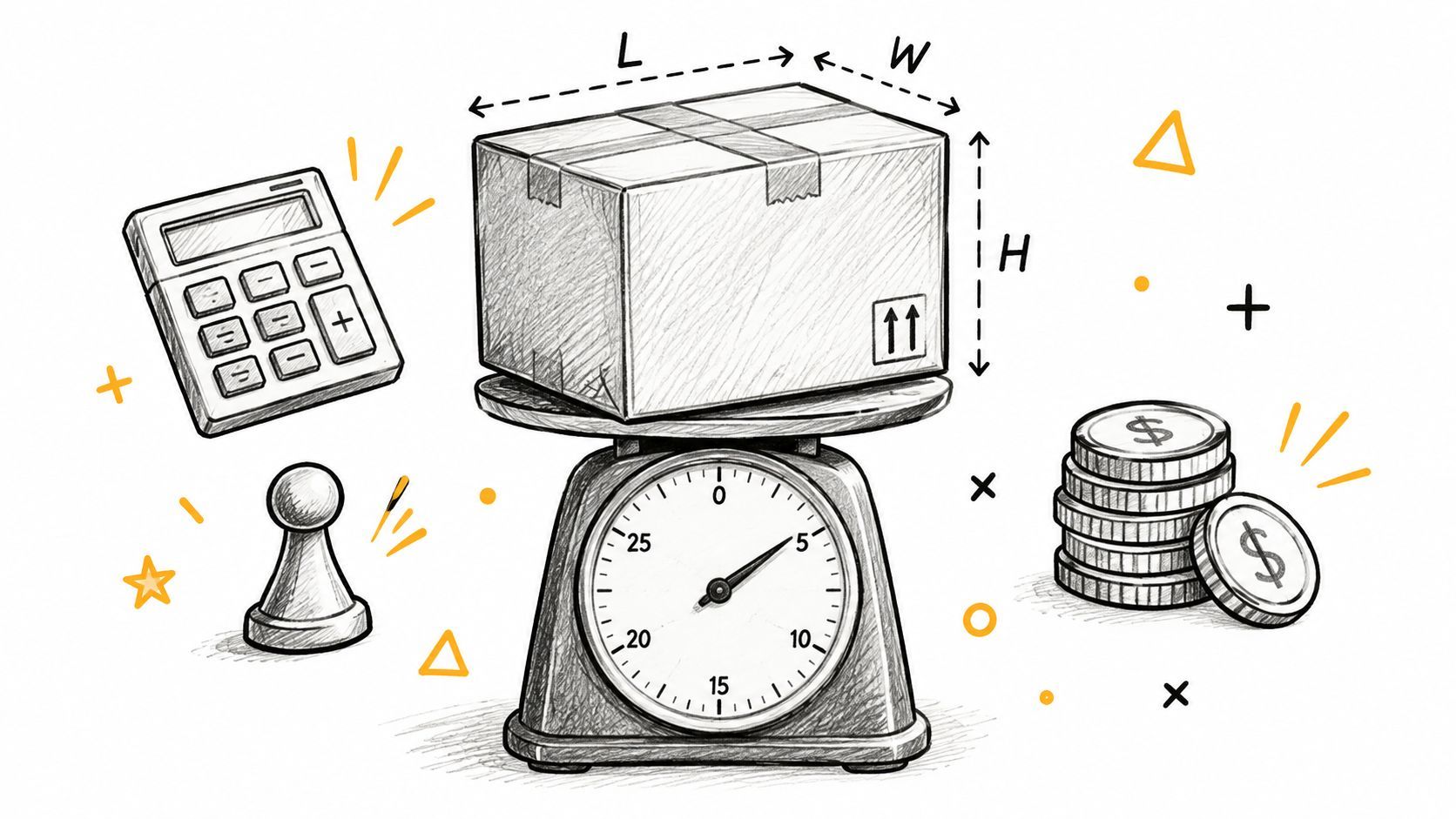
Learn how dimensional weight pricing affects Kickstarter fulfillment costs, carrier formulas, and shipping fees. Practical strategies
You're probably staring at a freight quote, a stack of sample boxes, and a shipping table that no longer makes sense. The reward itself feels settled. The campaign page is close. Then the box dimensions show up and the entire margin model shifts.
That's the part many creators miss. Dimensional weight pricing doesn't punish heavy products. It punishes empty air. In crowdfunding, that usually means the deluxe insert, the rigid mailer, the poster tube, the stretch-goal add-on, or the neat-looking reward bundle that suddenly bills like a much heavier shipment.
The mistake usually isn't in fulfillment alone. It starts earlier, in the pledge survey. If your survey tool can't collect shipping on real packed dimensions by region, you don't just misprice labels. You recover too little from backers, lose part of that recovery to platform fees, and turn every upsell into a packaging change you didn't price correctly.
I've seen this happen in a very familiar crowdfunding pattern. A board game creator finalizes manufacturing, books inventory out of Shenzhen, and tells backers international shipping will be affordable because the game weighs only 1.2 kg on a scale. Backers get charged $15. The creator budgets $12,000 for the outbound freight leg and last-mile parcel costs.
Then the actual invoice lands at $28,000.
The product wasn't overweight. The carton was oversized for its density. The finished reward box measured 46 x 32 x 14 cm, which pushed it into volumetric pricing across the carriers involved. The creator had priced by scale weight and ignored the packed cube.
That gap is brutal because it hits from both sides. Backers were charged less than cost, so the creator can't recover the shortfall without upsetting supporters. The factory run is already paid. The campaign is closed. The money has to come from somewhere, and usually that means margin disappears first.
This kind of miss rarely comes from one bad quote. It comes from one bad assumption.
The expensive mistake wasn't choosing the wrong carrier. It was collecting the wrong amount before fulfillment started.
A lot of creators think shipping trouble begins when labels are purchased. In practice, it begins when reward boxes are designed without billable volume in mind, then paired with a survey flow that can't recover the full cost cleanly.
The useful question isn't whether dimensional weight pricing is annoying. It is. The useful question is how it works, and how creators can price around it without making backers feel like they're getting ambushed after the campaign ends.
Dimensional weight pricing means the carrier measures space first, not just mass. They compare the package's scale weight with its volume-based weight, then bill the higher number.
Length × Width × Height ÷ Divisor = Dimensional weight
The divisor is the carrier's conversion rule. It defines how much box volume counts as one pound or one kilogram. For many U.S. parcel services, UPS and FedEx commonly use 139 cubic inches per pound. USPS often uses 166 cubic inches per pound for eligible parcels, and DIM pricing typically starts once the package is over 1 cubic foot, or 1,728 cubic inches, under USPS parcel size rules.
Here is the part creators miss. The carrier is pricing the carton you designed, but the financial problem often starts earlier, in the pledge survey. If the survey collects shipping by rough region rates and ignores packed dimensions, the DIM charge does not show up until fulfillment. At that point, the carrier invoice is fixed, but your recovery options depend on the tool you used to collect post-campaign charges. Kickstarter's built-in flow and platforms like PledgeBox do not create the same fee stack, upsell margin, or flexibility when you need to charge accurately for bulkier reward combinations.
Carriers use DIM pricing because trucks, cages, and aircraft fill by cube long before they max out by weight. A large light box can block out the space of several denser parcels. From the carrier side, that box is expensive even if it feels cheap to lift.
Crowdfunding runs into this problem more than standard ecommerce because reward boxes change after the campaign closes. Add-ons, stretch goals, inserts, and better presentation all increase cube. A box that looked harmless during campaign planning can move into DIM territory once the final survey mix is locked.
I treat this as a survey-design problem as much as a shipping problem. If a reward is light for its size, I assume DIM will set the bill, then I build survey rules around packed-out scenarios instead of product-only weight. That is also why creators review outside references on volumetric math and AUSFF shipping cost savings before finalizing shipping charges.
For many Kickstarter campaigns, the box is not packaging overhead. It is a billable part of the product.
Carrier DIM math is close enough to look interchangeable on a spreadsheet and different enough to wreck a shipping budget in a pledge survey.
I see creators make the same mistake every cycle. They price shipping around product weight, then let backers add bundles, playmats, sleeves, plush add-ons, or collector packaging in the survey. The carrier does not care that the extra weight was small. The carton got bigger, the divisor changed the billable weight, and the shipping line in the survey stopped covering the order.
| Carrier | Service Scope | Divisor (Imperial) | Divisor (Metric) | Threshold Rule | Unit Conversion |
|---|---|---|---|---|---|
| UPS | U.S. domestic parcels | 139 cubic inches per pound | Not stated in this source for UPS domestic | DIM applies when the package exceeds 1 cubic foot; UPS bills the greater of actual or dimensional weight per UPS surcharge materials | Divide cubic inches by 139 to get pounds |
| FedEx | Common U.S. and international practice | 139 cubic inches per pound | 5,000 cm³/kg | Threshold not specified here | Divide cubic inches by 139 for pounds, or cubic centimeters by 5,000 for kilograms |
| USPS | U.S. domestic parcels | 166 cubic inches per pound for many parcels | Not stated in this source | Packages over 1 cubic foot can trigger DIM for the applicable classes and zones, as noted earlier | Divide cubic inches by 166 to get pounds |
| Canada Post | Metric markets | Not stated | 6,000 cm³/kg | Threshold not specified here | Divide cubic centimeters by 6,000 to get kilograms |
The divisor is the part creators need to watch. Smaller divisor, higher billable weight. A 139 divisor punishes airy boxes harder than a 166 divisor, even when the packed contents are identical.
That matters in crowdfunding because survey choices create new box profiles after the campaign ends. One backer picks the core game. Another adds neoprene mats and an expansion. Another wants the same items plus retail-safe outer packaging. Those are not one shipping case with one clean rate. They are separate DIM outcomes, and your pledge manager has to collect shipping like they are separate outcomes.
UPS and FedEx often converge around 139. USPS has historically been friendlier on the divisor for qualifying parcels, which is one reason creators use it to keep domestic rates survivable on lighter boxes. But a friendlier divisor does not save a bad carton choice. If your reward only fits because the insert, void fill, and presentation box pushed the outer dimensions up, the survey needs to charge for the packed result, not the BOM estimate.
That is where the fulfillment decision crosses into a fee decision. If Kickstarter's built-in survey tool under-collects on a bulky reward mix, the shortfall usually comes straight out of margin. If a creator is using PledgeBox or another pledge manager with stronger shipping rule logic, they can segment by reward combination, region, and add-on set with fewer manual patches. The trade-off is platform fees. The upside is that recovered shipping and retained upsell revenue can outweigh those fees fast on DIM-sensitive campaigns.
I do not trust a single “standard shipping rate” once a campaign has optional buys. I want each likely packed configuration matched to the service that will carry it. Domestic parcels may favor one divisor. International parcels may be priced in metric and rounded differently. Canada Post and other metric-first carriers can look fine at the product-planning stage, then drift once the final carton is converted to cubic centimeters and rated by kg.
Regional carriers can still beat the majors in specific lanes. Amazon Shipping can also be a useful quote benchmark. The practical rule stays the same. Measure the final packed carton, apply the divisor for the service you will really use, then build the survey around that number so shipping is recovered before labels are purchased.
Let's use one reward box and run the math, because this gets clear fast when you stop talking about formulas in the abstract.
Take a packed box at 20" × 20" × 20". That is 8,000 cubic inches of volume. If a carrier uses a 139 divisor, the dimensional weight is about 57.6 lb. If the same box goes through a 166 divisor, the dimensional weight is about 48.2 lb as shown in this dimensional calculator reference.
That example is extreme enough to make the point. The carton didn't gain product. The warehouse team didn't mis-weigh it. The only thing that changed was the divisor.
| Box Size | Volume | Divisor | Calculated DIM Weight |
|---|---|---|---|
| 20" × 20" × 20" | 8,000 cubic inches | 139 | about 57.6 lb |
| 20" × 20" × 20" | 8,000 cubic inches | 166 | about 48.2 lb |
The same principle affects much smaller crowdfunding shipments. A reward can feel light in hand and still bill like a far heavier parcel once the box passes the carrier's threshold.
What creators usually need isn't a spreadsheet masterpiece. It's a repeatable way to test each packed SKU before survey charges go live. A simple cubic calculator for shipping is useful for checking whether a reward bundle that looks harmless on the packing table is pricing by cube.
If you only record item weight and skip packed dimensions, you're not estimating shipping. You're estimating half of shipping.
A second trap is mixed-unit workflow. Manufacturers often send carton specs in centimeters, while U.S. parcel labels may bill from cubic inches and pounds. One wrong conversion can make a reasonable quote look cheap.
The operational lesson is simple:
For crowdfunded rewards, the expensive package is often the one that looks the most polished.
Crowdfunding packaging is built to impress. Dimensional weight pricing is built to charge for that.
A standard e-commerce seller often designs the product around the shipping carton. Crowdfunding creators usually do the reverse. They build tiers, stretch goals, add-ons, promos, and backer gifts first, then try to fit all of it into a box that still feels premium.
That's where the trouble starts. A rigid mailer, folded art print, sticker stack, pin card, and printed insert can create a package that looks lightweight but occupies a footprint the carrier prices aggressively.
The pressure points show up in familiar places:
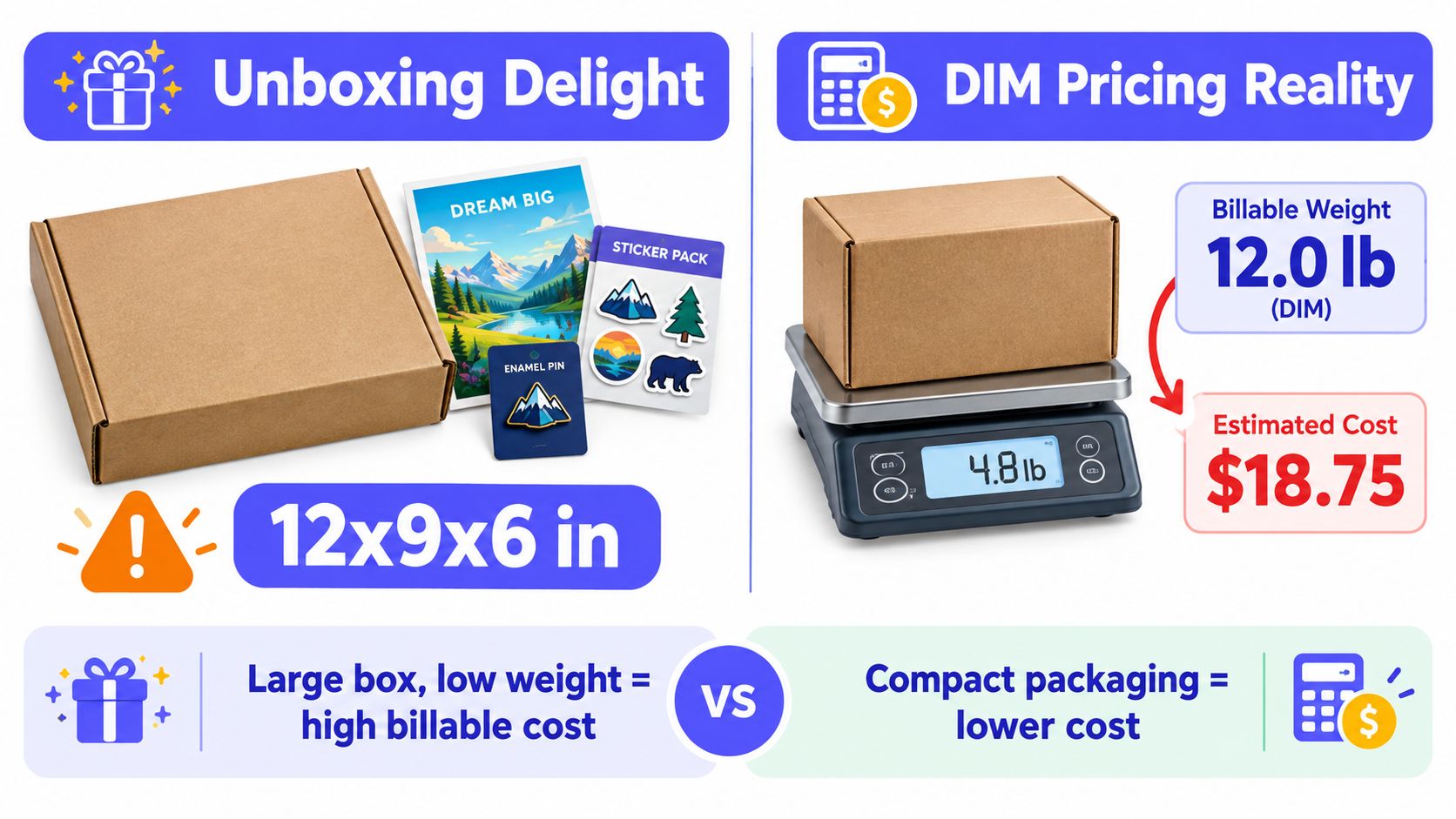
The campaign page usually contains broad shipping assumptions. The pledge survey is where those assumptions meet actual reward selection. If a backer adds a bundled expansion, apparel item, or art pack after the campaign, the shipment can jump to a different carton profile.
That matters because survey-stage add-ons don't just increase product revenue. They reshape fulfillment. A single added SKU may change the carrier service, the billable weight, and the regional charge you should collect.
Crowdfunding creators don't ship one product. They ship a moving target that changes as backers customize rewards.
International addresses amplify that problem because the least dense package in the batch can become the most expensive one to send. That's why reward design and survey design have to stay connected. If they're handled separately, costs drift long before the first label prints.
The pledge survey is where creators either recover shipping accurately or lock in a loss. If the survey only adds a flat surcharge, it usually undercharges some regions, overcharges others, and breaks the moment a backer changes reward composition.
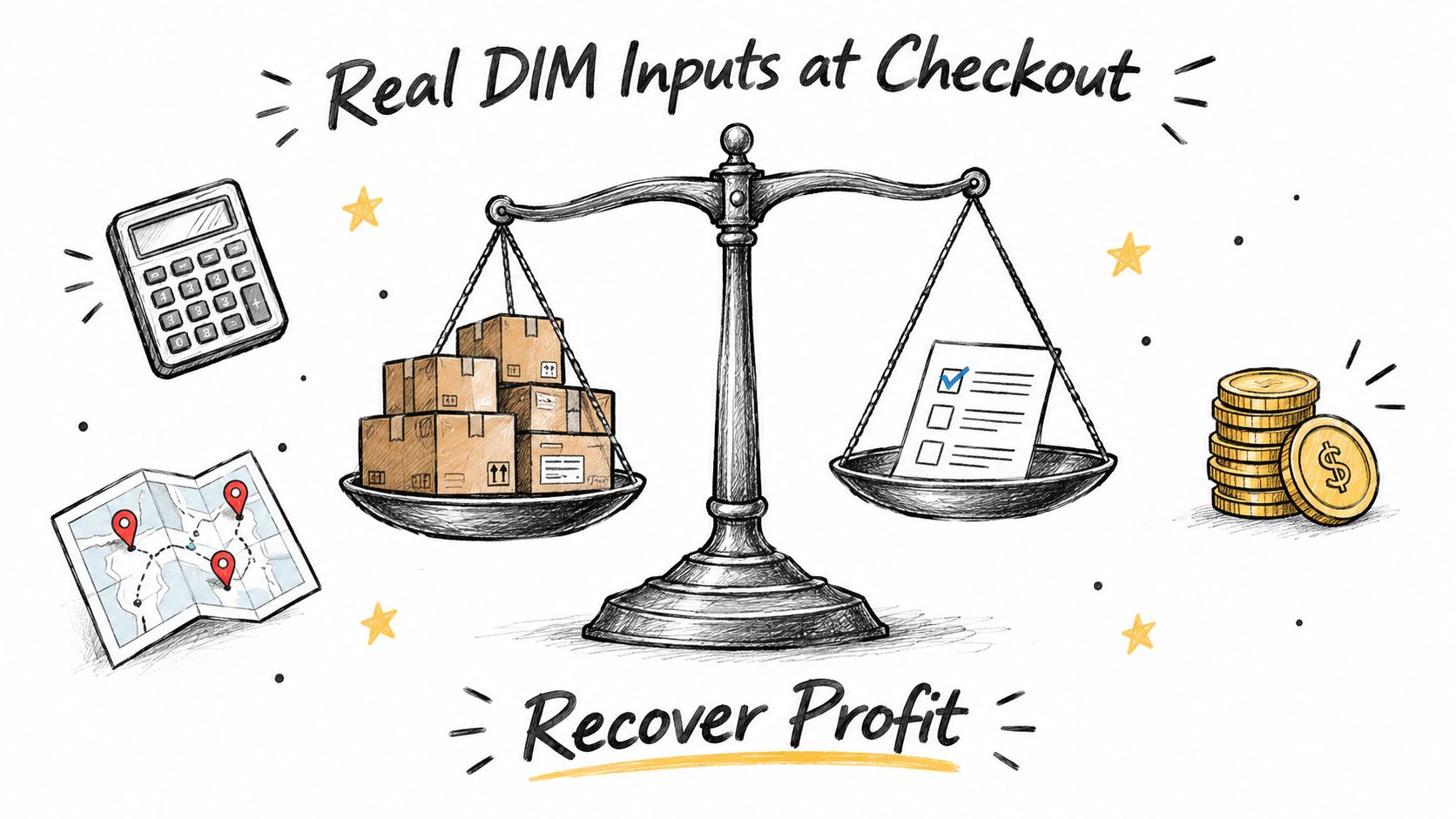
Kickstarter's built-in pledge manager has no upfront cost, but Kickstarter deducts its usual fees from payments made through it. Kickstarter also says it collects the same fees on shipping and add-on funds raised there as on campaign pledges, while taxes collected through the pledge manager aren't charged fees per Kickstarter's pledge manager help page.
For U.S. Kickstarter projects, the platform fee is 5%, and Stripe payment processing is typically 3% + $0.30 per pledge. Kickstarter also notes a discounted micropledge fee of 5% + $0.08 for pledges under $10 per Kickstarter's fee schedule.
That means shipping recovery collected inside that system doesn't land untouched. If your freight assumptions were already thin, losing part of the recovered amount to fees tightens the margin further.
The practical analogy is simple. Kickstarter pledge manager is the like amazon and pledgebox pledge manager is like shopify. One keeps you inside the platform's native flow. The other is approached more like your own post-campaign commerce layer.
Creators who need flexible shipping recovery often care about three things more than anything else:
A lot of teams also miss a simple cost distinction. PledgeBox is free to send the backer survey and only charge 3% of upsell if there's any. That changes the economics of shipping recovery because the charge is tied to add-on upsell revenue rather than to shipping you're trying to recoup.
For creators working through dimensional weight pricing, that difference is operational, not philosophical. If you want a practical walkthrough on setting charges, this guide on how to calculate shipping costs is the kind of resource that belongs in the survey setup phase, not after funds are already collected.
The cheapest fix is usually the box. Creators often spend too much time hunting rate discounts and not enough time cutting empty space out of the packed unit.
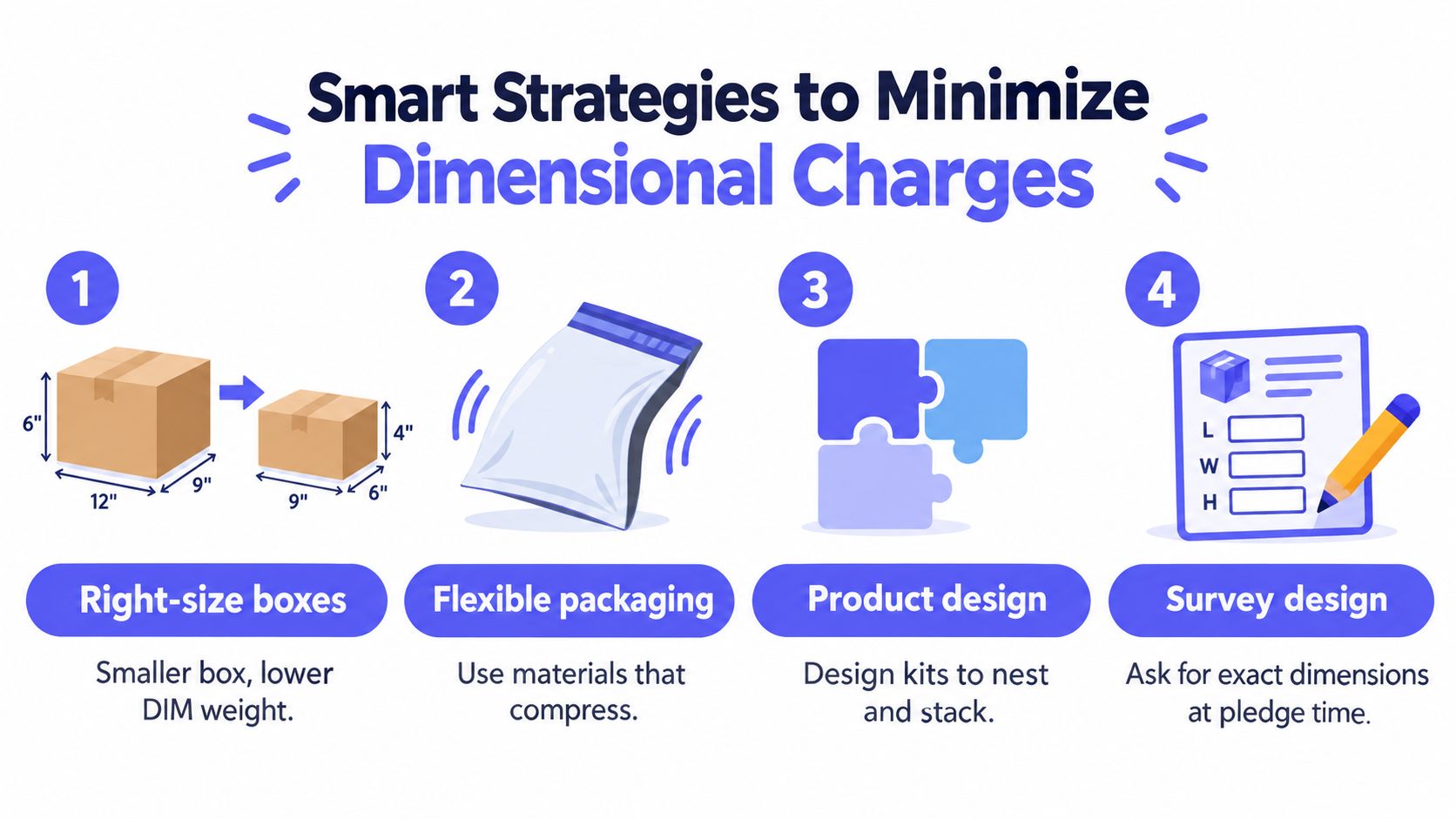
Some changes produce outsized savings because they attack the volume directly.
Not every dimensional problem is solved with corrugate. Some begin in reward design.
Here's a useful habit. Before a campaign goes live, pack the final reward as if a warehouse had to ship it tomorrow. If the package feels oversized in hand, it will almost always look worse once dimensional weight pricing is applied.
Later in the process, automation helps. Some creators use survey tools and shipping workflows that support weight-and-dimension logic per reward, then surface the cheapest qualifying service and connect the resulting orders to downstream fulfillment systems. If you're tightening the recovery side as well, this article on how to reduce shipping costs is a practical companion to carton testing.
A short tutorial can also help teams who need to explain the issue internally before they redesign packaging:
Operator habit: Fix the box first. Redesign inserts second. Tune the survey third.
That order tends to save more money than negotiating labels before the package shape is under control.
A clean dimensional-weight workflow starts before launch and ends after the final export to your fulfillment partner. The teams that stay out of trouble usually follow the same sequence: measure the fully packed unit, calculate billable weight against the carrier rule that applies, build reward and add-on logic around that result, then collect shipping through a survey that can charge accurately by region and package profile.
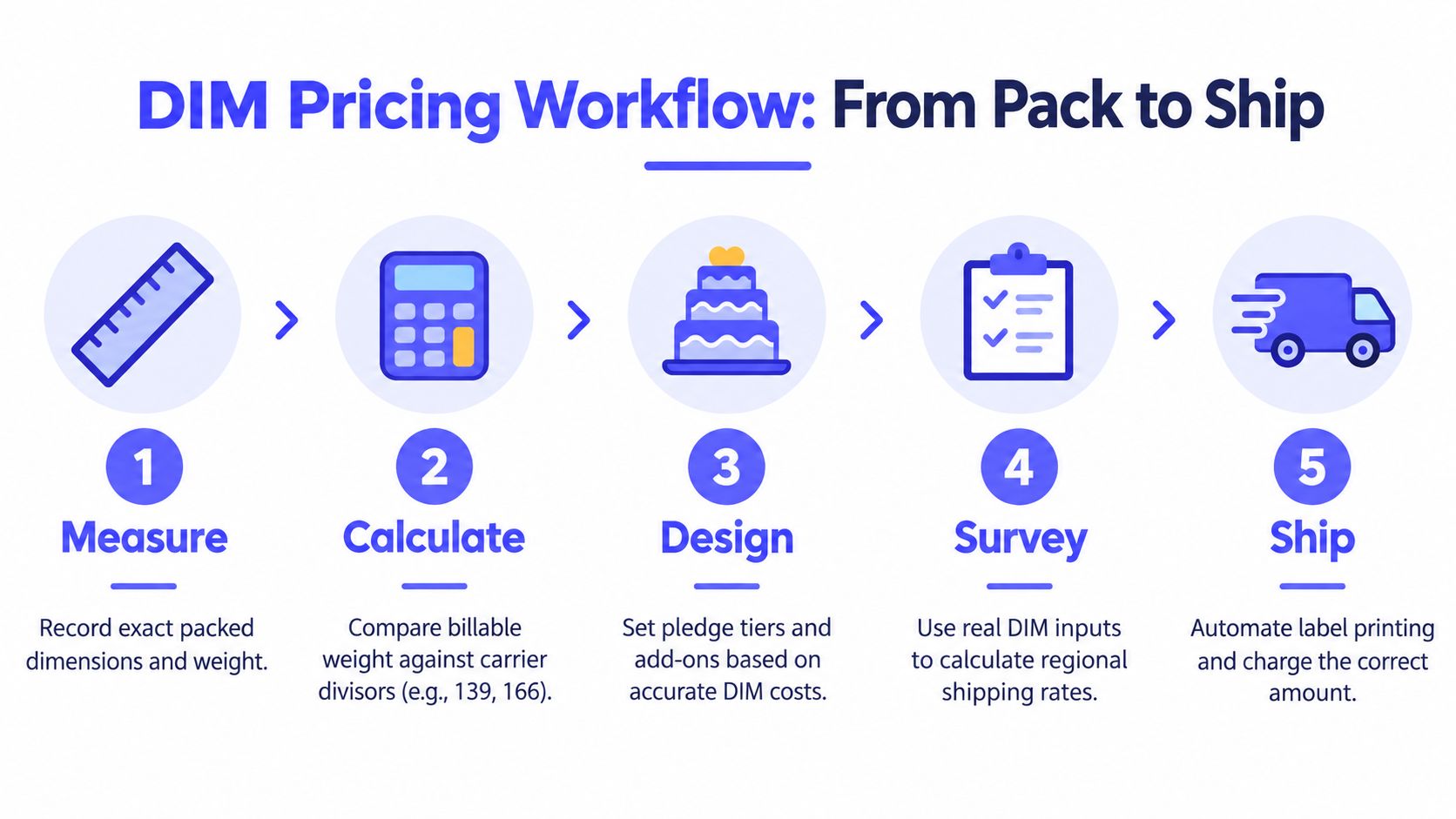
Use this before you lock your shipping table:
This isn't a logistics chore. It's a margin control system. The pledge manager is the point where your packaging data turns into collected revenue, which is why tool choice changes the outcome.
Kickstarter's built-in option is convenient, but it applies the platform's fee structure to payments collected there, including shipping and add-ons, as noted earlier. By contrast, some external workflows are built around free survey collection and upsell-based fees instead. In practical use, creators also tend to care about whether the system connects cleanly to shipping and fulfillment services such as Shippo, EasyPost, storefronts, or 3PL exports.
When dimensional weight pricing hits a campaign, the winner usually isn't the creator who finds the cleverest last-minute workaround. It's the one who measured early, priced fairly, and built the pledge survey around the actual package instead of the hoped-for one.
PledgeBox gives creators a post-campaign workflow that lines up with this problem: survey collection, shipping fee recovery, add-on upsells, and fulfillment handoff in one place, with the survey free to send and fees tied to upsell revenue rather than shipping collection. If you want to tighten your dimensional weight pricing process before your next campaign goes live, visit PledgeBox.
PledgeBox
The All-in-One Toolkit to Launch, Manage & Scale Your Kickstarter / Indiegogo Campaign