 PledgeBox
Supplier Contract Negotiation for Hardware Teams
Supplier contract negotiation for crowdfunding hardware teams: prep costs and samples, package trades, must-have clauses, red flags, and a calendar that feeds

Supplier contract negotiation for crowdfunding hardware teams: prep costs and samples, package trades, must-have clauses, red flags, and a calendar that feeds
The campaign funded, the factory sent a quote, and the unit price looks like a win. Then the deposit is due before inspection, tooling has its own schedule, and the part that holds up production comes from a sub-supplier nobody mentioned. For a hardware team, supplier contract negotiation isn't a last-minute haggle. It's how you protect the production calendar, product quality, tooling, cash, and the backers waiting for a shipment.
A small tabletop gadget can look simple on a quote: one product, one unit price, one production run. But a creator who picks the cheapest factory without checking the sample or mapping the payment schedule may discover too late that the deposit is due before the team can approve the goods. The factory may also depend on a specialist sub-supplier for a critical component, leaving the campaign stuck when that supplier's capacity slips.
The signed price doesn't tell you whether the deal worked. You need to know whether the team received the quality, capacity, delivery timing, and commercial value it negotiated, and whether those terms survived production and fulfillment.
A Vantage Partners study of more than 500 survey responses from professionals representing over 300 companies found that procurement organizations with a formal negotiation process achieved 27% more of their targeted strategic-sourcing value than those without one. Companies aligning negotiation strategy with category management and supplier relationship management realized 59% more value from supplier contracts. The study also associated collaboration with greater contract value, not weaker commercial discipline. Vantage Partners' customer–supplier negotiation study
The useful test: Don't ask only, “Did we get the lower quote?” Ask, “Can we produce, inspect, and ship the agreed product under the terms we signed?”
That distinction begins with understanding the commercial relationship between your order document and the supplier's terms. If you need a plain-language primer on purchase order versus supplier terms, use it to identify which document controls when the two conflict.
A repeatable, collaborative process gives the factory room to explain constraints while keeping your requirements firm. You'll build a cost baseline, tradeable packages, enforceable clauses, a red-flag screen, and a calendar that connects production to fulfillment. The aim isn't to win a tense call. It's to get the goods you promised backers, on workable terms, with a plan for what happens when something changes.
Before you ask a supplier for a discount, build a version of the deal that accounts for the costs and risks the quote leaves out. Start with the business outcome: what must arrive, by when, to what standard, and within what cash limit? Add technical requirements, support expectations, risk tolerance, and the cost of switching suppliers.
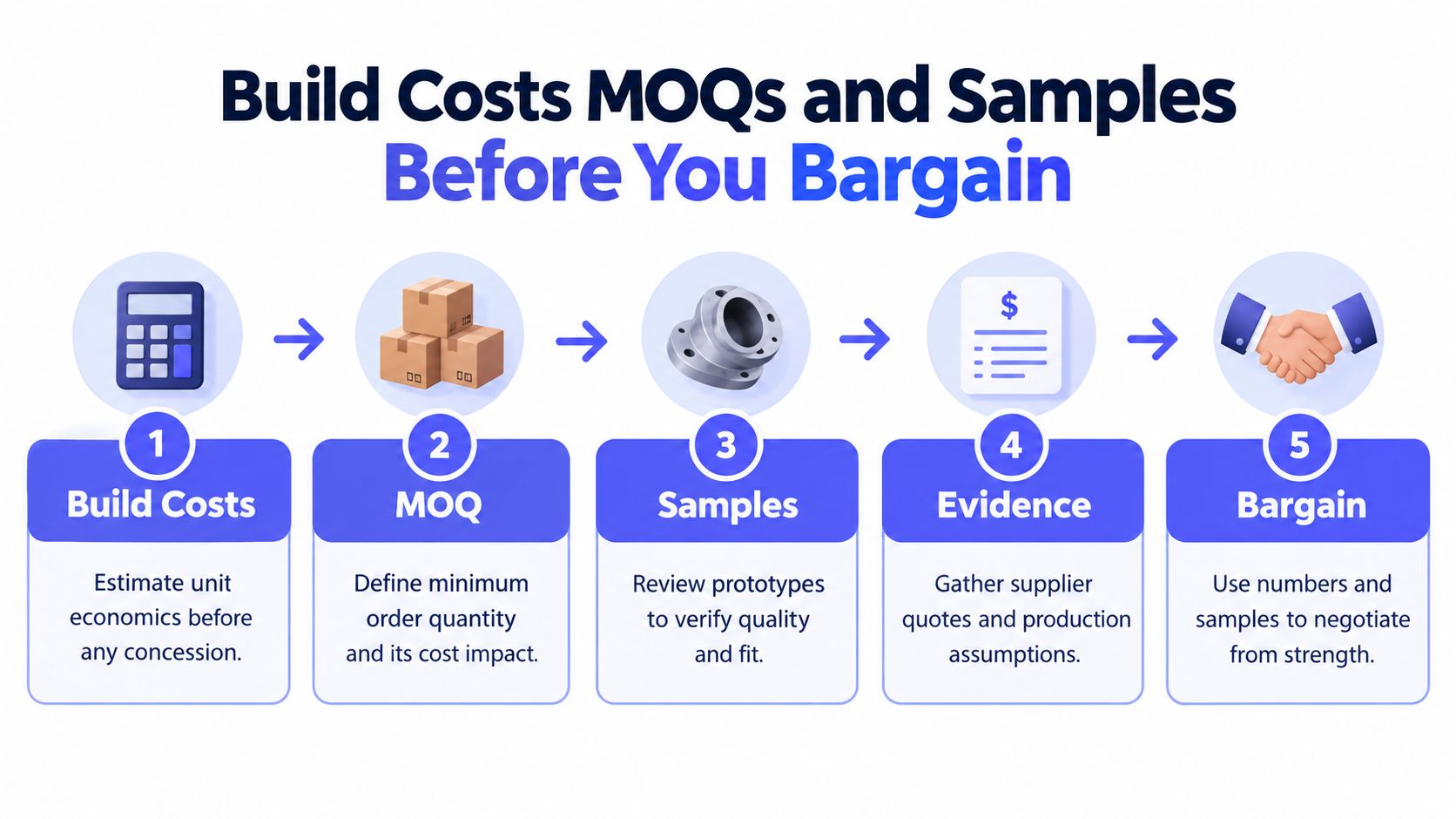
Normalize every offer before you compare it. Put the same assumptions beside each supplier's price: product units, order volume, packaging, freight, taxes, tooling, inspection, support, spare parts, and termination or transfer costs. If one quote excludes packaging and another includes it, they aren't competing on the same basis.
For a crowdfunding run, include the cash tied up by the minimum order quantity (MOQ), not just the per-unit price. A low unit cost can still be a bad deal if the MOQ forces you to pay for far more inventory than the campaign can sell or store. Ask for the supplier's assumptions in writing, including what changes the price or delivery estimate.
Samples are evidence, not decoration. Check workmanship, color, fit, function, packaging, and the instructions that will reach the backer. If you can, test a small pilot lot before committing the full MOQ. Your approval should identify the exact sample or specification the factory must match. For help turning product requirements into repeatable checks, use these hardware product testing protocols.
A credible BATNA, your best alternative to a negotiated agreement, means having a qualified alternative supplier or another workable production path. A name in a spreadsheet isn't enough. Know whether the alternative can make the product, meet the quality requirements, and support the campaign schedule.
Get written sign-off from the founder, the fulfillment owner, and the person responsible for inspecting goods. Independent benchmarking found that customers realized 54% of expected or potential contract value during implementation, while suppliers reported delivering 66%. Preparation and stakeholder alignment were recurring barriers, including end-users and technical staff working outside procurement processes. Supply Chain Management Review's analysis of strategic sourcing and negotiation
Carry three documents into the negotiation: a one-page cost model, a sample checklist, and an issue list divided into must-haves and tradable items. That gives the conversation a factual starting point and helps everyone on your team negotiate from the same position.
Once your costs and samples are in order, rank the negotiation issues by their impact on cost, on-time shipping, switching difficulty, and dependence on the factory. Then discuss complete offers rather than treating each line item as an isolated win or loss.
A package might combine forecast tolerance, volume flexibility, lead-time commitments, quality thresholds, tooling ownership, reserved capacity, and indexed pricing for materials. Each concession should buy something specific. A longer commitment, for example, should earn price protection and reserved capacity. Faster payment should earn a discount or stronger service credits.
Payment terms are a common trap. Stretching a short payment window into a much longer one may improve your cash position on paper but raise the unit price, reduce your priority when supply tightens, or reappear as a deposit elsewhere. Payment days aren't free value. Ask who carries financing costs, foreign-exchange movement, and the cost of a forecast change.
| Package | Buyer gives | Ask in return | Continuity risk |
|---|---|---|---|
| Shorter terms plus early-payment discount | Faster cash release after agreed checks | A defined discount and reliable delivery priority | Confirm that early payment follows inspection, not simply a date on the calendar |
| Milestone payments after inspection | Payment at agreed production stages | Evidence of progress, inspection access, and a clear remedy for a failed stage | Keep the release conditions precise so a dispute doesn't freeze the whole run |
| Partial prepayment with a performance guarantee | A deposit that helps the factory fund production | A guarantee, documented capacity, and a recovery plan if the order slips | Verify what the guarantee covers and how you can enforce it |
A global supplier-negotiation benchmark covering more than 500 respondents from over 300 companies reported that buy-side organizations realized 67% of potential contract value in execution, compared with 71% reported by suppliers. It also found that more than 80% of buy- and sell-side respondents viewed negotiations as highly or somewhat adversarial. The benchmark associated stronger realized value with alignment among negotiation strategy, category management, and supplier relationship management. Vantage Partners' supplier-negotiation benchmark
Bring objective cost drivers to the conversation and ask the supplier to help shape workable options. For teams comparing payment structures with fixed-price terms, FederalPipeline's fixed-price bidding guide can help frame what's locked and what still needs a clear allocation of risk. Tie incentives to accepted goods and actual shipment, not verbal promises.
A handshake doesn't tell an inspector what to accept or an operations lead what to do when a part fails. Convert every trade into language that's measurable, assignable, and tied to evidence.
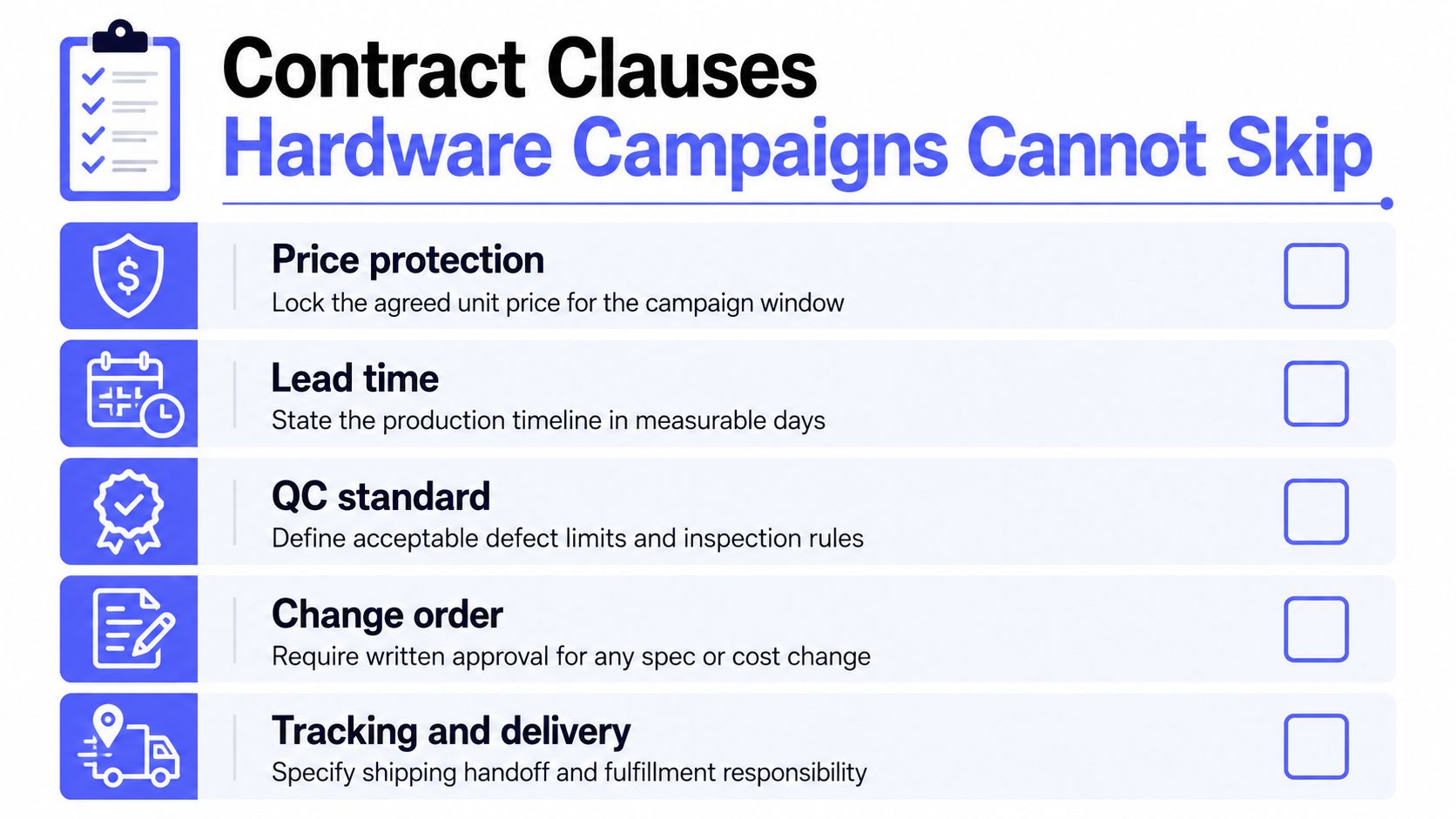
Write the payment milestones into the contract, and link them to inspection or documented production stages rather than a date alone. Define lead time in measurable terms, including when the clock starts. “After confirmation” is too vague unless the agreement says what counts as confirmation and which inputs the factory needs.
Acceptance criteria should cover function, cosmetic condition, packaging, and quantity. State who inspects, what evidence counts, how defects are handled, who pays for a failed re-inspection, and whether a lot can be repaired, replaced, or rejected. For quality thresholds, the contract needs a clear method for counting and resolving failures, not just a promise to make good parts.
Name who owns molds, tooling, firmware, and artwork. Record where tooling will be stored, how it will be maintained, and how the creator can retrieve or transfer it if the relationship ends. Include change-order rules so that a reward change, component swap, or forecast adjustment can't reset price or delivery dates without notice. Require a written impact assessment and approval before the change takes effect.
A resilient supplier agreement should also call for timely information about capacity, geographic exposure, critical sub-suppliers, inventory, and recovery assumptions. Give your team a right to verify important claims, define service levels, and use an alternate source if the supplier defaults. Graduated remedies can move from notice and corrective action to service credits, expedited recovery, alternate sourcing, and termination when objective thresholds are missed. Excessive penalties can raise prices or push smaller suppliers away, so match each remedy to a defined failure. JAGGAER's guidance on reducing supply-chain risk
Before signing, trace every important promise to a KPI or piece of evidence: accepted quantity, inspection result, shipment handoff, response to a change request, and recovery action. Teams setting up connected sourcing workflows can also review how to streamline sourcing with SAP, while keeping the contract's own responsibilities and measures explicit.
A friendly quote can hide a poor deal. Don't sign just because the supplier is responsive or the unit price fits the campaign math. Look for gaps that leave cost, capacity, or ownership unresolved.
The first warning is a quote that bundles tooling into the unit price without saying who owns it. Another is an MOQ well above the funded quantity, with no written path to a later run or an explanation of how the price changes. Ask for the missing breakdown or pause the negotiation.
Samples should match the quoted specification. If the sample differs in finish, materials, packaging, or function, don't treat approval as a formality. Attach the approved sample details to the agreement and resolve differences before production.
Don't accept “we'll confirm later” for a term that can stop production.
Vague lead-time language, such as “about eight weeks after everything is confirmed,” needs a defined start point and a list of required inputs. Inspection offered only after the goods have shipped doesn't protect you from accepting a bad lot. If the factory won't identify a critical sub-supplier or share meaningful capacity and recovery information, treat that as a continuity risk, not a minor communication issue.
Check the ownership language. A clause that gives the factory broad rights to use or license your design can outlast the production run. Ask for a clear statement of your IP rights and a practical process to retrieve tooling and files if the relationship ends.
Other stop signs include a demand for full prepayment without a performance guarantee, pressure to close the same day, missing warranty or exit assistance, and a change clause that lets the supplier reprice whenever your forecast moves. Ask for the relevant contract exhibit, a written correction, or a revised payment structure. If the factory won't fix the issue, use the backup supplier you qualified before bargaining. For campaign operators watching how external supply problems turn into backer delays, this guide to supply-chain disruptions affecting Kickstarter projects provides useful context.
Negotiations get rushed when nobody owns the dates. Put the work on the same board you use for launch and fulfillment, and assign each milestone to a person who can move it forward.
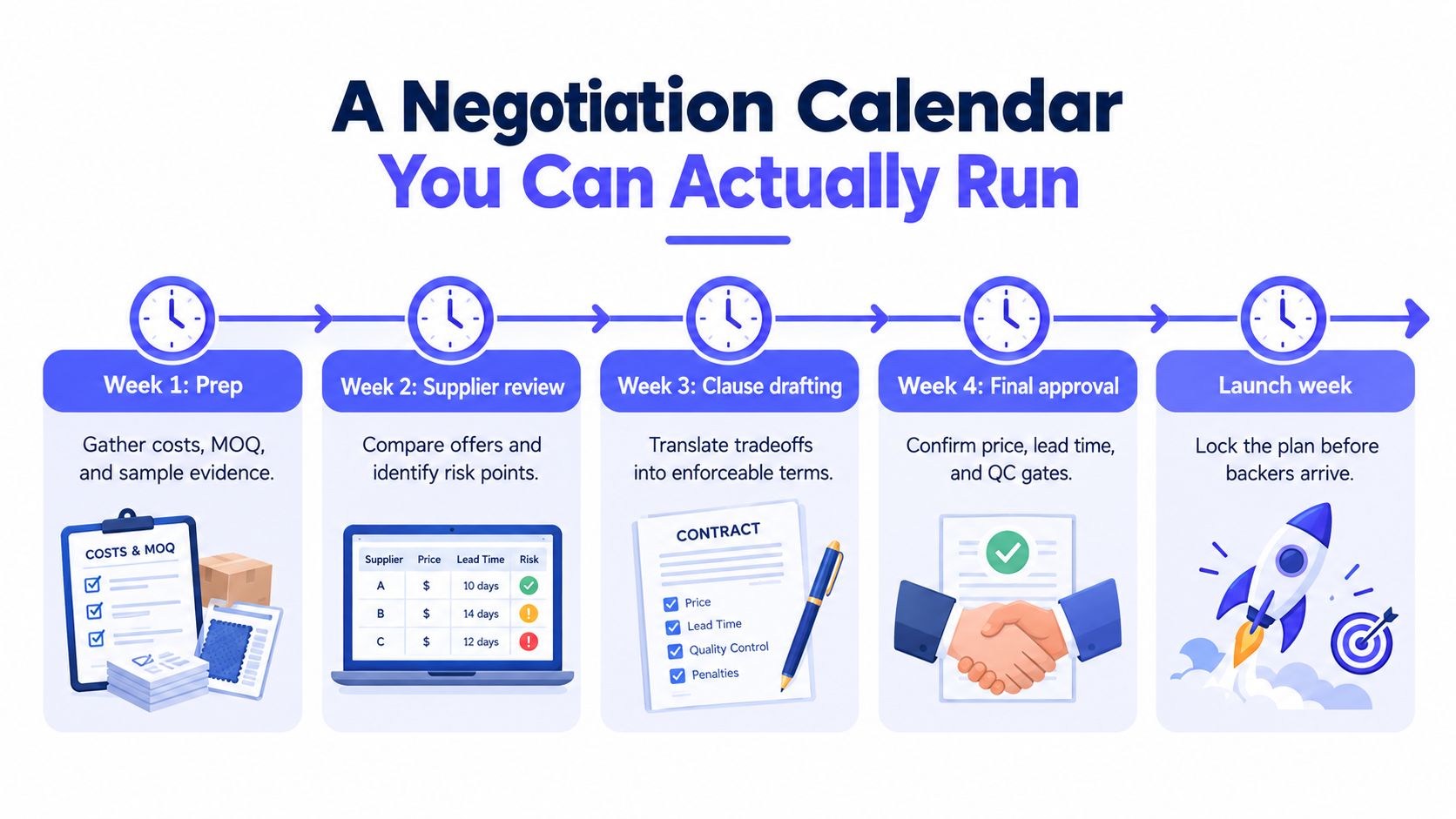
Week 1, prep: The founder gathers cost assumptions, the ops lead requests comparable quotes and samples, and the inspector defines the acceptance checks. Put the backup supplier's offer and capacity assumptions in the same folder.
Week 2, supplier review: The ops lead normalizes the offers and flags gaps in MOQ, tooling, delivery, and payment terms. The founder holds a decision meeting only after the quotes are comparable. Use a package discussion to test trade-offs, not a price-only call.
Week 3, clause drafting: The person managing the contract turns verbal agreements into written exhibits. Attach the cost build, approved sample reference, QC plan, tooling list, change-order form, and escalation contact. Don't send a deposit while key terms still live in meeting notes.
Week 4, final approval: The founder approves the commercial terms, the inspector confirms acceptance criteria, and the ops lead checks that supplier dates align with the campaign plan. Each owner confirms their part in writing before the team authorizes payment.
The backer survey needs to collect usable address, reward, and add-on information early enough to support production and shipping decisions. But don't ask the factory to freeze quantities until the team understands which SKUs, options, and packaging the run must cover. Map survey milestones against the contract's lead-time start, change-control rules, and any date when the factory needs final quantities.
After signature, the ops lead owns the kickoff and checks the deposit receipt and tooling schedule. At the 30-, 60-, and 90-day reviews, compare invoices and production output with the price, concessions, quality gates, and delivery commitments in the agreement. Assign an owner to each review, then record what needs escalation or correction. This is how a signed term becomes an operating control instead of a forgotten promise.
The contract only helps fulfillment if its requirements connect to the data your team collects from backers and sends to vendors. Lead times, QC gates, and change-order rules should determine when the survey opens, when quantities are finalized, and what the factory needs in its export.
Map each reward to the contracted bill of materials. Make sure the vendor export carries the SKU, quantity, chosen options, and any other production details your supplier needs. Shipping-fee and tax collection, address validation, and tracking then form the operational bridge between goods leaving the factory and rewards reaching backers. For the wider handoff from orders to delivery, review this guide to crowdfunding order fulfillment.
The tools aren't interchangeable in how they feel to creators. Kickstarter's Pledge Manager is like Amazon: a familiar platform-owned checkout with Kickstarter's own fee structure. PledgeBox's pledge manager is like Shopify: a creator-branded setup for configuring the survey, collecting choices, and running a post-campaign store.
PledgeBox is free to send the backer survey and only charges 3% of upsell revenue if there's any. A survey collecting only addresses and product choices stays free. If the survey collects add-ons, upgrades, shipping, or tax/VAT, the platform fee applies to those additional payments, not again to the original Kickstarter or Indiegogo pledge. For example, a $100 survey payment produces a $3 platform fee before payment-provider charges. PledgeBox's pricing details
Take one concrete next step: open the survey setup, map every reward SKU to the contracted bill of materials, and schedule the survey against the lead time already written into your agreement. That connects the factory's production plan to backer choices, vendor exports, and the shipment data your team needs to deliver.
PledgeBox helps crowdfunding teams collect backer choices, shipping fees, and tax, then connect survey data to vendor exports and shipment tracking. Set up your reward SKUs against the supplier terms you've negotiated, and visit PledgeBox to prepare your fulfillment workflow.
PledgeBox
The All-in-One Toolkit to Launch, Manage & Scale Your Kickstarter / Indiegogo Campaign