 PledgeBox
Valid Shipping Address Explained: Fields, Fixes and Checks
Learn what makes a valid shipping address, the common errors that cause failed deliveries, and how to validate backer addresses before fulfillment.

Learn what makes a valid shipping address, the common errors that cause failed deliveries, and how to validate backer addresses before fulfillment.
A valid shipping address is one a carrier can match to a real, reachable delivery point and hand a parcel to, with the recipient identified. Every year, postal services route a significant share of shipments into returned-to-sender piles because the address failed exactly that test.
The moment this becomes real for a creator looks like this. The campaign funded, the survey closed, and somewhere in a file of 2,000 rows sit addresses typed on phones at midnight: an apartment number buried in a notes field, a country written three different ways across the batch, a street spelled the way it sounds. One export and one label run later, every flawed row turns into a parcel that comes back, a support ticket, and a backer asking where their reward went.
Here is what trips teams up: a field can be filled in and still be wrong. A form only checks that the city box is not empty. The carrier checks whether the street exists in that city, whether the house number is a real delivery point, and whether unit 4B receives mail there.
The fix is knowing what a carrier needs, checking for exactly that, and keeping the locally useful detail instead of deleting it for the sake of a tidy database.
The nine components below apply in any country, and only the ordering and formatting rules change from one postal system to the next. Where a format needs a concrete illustration, the examples use the United States, including the ZIP+4 code that a US delivery point requires.
Address components and what a valid entry looks like
| Component | Valid when | Common failure |
|---|---|---|
| Recipient name | Matches the name the backer will accept at delivery | Nickname or company name used without the person's name |
| Street and number | Matches a real delivery point in the postal reference | Missing or transposed house number |
| Apartment, suite or unit | Present wherever the building has several units | Left blank in multi-unit buildings |
| Directional prefix (N, SW and similar) | Included wherever the postal system uses it | Dropped or given the wrong direction |
| City or locality | Official locality name for the postal code | Misspelled, or a neighbourhood name used instead |
| State, region or province | Matches the region the postal code belongs to | Does not match the postal code |
| Postal code | Matches the locality and uses the full format (ZIP+4 in the US) | Truncated, or wrong number of digits |
| Country | Written in full and in one consistent form across all records | Missing, or abbreviated differently from record to record |
| Phone number | Reachable for carrier or courier calls | Missing, or the wrong length for the country |
An address is valid only when every component passes and the whole thing resolves to a single delivery point. One failed component sends the record to review, not to export.
Working rule: before the batch leaves your account, mark every order pass, fix, or confirm with the backer. The three labels do the triage for you, and an unlabeled batch hides its own problems until a carrier finds them.
A key can be cut to the right shape and still fail to open the lock it was made for. A shipping form can be filled in completely and still point to a home no carrier can find. Completeness is a formatting property. Deliverability is an operational one, and they diverge more often than most creators expect.
Postal operators sort failures into three buckets, and each one needs a different response.
The Universal Postal Union's think tank brief on address quality puts the cost at up to 14% of delivery success rates, and it files those losses under exactly those three headings.
Validation tools bring a trade-off of their own. A strict validator will reject a usable rural address whose directions lean on a landmark, because the landmark isn't a postal field. A lenient one will pass a technically correct address that nobody can reach, because a demo unit number was typed into a street line. Both errors cost money, and the strict one is harder to notice because the record looks handled.
Validation should optimize a successful handoff, not database conformity.
Judge every record by two questions: can a carrier find this recipient, and can it complete delivery without calling anyone for help? If the answer to either is no, the record isn't valid yet, no matter how many fields are filled.
Undeliverable mail is rarely a mystery. In the 155-billion-piece year covered by the USPS Office of Inspector General's address-quality analysis, insufficient spelling accounted for 26.9% of address deficiencies, incorrect or missing directional information for 20.9%, and expired forwarding time for 15.8%. None of those are carrier failures. They're data-entry problems, and they're cheap to catch before export.
Common address problems, examples and fixes
| Problem | Example in a record | Fix before export |
|---|---|---|
| Misspelled street or city | Mapel Strete, Springfeld | Correct against the postal reference and confirm with the backer |
| Missing or wrong directional | N Oak Street entered as Oak Street | Restore the directional from postal data |
| Address changed since pledge | Address collected months earlier, backer has moved | Re-confirm through the survey before export |
| Missing unit number | 44 River Road, a building of 40 units, with no apartment field | Ask the backer for the unit and flag the record until it arrives |
| Truncated postal code | M5V entered instead of M5V 2T6 | Look up the full code from the postal reference |
| Inconsistent country name | UK and United Kingdom mixed in one batch | Standardize to one country name across all records |
Most of these fixes are mechanical: a lookup corrects the spelling, the postal file restores the directional, the full code replaces the stub. The exception is any correction that changes what the address means rather than how it reads. Moving a number from a street line into a unit field, or guessing a direction on a street that runs both ways, needs a backer's confirmation before the parcel moves.
Even a well-formed address can meet a delivery rule that sends the parcel back, and UPS Ground shipping policies explained from Rockdale Wreaths is a useful reference for how one carrier handles delivery attempts and returns.
An address can pass every field check and still come back as undeliverable. Validation works like a guest list at the door: the name has to match someone who lives there. In the United States the strongest test is USPS Delivery Point Validation, which the USPS address quality programme describes as its highest level of address-accuracy testing because it confirms the address exists as an active delivery point. It returns three outcomes: primary and secondary information both verified, primary only verified, or not verifiable as a known address.
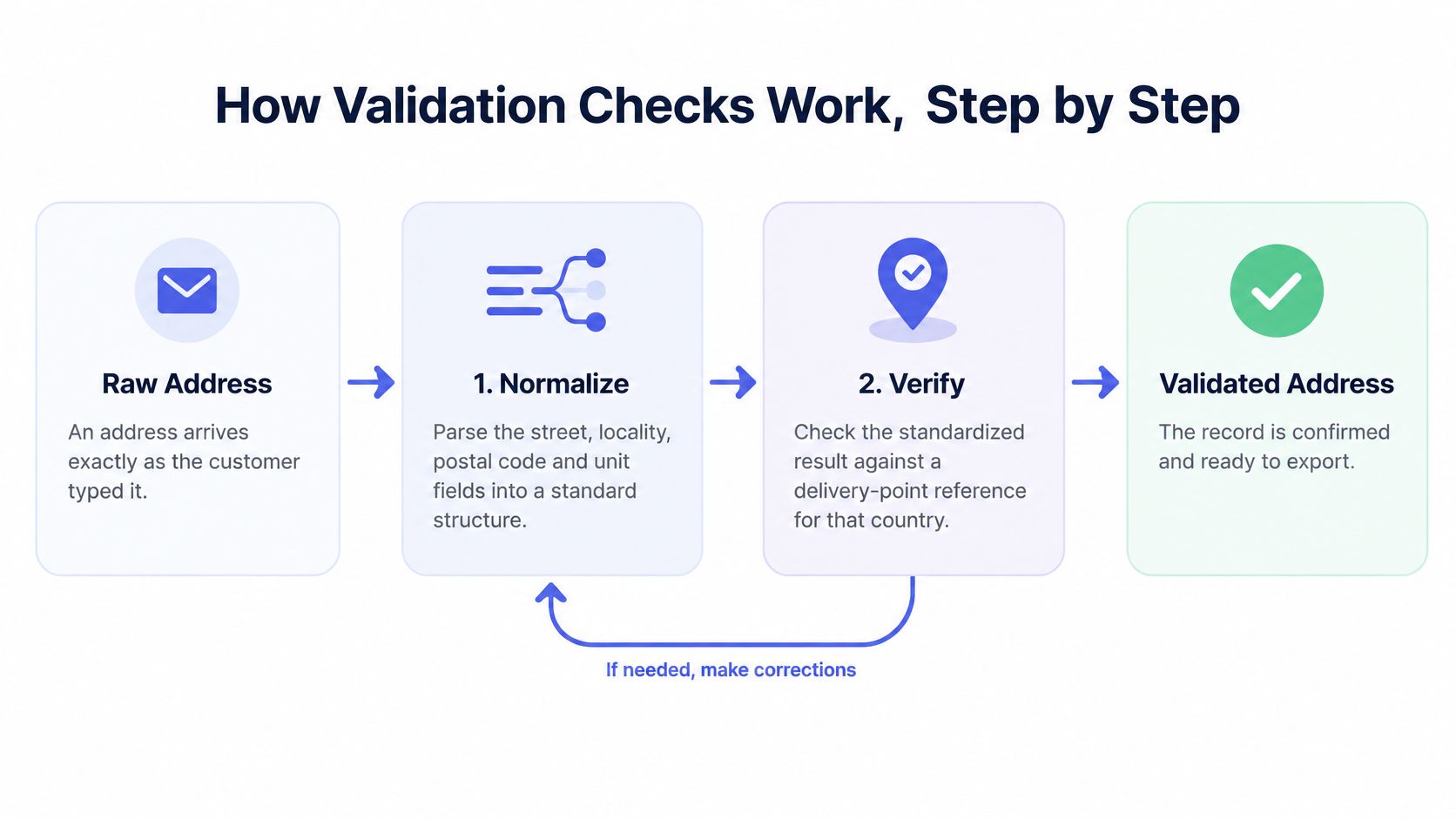
US implementations should run through CASS-certified matching software, since certification is how USPS holds matching tools to its accuracy requirements. Field design carries the rest of the load, and this guide to form field validation covers how to structure those fields so bad data never reaches the validator.
A clean export has one shape: every record either verified or explicitly confirmed by the backer.
Address components don't sit in the same order everywhere. Country rules decide where the recipient, building or unit, locality, region, postal code and country name appear, which is why the Universal Postal Union built the S42 standard: a common set of address components plus country-specific templates for ordering and formatting them, developed in alignment with ISO 19160-4, as the UPU addressing programme documents. A check that only confirms a field is filled cannot guarantee international deliverability.
The awkward cases show up in almost every worldwide campaign, and each has a handling rule.
Collect a phone number for every international order. It's the only field that lets a courier resolve an address the postal data can't, and it costs nothing to require at survey entry. Before you accept any address, check the expected format for that destination country first, because the logistics behind international shipping change what counts as complete from border to border.
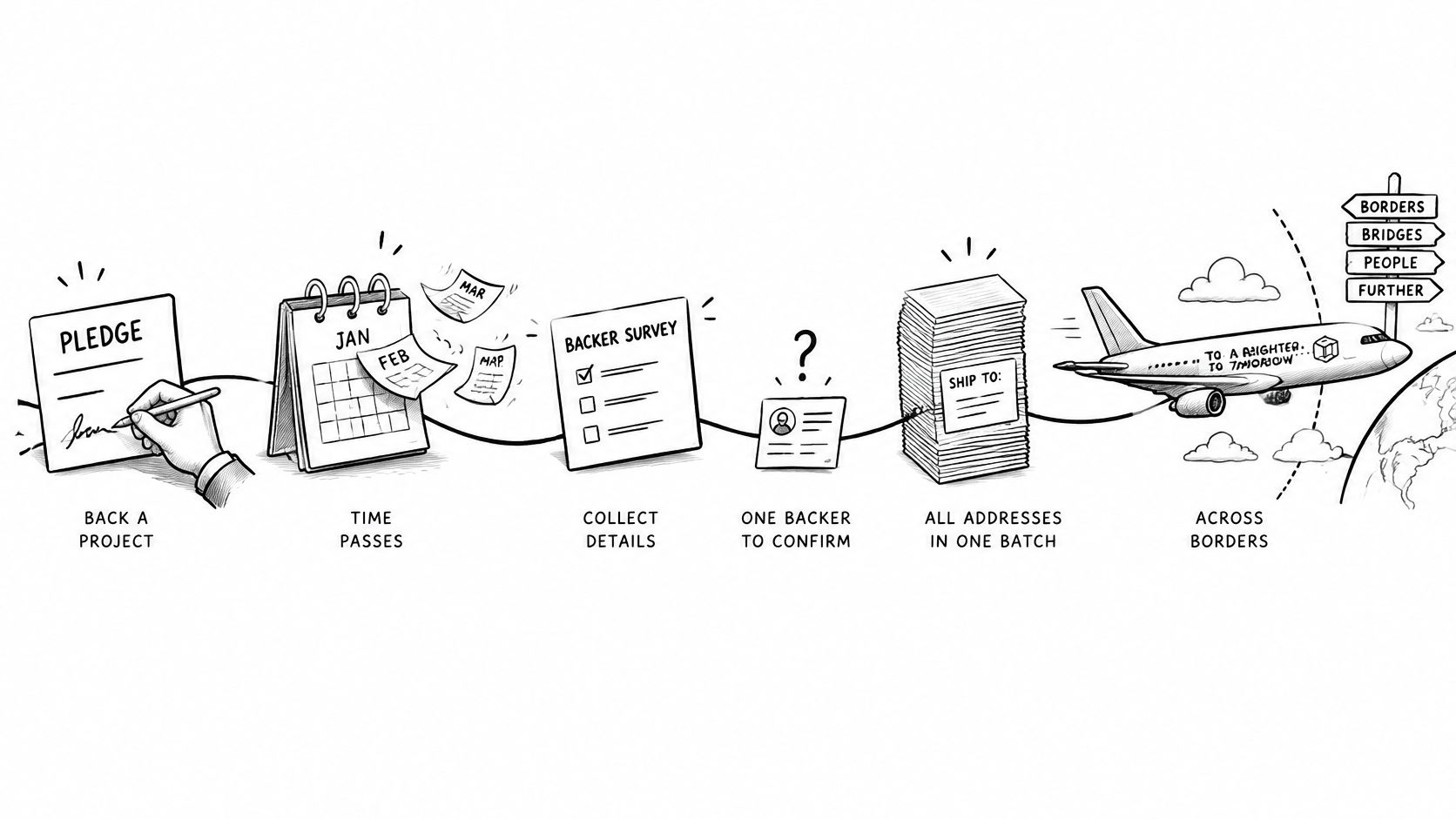
Walk the timeline. A backer pledges in March, the survey goes out in September, the survey closes in October, and the factory ships in January. In that window, people move, change jobs, finish a degree, or forget which apartment number they typed.
Kickstarter's pledge manager collects shipping addresses, reward choices, shipping fees and taxes in one place, and the survey updates automatically when a backer changes an order, as Kickstarter's pledge manager guide explains. That's the good news. The constraint is timing: a backer can change a shipping address while the order still allows edits, and once the order is locked or shipped, the backer has to contact the creator. A completed survey also doesn't mean the reward has shipped, so a confirmed address still needs validation before it goes to a carrier.
Run the arithmetic on a 1,000-backer campaign. If 50 addresses fail, that's 50 manual fixes, 50 support conversations, and some number of replacement shipments at your cost, plus the delay each one adds to a batch that has already been paid for. Address data decays even inside maintained systems; Deutsche Post Direkt's 2025 address study found 13.2% of customer addresses in German business databases were incorrect across roughly 120 million addresses. Your backer list, collected once and never touched, is not in better shape than that.
The timing rule is simple: validate and confirm while the order is still editable, because after the lock your only lever is a support ticket.
Treat the fulfillment checklist as a sequence you run before each batch, not a scramble you do after the first parcel bounces.
Four actions turn a backer list into a shippable one, and they fit inside a single working session.

Before that survey goes out, require a unit number for multi-unit buildings and a phone number for every international order. A gap caught at entry never becomes a manual fix at export.
Two pledge-management models exist, and the difference mirrors retail. Kickstarter's integrated pledge manager works like Amazon, a marketplace-controlled checkout inside the platform. PledgeBox's pledge manager works like Shopify, a creator-controlled storefront and survey system with more control over branding, checkout configuration and post-campaign sales.
Pricing follows the same logic. A survey that collects only addresses and product choices costs nothing to send, so you can re-confirm every backer without paying for the privilege. PledgeBox charges a 3% platform fee on payments collected through surveys, which covers add-ons, shipping and tax, so even a shipping-only or tax-only charge carries the fee.
If your backers are spread across markets with their own carrier quirks, worldwide Highlandwear shipping options from Kilts4Less show how one retailer publishes destination-by-destination delivery terms, which is the same information your survey should surface before a backer picks a tier.
PledgeBox runs the backer survey with Google Maps-powered address validation built in, so you collect deliverable addresses from the start and export orders only once they are ready to ship. Sending the survey is free, and the 3% platform fee applies to payments collected through it. Start your next shipment run at PledgeBox, while every order is still editable.
PledgeBox
The All-in-One Toolkit to Launch, Manage & Scale Your Kickstarter / Indiegogo Campaign