 PledgeBox
Types of Crowdfunding: Models, Pros and Cons Explained
Compare the types of crowdfunding, from reward and donation to debt and equity, with pros, cons and the best fit for hardware, games and agencies.

Compare the types of crowdfunding, from reward and donation to debt and equity, with pros, cons and the best fit for hardware, games and agencies.
You've got a prototype, a draft campaign page, and a budget that won't stretch to launch. Crowdfunding looks promising, but the options sound confusingly similar. Are you asking supporters to buy something early, lend you money, or own part of your business?
The difference matters most after the money arrives. Choosing between the types of crowdfunding means choosing the work your team will carry next: fulfillment, recurring content, repayments, or investor reporting.
Two creators launch on the same day. One accepts gadget preorders; the other borrows money to renovate a café. Both call it crowdfunding, but only one must schedule loan repayments.
Crowdfunding is a family of financing models, not a single method. Think of a stadium that hosts a concert, a charity dinner, or a share sale. The venue stays the same, but the ticket means something different each time.
The World Bank's crowdfunding report distinguishes donation, reward, lending, and equity models, including the fundamental separation between securities-based financing and non-securitized donations and rewards. Subscription crowdfunding sits beside those classic models as a recurring reward arrangement.
| Model | What the backer gets | Money returned | Typical use | Regulation |
|---|---|---|---|---|
| Donation | Nothing material | No | Charities, causes, community projects | Usually lighter financing requirements, with charity and fundraising rules |
| Reward | A product, perk or experience | No, in cash | Hardware, board games, creative projects | Platform terms and consumer law |
| Subscription | Recurring access or perks | Not applicable, ongoing fee | Publications, media, membership communities | Platform terms and billing rules |
| Lending | Loan repayment, usually with interest | Yes, principal plus agreed interest | Small business and personal loans | Country-specific lending rules |
| Equity | Shares or a profit-linked claim | Potentially through dividends or exit value | Startups seeking growth capital | Securities law, such as Regulation Crowdfunding in the US |
Use this table as your map. Most creators only need to investigate the row that matches their promise, plus a possible alternative.
The key question isn't which platform looks easiest. It's what the contributor can expect or claim in return.
A reward supporter doesn't become a shareholder because the campaign succeeds. A lender doesn't lose the right to repayment because the café has a quiet month. An equity investor may benefit from growth, but doesn't automatically receive dividends or a guaranteed exit.
Practical rule: Write the backer's entitlement before writing the campaign headline.
Lending also needs careful classification. A repayment contract isn't automatically a securities offering, although some debt instruments are securities. The instrument and jurisdiction determine the rules, not the crowdfunding label.
Audience selection should follow that distinction. If you're mapping potential funding contacts, you can find crowdfunding backers with Gritt.io, then assess whether those contacts seek products, community impact, or investment opportunities. A large audience won't help if it expects a different exchange.
A reward campaign works like a preorder store opened before the stock exists. That's a useful operating analogy, not a promise that backing an unfinished project carries the same certainty as buying an item already on a shelf.
A board game prototype makes the exchange tangible.
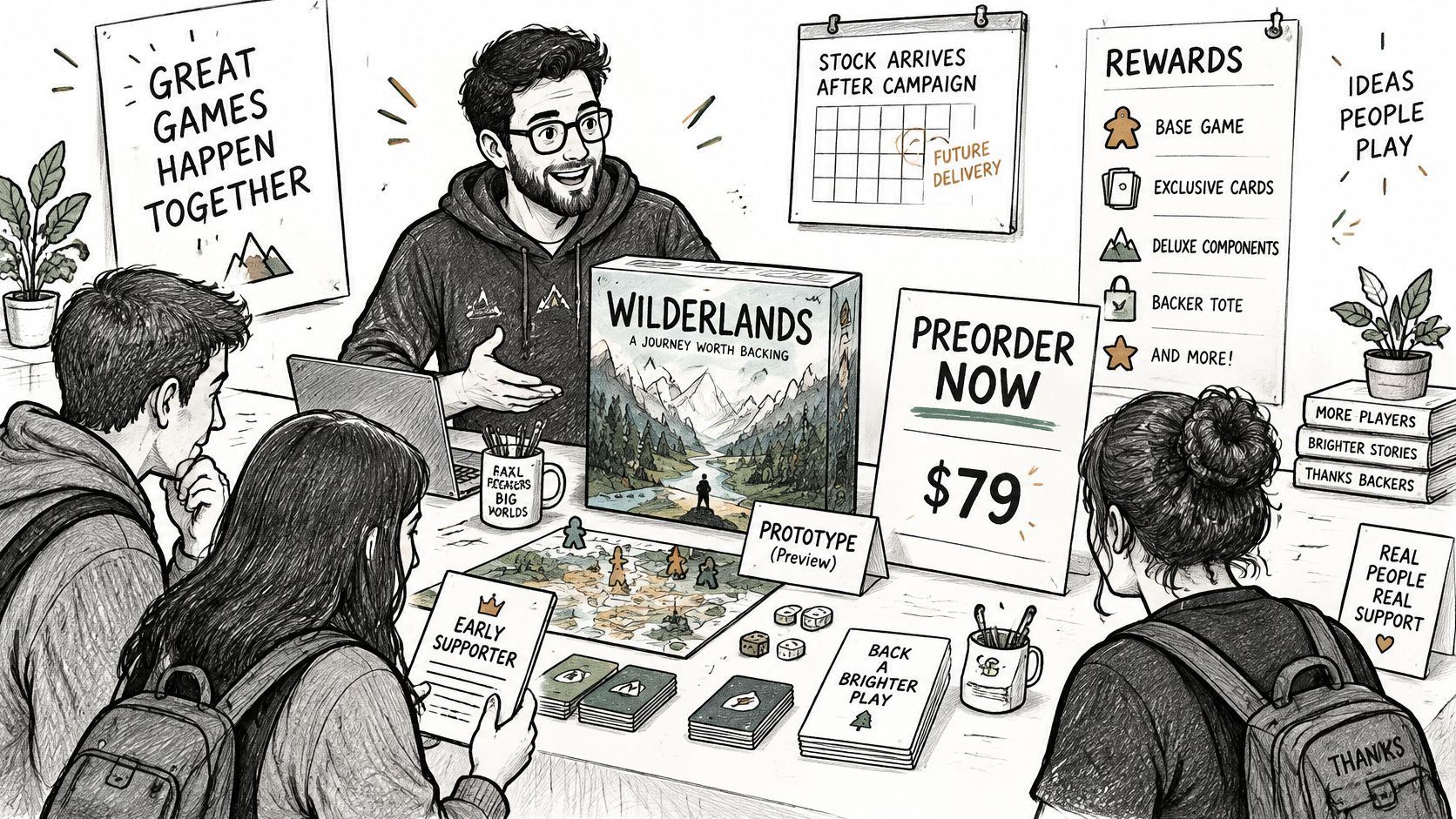
Say you're launching a board game with a hypothetical $79 early-copy reward. Backers can choose the base game, add an expansion, or place a late-backer order after the campaign closes. Each choice creates an order your team must identify, manufacture, pack, and deliver.
The expansion isn't just extra revenue. It needs its own component count, packaging space, shipping weight, and replacement-parts plan. A supporter who changes their selection also changes your fulfillment instructions.
The systematic review of crowdfunding models distinguishes models by the contributor's return and highlights the production, delivery, and customer-support obligations attached to rewards. For creators, that means treating the campaign as a preorder-plus-fulfillment system, not merely a fundraising page.
Collect shipping addresses close enough to dispatch that they remain useful. Record language editions, sizes, colors, and other variants in structured fields rather than scattered messages. Communicate estimated delivery dates, including dependencies such as manufacturing approval.
The video below offers another way to approach the crowdfunding process.
Donation campaigns resemble a tip jar with a thank-you note. Supporters don't receive a product or financial return, making the model appropriate for causes, community projects, and emergency funds. Your work centers on explaining the need and accounting for how contributions are used, while accepting that totals can be unpredictable.
Subscription campaigns resemble memberships that renew. You're promising a continuing reason to stay, such as reporting, tutorials, creative work, or community access. When comparing subscription revenue models, pay attention to churn, the loss of paying members, rather than celebrating new signups alone.
Before launch, answer these questions:
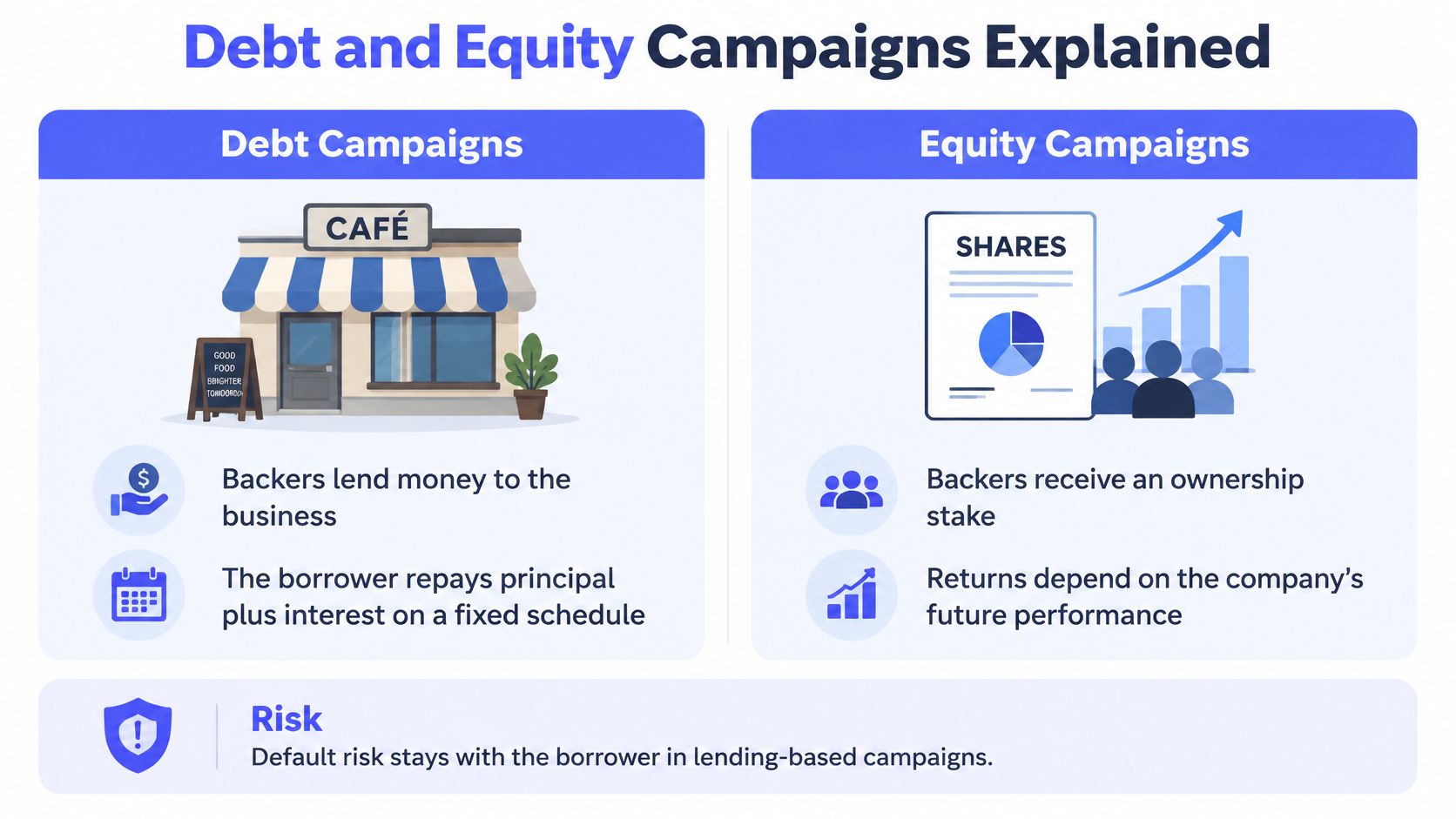
Debt means owing money. Equity means selling an ownership interest. Neither should be presented as a reward tier with a more attractive financial promise.
Consider a café borrowing to replace its kitchen equipment. Backers become lenders, and the business repays principal plus agreed interest on a fixed schedule. The borrower remains responsible for repayment even if trading disappoints; lenders bear the risk that the borrower defaults and they lose money.
An equity campaign changes the relationship. Investors buy a small piece of the company, with potential returns tied to its performance and the investment terms. The founder accepts dilution and the associated shareholder communication and reporting workload.
The comparison below shows the structural difference.
According to the SEC's Regulation Crowdfunding analysis, the US framework took effect on May 16, 2016, and through December 31, 2024, recorded 8,492 offerings from 7,134 issuers, excluding withdrawn offerings. Alongside that market activity, the SEC's exempt-offering overview explains that eligible companies may raise up to $5 million in a 12-month period, through a registered broker-dealer or funding portal, with prescribed disclosures.
The SEC analysis also puts the median minimum target at approximately $25,000, compared with an average of about $66,000. These are offering targets, not typical successful fundraising amounts.
Of those initiated offerings, 3,869 had reported proceeds, according to the SEC's crowdfunding offering statistics. An initiated offering isn't the same as documented funds raised, and missing reported proceeds shouldn't automatically be labeled a failed campaign.
The following thresholds come from the SEC's issuer guidance, which sets aggregate limits for non-accredited investors across Regulation Crowdfunding offerings over 12 months. Confirm the applicable thresholds before opening an offering.
Investor limits for non-accredited backers in US Regulation Crowdfunding
| Income and net worth situation | 12-month investment limit |
|---|---|
| Either annual income or net worth below $124,000 | Greater of $2,500 or 5% of the greater of the two measures |
| Both annual income and net worth at least $124,000 | 10% of the greater of the two measures, capped at $124,000 |
Strong interest doesn't guarantee investment conversion. An interested retail investor may have limited remaining capacity, so don't build your funding forecast around identical contributions.
For a legal orientation before selecting an instrument, Coto & Waddington, Attorneys at Law provides a founder's guide to regulated fundraising. Choose debt or equity when you need working capital or growth funding and can sustain the resulting obligations for years, not just because the headline fundraising ceiling is larger.
The best crowdfunding model isn't necessarily the one that appears capable of raising the most money. It's the one whose obligations your team can carry without undermining the project.
Compare each advantage with the work it creates.
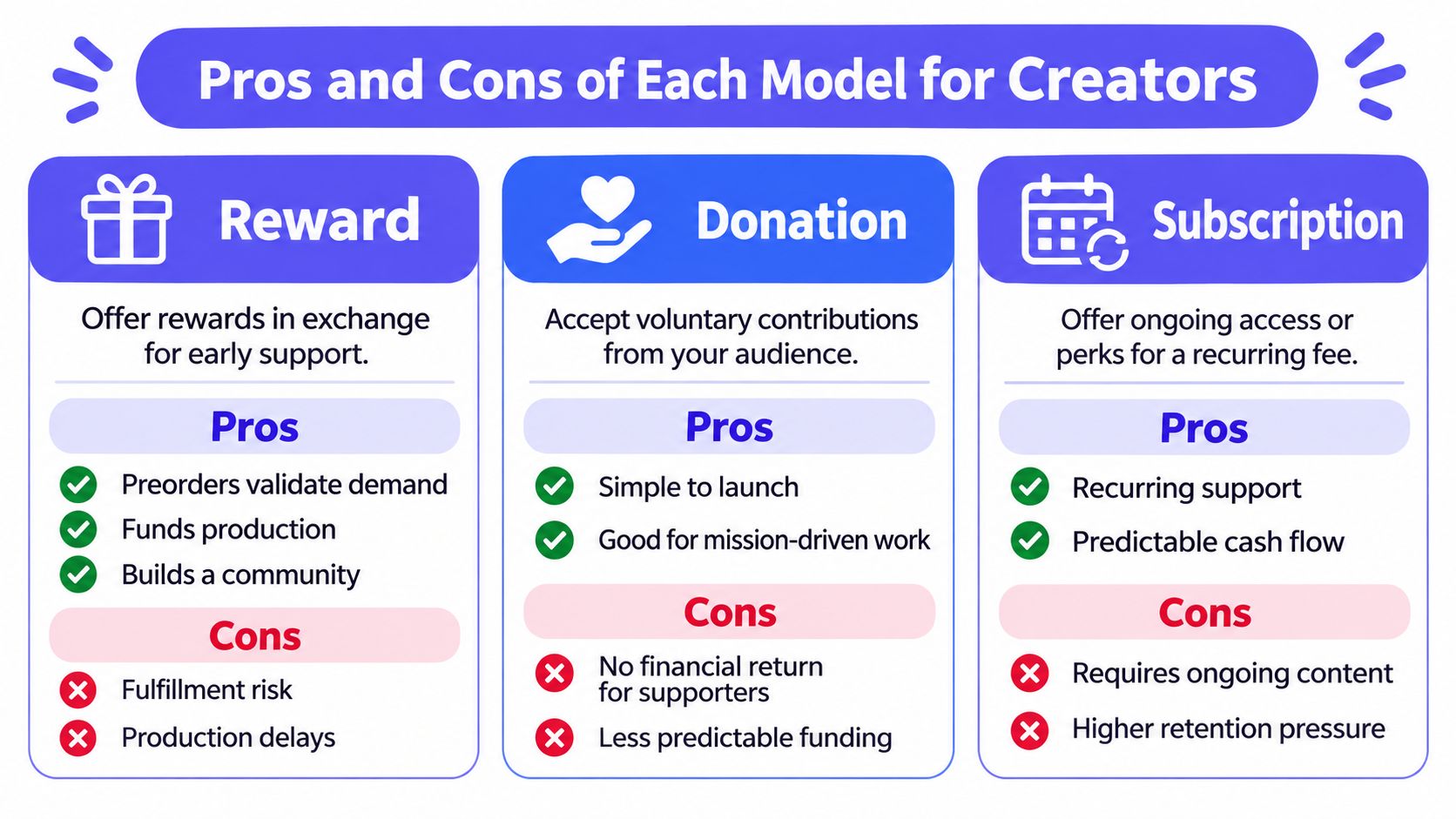
Reward crowdfunding
Donation crowdfunding
Subscription crowdfunding
Lending crowdfunding
Equity crowdfunding
Don't select the advantage without naming the person responsible for its corresponding obligation.
The post-campaign workload isn't identical across models. Rewards can require address collection and replacements; subscriptions need cancellation handling; debt requires payment administration; equity needs reliable investor records. Tax handling, support, and applicable refunds also need an owner.
A small team can manage a demanding model when responsibilities are explicit. Problems arise when everyone assumes the campaign lead will somehow absorb fulfillment, bookkeeping, and stakeholder communication alongside their normal work.
Ask which obligation your team can carry, and for how long. Then test that answer against a delayed shipment, a weak sales period, or a key employee's absence.
Start with what the money must enable. A physical product needs a different funding structure from a studio trying to cover payroll while waiting for invoices.
For a hypothetical $150 smart gadget, reward crowdfunding can support an initial production run through early-bird tiers. Validate demand before committing heavily to tooling, but don't confuse enthusiasm for a prototype with proof that the product is ready to manufacture. Genpire's resource on turning product ideas into production assets is useful context for that handoff.
A board game also fits rewards, particularly when an expansion gives supporters a meaningful upgrade. Build the margin around packed weight, freight, customs, and manufacturing changes, not just the factory's unit quote. Digital projects need a different delivery plan; this guide to crowdfunding for video games helps frame that distinction.
An agency or studio usually needs staff capacity rather than stock. Lending may fit predictable incoming client payments; equity may suit a growth strategy that can justify selling ownership. A productized service, course library, or recurring creative package may instead support subscription or reward tiers.
The Kickstarter Pledge Manager is like Amazon's marketplace checkout: the platform provides the purchasing environment. According to Kickstarter's Pledge Manager page, there's no additional upfront cost, but applicable funds face a 5% platform fee excluding taxes, while Stripe generally charges approximately 3%–5% on the full payment, including taxes.
The PledgeBox pledge manager is like Shopify: the analogy is a creator-controlled survey and post-campaign checkout rather than a marketplace-controlled experience. These comparisons describe the operating approach, not ownership relationships between the companies.
Best crowdfunding model by product or business type
| Product or business | Best model | Why it fits | Main risk |
|---|---|---|---|
| Hardware gadget | Reward | Preorders fund tooling and the first production run | Delivery delays and shipping cost overruns |
| Board game | Reward | Backers pre-buy, and add-ons raise the average pledge | Freight, customs and manufacturing swings |
| Software or app | Reward or equity | Early access validates demand; equity funds growth | Feature promises and investor expectations |
| Agency or studio | Lending or equity | Working capital supports staff rather than stock | Repayment obligations or dilution |
| Local business | Lending or community share | Steady cash flow can support repayment; community shares provide ownership capital | Loan default risk or shareholder obligations |
Match your case to a row, then check its main risk before launch. Community shares belong on the ownership side of the decision, not in a loan repayment forecast.
A campaign can hit its funding goal and still run short of cash. The money arrives in one lump, while production deposits, freight, support staff, and repayment dates arrive on separate clocks. A cost-benefit analysis should count the work required to honor the promise, not only the cost of collecting money.
Name the cash need and deadline. Separate production deposits, payroll, shipping, and contingency funds. Record when each payment becomes due.
Write the backer's entitlement. Specify whether the contribution buys a product, supports a cause, renews access, creates repayment rights, or purchases ownership.
Assign the continuing work. Name who handles shipping and support, subscription retention, scheduled repayments, or disclosures and shareholder administration. Put a time budget beside each task.
Compare the actual checkout costs. Ask which payments each manager processes and what its fee applies to. Check whether shipping and tax are collected in the same checkout or added later, because each manager treats those lines differently. If subscriptions are part of your model, PledgeBox's subscription management guide explains how recurring billing fits into that operating load.
Price an additional payment. PledgeBox charges no setup fee and no campaign fee on the original Kickstarter or Indiegogo funds. During the survey, its 3% fee applies only to add-on and upsell payments collected through that survey. A $100 in-survey add-on payment produces a $3 platform fee before separate payment-provider fees. The original pledge processed by Kickstarter or Indiegogo is not charged again.
PledgeBox's Pledge Manager supports Kickstarter and Indiegogo campaigns. To connect a campaign, select Add New Project, choose Kickstarter or Indiegogo, and enter the campaign URL.
This week, write a one-line promise to backers and decide which manager will send the survey before the campaign ends. Check that the promise still works after fees, delivery costs, and support time.
PledgeBox offers backer surveys, reward management, additional payment collection, and late-backer orders for Kickstarter and Indiegogo creators. If reward crowdfunding fits your project, visit PledgeBox to plan how you'll collect backer choices and manage the work between a funded campaign and delivery.
PledgeBox
The All-in-One Toolkit to Launch, Manage & Scale Your Kickstarter / Indiegogo Campaign