 PledgeBox
Fulfillment Best Practices for Crowdfunding Creators
Discover fulfillment best practices for crowdfunding creators, from pledge surveys and upsells to shipping, vendor handoffs, tracking, privacy, and KPI control.
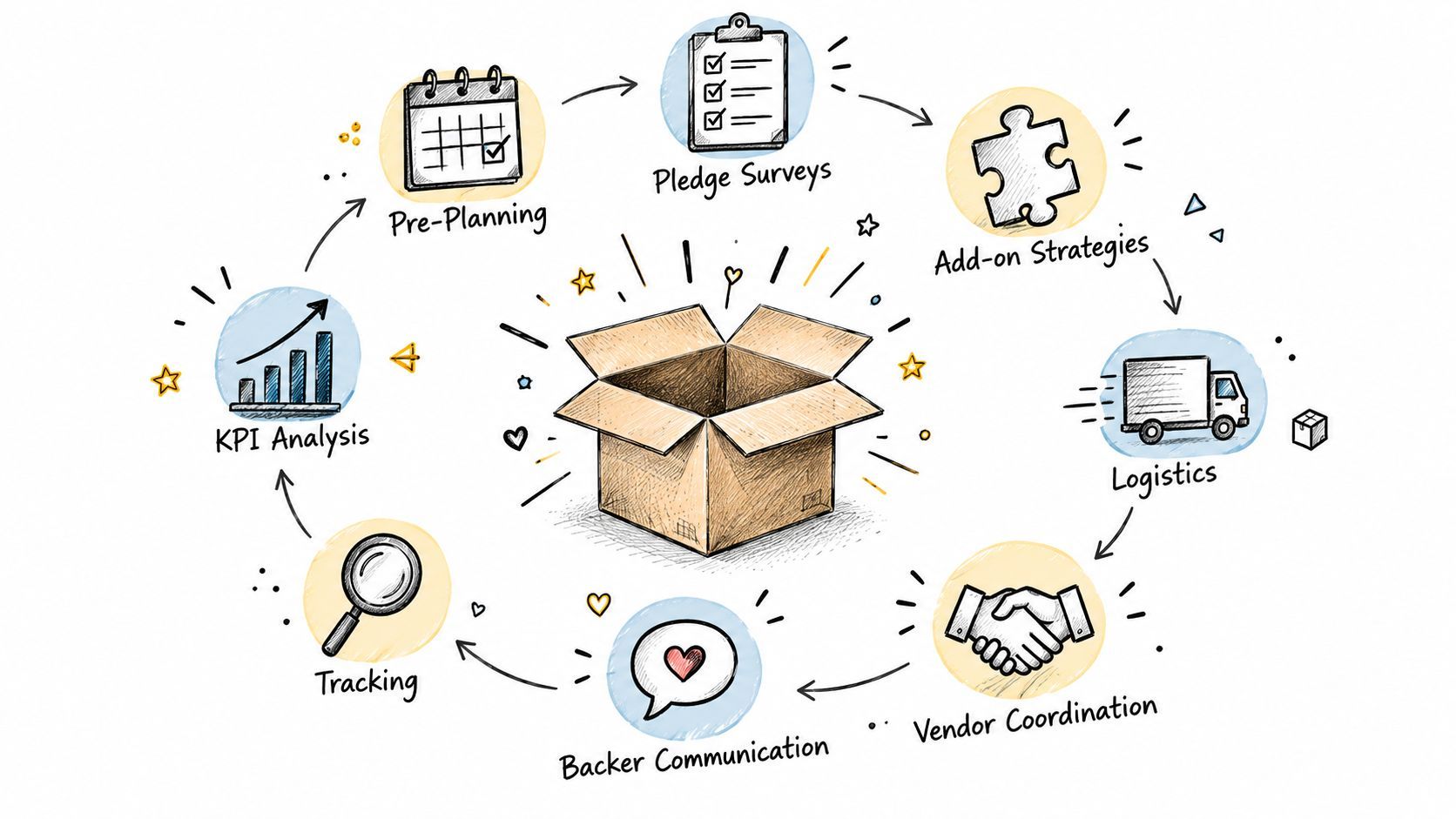
Discover fulfillment best practices for crowdfunding creators, from pledge surveys and upsells to shipping, vendor handoffs, tracking, privacy, and KPI control.
Fulfillment doesn't begin when products reach the warehouse. By then, the decisions that create the most avoidable cost may already be locked in, including incomplete backer data, unclear reward variants, underpriced shipping, weak vendor handoffs, and vague delivery updates. A successful campaign can still become an operational failure if the team treats shipping as the final task instead of a workstream that starts before the campaign closes.
The strongest fulfillment best practices connect revenue, data, operations, and trust. You need a survey that captures the right information, reward logic that prevents ambiguity, address validation that catches errors early, shipping rules that reflect real destinations, and communication that keeps backers informed when conditions change. You also need clean exports, measurable controls, privacy procedures, and a plan for late sales.
This practical 10-step system shows how to move from campaign close to reliable delivery. PledgeBox fits naturally into that workflow by coordinating backer surveys, payments, shipping data, reports, vendor exports, shipment tracking, add-on sales, and post-campaign orders. The platform is free to send the backer survey, with no per-backer or upfront survey charge, and only charges 3% of upsell revenue when there's an add-on sale.
A backer survey is the order record that connects each person to a reward, variant, add-on, tax amount, shipping choice, and fulfillment status. If those details remain scattered across email, spreadsheets, and payment notes, production staff must resolve questions that a well-designed survey could have prevented. Treat the survey as an operational handoff and a source of usable customer data, not a post-campaign formality.
Kickstarter's workflow asks creators to send reward surveys and collect shipping addresses after the campaign ends. Creators can export the responses through the backer report, while the fulfillment dashboard tracks survey response rates and shipped rewards. Kickstarter advises aiming for 100% survey completion in its fulfillment dashboard guidance.
PledgeBox lets creators send the backer survey free of charge and does not charge per response. Use one branded, mobile-friendly experience to collect shipping details, reward selections, color or size preferences, add-ons, tax information, and custom fields. A HIPAA-compliant form builder can also inform how you structure sensitive fields and access controls, even when your campaign does not require HIPAA compliance.
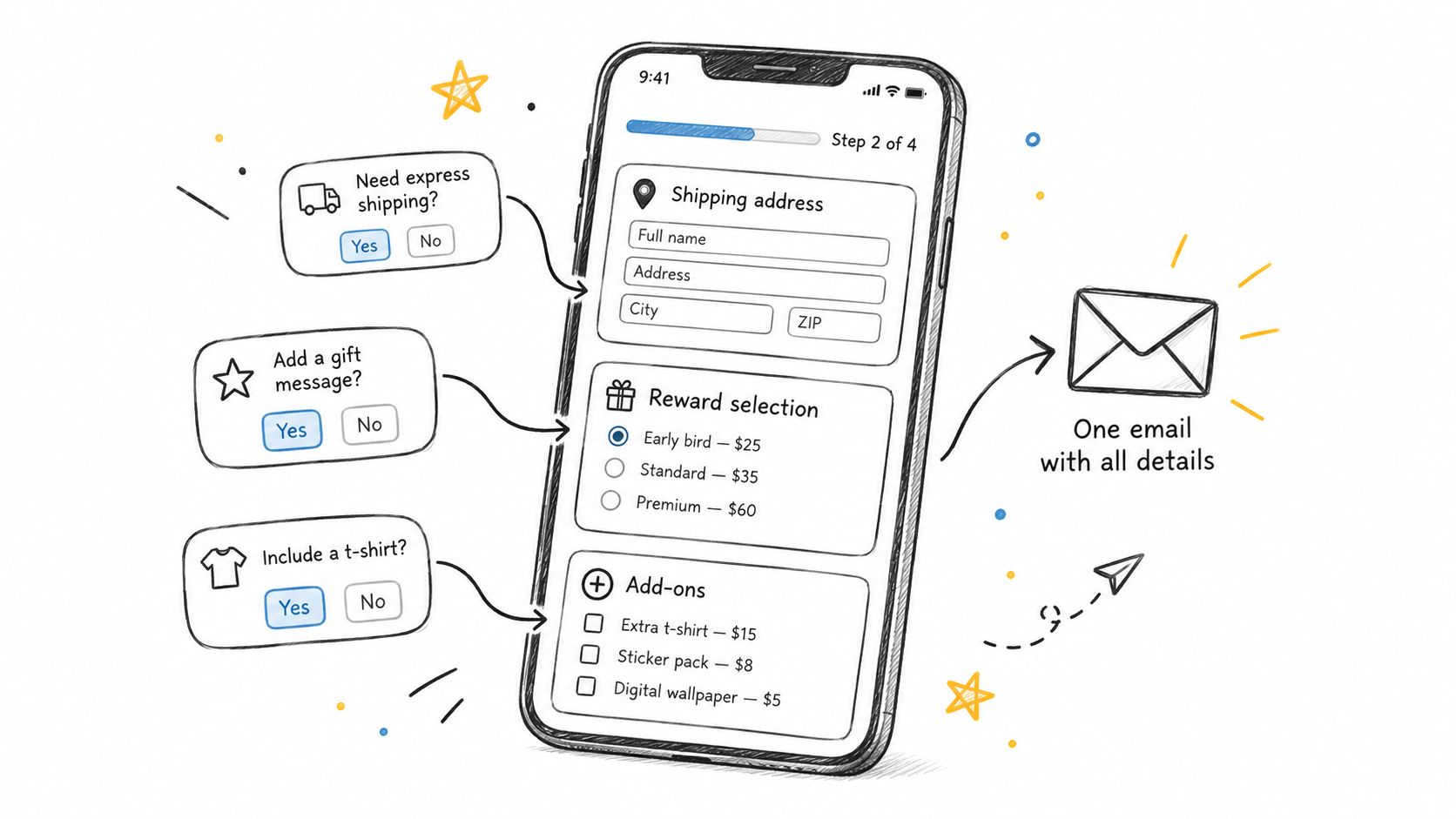
Keep the opening screen focused on information required to fulfill the order, then show optional questions conditionally. A hardware creator can request shipping details and device color before displaying compatible accessories. A tabletop publisher can show expansion choices only after a backer selects a supporting bundle.
Use a progress indicator for longer surveys, test every path on a phone, and state the response deadline clearly. Explain what happens after submission, including whether an address can still change once production begins. For field planning and question design, use this guide to backer surveys.
Practical rule: Every answer should determine what ships, where it goes, what the backer pays, or how your team communicates. Remove fields that serve none of these purposes.
The survey can be a second checkout window, but only if you treat add-ons as a curated offer rather than a warehouse clearance list. Backers already understand your product, so complementary items can increase order value while giving you better information about demand before final production decisions.
PledgeBox is free to send the backer survey and charges only 3% of upsell revenue if there's any. That pricing structure applies to the add-on revenue collected through the survey, not to every pledge. PledgeBox works like Shopify for pledge management, with flexible commerce and customization, while Kickstarter's pledge manager is more like Amazon, a large, structured marketplace-style system with less control over the storefront experience.
A smartwatch campaign might offer an extra band, charging dock, or protective case. A board game publisher could present an expansion, organizer, or upgraded token set. A creator selling educational hardware might pair the physical product with a digital setup course or downloadable guide. These offers should make sense beside the original reward, not compete with it.
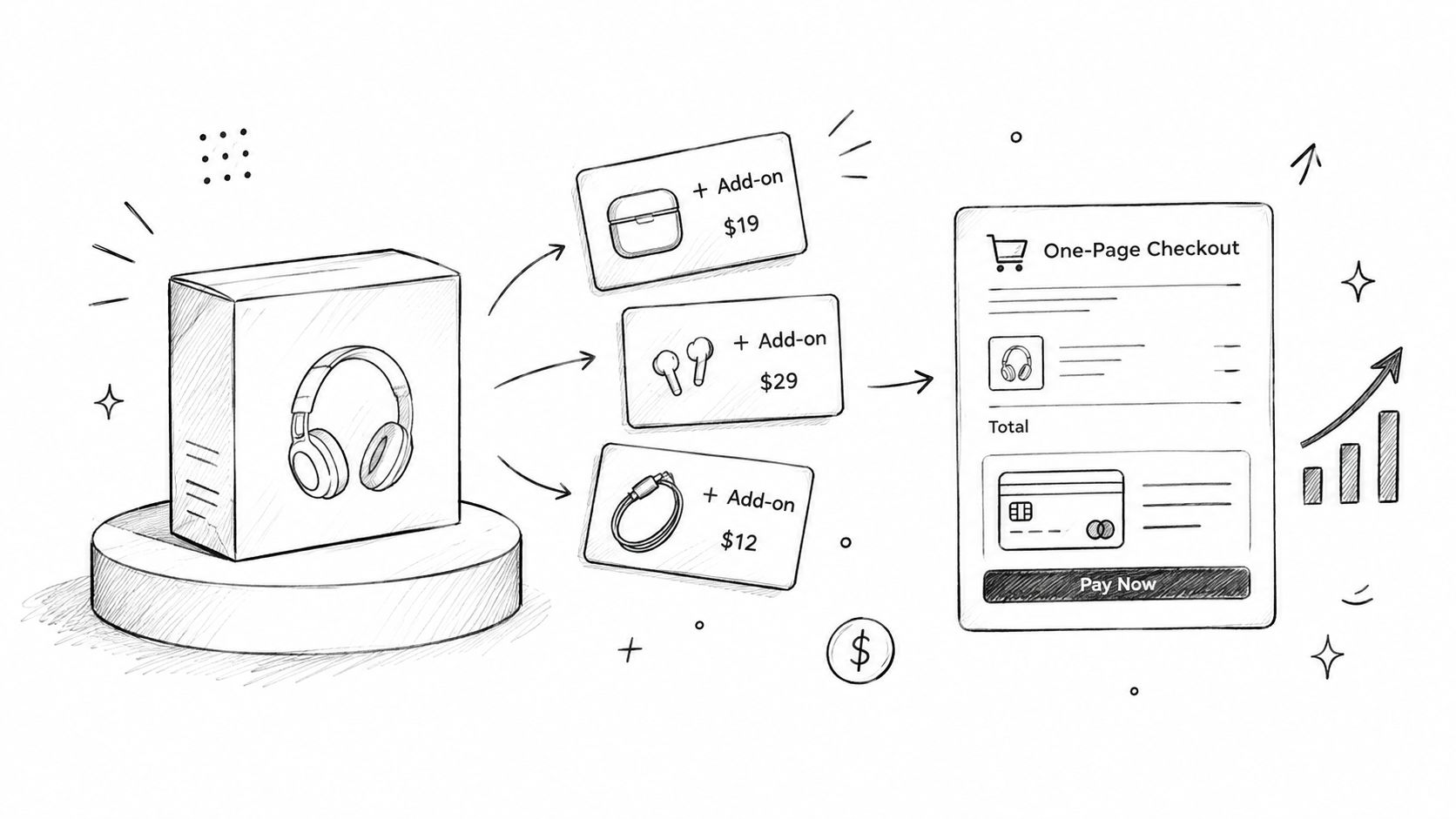
Start with a small set of relevant add-ons. Too many choices slow completion and create extra SKUs, packaging combinations, and inventory allocations. Show the value of bundles clearly, disclose availability directly, and avoid promising quantities you can't manufacture or source.
Use the survey to capture the add-on choice and payment together. PledgeBox's add-on item guidance can help creators structure those offers without adding a separate sales system.
Track which add-ons sell, which combinations create packing complexity, and which products generate support questions. Revenue matters, but an add-on that creates frequent split shipments or uncertain sourcing may cost more operationally than it earns.
An incorrect address can turn a correctly packed order into a failed delivery, return, reshipment, or support ticket. Address quality belongs inside the survey flow, before your team finalizes regional inventory and sends files to a warehouse.
An independent e-commerce user experience benchmark found that 47% of sites still don't provide an address validator at checkout, despite describing address validation as a critical safeguard for physical-goods shipments. The benchmark recommends placing validation directly in the shipping-address step, as explained in this parcel-delivery experience benchmark.
PledgeBox supports Google Maps-powered address validation that can standardize formats, identify invalid entries, and prompt a backer to confirm a suggested correction. That's particularly useful for international campaigns, where postal conventions and address structures vary widely.
Don't overwrite a backer's entry. Show the suggested correction and let the backer confirm it. If the system can't validate an address, route it to a manual review queue instead of passing uncertain data to your fulfillment partner.
A creator shipping a hardware reward across several regions might use validated addresses to group orders by destination, compare carrier options, and prepare clean files for a 3PL. A board game publisher can separate orders that require local tax handling or different packaging instructions before the warehouse starts picking.
Keep an audit trail for address edits, including the original entry, the correction, and the date of confirmation. The international address validation workflow offers a useful reference for designing this step.
A clean address file is an operational asset. It supports carrier selection, regional allocation, vendor imports, and dispute resolution. Treat it with the same care as your inventory file.
Platform architecture shapes revenue, data quality, and handoffs after a campaign closes. It determines how you model reward tiers, sell add-ons, collect shipping and tax, connect vendors, manage partial shipments, and keep orders open for later sales.
A simple campaign with one product, one primary reward, and limited post-campaign complexity may work well with Kickstarter's Pledge Manager. Kickstarter describes it as having no upfront cost, with payment fees for transactions processed through the manager matching those applied to successful pledges, including roughly 3% to 5% card processing plus a 5% platform fee on funds other than taxes, according to its Pledge Manager information.
PledgeBox provides a more configurable model, similar to Shopify for pledge management. Creators can set up branded workflows, add-ons, shipping fees, taxes, subscriptions, reports, exports, and extended sales. Kickstarter's manager is closer to Amazon, offering a powerful but more standardized environment focused on coordinating pledges and fulfillment.
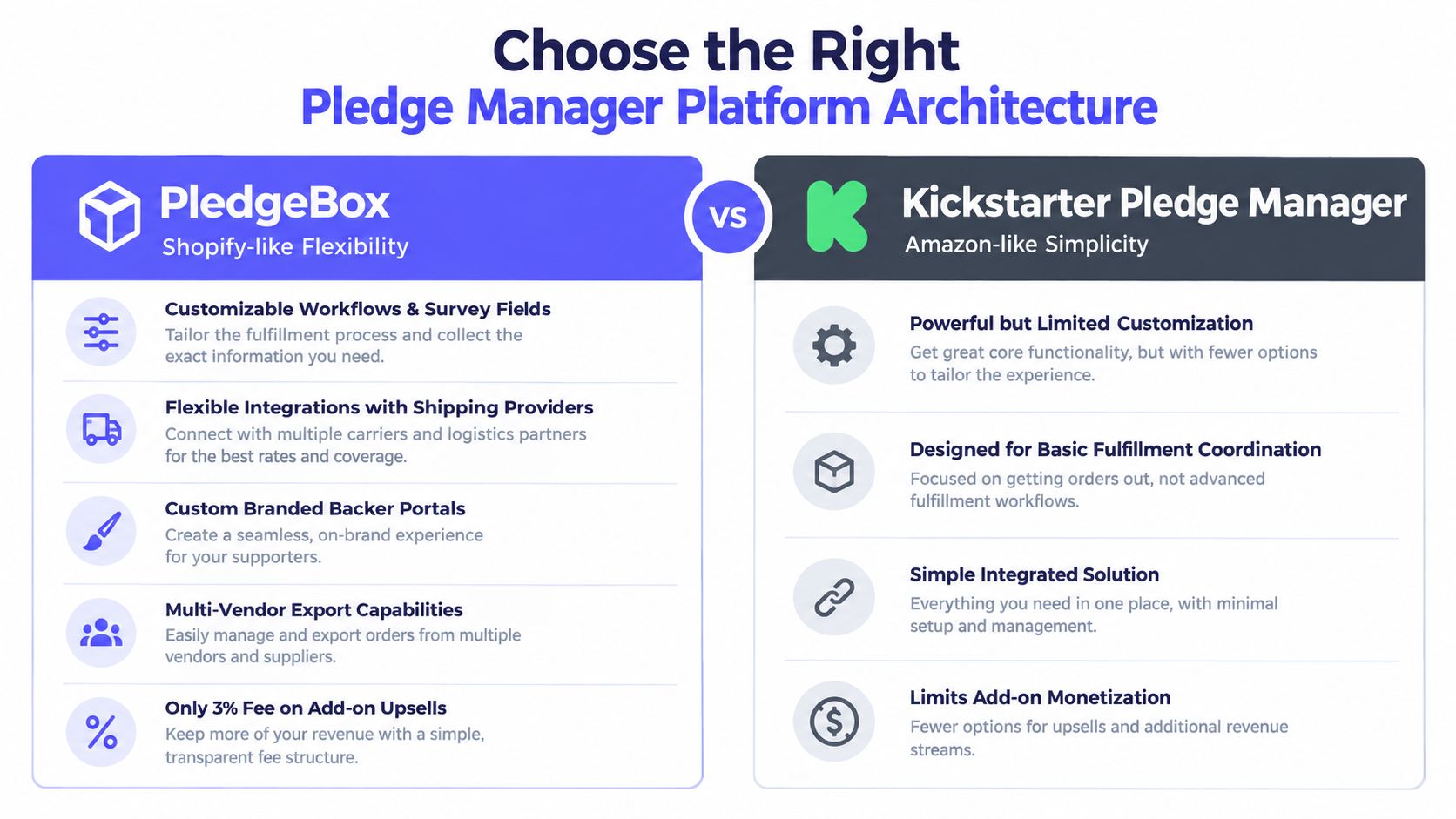
A board game with stretch goals, language editions, expansions, sleeves, and regional shipping needs flexible order logic. A hardware campaign may require variant controls, staged shipments, and warehouse-specific allocations. Agencies may need separate branded workflows for each client.
Map required handoffs before choosing. Check whether the platform can pass clean order data to your payment provider, shipping system, warehouse, and reporting process. For warehouse planning, middle-mile fulfillment center insights can also help clarify where inventory control and transport coordination belong. PledgeBox supports Kickstarter and Indiegogo campaigns, so the platform does not dictate where you run the campaign.
Compare total cost with control. Kickstarter charges fees on payments processed through its manager. PledgeBox charges 3% only on add-on upsell revenue and lets creators send surveys for free. That difference matters when add-ons, extended sales, and operational exports form a meaningful part of campaign revenue.
Backers usually tolerate a realistic delivery timeline better than silence. They become frustrated when the product may already be moving but the order page still shows no useful status, or when a tracking number exists without a carrier name, destination, or explanation of what happens next.
UK parcel-delivery research found that 78% of consumers were satisfied overall with parcel delivery services, yet 67% had experienced a delivery problem in the previous six months, including delays, misplaced parcels, failed deliveries, or incorrect tracking details. The findings appear in this Ofcom parcel-delivery coverage. The lesson for creators is straightforward: a generally positive delivery experience can still include frequent points of failure, so visibility needs active management.
Send a notification when the shipment is handed to the carrier. Include the carrier, tracking number, direct tracking link, reward summary, and support route. A backer portal gives customers a place to check status without asking your team to retrieve an order manually.
Create alerts for labels that haven't received a carrier scan, deliveries marked as failed, returned parcels, and tracking events that stop progressing. Assign an owner to each exception and define when the team contacts the backer, the warehouse, or the carrier.
A campaign with warehouses in different regions might need different message timing and carrier links. The wording can change by destination, but the essential information should remain consistent. Don't promise a delivery date the carrier can't support, and don't mark an order complete merely because a label was created.
Archive tracking events and resolution notes. They'll help your team answer disputes, identify recurring carrier problems, and improve the next campaign's delivery estimates.
A single shipping price rarely reflects the full cost of sending a reward to every backer. Product weight, package dimensions, destination, customs requirements, carrier service, and delivery speed all affect the final order economics. If you hide those differences, you may absorb avoidable cost or surprise backers late in the process.
Set shipping rules by destination and service level. A creator might offer economy, standard, and expedited delivery, while a premium gadget campaign could provide postal and express options. Show what each option includes, and explain whether taxes, duties, insurance, or handling are collected separately.
Regional fulfillment can make sense when the backer base is spread across several markets and the inventory plan supports it. Before production finishes, estimate how many units belong in each warehouse, define which regions each facility serves, and confirm how returns will be handled. The best warehouse isn't always the cheapest one. Reliability, customs knowledge, address quality, and returns capability can matter more than a low pick fee.
Use validated addresses to route orders by region and calculate the correct shipping amount during survey completion. Export the resulting order data to the appropriate warehouse, rather than asking a warehouse team to interpret a mixed global spreadsheet.
A tabletop publisher might allocate stock to regional fulfillment centers and use different carriers for domestic and international orders. A hardware creator may reserve expedited service for backers who select it, while keeping standard orders in the regular production batch.
Be transparent about cutoffs, customs responsibility, and delivery ranges. This postal packaging guide is also a useful reminder that packaging choices affect protection, dimensional weight, and the suitability of a parcel for postal handling.
Fulfillment data shouldn't disappear into a warehouse portal after the last package leaves. It tells you which regions ordered, which rewards created complexity, which add-ons attracted interest, where address issues appeared, and how quickly the team moved from survey completion to shipment.
Create a reporting rhythm before fulfillment starts. Export current data regularly, keep a consistent file structure, and separate operational records from exploratory analysis. Useful views include backer counts by reward, inventory requirements by variant, shipping distribution by region, add-on performance, revenue components, survey completion, and shipment status.
PledgeBox provides downloadable reports and exportable campaign data, allowing creators to review both revenue and fulfillment activity in one operating record. A hardware company can use regional demand patterns to inform its next launch. A board game publisher can compare expansion interest with the inventory it plans to print.
A report is useful when someone acts on it. If a particular add-on creates frequent packing errors, change the bundle or packaging instruction. If one destination produces repeated address exceptions, review the validation and communication flow. If a reward variant moves slowly, use that information in future manufacturing plans.
Maintain a simple dashboard with backer volume, collected revenue, survey completion, allocated inventory, shipped orders, unresolved exceptions, and late orders. Keep definitions stable so your team can compare campaign stages without changing the meaning of each metric.
Share only the data a fulfillment partner needs. Regional order counts and SKU totals may help a vendor plan labor, while personally identifiable information should remain restricted to the people and systems that require it.
The handoff from creator to warehouse is one of the most fragile points in a campaign. Manual rekeying creates opportunities for wrong variants, missing apartment numbers, duplicate orders, and mismatched shipping charges. A clean export gives the vendor a usable order file and gives your team a reference for reconciliation.
Define the export format with the fulfillment partner before the campaign closes. Confirm required column names, SKU conventions, address fields, tax fields, shipping methods, tracking fields, and any kitting instructions. Send test records through the vendor's system while changes are still easy to make.
PledgeBox supports a Push to Fulfillment workflow, and creators can send survey results to shipping partners or export them as CSV or Excel files. Fulfillment-ready data can include backer addresses, reward selections, shipping fees, VAT or tax, add-ons, and shipment tracking.
Schedule the first production export promptly after the campaign closes, but don't confuse speed with readiness. First confirm that surveys are complete enough, inventory is allocated, payment issues are identified, and the vendor has accepted the file structure.
Use versioned files and record the export time, order count, included statuses, and person responsible. Ask the vendor to confirm receipt and report any rejected rows. Then compare the sent file with the imported file, checking totals by reward, variant, region, and shipping service.
A hardware campaign may send a manufacturing partner a file containing device color, accessory bundle, and destination warehouse. A tabletop publisher may provide separate allocation files for regional facilities. In both cases, the creator should retain a master record and avoid making silent edits after the file is sent.
The handoff isn't complete when you click export. It's complete when the vendor confirms what it received and both sides agree on the totals.
Backer data is operationally valuable, but it also creates responsibility. Names, addresses, payment-related details, survey responses, and support records shouldn't be copied into every spreadsheet or retained indefinitely without a business reason.
Tell backers what information you collect, why you need it, who may receive it for fulfillment, and how long you plan to retain it. Ask for separate consent if you want to use fulfillment data for marketing after the order is complete. Keep marketing permissions distinct from the information required to ship a reward.
PledgeBox uses privacy-first data isolation and offers one-click data erasure, which lets creators remove backer information after fulfillment while preserving appropriate campaign records. That gives a team a defined cleanup action instead of relying on scattered manual deletion across exports, inboxes, and vendor accounts.
Limit access by role. The person handling survey support may need to view an address, while a marketing contractor may only need an anonymized segment. Use secure transfer methods for vendor files, document retention periods, and maintain a record of deletion requests and completed actions.
An agency managing several campaigns should keep each client's data separated and avoid using one project's backer list in another project's workflow. A creator serving European backers should also consider regional privacy obligations before exporting data to an overseas vendor.
Retain anonymized campaign insights when they support planning, but remove unnecessary personal identifiers. Privacy isn't just a compliance task. Backers who trust your data practices are more likely to engage with future launches and post-campaign offers.
Campaign close doesn't have to end demand, but late sales must fit the fulfillment plan. Every additional order affects inventory, packaging, payment reconciliation, shipping, support volume, and the date when the warehouse can finalize its first shipment batch.
Use a defined cutoff for late backers. State whether they'll join the initial shipment, a later batch, or a separate production run. Don't advertise the same delivery expectation to early backers and late buyers if their inventory position is different.
PledgeBox supports post-campaign pre-orders and extended sales windows, allowing interested buyers who discovered the campaign late to purchase available rewards. It can also support additional add-ons during that period, provided the creator has enough stock and a clear fulfillment rule.
Set manufacturing and allocation cutoffs before opening late sales. Reserve inventory for confirmed early backers, then offer only the remaining products or clearly label late orders as a subsequent batch. A board game publisher might use late pre-orders to judge demand for an expansion before committing to another print run. A hardware creator could keep a storefront open for accessories while closing sales of the main device once production is locked.
Keep shipping policies consistent unless late orders require a different service. Monitor late-order volume, payment completion, inventory impact, and support questions. If an offer creates more operational uncertainty than revenue, close it.
Late sales work best when they extend a controlled system, not when they reopen every decision the team already made.
| Item | Implementation Complexity 🔄 | Resource Requirements ⚡ | Expected Outcomes ⭐📊 | Ideal Use Cases 💡 | Key Advantages ⭐ |
|---|---|---|---|---|---|
| Implement a Comprehensive Backer Survey Strategy | Medium 🔄🔄, branching logic & UX design | Low–Medium ⚡⚡, survey tool + integrations | ⭐⭐⭐⭐, consolidated backer data; fewer follow-ups | All campaigns needing centralized fulfillment data | Reduces manual entry; mobile-optimized; free unlimited surveys |
| Leverage Add-On Upsells for Incremental Revenue | Medium 🔄🔄, product catalog + checkout flow | Medium ⚡⚡⚡, payments, inventory tracking | ⭐⭐⭐⭐, +15–30% incremental revenue potential 📊 | Campaigns with complementary products or high engagement | Converts interest to revenue; low 3% upsell fee |
| Validate and Standardize Shipping Addresses | Low–Medium 🔄🔄, integrate validation API | Low ⚡⚡, validation service usage | ⭐⭐⭐⭐, reduces shipping errors 40–60% 📊 | International and high-volume shipments | Fewer returns/reships; clean vendor exports |
| Choose the Right Pledge Manager Platform Architecture | High 🔄🔄🔄, platform selection & migration | Medium–High ⚡⚡⚡⚡, integration and training | ⭐⭐⭐⭐, flexibility vs simplicity tradeoffs 📊 | Complex SKU/region campaigns vs simple projects | Scalability, customization, multi-vendor support |
| Automate Shipment Tracking and Backer Communication | Medium 🔄🔄, carrier API setup & templates | Medium ⚡⚡⚡, API integrations, notification systems | ⭐⭐⭐⭐, reduces support 60–70%; better satisfaction 📊 | Post-campaign fulfillment and international deliveries | Proactive updates, backer self-service tracking |
| Implement Flexible Shipping and Regional Fulfillment Strategy | High 🔄🔄🔄, multi-warehouse routing & rules | High ⚡⚡⚡⚡, 3PLs, inventory splits, carrier contracts | ⭐⭐⭐⭐, reduces shipping costs 30–50%; faster delivery 📊 | Large international campaigns with diverse regions | Lower shipping time/costs; regional optimization |
| Create Downloadable Reports and Analytics for Campaign Insights | Low–Medium 🔄🔄, reporting setup & dashboards | Low ⚡⚡, export tools and analyst time | ⭐⭐⭐, actionable insights; better forecasting 📊 | Data-driven creators and agencies | Informs inventory, marketing, and financial planning |
| Export Data Directly to Fulfillment Vendors and 3PLs | Medium 🔄🔄, format mapping & testing | Medium ⚡⚡⚡, custom exports, vendor coordination | ⭐⭐⭐⭐, faster vendor prep; fewer errors 📊 | Campaigns using external vendors or multiple 3PLs | Eliminates manual entry; accelerates timelines |
| Maintain Data Privacy and Enable One-Click Data Erasure | Medium 🔄🔄, security & policy implementation | Medium ⚡⚡⚡, encryption, access controls, legal review | ⭐⭐⭐, compliance and increased trust 📊 | EU/CCPA-sensitive campaigns; privacy-focused creators | Simplifies GDPR/CCPA compliance; one-click erasure |
| Leverage Late Backer Pre-Orders and Extended Sales Windows | Low–Medium 🔄🔄, enable post-campaign sales | Low–Medium ⚡⚡, marketing & extended fulfillment planning | ⭐⭐⭐, +5–15% additional revenue; 30–60 day window 📊 | Campaigns seeking improved print-run economics or extra sales | Captures late demand; improves production margins |
The most reliable creators don't treat fulfillment as a warehouse problem that begins after fundraising. They build an operating sequence that starts with reward logic and ends with a documented review. That sequence protects cash flow, reduces avoidable support work, gives vendors better instructions, and turns backer information into useful planning data.
Start by finalizing the survey before the campaign closes. Confirm every reward tier, variant, add-on, shipping method, tax field, and custom question. Keep the survey concise enough to complete on a phone, but detailed enough that a fulfillment partner won't need to interpret ambiguous answers. PledgeBox is free to send the backer survey, so creators can collect this information without an upfront survey charge or a per-backer fee.
Next, validate addresses and resolve exceptions before production files are finalized. Collect shipping fees and tax information through the same order flow, then confirm inventory requirements by SKU, reward, variant, and region. If you're splitting orders across warehouses, document the allocation rules and make sure each vendor knows which destinations it serves.
Before the warehouse receives the live file, test the export. Check that addresses, reward selections, shipping fees, VAT or tax, add-ons, and fulfillment statuses map correctly to the vendor's system. Use a Push to Fulfillment workflow or a controlled CSV or Excel export, then ask the partner to confirm receipt and reconcile totals.
Once shipments begin, automate tracking messages and monitor exceptions. A tracking number without a useful update doesn't reassure a backer. Send carrier details and direct links, flag stalled or failed deliveries, and give someone on your team responsibility for resolving each exception. Review survey completion, shipped rewards, inventory accuracy, on-time shipping, returned parcels, unresolved cases, and add-on revenue regularly. Industry fulfillment benchmarks commonly target at least 99% inventory accuracy, with mature operations aiming for 99.5% to 99.8% order or stock accuracy and on-time shipping above 97% to 98.5%, as described in this ecommerce inventory counting guidance.
The risk is substantial for physical rewards. A 2022 study of Kickstarter projects found that only about 30% were fulfilled or delivered on time or with less than a six-month delay, according to the inventory management reference discussing crowdfunding fulfillment. The finding reinforces why production planning, supplier coordination, realistic shipping buffers, and continuous tracking belong in the campaign plan, not in a last-minute shipping checklist.
PledgeBox's model complements this approach. It works like Shopify for pledge management, giving creators flexibility around surveys, add-ons, shipping, reports, vendors, and late orders. Kickstarter's Pledge Manager is more like Amazon, a structured, included option that can suit simpler fulfillment coordination. PledgeBox sends surveys for free and charges only 3% of add-on upsell revenue when there's an upsell, so creators can choose the workflow that fits their campaign's complexity and revenue model.
After delivery, document what changed, what failed, which vendors performed well, which reward combinations caused friction, and where backers needed clearer communication. Erase personal data when retention is no longer necessary, preserve anonymized insights, and apply the operational lessons to the next launch. Fulfillment becomes a growth system when every campaign leaves behind cleaner data, stronger trust, and better decisions.
PledgeBox gives crowdfunding creators free backer survey sending, flexible reward and add-on configuration, address validation, fulfillment-ready exports, shipment tracking, reports, and late pre-order tools. If you want to connect post-campaign revenue with reliable delivery operations, visit PledgeBox and build your fulfillment workflow before the campaign ends.
PledgeBox
The All-in-One Toolkit to Launch, Manage & Scale Your Kickstarter / Indiegogo Campaign