 PledgeBox
Process Documentation Standards for Crowdfunding Success
Learn how process documentation standards boost crowdfunding success. Follow our guide to streamline your campaign operations.
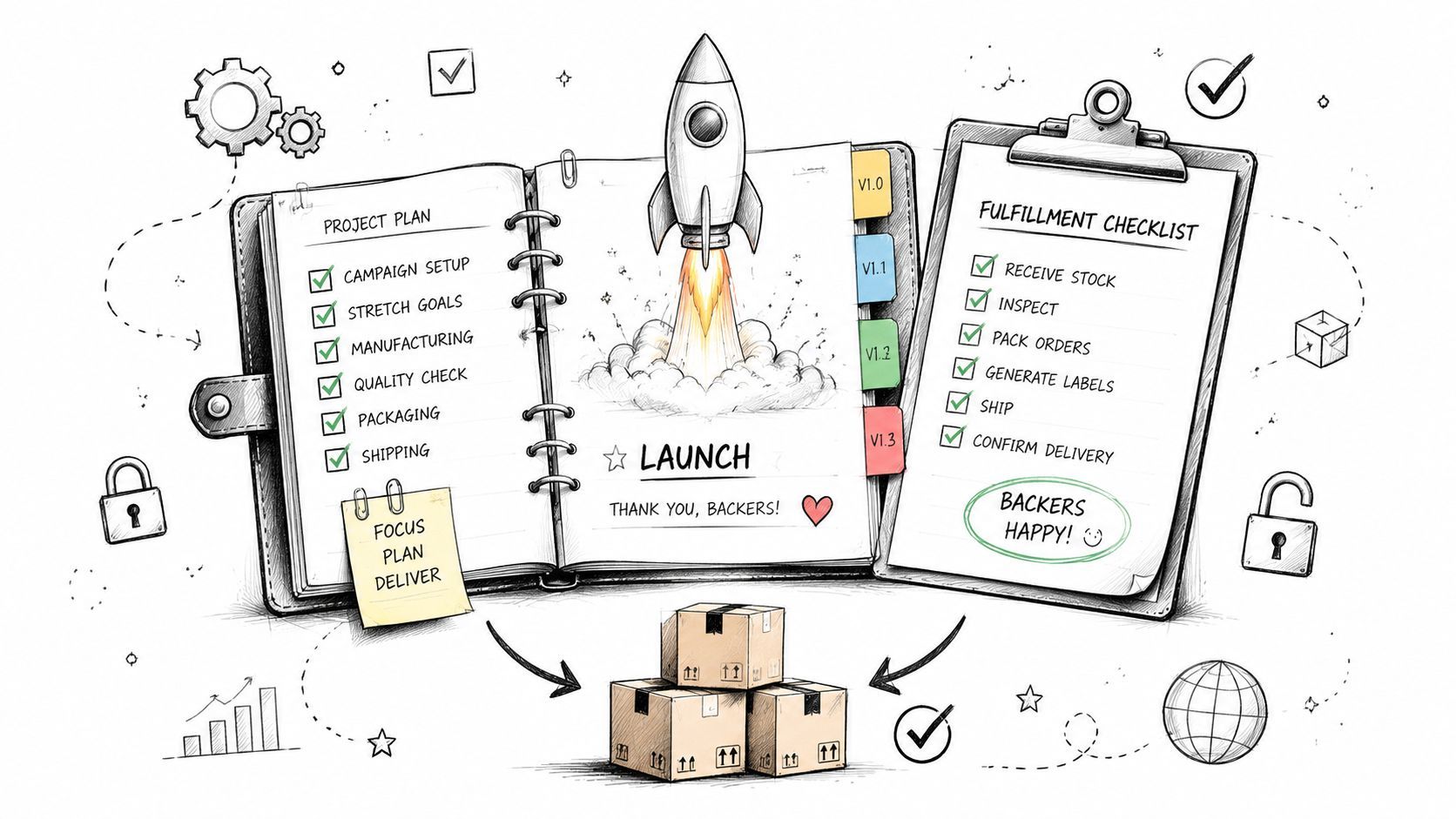
Learn how process documentation standards boost crowdfunding success. Follow our guide to streamline your campaign operations.
You've just closed a successful campaign, but fulfillment feels less like a celebration and more like an emergency room. Backers are submitting different addresses, reward names don't match your warehouse SKUs, shipping charges need correction, and your team is debating which spreadsheet is current. A creator can lose days deciding which file to trust.
That chaos usually isn't caused by a lack of effort. It comes from undocumented handoffs. A campaign needs a reliable operating system that connects the pledge export, backer survey, payment collection, address validation, vendor handoff, and shipment tracking. Process documentation standards provide that operating system without forcing a small crowdfunding team to build a mountain of paperwork.
A fulfillment process can look obvious while everyone works in the same room. The campaign owner knows which reward includes an expansion, the operations lead knows which shipping rule applies, and the warehouse contact knows how to interpret the export. Once those decisions live in conversations, private notes, and old files, the process becomes fragile.
A new contractor may send the wrong SKU to a vendor. A backer may pay a shipping adjustment that never reaches the fulfillment report. Someone may update an address after the order has entered production. Each mistake creates a support ticket, a correction, or a delay that your original campaign plan never accounted for.
Practical rule: If another person can't complete the handoff without asking you what you meant, the process isn't documented well enough.
Standards help by defining the evidence each stage should produce. You don't need an enormous quality department. You need a clear record showing what happened, who approved it, which version was used, and where the resulting information went.
For Kickstarter and Indiegogo creators, that means documenting practical workflows such as:
The payoff is more than an orderly folder. Good documentation protects backer trust, reduces avoidable rework, supports audit readiness, and gives you a dependable way to capture post-campaign revenue. The strongest system doesn't merely describe what should happen. It makes it possible to prove that the intended process was followed.
Think of a recipe book and a working kitchen. The recipe explains the intended ingredients and method. The kitchen shows whether someone used the right ingredients, followed the sequence, adjusted for an allergy, and served the finished dish correctly. Crowdfunding documentation needs both views.
A high-level process might say, “Collect complete backer information and prepare approved orders for fulfillment.” A procedure explains how your team configures the survey, reviews responses, handles exceptions, and exports orders. A work instruction gives task-level detail, such as which field to inspect before approving an international shipment.
That hierarchy aligns with ISO 9001:2015. The revision replaced the older prescriptive model with “documented information.” The 2008 version required a quality manual and six documented procedures. The 2015 revision removed that fixed list and asks organizations to maintain information only as far as needed to support process operation, while retaining evidence that processes are carried out as planned. The ISO guidance on documented information explains this shift toward useful operational evidence rather than paperwork for its own sake.

The distinction matters for a lean creator team:
The standard also expects controls around approval, review, updating, availability at points of use, and protection against unintended use of obsolete information. The global transition to ISO 9001:2015 ended on 15 September 2018, when organizations certified to earlier versions had to complete the transition, as described in this ISO 9001 documentation overview.
For crowdfunding, a maintained document might be the current “Backer Survey Setup” procedure. A retained record might be the approved survey export used by the fulfillment vendor. One tells the team how to work. The other helps demonstrate what the team did.
Complex workflows become easier to inspect when people use consistent symbols and terms. BPMN 2.0 is a neutral, standardized notation for documenting business processes. Government guidance that uses BPMN requires a controlled vocabulary of elements and terms, while the notation's standardization supports consistent reading by analysts, IT teams, and auditors. The BPMN and work-instruction guidance is useful when a campaign includes branching decisions, automated actions, and several ownership handoffs.
You don't need BPMN for every short checklist. A simple flow may be enough for a small reward set. Use a more formal map when a process includes payment exceptions, address locks, tax decisions, vendor dependencies, or several possible outcomes.
A board game publisher once kept reward data in files named “final,” “final2,” and “final-really-final.” The warehouse used one export, the campaign owner reviewed another, and a late correction sat in a third file. Nobody was being careless. The team had created documents without a control system.
The fix starts with names that reveal context. A file such as CampaignName_BackerExport_Region_Date_Version tells a reader what the file contains and why it exists. Your naming convention should identify the campaign, workflow, date or release point, and revision. Avoid names that depend on memory, color coding, or the person who created the file.
A practical document header can include:
The control requirement is simple in principle. A document should be approved before issue, reviewed and updated when needed, accessible where the work happens, and protected from accidental use after it becomes obsolete. That might mean an archived folder for retired exports, read-only access for final vendor files, and a clearly labeled working area for drafts.

Suppose a vendor asks why an order contains a particular reward combination. Your team should be able to connect the answer to the approved survey configuration, the backer's submitted response, the payment record, and the export sent for fulfillment. That chain doesn't require a complicated audit department. It requires consistent identifiers, controlled access, and retained evidence.
Use permissions that match responsibility. A creator may approve a reward mapping, an operations lead may prepare the export, and a vendor may receive only the fields needed for fulfillment. Keep personal information out of general planning documents whenever possible.
A documented knowledge-sharing practice can help teams preserve decisions instead of repeating them in private messages. The knowledge-sharing systems guide offers a useful reference for making operational knowledge accessible to the people who need it.
Control the current version, archive the old one, and record the decision that moved the process forward.
A useful document has enough structure to prevent variation, but not so much detail that nobody reads it. ISO 9001 guidance distinguishes between a process, a procedure, and a work instruction. A process explains what needs to happen and why. A procedure explains how the process works. A work instruction gives task-level execution detail. The guidance on processes, procedures, and work instructions also notes that ISO 9001:2015 doesn't require work instructions unless they add value or are necessary for consistent execution.
Use these six elements as a layered checklist.
Start with the result, not the software menu. “Prepare paid, address-complete orders for the fulfillment partner” is a stronger purpose than “Manage the pledge export.”
Define where the document starts and stops. For a Kickstarter workflow, the scope might begin when the campaign file is imported and end when the approved vendor export is retained. For an Indiegogo workflow, it might include a separate step for late backers or pre-orders.
Give every procedure a clear title and revision identifier. Record the owner, approver, effective date, and change reason. A reward mapping procedure should distinguish between a draft mapping and the approved mapping used to generate orders.
Keep the revision history short but meaningful. “Added expansion bundle and changed vendor field mapping” is more useful than “updated document.”
List what the process needs and what it must produce. Inputs can include campaign pledges, reward definitions, shipping rules, tax settings, and backer responses. Outputs can include a validated order file, exception list, payment reconciliation, and vendor handoff record.
Acceptance criteria turn opinion into a check. An order may be ready only when the reward is mapped, required address fields are present, payment status is confirmed, and unresolved exceptions are assigned to an owner.
Name roles rather than relying on personal names. A simple responsibility matrix can identify who performs the task, who approves it, who provides input, and who receives the final result.
For example, the campaign owner approves reward definitions, the operations lead configures the survey, the finance reviewer checks collected charges, and the fulfillment partner receives the final export. The exact arrangement can vary, but the document should remove uncertainty at each handoff.
Backer addresses and payment-related information deserve controlled handling. State who can access exports, where files are stored, how vendors receive them, and when outdated copies are removed or archived.
A privacy control should appear in the workflow, not only in a policy folder. If a backer requests erasure, your team needs a defined path for finding the relevant records and recording the action without exposing unrelated data.
Choose the simplest format that makes the work reliable. A short procedure may need a numbered list. A workflow with decision points can benefit from a swimlane diagram or BPMN model that shows the campaign team, payment system, survey platform, and fulfillment vendor.
Add detailed work instructions for high-risk or high-variation tasks, such as customs data review or reward combinations with many components. Keep low-risk activities at procedure level when extra detail won't reduce inconsistency. Over-documenting slows the team, while under-documenting leaves room for different interpretations.

Templates work best when they mirror the decisions your team makes. A backer survey setup document should record the campaign source, reward mapping, add-ons, shipping rules, tax settings, required questions, owner, approver, and release status.
For an upsell flow, document the sequence from product selection to payment confirmation, order update, and vendor export. Include the rule for unavailable products and the person who resolves a failed payment. For address management, record when validation occurs, which fields are mandatory, how international addresses are reviewed, and when edits stop being accepted.
Before opening a survey, confirm:
The pledge manager choice affects how much control you have over these records. Kickstarter's pledge manager is like Amazon, a marketplace environment where many sellers list through the same site. PledgeBox's pledge manager is like Shopify, a platform model that gives a creator more ownership over the store experience and operating configuration. The broader Shopify comparison of Shopify and Amazon explains this marketplace-versus-owned-store distinction and the different fee models associated with each.
| Capability | Kickstarter Pledge Manager Like Amazon | PledgeBox Pledge Manager Like Shopify |
|---|---|---|
| Operating model | Marketplace-style pledge experience connected to the Kickstarter ecosystem | Creator-controlled store-style pledge experience |
| Documentation impact | Document the platform handoff, available settings, and exported evidence | Document your own configuration, rules, approvals, and connected workflows |
| Upsell process | Record available campaign and pledge-manager options | Record add-ons, late backers, pre-orders, shipping, and tax settings in your operating file |
| Vendor handoff | Define how platform data becomes a fulfillment export | Define the export fields, approval step, and vendor delivery process |
| Control focus | Track platform constraints and the final records you can retrieve | Track configuration ownership, access, revision history, and data isolation |
PledgeBox states that sending the backer survey is free when there are no add-on upsell sales. Its only platform fee is 3% of revenue collected through the survey, and that fee applies to add-on products, shipping fees, and taxes or VAT charged during the survey, as documented on the PledgeBox pricing page.
Use the crowdfunding success checklist to compare your current workflow against these control points before inviting backers.
Documentation becomes useful when it appears at the moment a decision is made. Start with a single operating record for the campaign. Link the approved reward map, survey configuration, payment rules, address policy, exception queue, export specification, and vendor confirmation. Don't scatter the current process across private messages and disconnected spreadsheets.
A practical workflow can follow this rhythm:
PledgeBox supports branded surveys, Stripe and PayPal, shipping integrations, auto shipment tracking, Google Maps-powered address validation, downloadable reports, direct vendor exports, privacy-first data isolation, and one-click data erasure. Those capabilities should appear in your procedure as controlled steps, not as an assumption that the software itself makes the workflow audit-ready.
For example, the procedure can state that the operations lead validates addresses before export, the finance reviewer checks how Stripe or PayPal charges are represented, and the fulfillment owner confirms the vendor received the approved report. The record should show what was checked and what happened when a check failed.

AI can help draft, structure, retrieve, and check documentation freshness. Capture-first workflows are safer than asking a tool to reconstruct a procedure from memory because the source record begins with what the team did. Automatic updating still isn't solved, so a human should approve changes before a revised SOP becomes active.
A safe pattern is to let AI suggest a summary from approved records, flag steps that appear outdated, or locate the relevant procedure. Keep the source evidence, reviewer, decision, and revision history. Don't allow generated text to replace the controlled version.
The PledgeBox project lifecycle can help you organize campaign stages so the documentation changes with the work instead of becoming an abandoned file after launch.
The best process documentation standards don't produce impressive binders. They produce a fulfillment trail that a teammate, vendor, or auditor can follow without guessing. Your process should show what you intended to do, what you did, who approved the decisions, and how you handled exceptions.
Start with one current SOP. Check whether it has an owner, revision history, approval record, acceptance criteria, and a clear location for the active version. Then test it by asking someone who didn't write it to complete a small handoff.
Your next three actions are straightforward:
Kickstarter's Pledge Manager payments carry the same fees as successful projects. Kickstarter collects a 5% platform fee, while Stripe collects a variable card-processing fee of roughly 3–5%, as explained in Kickstarter's fee guidance. Compare that structure with your projected upsell and fulfillment workflow before you choose where documentation should live.
A controlled system protects more than shipping accuracy. It helps your team answer backer questions, preserve trust, reduce rework, and make post-campaign revenue easier to manage.
PledgeBox gives creators a pledge manager for branded surveys, add-ons, shipping and tax collection, address validation, vendor exports, and shipment tracking, all of which can be organized through clear process documentation standards. Send your backer survey for free when there are no add-on upsell sales, pay only 3% on applicable survey revenue when upsells occur, and visit PledgeBox to build a more controlled fulfillment workflow for your next campaign.
PledgeBox
The All-in-One Toolkit to Launch, Manage & Scale Your Kickstarter / Indiegogo Campaign