 PledgeBox
Crowdfunding Email Marketing: A Practical Playbook
Master crowdfunding email marketing with proven sequences, segmentation tactics, and automation flows that turn subscribers into backers and boost post-campaign
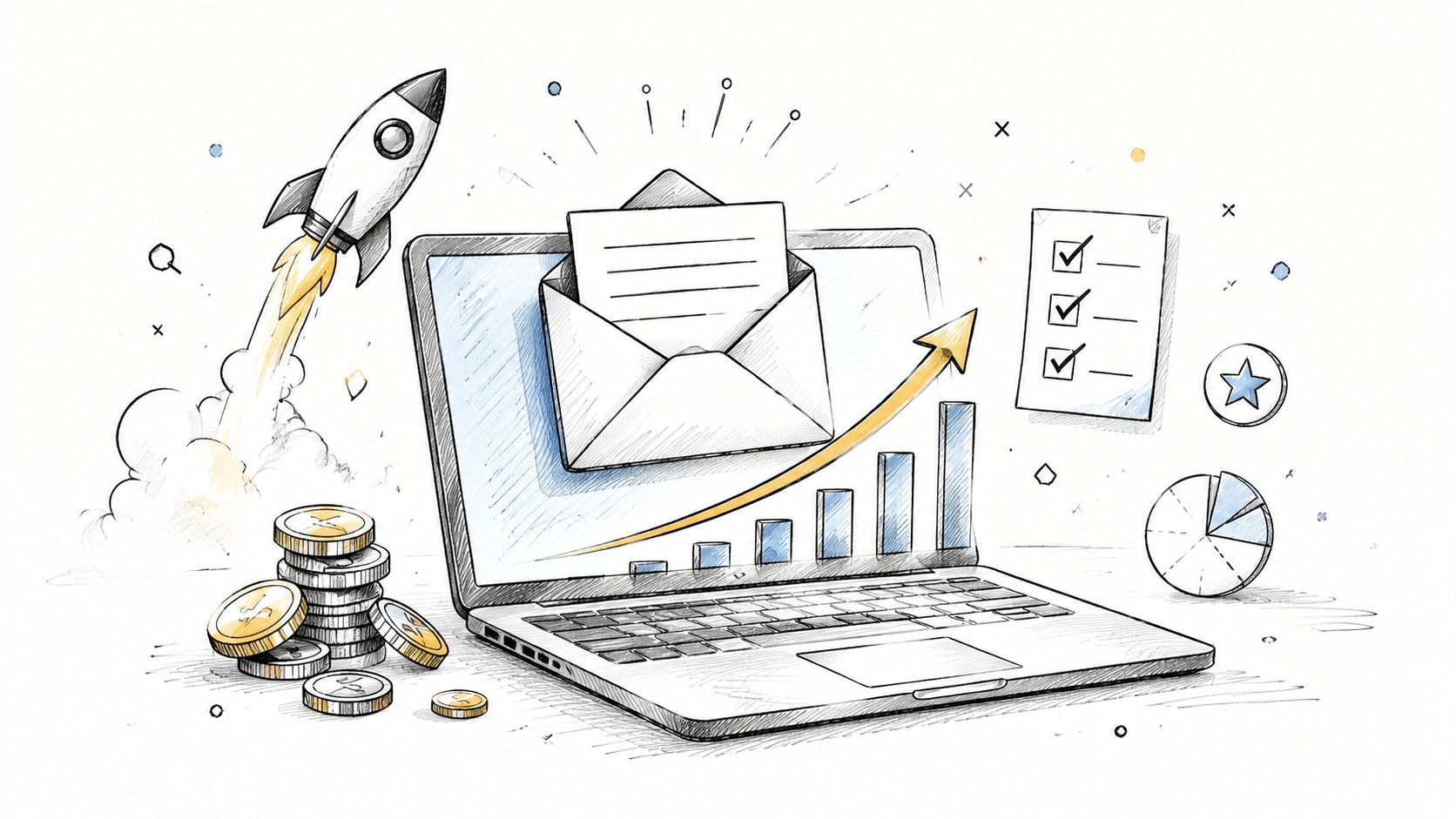
Master crowdfunding email marketing with proven sequences, segmentation tactics, and automation flows that turn subscribers into backers and boost post-campaign
Email marketing is 34% more effective than other outreach methods for crowdfunding campaigns, according to the benchmark summarized by Google for Nonprofits. That advantage changes how a creator should think about launch promotion. Email isn't merely another traffic source to add beside social posts. It can become the owned channel that warms prospects before launch, creates an opening surge, supports the campaign through its quiet middle, and continues selling add-ons after the funding deadline.
The strongest crowdfunding email marketing programs treat the backer relationship as a lifecycle. They capture permission before launch, send relevant messages during the campaign, and keep communicating through surveys, shipping updates, late pledges, and fulfillment. The tactics below focus on the operational details that tend to decide whether an email program produces pledges or just fills a dashboard with opens.
The 34% effectiveness advantage matters because crowdfunding depends on concentrated attention. As noted earlier, the Indiegogo study found that email marketing was 34% more effective than other outreach methods for crowdfunding campaigns. That result is not a promise that every subscriber will pledge, and it does not make paid media or community posts irrelevant. It does establish email as a primary acquisition channel, not a follow-up task after launch.
An owned list gives creators direct access to people who have already agreed to hear from them. Platform feeds can bury updates, ad accounts can be restricted, and social reach can change without notice. Email still demands permission, deliverability, relevant content, and disciplined timing. The advantage is control: a permission-based audience can receive pre-launch education, launch notices, campaign updates, survey prompts, late-pledge offers, and fulfillment information without relying on a platform algorithm.
Platform discovery can help, but it is a poor launch plan on its own. Kickstarter and Indiegogo may introduce a project to interested visitors, while the creator has little control over when that exposure arrives or whether it reaches likely backers. The Kickstarter weekly-email analysis shows why editorial placement can produce a sharp lift while remaining difficult to plan around. Campaigns featured in a Kickstarter email raised an average funding bump equal to 150% of their goal in the following day and 428% of their goal on average overall. The analysis estimated that only about three campaigns per week were featured from roughly 4,000 or more live campaigns, an estimated feature rate of about 0.075%.
| Traffic Source | Avg Conversion Rate | Revenue Contribution | Cost Per Acquisition | Reliability Score |
|---|---|---|---|---|
| Owned email list | 10-15% for warm lists (Nalin) | Primary revenue driver (60-80% of total) | Variable list-building cost | High when permission and engagement are strong |
| Platform editorial email | Not consistently available | Potentially substantial when selected | Usually no direct buying cost | Low because placement is scarce |
| Social posts | Audience and timing dependent | Indirect and variable | Content and promotion cost | Volatile |
| Paid advertising | Campaign and audience dependent | Direct but tracking-sensitive | Media spend plus creative cost | Variable |
| Platform discovery | Campaign dependent | Incremental | Platform fees and campaign effort | Unpredictable |
Email also retains value after the funding deadline. A subscriber who does not pledge at launch can respond to a mid-campaign update, late-backer invitation, add-on announcement, survey upsell, or future product release. That continuity matters during fulfillment too, when clear shipping updates and support messages protect trust. The list is valuable because it preserves permission across each commercial and operational stage, not because it contains addresses.
Practical rule: Use social content and paid traffic to create attention, then use email to turn that attention into an audience you can reach again.
A pre-launch list starts with a landing page that answers one question quickly: why should someone give you permission to contact them? Put the strongest product image, prototype render, gameplay moment, or creative preview above the fold. Pair it with a benefit-led headline and one clear call to action. An email-only form usually creates less friction than asking for extra information before the visitor understands the offer.

A generic “join our newsletter” request rarely gives a prospective backer enough urgency. Stronger incentives fit the campaign rather than the email platform:
The incentive must be honest. Don't promise a discount you haven't budgeted for, and don't imply guaranteed scarcity if the reward will remain available. For broader list-building principles, these B2B email tips from Machine Marketing provide useful context, but crowdfunding pages need a sharper offer tied to launch intent.
Use separate tracking tags for paid ads, creator partnerships, community posts, and direct referrals. Those tags will later help you distinguish a highly engaged tabletop audience from a broad awareness audience. A Reddit post should contribute genuine discussion before it points to a landing page, while a cross-promotion works best when the other creator serves a complementary audience without selling a competing product.
Facebook Lead Ads can shorten the path from interest to signup, particularly when the creative uses a lookalike audience built from relevant supporters. Reddit requires more restraint. Value-first participation earns attention; dropping a bare landing-page link into a community usually damages trust.
Use double opt-in where appropriate, then send a welcome email immediately. Confirm what the subscriber signed up for, state when launch information will arrive, and set expectations about frequency. The PledgeBox guide to building a potential-backer list offers a crowdfunding-specific reference for connecting audience capture with launch preparation.
Industry guidance recommends treating 1,000 to 3,000 subscribers as a practical minimum range for a viable launch list, while also emphasizing list quality over raw size. The crowdfunding email guidance from Nalin gives a practical welcome-email benchmark of 40% to 50% opens, an 8% to 10% click-to-open rate on the primary call to action, and 3% to 5% subscriber-to-backer conversion for a typical campaign list. These are planning benchmarks, not guarantees. A smaller, responsive audience can be more useful than a larger list built from weak incentives.
A campaign sequence should change as the reader's job changes. Before launch, the subscriber is deciding whether the project deserves attention. During launch, they need a direct path to the campaign. In the middle, they need a reason to return. Near the deadline, they need clarity about what disappears when the timer ends.

In the 14 to 30 days before launch, send three or four messages with distinct jobs. One can reveal the prototype or product promise, another can introduce the team, and a third can explain the reward logic or early access. A final pre-launch note should make the launch date and expected next step impossible to miss.
Subject-line directions include:
Don't turn every pre-launch email into a sales pitch. The reader needs enough substance to believe the project is real, understand who is making it, and know why their early action matters.
The first 72 hours deserve a planned burst, not a single announcement. Send a live-launch message with one dominant CTA, follow with early backer proof or a meaningful campaign update, and use a later message to explain a time-limited reward or early-bird condition if one exists.
Segment the sends where possible. A subscriber who clicked the pre-launch page needs a different reminder from someone who never opened a message. The Seed&Spark guide to writing crowdfunding emails warns against broad mass-BCC outreach and weak CTA structure. Personal, trackable messages make it easier to see who needs information, who needs urgency, and who should be left alone.
From day four through day 25, a reliable rhythm matters more than constant noise. Two useful messages per week can alternate between a stretch-goal explanation, a backer or community spotlight, press coverage, a production update, and a campaign-progress reminder. Each email should add a new reason to care instead of repeating the launch announcement.
Before publishing the sequence, decide which content is evergreen and which depends on live campaign conditions. A stretch-goal message may need a manual review, while a scheduled behind-the-scenes story can run automatically. For broader content planning ideas, Gainsty's guidance to enhance your content marketing is useful, but crowdfunding messages still need a direct relationship with the live campaign.
The final 48 to 72 hours call for escalating clarity. Send a last-chance message around the 24-hour mark, then a final-hours email that states exactly what ends, which reward options remain, and where the reader should click. Don't manufacture panic. A real deadline already supplies urgency, so your job is to remove uncertainty.
A single broadcast forces every subscriber into the same conversation. That creates avoidable waste. A new prospect needs context, a repeat supporter may need a fast route to the right reward, and an inactive address may need a quiet re-engagement message rather than another high-frequency launch email.

Create a warm segment from subscribers who clicked a pre-launch email or visited the campaign page. Give that group the earliest practical notice about launch, reward changes, or important campaign updates. Keep highly engaged subscribers separate from people who joined recently but haven't interacted, because the same frequency can feel valuable to one group and intrusive to the other.
A simple engagement model can include:
Avoid relying on opens as your only signal. Apple Mail privacy features and other inbox behaviors can make open data less precise. Clicks, pledge activity, survey completion, add-on purchases, and replies reveal stronger intent.
Personalization should change the offer, not just insert a first name. A tabletop creator can distinguish first-time backers from repeat supporters and offer each group a relevant explanation of the campaign's new material. A hardware team can use geographic segments to clarify shipping expectations, regional fulfillment options, taxes, or customs considerations.
Past pledge behavior also informs recommendations. Someone who selected a core reward may need an accessory explanation, while someone who already chose a premium tier may respond better to a limited edition or expansion. Keep the content accurate, especially when shipping or reward availability differs by destination.
Subscribers who haven't engaged for 60 days or more can receive a short re-engagement sequence, followed by suppression if they remain unresponsive. That protects list quality and prevents the campaign team from mistaking a large database for an active audience.
Send the smallest audience that can reasonably act on the message. Better targeting often improves clarity before it improves any metric.
The pledge manager is where crowdfunding email marketing continues after the campaign page closes. It collects addresses, reward preferences, and fulfillment details, but it can also present add-ons, late-backer options, and complementary products. The right choice depends on whether the team values a simple native flow or needs a more controlled commerce layer.
Kickstarter's Pledge Manager is like the Amazon model. It offers a centralized, native checkout experience connected to the Kickstarter ecosystem. Kickstarter says the tool has no upfront cost, uses the backer survey to collect fulfillment information, and applies its usual fees to payments made within the manager. Its fee guidance specifies a 5% platform fee on funds except taxes, plus Stripe card processing fees of roughly 3% to 5% on the full payment including taxes. Review how Kickstarter's Pledge Manager works before estimating net revenue.
PledgeBox's pledge manager is like the Shopify model. It gives the creator a more customizable, creator-controlled system for surveys and post-campaign sales. PledgeBox is free to send the backer survey and only charges 3% of upsell revenue if there's any. If the survey generates no additional revenue, the survey use is free. Its comparison content also distinguishes the native Kickstarter flow from a third-party setup that supports add-ons and upsells more directly.
| Platform | Upsell Automation | Segmentation Depth | Avg. Revenue Lift | Integration Complexity |
|---|---|---|---|---|
| Kickstarter Pledge Manager | Native survey and payment flow | Primarily campaign-native | Not specified | Lower for Kickstarter campaigns |
| PledgeBox | Survey-led add-ons and post-campaign sales | Creator-controlled audience and offer structure | Not specified | Depends on email and fulfillment setup |
| Other third-party managers | Varies by provider | Varies by provider | Not specified | Varies by provider |
Don't promise an upsell lift without campaign-specific evidence. Instead, build a sequence around the backer's actual state: survey incomplete, survey complete, add-on viewed, add-on purchased, or order ready for fulfillment. For a practical framework for selecting a tool, use this guide to choosing the right pledge manager.
A useful dashboard ties every email to a decision. Track delivery, opens, clicks, campaign actions, pledges, survey completion, add-on revenue, unsubscribes, and revenue per email. Open rates help diagnose subject lines and list health. Clicks, pledges, and revenue show whether the message moved a backer toward action. After the campaign, add survey completion, add-on purchases, and fulfillment status so the dashboard covers the full customer lifecycle.
The benchmarks cited earlier provide practical reference points: a 40% to 50% welcome-email open rate, an 8% to 10% click-to-open rate on the main CTA, and 3% to 5% subscriber-to-backer conversion for a campaign list. Warm lists commonly convert at 10% to 15%, VIP segments can reach nearly 30%, and cold traffic may convert at only 2% to 3%. Use these ranges to diagnose list quality and sequence performance, not to promise results.

Use triggers tied to events the system can detect reliably:
Set up domain authentication and monitor sender reputation before launch. Keep attribution consistent across the landing page, email platform, campaign page, and pledge manager. StreamGen autopilot features can support automated content operations, but a person should review any send affected by reward changes, deadlines, or fulfillment promises.
PledgeBox email workflow automation offers a crowdfunding-specific implementation reference. Configure the pledge manager around the backer's actual state, such as survey incomplete, add-on viewed, add-on purchased, or order ready for fulfillment. Automate reminders and routing. Keep judgment with the team, because an incorrect shipping message creates more support work than a reviewed send.
Start 90 days before launch with the foundation. Build the landing page, connect consent and source tracking, prepare the lead magnet, and write the welcome email. Use the early period to learn which message earns clicks, not just which image attracts attention.
By 60 days before launch, your list-building traffic should be active. Begin the pre-launch story sequence, test the signup path, and remove friction from the form. By 30 days out, lock the launch emails, create engagement segments, verify the campaign links, and prepare the first post-launch update.
During launch, use the segmented sequence rather than one universal blast. In the middle, maintain a consistent rhythm and reserve manual review for stretch goals, inventory, reward changes, and press claims. In the final days, make the deadline explicit and suppress people who have already taken the intended action where possible.
After the campaign, connect the pledge manager to the fulfillment plan. Send survey invitations, reminders, add-on messages, and shipping communications as separate lifecycle flows. Continue the relationship after delivery with product education, feedback requests, and future launch permissions.
Avoid these five failure modes:
Before publishing, compare your welcome performance with the 40% to 50% open benchmark, your CTA engagement with the 8% to 10% click-to-open benchmark, and your expected subscriber-to-backer performance with the 3% to 5% practical range cited in the crowdfunding guidance. Also confirm that the list contains enough interested subscribers to support the campaign's funding plan, rather than treating a raw contact count as proof of readiness.
PledgeBox lets creators send branded backer surveys, collect fulfillment information, and offer add-ons through a creator-controlled pledge manager. It's free to send the survey and charges only 3% of upsell revenue if any is generated. Visit PledgeBox to connect your pre-launch audience strategy with post-campaign surveys, upsells, and fulfillment.
PledgeBox
The All-in-One Toolkit to Launch, Manage & Scale Your Kickstarter / Indiegogo Campaign