 PledgeBox
International Shipping Tax Calculator: Master Global Trade
Simplify global trade. Our international shipping tax calculator helps you master duties, VAT, HS codes, & landed costs for seamless international shipping.
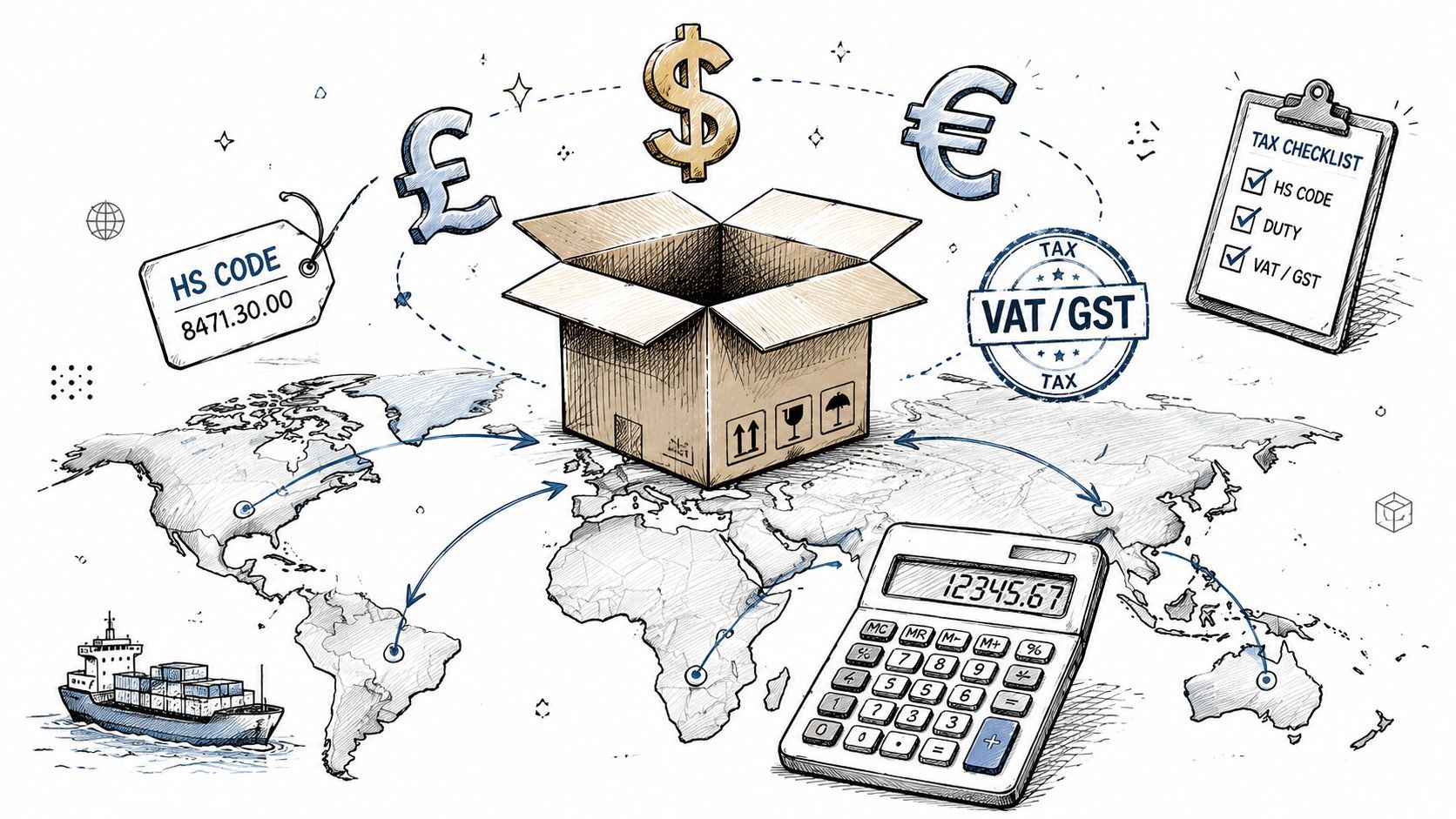
Simplify global trade. Our international shipping tax calculator helps you master duties, VAT, HS codes, & landed costs for seamless international shipping.
You hit funding, the comments are full of congratulations, and the campaign dashboard finally looks the way you hoped it would. Then fulfillment planning starts, and the first ugly question lands on your desk. What are backers in the US, UK, EU, Canada, and everywhere else going to owe when rewards ship?
That's where a lot of crowdfunding teams lose control. They price shipping too low, treat taxes as a vague future problem, and assume the carrier or local customs office will sort it out cleanly. It rarely works that way. Backers get surprise charges, support inboxes fill up, parcels stall at the border, and your margin disappears one correction at a time.
An international shipping tax calculator helps, but only if you understand what it's really calculating and where those numbers come from. For creators, especially in hardware and tabletop, this isn't a finance side quest. It's part of fulfillment planning, backer communication, and protecting the campaign's last impression.
The hardest part of a campaign often starts after the funding total locks in.
A creator can survive a hectic launch page, late-night ad changes, and stretch goal debates. International fulfillment is different. It punishes assumptions. The product is real, cartons are booked, and every wrong tax decision turns into a bill, a delay, or an angry message from a backer who thought shipping was already covered.
The first mistake is treating shipping tax as a line item you can estimate loosely. That works for domestic fulfillment. It fails once you send rewards across borders, because customs authorities care about classification, origin, and taxable value, not your rough spreadsheet logic.
The second mistake is waiting too long to model landed cost. By the time many teams start checking duties and VAT, they've already promised backers a shipping charge that doesn't reflect reality. At that point, every option is bad. Eat the difference, charge more later, or let backers face import fees on delivery.
Practical rule: If you don't decide who pays duties and taxes before surveys go out, customs will decide for you later.
Backers don't think in tariff tables. They think in outcomes.
If the parcel arrives with an extra bill, they feel misled. If the reward gets held for customs paperwork, they blame the campaign. If they have to refuse delivery because the final cost is higher than expected, you lose money on shipping, returns, and support time.
A workable process looks more like this:
That discipline matters because calculators can be accurate, but they can't fix a messy post-campaign workflow on their own. They're only useful when the inputs are right and the collection plan matches the fulfillment model.
Most creators use the term shipping cost when they really mean landed cost. They aren't the same thing. Shipping cost is what you pay to move the parcel. Landed cost is the full amount tied to getting that reward into the destination country legally.
International shipping tax calculators determine landed costs by applying duty rates based on the Harmonized System (HS) code, shipment value, and origin country. In the United States, import duty rates vary significantly by product category, with some goods exempt from duties while others face rates up to 30% or more, so the calculator has to account for those differences to be useful for creators shipping rewards internationally, as outlined by the Freightos import duty calculator.

A good international shipping tax calculator needs a short list of inputs, but each one carries weight.
If you want a creator-friendly explanation of how shipping charges fit into campaign planning, the PledgeBox article on international shipping fees is a useful operational reference.
The easiest way to think about landed cost is to split it into buckets.
| Component | What it includes | Why creators miss it |
|---|---|---|
| Product cost | The declared value of the reward | Teams often use pledge price without checking customs valuation logic |
| Shipping costs | Freight and delivery charges | Many budgets track carrier cost but ignore how it affects tax |
| Duties and taxes | Import duty, VAT, GST, sales tax depending on country | These vary by destination and product classification |
| Other fees | Brokerage, handling, special surcharges | They show up late and create support headaches |
A creator sending board games, electronics, or mixed reward bundles can't assume one rule applies everywhere. The same product may be duty-free in one market and taxed heavily in another, because the classification or local import framework is different.
Landed cost is not one number you discover at the end. It's a chain of decisions you make before you collect surveys.
A calculator is only as good as the product description behind it. “Game accessory,” “electronic device,” or “collector item” might sound clear in a campaign update, but those labels are often too vague for customs use.
That's why experienced teams validate descriptions before they scale fulfillment. If you need another practical reference for breaking down import charges, the AUSFF guide to Australian imports is helpful because it frames landed cost as a sum of visible and less visible import expenses, which is exactly how creators should budget.
The core method behind most calculators is the CIF standard, short for Cost, Insurance, and Freight. Under this approach, import duty is calculated by multiplying the duty percentage by the total CIF value. The formula is given directly in the DTS One guide to calculating international shipping taxes: Duty = (Product Price + Shipping + Insurance) × Duty Percentage.
That formula matters because many creators still calculate duty against the item value alone. Customs often won't.

When I review a campaign's international plan, I keep the calculation process simple:
The order matters. If the taxable base is wrong, every later number is wrong too.
Here's a walkthrough video that shows the calculation flow in a more visual format:
Take a hypothetical board game reward with:
The method is still the same. First, identify the HS code. Then confirm the origin country. Then calculate CIF by adding product price, shipping, and insurance. After that, apply the US duty treatment for that classification.
What changes the outcome isn't the math. It's the classification. Some goods entering the US may be exempt, while others can face substantially higher duty treatment depending on product category, as covered earlier. So the creator's job isn't just “do the formula.” It's “feed the formula the right classification and shipment details.”
The UK version follows the same sequence, but the tax structure will differ from the US.
You still start with the reward value and transport-related costs, then apply the duty rule that fits the product and origin. After that, assess whether VAT applies and what part of the shipment forms the taxable base. A lot of creators stumble here because they copy a US-centric shipping setup into a UK survey flow and assume the same approach will hold.
What works better is building a destination-specific rule set. If a campaign has meaningful UK volume, test the full buyer experience from survey to import charge before launch or before surveys go live.
Germany is a good example because it reminds creators that “the EU” isn't shorthand for “simple.”
You still calculate CIF first. Then you apply the relevant customs treatment for the product and origin, followed by VAT treatment at import where required. The same board game might remain manageable on paper, then become far more expensive once freight, insurance, and local tax handling are included.
The campaign reward didn't get more valuable on the way to customs. The tax base got bigger.
The lesson isn't that one country is always expensive and another is always easy. The lesson is that identical rewards can produce different import outcomes because the taxable base and tax rules change by destination.
That's why an international shipping tax calculator should be part of your reward design process, not something you check after production is finished. The earlier you model landed cost, the easier it is to set realistic shipping fees, decide where to absorb costs, and write honest delivery expectations for backers.
Standalone calculators are useful, but they solve only part of the problem. They estimate what customs may charge. They don't collect that amount from backers, connect it to reward logic, or keep your fulfillment workflow clean.
For crowdfunding, the more durable solution is to move tax calculation into the post-campaign system where backers confirm addresses, add products, and pay outstanding charges.
A browser-based calculator is good for early forecasting. It helps answer questions like:
But once the campaign ends, disconnected estimates start to create problems.
A creator may have one spreadsheet for duties, another for shipping zones, a third for VAT assumptions, and a survey tool that can't enforce the final payment logic cleanly. That setup usually produces exceptions, manual corrections, and support tickets.
An integrated pledge manager changes the job from estimation to execution. Instead of merely checking possible tax exposure, you can build the post-campaign flow so the backer sees the right charges during the survey stage.
That's the operational advantage. The team isn't passing tax complexity downstream to the warehouse or the backer. It's handling it where order data is already being confirmed.
For creators comparing workflows, it helps to think of the tools this way. Kickstarter pledge manager is like Amazon, standardized and rigid. PledgeBox pledge manager is like Shopify, with a more customizable toolkit for how products, surveys, shipping, and tax logic are handled, based on the PledgeBox comparison explained in The Pledge Book.

For budget planning, the important detail is simple. PledgeBox is free to send the backer survey and only charge 3% of upsell if there's any. That performance-based structure matters because teams can avoid adding another fixed post-campaign software expense while still collecting shipping fees, taxes, and add-ons through the survey flow. The platform details are outlined in the PledgeBox crowdfunding pledge manager overview.
That's a very different decision from paying upfront for a survey system before you know whether post-campaign upsells will justify it.
If you're comparing options, don't ask only “Which calculator is more accurate?” Ask these questions too:
| Decision area | Standalone calculator | Integrated pledge manager |
|---|---|---|
| Estimate duties and taxes | Yes | Yes, when configured into workflow |
| Collect charges from backers | No | Yes |
| Tie tax logic to reward tiers and add-ons | Limited | Stronger |
| Reduce delivery-time surprise costs | Only indirectly | More directly |
If you want a useful contrast from another import-heavy niche, the car importing example in DreamBid's guide to oblicz koszty importu auta z USA shows the same core lesson. A calculator is helpful, but the main challenge is how those costs get operationalized before the item reaches the buyer.
Most fulfillment blowups don't start with fraud or incompetence. They start with a small assumption that survives too long.
The biggest one is underestimating the tax base. Data shows 78% of cross-border creators face unexpected charges because their calculation tools don't account for freight and insurance inclusion in the tax base. The same source notes that 63% of backers in high-value hardware and board game shipments report VAT surprises upon delivery, according to FedEx guidance on duties and taxes.

Creators often use internal language that makes sense to fans but not to customs. A “deluxe gameplay accessory” might need a very different classification from the core board game. A bundled smart device may not be treated the same way as its components.
What to do instead:
This is the quiet margin killer. Teams know the product value, then estimate duty from that number alone. Customs may calculate against a broader base than the one in your internal sheet.
If your spreadsheet treats shipping as separate but customs treats it as taxable, your budget is already wrong.
What to do instead is simple. Build landed cost from the actual import method you'll use, not from a backer-facing shipping line item.
A creator may technically disclose that import charges are possible, but burying that note in a campaign FAQ won't save the support queue later.
Backers need direct language. Tell them whether charges are prepaid, collected in survey, or due on delivery. Then repeat it in the survey itself. If you change the policy, explain why and give examples based on destination regions, not abstract tax jargon.
The easiest way to break your fulfillment budget is to create one universal shipping rule and hope it stretches across every destination. It won't.
Some markets are forgiving for certain product categories. Others aren't. Some shipments move smoothly when reward bundles are simplified. Others benefit from splitting products or adjusting declared structure. The practical fix is to segment your fulfillment logic by destination, then test the survey flow as if you were a real backer in each region.
Creators usually ask the sharpest questions once surveys are close to going live. That's the right time to ask them, because at that point theory turns into actual money collection and actual support burden.
Often, they can be part of the taxable base. That's why creators shouldn't assume freight sits outside customs valuation just because it appears as a separate line in the survey or checkout flow. The right working habit is to check the destination-country import treatment before setting shipping charges and tax collection rules.
Separate the bundle internally even if the backer sees one reward choice.
That doesn't always mean customs or tax authorities will treat every component independently in the way you'd prefer, but it gives you a cleaner operational starting point. If the physical item crosses a border, build the import logic around the physical shipment first. Then make sure your survey and compliance records show what was digital and what was shipped. For a broader operational view, the PledgeBox guide to international tax compliance is worth reviewing.
This happens often enough that you should plan for it. Don't promise fixed all-in landed pricing unless you're certain you can support it through fulfillment. If your campaign timeline is long, write your policy so backers understand that final import treatment depends on the destination country's rules at the time of shipment.
A practical approach is:
You can, but it usually creates a worse backer experience.
Delivery-time collection increases surprise, slows delivery in some cases, and shifts customer frustration to the final mile. It may still be the right choice for some campaigns, especially when destination coverage is broad and order values vary a lot, but it's rarely the option that produces the fewest support problems.
The best tax workflow is the one your backer understands before the parcel moves.
Use it in three passes, not one.
First, use it during reward planning to pressure-test whether a product can ship internationally without wrecking margin. Second, use it before surveys to configure destination logic. Third, use it again right before fulfillment to catch any rule changes, classification issues, or cost assumptions that no longer hold.
If you want a cleaner way to turn tax estimates into a real post-campaign workflow, PledgeBox is worth a close look. It gives creators a pledge manager that works more like Shopify than Amazon, supports branded surveys, and helps collect shipping fees, VAT, taxes, and add-ons in one place. It's free to send the backer survey and only charges 3% of upsell if there's any, which makes it a practical fit for campaigns that need flexibility without upfront survey fees.
PledgeBox
The All-in-One Toolkit to Launch, Manage & Scale Your Kickstarter / Indiegogo Campaign