 PledgeBox
International Shipping Fees: A Kickstarter Guide 2026
Demystify international shipping fees for your Kickstarter or Indiegogo campaign. Learn to estimate costs, manage VAT, and use a pledge manager to save money.
Demystify international shipping fees for your Kickstarter or Indiegogo campaign. Learn to estimate costs, manage VAT, and use a pledge manager to save money.
You've done the hard part. The campaign funded, backers are cheering, and your inbox is full of congratulations. Then fulfillment starts staring back at you from a spreadsheet.
That's when many first-time creators discover that international shipping fees aren't one line item. They're a stack of moving parts, and each one can nibble away at your margin or create a nasty surprise for your backers. A reward that looked profitable on launch day can feel very different once fuel surcharges, customs handling, VAT, and remote delivery fees show up.
At this stage, many creators freeze. They think the answer is to hunt for the cheapest carrier quote and hope for the best. It usually isn't. The bigger win comes from building a post-campaign workflow that lets you collect the right shipping amount, from the right backer, at the right time.
If you've ever looked at ecommerce brands trying to fix Shopify abandoned carts, you've seen a similar lesson. The problem often isn't just traffic. It's the checkout flow. Crowdfunding shipping works the same way. The problem often isn't just the carrier. It's the system you use after the campaign ends.
A creator launches a board game. Another launches a compact gadget. A third offers enamel pins, sleeves, and a deluxe add-on box. Their campaigns go well, and the funding total looks healthy.
Then the surveys go out.
Suddenly, the clean reward structure from the campaign page turns messy. One backer wants two add-ons. Another moved to a new country. Someone in a major city costs one amount to ship, while someone in a remote region costs much more. A package that seemed “small enough” gets priced by volume instead of scale weight. A shipment marked unpaid arrives with taxes due, and the backer thinks the creator hid the true cost.
That's the post-campaign shipping shock. It doesn't come from one huge mistake. It usually comes from many small assumptions.
Kickstarter creators often build reward tiers first and treat shipping like a footer note. That's understandable. Shipping feels like operations, not storytelling. But after funding, shipping becomes customer experience, margin protection, and reputation management all at once.
A few patterns cause trouble fast:
Practical rule: If your campaign ships to more than a handful of countries, your shipping problem is no longer just logistics. It's data collection and fee collection.
The reassuring part is that this is manageable. You don't need to become a freight forwarder. You need to understand the fee structure, model it conservatively, and use a workflow that can adjust after the campaign instead of locking you into static guesses.
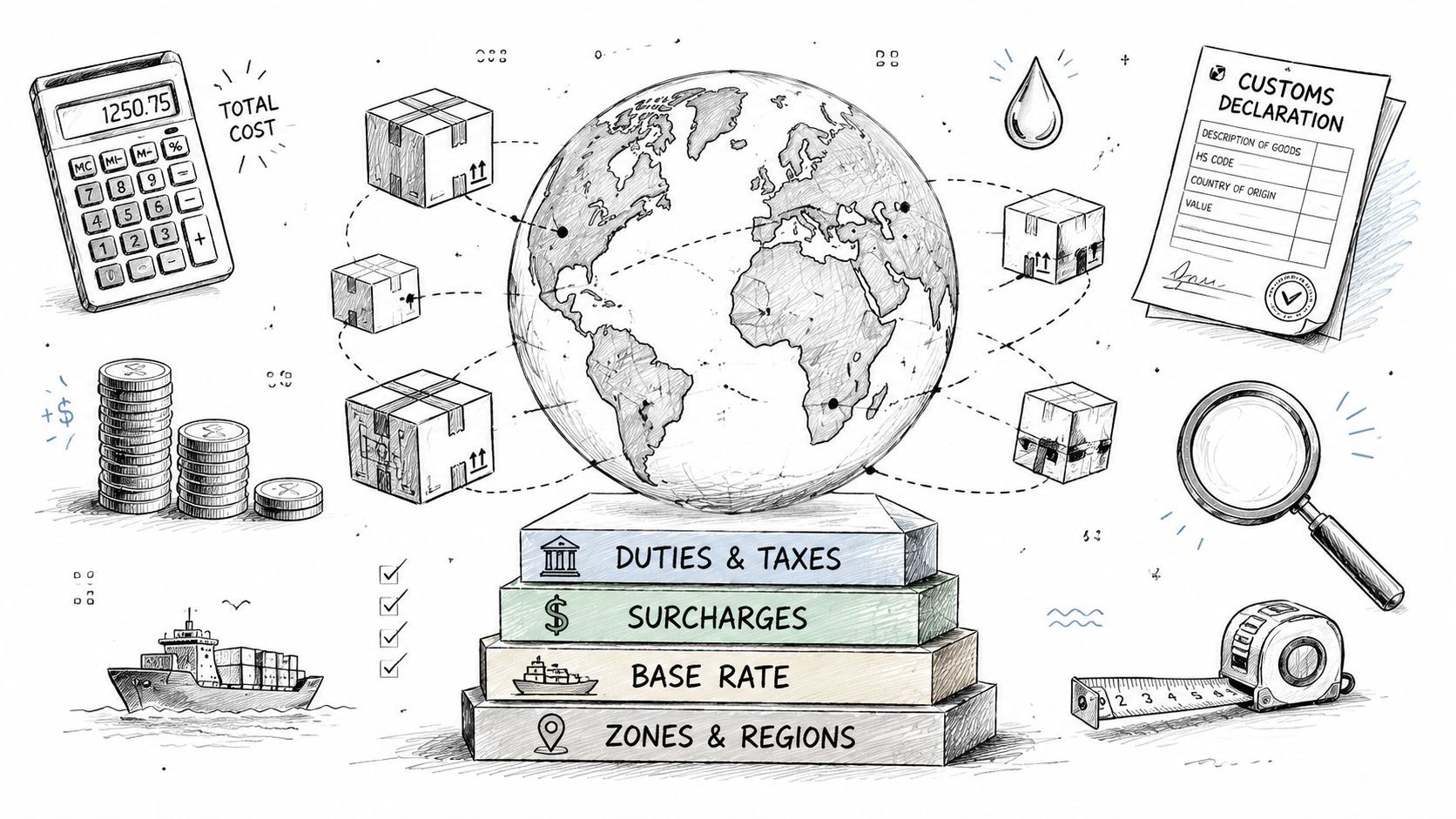
Think of an international shipment like a restaurant bill. The menu price gets your attention first, but the final total includes tax, service, add-ons, and sometimes fees you didn't notice on the first read. International shipping fees work the same way.

The base rate is the transportation price before the extras. It usually depends on origin, destination, package weight, package dimensions, and service level.
Then carriers start layering charges:
If you want a plain-language companion read, this shipping cost guide for online merchants is useful for seeing why the quote your backer imagines is often lower than the invoice you pay.
A lot of creators think shipping cost is just about how heavy the package is. It isn't.
Carriers also care about how much space the box takes up. That's dimensional weight. The easiest analogy is an airplane seat. A giant pillow doesn't weigh much, but it still occupies room that could have held something else. Carriers price for that lost space.
This matters for board games, collector boxes, plush rewards, and anything with premium packaging. A lighter but bulky package can cost more than a denser item.
For customs paperwork, product classification, and documents that support smooth clearance, this guide to customs documentation is worth reviewing before you lock your shipping setup.
Customs is where many creators get blindsided. The carrier may transport the package, but the destination country decides what import charges apply.
Under DDP, the shipper covers duties, taxes, and local fees. Under DDU, the receiver pays on arrival. UPS explains this clearly in its guide to international shipping costs and duty terms. That same guidance also notes that fuel surcharges can change weekly and sit on top of the base rate.
Under DDP, the shipper covers all import costs for a smoother backer experience. Under DDU, the backer gets the bill at the door.
For crowdfunding, DDP is often easier on the backer because the total feels predictable. DDU can work, but only if you communicate it clearly and your audience accepts that tradeoff.
Once you stop looking at shipping as one number, the next step gets easier. You estimate the landed cost, not just the postage.
FedEx describes the formula this way in its guide to understanding international shipping cost: Base Carrier Rate + Surcharges + (Duty Rate × Declared Value) + (VAT/GST % × [Declared Value + Duty]) + Fees. For many consumer goods, duties and taxes can add 10–25% on top of freight.
Break the calculation into layers:
Start with transport Get the carrier estimate for the package size, weight, origin, and destination.
Add variable surcharges Fuel, remote delivery, and similar extras belong here.
Apply import charges Duties depend on the product and destination. VAT or GST is then applied based on the country's rules.
Add fees Customs handling, disbursement, or brokerage-style fees can appear depending on the service.
For creators who want a practical planning workflow, this guide on how to estimate shipping costs is a helpful companion to your own spreadsheet.
Let's use a 2 kg board game as a planning example. Because duty rates, VAT, and fees vary by product classification and destination, treat this as a worksheet structure, not a universal quote.
| Cost Component | Ship to USA (Example) | Ship to Germany (Example) |
|---|---|---|
| Base carrier rate | Start with your chosen carrier quote for a 2 kg parcel | Start with your chosen carrier quote for a 2 kg parcel |
| Surcharges | Add fuel surcharge and any destination-specific extras | Add fuel surcharge, plus any remote or handling extras |
| Duty | Apply the destination's duty rate to declared value if applicable | Apply the destination's duty rate to declared value |
| VAT/GST | Often simpler than many VAT markets, but confirm local rules | Apply VAT to declared value plus duty under local rules |
| Fees | Add customs or carrier handling fees if charged | Add customs or carrier handling fees if charged |
| Final landed cost | Total of all above | Total of all above |
The common error isn't bad math. It's missing a layer.
A creator gets a parcel quote, multiplies it by backer count, and calls it done. But the backer experience depends on the final delivered cost, not the shipping label cost. If your reward is consumer goods crossing a border, the customs portion can materially change what you should charge.
Don't estimate from memory. Estimate from the exact package, service level, declared value, and destination country.
Most campaign pages need simple shipping language. Fulfillment does not. That tension creates a lot of avoidable mistakes.
The most dangerous shortcut is a single flat worldwide shipping fee. It feels clean during launch, but it treats very different destinations as if they were interchangeable. They aren't. A reward shipped to one region may work at your planned margin, while another destination turns into a loss.

A better model groups countries into practical shipping zones based on similar cost behavior. That doesn't mean every country in a zone costs the same. It means the range is manageable enough for one pricing rule.
Your spreadsheet should track:
Carriers changed rates between 2024 and 2025. UPS applied about a 5.9% increase to key services, FedEx applied about 5.9% on core package services and 6.9% on its Mexico Door-to-Door rate, and DHL Express increased U.S. account holder rates by about 5.9%, according to this roundup of 2025 shipping rate increases.
That's the practical problem with static Kickstarter shipping fields. You may set them months before fulfillment. If your estimate goes stale, your budget absorbs the difference.
A stronger campaign model usually follows this pattern:
This is why shipping strategy belongs in your financial model, not just your campaign copy.
A lot of guides stop right before the hardest step. They explain the fees, but not the collection workflow.
That's a problem, because surcharge risks can add 15–25% to cost, and remote area surcharges alone can increase costs by 25–50% for non-urban deliveries in 2025, according to this guide on hidden fees and surcharges in international shipping. If your system can't translate those risks into pledge-level charges, the insight doesn't help much.

Kickstarter's native pledge management flow is fine for simple use cases. But for international shipping fees, it behaves a lot like Amazon checkout. It's standardized, limited, and not built around your custom logistics logic.
A dedicated pledge manager works more like Shopify. You control more of the store, the rules, the add-ons, and the post-purchase flow. That difference matters when you need to:
That's why the pledge manager decision isn't just an operations choice. It's part of margin control.
A practical post-campaign workflow usually does four jobs in order:
Collect accurate addresses Bad addresses create failed deliveries, relabeling work, and extra support tickets.
Apply shipping rules Country, order composition, and service level should affect what the backer pays.
Handle taxes and customs choices If you're covering import costs, your system should reflect that. If you're not, your messaging must be unmistakable.
Offer relevant add-ons Relevant add-ons can generate revenue that offsets some fulfillment pressure.
A useful reference point here is PledgeBox. It's free to send the backer survey and only charges 3% of upsell if there's any. That fee structure matters because it lets creators use the survey and shipping collection process without adding a survey fee burden before they've even sorted fulfillment.
Here's a quick walkthrough of the kind of workflow a pledge manager supports:
The cheapest carrier quote can still become the most expensive outcome if the workflow around it is weak.
A static survey can't easily absorb changing surcharges, split regions intelligently, or collect extra payment from only the backers who trigger higher costs. A flexible pledge manager can. That's the effective solution for international shipping fees in crowdfunding. Not perfect prediction, but controlled collection after the campaign, when you know more.
A creator doesn't need one magic number. A creator needs a system that can adapt when the real numbers arrive.
Once your collection workflow is flexible, you can start reducing costs with intention instead of guesswork.

Shrink the parcel before you negotiate the rate
Packaging design affects dimensional pricing. A slightly tighter insert, fold, or outer carton can lower billed shipping weight. This matters a lot for board games and deluxe collector boxes.
Use shipping zones instead of one world price
Regional pricing reduces the need to overcharge easy destinations just to protect yourself from difficult ones.
Separate outliers
Remote islands, low-volume destinations, and hard-to-serve postcodes shouldn't distort the shipping fee for your core audience. Treat them as special cases.
Consolidate items into one shipment when possible
If a backer buys multiple add-ons, one well-packed parcel is often easier to manage than fragmented fulfillment.
Offer more than one service level
Some backers want the lowest possible shipping fee. Others will pay more for speed or smoother customs handling. Giving them a choice can reduce complaints on both sides.
Collect customs information early
Missing information slows fulfillment and can create avoidable fees later. Clean data upfront saves time and money.
For more practical methods you can apply inside a post-campaign workflow, this guide on how to reduce shipping costs is a useful checklist.
Creators often treat packaging as a branding decision first and a freight decision second. That's backwards for international fulfillment.
If you're rethinking inserts, outer cartons, or material choices, this piece on sustainable packaging for Australian businesses is a useful outside perspective. Sustainable packaging decisions can also overlap with shipping efficiency when they reduce bulk and unnecessary material.
Good packaging protects the product. Great packaging also protects the shipping budget.
International shipping fees feel chaotic when you treat them as one scary number. They become manageable when you break them into components, estimate landed cost carefully, and collect final charges through a flexible post-campaign process.
That's the shift that matters. You're not trying to eliminate complexity. You're building a system that can handle it without hurting your margin or surprising your backers.
For most creators, the key isn't finding a miracle carrier quote. It's moving from static campaign-era guesses to a smarter pledge-management workflow after funding. Kickstarter pledge manager is like Amazon and PledgeBox pledge manager is like Shopify. One is fixed and standardized. The other gives you room to run your project like a real store.
If you want a cleaner way to collect shipping, taxes, add-ons, and backer details after your campaign, PledgeBox gives creators a post-campaign workflow built for crowdfunding. It's free to send the backer survey and only charges 3% of upsell if there's any, which makes it practical for creators who need flexible international shipping fee collection without adding another fixed platform cost.
PledgeBox
The All-in-One Toolkit to Launch, Manage & Scale Your Kickstarter / Indiegogo Campaign