 PledgeBox
Crowdfunding Success: Deliverance Board Game Case Study
Discover how the Deliverance board game became a crowdfunding success. Learn vital lessons on fulfillment, pledge managers, & shipping for your project.
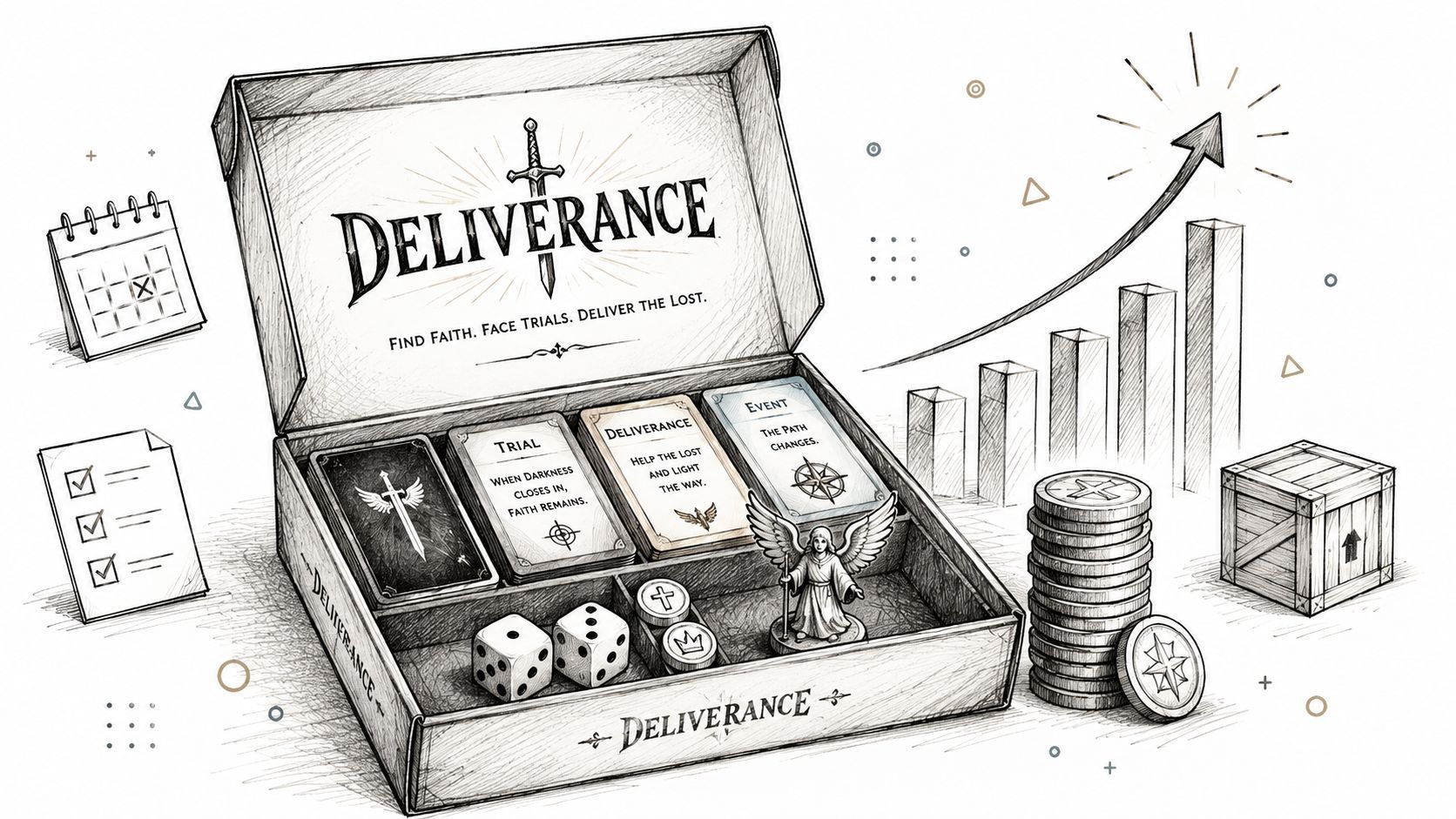
Discover how the Deliverance board game became a crowdfunding success. Learn vital lessons on fulfillment, pledge managers, & shipping for your project.
You're probably in one of two places right now. You've either got a board game campaign on the horizon and you're obsessing over the launch page, or you've already realized the launch is only half the job and the hard part starts when the funding period ends.
That's why the Deliverance board game is such a useful case study. Most coverage focuses on theme, minis, missions, or market buzz. Creators need a different lens. They need to ask what a project like this teaches about product positioning, survey design, add-ons, SKU control, freight planning, and the systems that protect your margin after the applause fades.
Launch day creates a flattering illusion. Funding climbs, comments fill up, and creators start reading the campaign as proof that the hard part is behind them. In practice, a strong launch usually means the opposite. It means the project has earned enough attention to make every later operational mistake more expensive.
Deliverance is a useful case study for that reason. Independent coverage describes it as a Christian fantasy angels-versus-demons board game with a 14-mission campaign, support for solo and group play, and a separate skirmish mode for replayability. The same review also points to signs that interest lasted well beyond the campaign itself, including standout crowdfunding performance in its niche and a later surge in BoardGameGeek visibility in late 2023, as noted in EverythingBoardGames' review.
For creators, the lesson is not about copying the theme. The lesson is product clarity. Deliverance presented a specific promise to a specific audience, and that usually gives a campaign more durable traction than broad fantasy positioning aimed at everyone.
Audience fit showed up in the way the project was discussed. Backers could describe what made it distinct, who it was for, and why it felt different from a generic dungeon crawl. That kind of clarity lowers acquisition costs, improves referral behavior, and gives creators better odds of carrying momentum into pledge collection and late support.
I have seen first-time teams miss this by treating prelaunch audience building as a follower count exercise. It works better as offer design. A subscriber joins because they get something concrete, whether that is early faction previews, scenario updates, or a useful print-and-play sample. If you need a practical refresher on that, what is a lead magnet is a useful read because it frames audience building as a clear exchange rather than vague community growth.
Practical rule: If a backer cannot explain your game in one sentence, your campaign page is creating confusion that will show up again in customer support.
Deliverance also highlights a point many creators only learn after funding closes. Product depth sells. Product depth also creates work. A campaign game with multiple modes, strong thematic identity, and engaged backers usually brings more questions about pledge levels, add-ons, replacement parts, wave timing, and shipping expectations.
That is the operational angle standard reviews often miss. Crowdfunding success does not just validate demand. It increases the number of records you need to manage correctly, the number of edge cases your survey must handle, and the cost of every unclear promise on the campaign page.
Deliverance looks like the kind of project creators want to build. It is also the kind of project that rewards disciplined post-campaign systems and exposes weak ones quickly.
A creator hits funding, opens the manufacturing files again, and realizes the game is carrying more operational complexity than the campaign page made obvious. Deliverance is a good case study because its appeal comes from structured tactical play, not just theme. That distinction matters after funding closes, because systems-heavy games create tighter production tolerances and more support risk.

Deliverance presents itself as a mid-weight tactical co-op with enough rules structure to reward repeat play. The official how-to-play video shows a 2d6 resolution system, modifier-based tests, orthogonal movement, a Darkness phase, and a staged Prince deck that increases pressure over time (official how-to-play video).
For players, that creates decision density. For creators, it changes the job after the campaign.
A game built around position, timing, card sequencing, and coordinated actions usually draws backers who read closely and notice inconsistencies fast. They care whether iconography is clear, whether reference text is precise, and whether edge cases are answered in the rulebook instead of in the comments. If you want a practical framework for sizing that operational workload before launch, this board game Kickstarter planning guide is useful because it connects campaign structure to what has to be administered later.
The Prince deck is the most instructive design signal here. It appears to use layered encounter escalation rather than flat randomness. That tends to produce a better tactical arc, because players can feel the pressure building and adjust around it.
It also raises the cost of small production errors.
If difficulty depends on deck order, card labeling, star-level grouping, and consistent wording, then prepress review has to be tighter than it would be for a lighter game with looser scenario logic. One swapped card back or one ambiguous timing phrase can create replacement requests, FAQ sprawl, and avoidable friction in the pledge manager period. I have seen creators underestimate this point, then spend weeks answering rules questions that were really file-control problems.
Deliverance works as a creator case study because the fantasy hook and the mechanics support the same promise. Angels versus demons gets attention. Tactical cooperation and progression give the game staying power.
That combination often improves conversion, but it can also raise customer acquisition costs if ads promise theme while the game sells on systems. Teams trying to scale paid traffic need to protect ROAS with Meta ad cost modeling before they widen targeting, especially for a game that appeals to strategy buyers more than impulse buyers: protect ROAS with Meta ad cost modeling.
The post-campaign lesson is straightforward. If your replay value depends on tightly connected mechanics, fulfillment is not just a shipping exercise. It is quality control, data accuracy, parts consistency, and clear backer communication all the way through delivery. A tactical game can survive a longer teach. It does not survive sloppy execution nearly as well.
Deliverance found a lane that many campaigns chase and few hit cleanly. It sat in a market position that was specific enough to stand out and broad enough to scale. That's a useful combination.
Official product data places it in the 1 to 4 player, 1 to 2 hour range, and product copy frames it as a game driven more by systems and resources than story on the official product page. That tells experienced backers what kind of evening this is going to be. It's not a filler game. It's not an all-day campaign marathon either.
A lot of campaign pages fail because they keep adding features without clarifying the play experience. Deliverance appears to have done the opposite. The game's market position was readable:
| Positioning element | Why it matters to backers |
|---|---|
| Mid-weight strategy | Signals meaningful decisions without extreme teach burden |
| 1 to 4 players | Covers solo buyers and standard game night groups |
| 1 to 2 hour playtime | Fits regular table schedules better than very long scenarios |
| Systems-first design | Appeals to players who value optimization and replayability |
That kind of clarity helps every layer of the campaign. It sharpens ad targeting, makes preview coverage easier to understand, and reduces confusion in pledge selection.
Deliverance didn't need to convince everyone. It needed to convince the right overlapping groups. Hobby board gamers could see the tactical angle. Faith-based players could see the thematic identity. That overlap is valuable because it creates multiple entry points into the same product.
If you're planning ads before launch, don't guess at cost tolerance. Model it. Teams trying to protect margin on paid acquisition should protect ROAS with Meta ad cost modeling before they scale spend. That work is boring compared with art reveals, but it keeps you from buying expensive traffic for a weakly defined offer.
Operational takeaway: The easier it is to describe who the game is for, the easier it is to build pledge tiers that don't confuse buyers later.
Creators often separate marketing from operations as if they're different jobs. They aren't. The campaign structure determines what kind of fulfillment mess you inherit.
When I review successful tabletop campaigns, I look for one thing first. Can I see the fulfillment problem forming inside the offer structure? A polished project page can still hide a bad post-campaign model if it stacks too many optional extras, edition differences, and vague exclusives.
If you want a practical breakdown of how board game creators structure Kickstarter offers, the board game Kickstarter guide is useful because it treats the campaign as a commercial system, not just a marketing event.
Deliverance is a good example of product-market fit done well. The hidden lesson is that strong fit creates stronger expectations. Once backers understand the value proposition, they expect the post-campaign operation to be just as clear.
The campaign is over. Funding is secured. Backers are excited. That's exactly when operational mistakes get expensive.
Deliverance is a strong case study because the product is content-rich enough to be commercially attractive and operationally risky. The expansion adds 6 new playable angels and a branching campaign with secondary objectives, according to the reporting referenced in this video coverage of the project. For players, that sounds exciting. For operations, that means more files, more components, more packaging decisions, and more ways to ship the wrong thing.

Creators usually think about complexity as a design issue. Backers feel it as a delivery issue.
Once a campaign includes a base game plus expansion content, you're dealing with questions like these:
A single add-on can ripple through manufacturing and freight. A campaign expansion with new playable characters and branching content does more than that. It changes the whole fulfillment map.
Creators commonly get burned. They build stretch content like designers and have to ship it like logistics managers.
A practical shipping framework helps. The board game shipping guide is useful because it keeps attention on cartons, warehouse handling, regional delivery, and the final handoff to backers. Those are the places where “we'll figure it out later” becomes margin loss.
The post-campaign phase rewards teams that make fewer promises and document them better.
This short walkthrough helps frame what happens after funding:
The right lesson from Deliverance isn't “avoid ambition.” It's “price ambition into your operations.”
Use the project as a checklist for your own planning:
The Deliverance board game shows how attractive campaign content can create a harder fulfillment environment. Backers increasingly scrutinize those risks before they pledge. Creators should, too.
Once the campaign closes, you need one system to collect addresses, lock orders, handle add-ons, calculate shipping charges, and keep late decisions from breaking your fulfillment file. That system is the pledge manager.
I see creators choose convenience over control. That can work for a very simple project. It breaks down fast once you have multiple reward combinations, add-ons, tax handling, and post-campaign upsells.
The cleanest analogy is this. Kickstarter's pledge manager is like Amazon. PledgeBox pledge manager is like Shopify. Amazon is integrated and easy to step into, but you operate inside tighter constraints. Shopify gives you more control over how the store works, what the customer sees, and how you structure the buying experience.
That difference matters more for tabletop than many teams expect. Board games often need late pledge handling, expansion offers, address corrections, region-specific shipping collection, and exports that manufacturers and fulfillment partners can use.
Here's the practical comparison.
| Feature | Kickstarter Native Surveys | Dedicated Pledge Manager (e.g., PledgeBox) |
|---|---|---|
| Survey collection | Basic native flow | More configurable branded flow |
| Add-on upsells | More limited | Built for post-campaign expansion and add-ons |
| Shipping fee collection | Simpler use case | Better suited for layered shipping collection |
| Late backers | Narrower workflow | Better fit for ongoing pre-order handling |
| Operational exports | Platform dependent | Typically designed for fulfillment handoff |
| Storefront flexibility | More rigid | More customizable |
This is the point creators usually care about most. If you're watching margin after manufacturing quotes, software fees become emotional very quickly.
The author's brief here is directionally right and worth stating plainly. PledgeBox is free to send the backer survey and only charges 3% of upsell if there's any. For a creator, that means you can run surveys without adding an upfront software line item just to gather shipping data and finalize orders. The fee only shows up if upsells happen.
That structure changes how I'd evaluate tools for a board game campaign. If the project has expansion potential, add-on bundles, or late backer demand, the question isn't just “what does the tool cost?” It's “what does rigid workflow cost me in missed revenue and preventable admin time?”
If you're also planning a late pledge or pre-order phase, the pre-order board games guide is a useful reference because it treats post-campaign demand as an extension of operations, not an afterthought.
What works:
What doesn't work:
Decision test: If your project has enough complexity to need a spreadsheet owner, it has enough complexity to justify a real pledge manager.
For a project with Deliverance-level content planning, I wouldn't rely on the simplest native workflow unless the offer structure stayed extremely tight. Tactical board games with expansions and long-tail interest need cleaner post-campaign systems than most creators think.
A campaign closes on Friday. By Monday, backers are asking whether solo play gets the same support as group play, which add-ons fit their pledge, and when addresses will lock. That period decides whether your project feels managed or improvised.
Deliverance makes a useful case study because the game itself gives creators clues about what happens next. It is officially listed as a “1-4 co-op & solo” game on the official site. That matters operationally, not just commercially. A solo buyer and a regular four-player host often respond to different post-campaign offers, ask different support questions, and judge value in different ways.
Creators often treat the survey as an address form with upsells attached. That leaves money on the table and creates avoidable support load.
If your game serves distinct play styles, build survey logic and update language around those differences. Solo players tend to care more about setup friction, replay structure, and storage convenience. Group-focused backers are more likely to ask about teaching time, campaign scheduling, and how expansions fit into a shared collection. If you know those patterns early, you can present add-ons more clearly and reduce confused follow-up messages after the campaign.

Use this before your campaign closes:
Backers forgive complexity when the creator makes decisions clear. They punish complexity when the creator makes them do the sorting.
The lesson I would carry from Deliverance into a first campaign is simple. Post-campaign operations are part of backer trust, not a back-office task. Creators who handle surveys, add-ons, delays, and fulfillment changes with clear rules train their audience to stay with them for the next launch. That matters more now because crowdfunding does not end at funding anymore. It continues through late pledges, follow-on products, and repeat campaigns, and backers remember which teams stayed organized after the excitement wore off.
If you're planning a tabletop campaign and want a cleaner post-campaign process, PledgeBox is worth evaluating as part of your operations stack. It handles backer surveys, shipping and tax collection, add-on upsells, and late pledge workflows in one place, which is exactly the kind of control creators need when a board game campaign grows beyond a simple base-game offer.
PledgeBox
The All-in-One Toolkit to Launch, Manage & Scale Your Kickstarter / Indiegogo Campaign