 PledgeBox
How Long Does a Kickstarter Campaign Last? Optimal Length
Discover how long does a kickstarter campaign last. We analyze data on 14, 30, & 60-day campaigns to find your optimal length for success.
Discover how long does a kickstarter campaign last. We analyze data on 14, 30, & 60-day campaigns to find your optimal length for success.
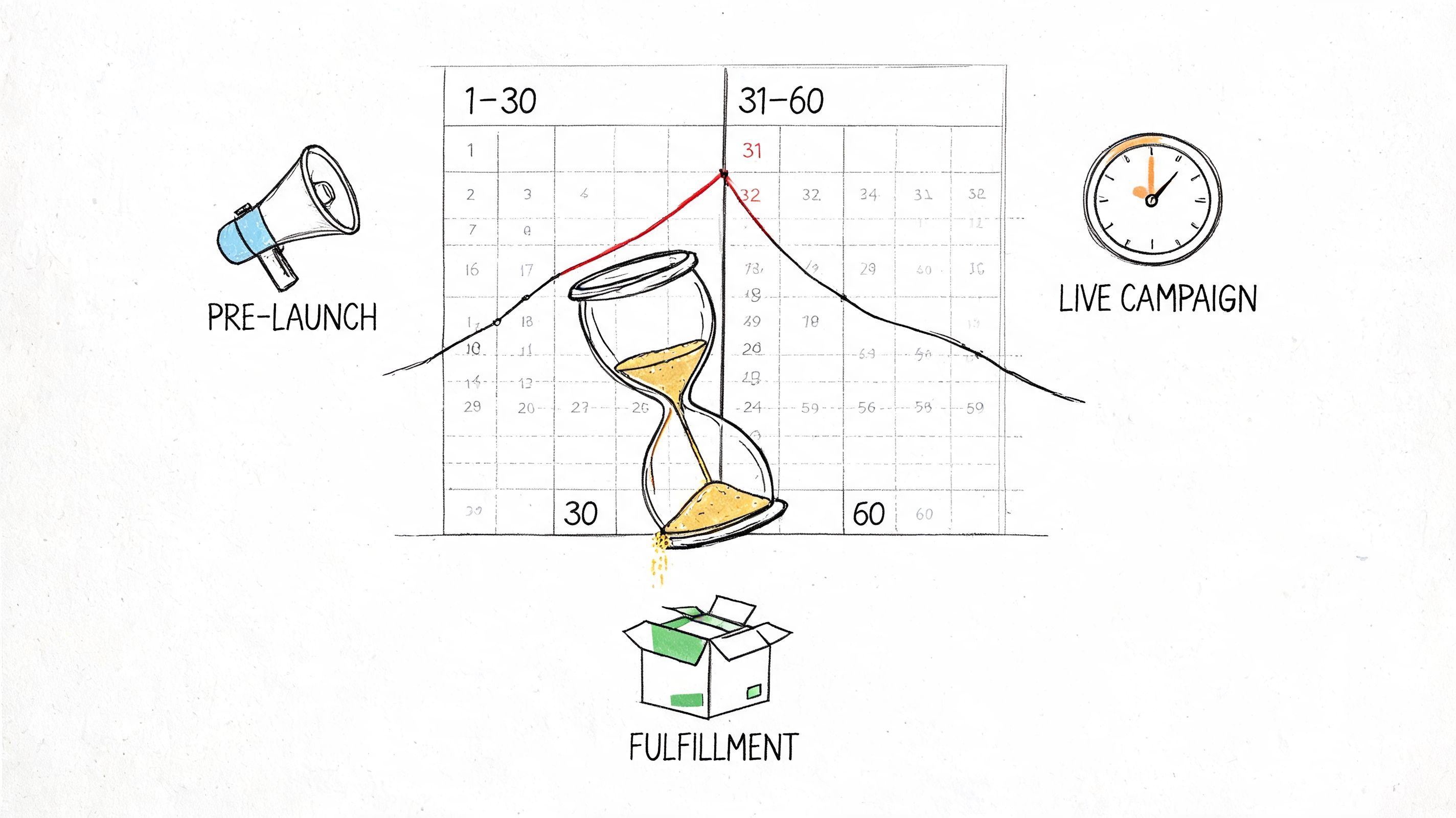
A Kickstarter campaign can last from 1 to 60 days, but campaigns of 30 days or less have significantly higher success rates. In practice, the best duration for most creators is a shorter window, because long campaigns lose urgency and rarely perform better.
If you're on the Kickstarter setup screen right now, the duration field can feel deceptively small. It isn't. That one choice affects your launch calendar, your ad spend, your update schedule, your energy, and the amount of post-campaign work you'll have waiting for you.
Most first-time creators ask the wrong version of the question. They ask, "How long does a Kickstarter campaign last?" The better question is, "What is the shortest campaign length that gives my project enough time to win?" That framing leads to better decisions.
I've seen creators treat duration like extra insurance. They assume more days means more discovery, more pledges, and more room to recover. Usually, the opposite happens. A campaign that drags on creates a soft middle where backers stop checking in, creators burn through their launch content, and the project starts to feel old before it's even funded.
A smarter approach starts before launch. If you're still validating your offer, your audience, or the problem your product solves, resources like Bruce and Eddy can help you tighten the idea before you lock in a duration you can't change.
Campaign duration isn't an admin setting. It's a strategic constraint. Once you choose it and launch, you're committed to it, so the decision has to match both your audience and your operational reality.
Creators often swing between extremes. One group wants a short sprint because they like urgency. The other wants the full runway because they fear missing late backers. Neither instinct is wrong. The mistake is choosing based on comfort instead of campaign mechanics.
Your duration shapes more than the fundraising period. It influences:
Practical rule: Choose the shortest duration that your audience and launch plan can realistically support.
That last point matters more than most articles admit. A campaign doesn't end when funding closes. It rolls straight into surveys, production coordination, shipping decisions, and backer communication. A bloated live campaign often means you arrive at that phase already tired.
If this is your first project, duration needs to fit your actual readiness, not your optimism. If your audience is still warming up, a little more room can help. If your audience is already waiting, extra days usually add friction, not value.
A good duration does three jobs at once. It creates urgency for backers, protects your own energy, and gives you a clean handoff into the much longer fulfillment phase that follows.
Kickstarter's official rule is simple. You can set your project for 1 to 60 days, and once the campaign is live, that duration can't be changed, according to Kickstarter's project duration guidance.

That sounds flexible. In reality, experienced creators treat it as a narrow decision range, not a broad one. Kickstarter's own guidance says projects lasting 30 days or less achieve significantly higher success rates, and campaigns beyond the outer limit rarely succeed because they dilute urgency and momentum.
A long duration feels safe when you're anxious. It gives you the illusion of time to fix weak launch performance. But weak launch performance usually isn't fixed by waiting. It's fixed by stronger pre-launch work, better rewards, sharper pricing, or clearer messaging.
Backers don't think in terms of your production calendar. They react to urgency and confidence. If they see a campaign with a long runway, many assume they can come back later. Some do. Many don't.
Three things usually happen in long campaigns:
If you need a basic platform refresher before choosing duration, read how Kickstarter works. It helps to understand the mechanics before optimizing the timeline.
Shorter campaigns concentrate attention. That matters because the strongest funding activity typically clusters early, when your core audience is most alert and your launch messaging is fresh. A compact timeline pushes your best prospects to decide while your campaign still feels active.
Kickstarter's help guidance also points to practical recommendations from Jamey Stegmaier. First-time creators should generally consider 28 to 35 days, while repeat creators should aim for 21 to 25 days. That advice lines up with what seasoned campaign operators already know. New creators need some room for discovery and momentum-building. Returning creators can rely more heavily on launch-day energy.
A short campaign doesn't mean rushed. It means prepared.
A short campaign only works when the heavy lifting happened before launch.
That's why creators who insist on 45 to 60 days often end up solving the wrong problem. They're trying to compensate for weak pre-launch planning with extra time on the calendar. Time doesn't create trust. It only exposes whether demand was there in the first place.
This walkthrough is useful if you want a visual perspective on why duration and pacing matter during a live campaign.
Don't ask how long your campaign can last. Ask how short it can be without hurting conversion. That's the decision experienced creators make.
If your pre-launch list is active, your page is strong, and your rewards are clear, a long campaign usually weakens performance. If those ingredients aren't ready yet, extending the campaign won't save it.
Duration is a trade-off between urgency, discovery time, and creator endurance. There isn't one perfect number for every project, but there is a pattern. The more audience certainty you have before launch, the shorter your campaign can be.
| Factor | Short (14-21 Days) | Medium (28-35 Days) | Long (45-60 Days) |
|---|---|---|---|
| Backer urgency | Very high. People feel they need to act now. | High, but still comfortable for most backers. | Low. Many delay and forget. |
| Discovery window | Narrow. You need attention early. | Balanced. Enough time for momentum and discovery. | Wide in theory, weak in practice if momentum fades. |
| Marketing pressure | Intense. You need your launch assets ready. | Manageable for most teams. | Hard to sustain without repetition and fatigue. |
| Creator workload | Compressed and demanding. | Busy, but more stable. | Draining. The campaign can start to dominate your calendar. |
| Mid-campaign slump risk | Lower because there isn't much middle. | Present, but easier to manage. | High. The middle often feels endless. |
| Best fit | Established audience, warm leads, nearly finalized offer | First-time creators and most balanced launches | Rare cases where timing constraints justify it |
A 14 to 21 day campaign can work well when you already have a responsive audience, a polished page, and a simple reward structure. This format creates sharp urgency. Your launch communications feel more like an event than an open-ended invitation.
The problem is that short campaigns leave little room for correction. If your trailer underperforms, your email timing is off, or your ad creative misses, the window closes fast. You don't have much time to recover.
This format is strongest when:
A 28 to 35 day campaign is where most first-time creators should start. It gives you enough room to launch hard, collect outside discovery, and still keep the finish line visible.
This is the range I recommend most often because it balances two competing needs. Backers still feel time pressure, but your campaign doesn't become a marathon. You can pace updates, build a midpoint story, and save meaningful content for the final push.
The best campaign length isn't the one with the most days. It's the one that lets you stay convincing from launch to close.
A medium campaign also gives you room to execute stronger endgame tactics. If you want to sharpen your finish, study how to maximize the last 48 hours of your Kickstarter campaign. The final stretch matters more when the earlier pacing has been controlled.
A 45 to 60 day campaign sounds forgiving. It usually isn't. The biggest issue isn't just backer hesitation. It's operational drag.
By week four or five, many creators have already used their strongest announcements, partnership outreach, update themes, and social proof. Then they start inventing activity to keep the page alive. That often leads to unnecessary stretch complexity, mixed messaging, or pricing moves they hadn't planned carefully.
Long campaigns also distort your internal timeline. Your manufacturer conversations, survey planning, logistics prep, and post-campaign customer support all get pushed back because the live campaign consumes more attention than expected.
A long duration can make sense in narrow situations, such as a campaign tied to an event calendar, a licensing window, or a staggered audience rollout. But those are exceptions. They are not a default strategy.
The best duration depends on what you're selling, how finished it is, and how your audience buys. Product type changes the rhythm of the campaign.

If you're launching a board game, card game, or tabletop expansion, a 28 to 35 day range is usually the most practical fit. These campaigns often rely on community engagement, rules questions, component reveals, and stretch content that unfolds over time.
Backers in tabletop don't just buy. They inspect. They want to understand gameplay, reward differences, add-ons, and shipping implications. A medium duration gives you room to answer those questions without dragging the campaign into fatigue.
This is a good fit when:
If you're launching a hardware product with a strong prototype and a clean value proposition, a 21 to 25 day campaign often works better. Tech backers tend to respond to momentum, media spikes, creator credibility, and a sense that the launch is moving quickly.
A longer campaign can become dangerous here because hardware campaigns already face skepticism around delivery. If your live period stretches too long, some backers start wondering why the demand isn't stronger.
The right message is confidence, not caution. A shorter campaign supports that signal.
If you're selling a finished concept with a working prototype, act like it. Long timelines can make a polished product feel tentative.
For projects where most of the creative work is already complete, a 15 to 20 day sprint can be very effective. Books, comics, art prints, and smaller creative editions often benefit from concentrated launch energy rather than prolonged exposure.
These campaigns do well when the rewards are easy to grasp. A signed edition, a deluxe version, a bundle, or a digital package doesn't need six weeks of explanation. If the audience already knows you, a shorter campaign keeps the experience lively and manageable.
A sprint format is strongest when the project is already close to fulfillment readiness. That matters because shorter campaigns transition more cleanly into the operational phase.
Some creators don't fit neatly into a category. Maybe your audience is warm but not huge. Maybe the prototype is good, but your page is still being refined. Maybe your product is simple, but your shipping setup is not.
In those cases, don't optimize for boldness. Optimize for control.
Choose a medium window if:
The right duration is the one that matches your weakest constraint. If your marketing is strong but operations are shaky, don't choose a duration that creates more chaos. If your product is polished but your audience is still small, don't force an ultra-short sprint just because it sounds disciplined.
Campaign duration only makes sense inside the full project timeline. A Kickstarter isn't just a funding window. It's a chain of commitments that starts before launch and keeps going long after the page closes.

If you're still building your audience, your duration choice should reflect that realistically. A shorter campaign needs stronger pre-launch preparation. A medium campaign gives you a little more room, but it still can't compensate for weak demand.
Your pre-launch work should focus on three things:
If you need help tightening this phase, Kickstarter pre-launch planning is worth reviewing. A good campaign duration starts with a good pre-launch signal.
Once you're live, duration determines the shape of your work. A short campaign is intense and compressed. A medium campaign needs pacing. A long campaign demands stamina most creators underestimate.
During the live period, your job is repetitive in the best way. You answer questions, publish updates, monitor traffic quality, and keep the page trustworthy. The mistake is thinking every day needs a new stunt. It doesn't. It needs consistent signals that the campaign is active, responsive, and moving toward delivery.
Here's the practical difference by timeline:
Many first-time creators underestimate the post-campaign phase. After the campaign closes, fulfillment usually takes about 12 months from campaign end to last backer delivery, according to Kickstarter's post-campaign fulfillment timeline. That same guidance notes that funds take a few weeks to clear, and complex products or first-time creators can extend the process to 18 to 24 months.
That changes how you should think about campaign duration.
If a campaign only lasts a few weeks but fulfillment may take around a year or longer, then your live duration should serve the next phase, not compete with it. A leaner campaign lets you move faster into surveys, production confirmation, shipping setup, and backer expectation management.
The campaign page closes fast. The responsibility to deliver stays with you for months.
Post-campaign work isn't glamorous, but it's where many projects either gain control or lose it. You'll need a system for collecting addresses, confirming reward selections, handling add-ons, charging shipping where appropriate, and keeping communication organized.
This is also where creators should think like store operators, not just campaign owners. Kickstarter's native pledge tools are more like Amazon. Functional, standardized, and limited in how much you can customize the buying experience. A dedicated pledge manager is more like Shopify. It gives you more control over branding, product presentation, add-ons, and the backer journey after funding.
That distinction matters because the end of the campaign is often where extra revenue is either captured or abandoned. If your rewards support add-ons, late selections, or upgraded bundles, your operational stack should make that easy, not awkward.
One practical note from the publisher's brief belongs here because it's specific and useful. PledgeBox is free to send the backer survey and only charges 3% of upsell if there's any. That pricing model changes the risk calculation for creators who want a more flexible post-campaign flow without adding fixed survey cost.
The cleanest campaigns are built backward from fulfillment. If production is complex, don't burn unnecessary energy on an oversized live period. If your rewards are simple and mostly complete, use a shorter duration to reach the post-campaign phase faster.
When creators ask me how long does a kickstarter campaign last, I answer with the platform rule first. Then I answer with the operational truth. The campaign may run for a few weeks, but your responsibility runs much longer. Choose a duration that helps you manage both.
The right Kickstarter duration is rarely the maximum allowed. It's the shortest timeline that lets your audience act while your campaign still feels alive.
For most creators, that means staying at 30 days or less. If it's your first campaign, a medium window usually gives you the best balance of urgency and discovery. If you already have an engaged audience and a polished offer, you can go shorter. If you're leaning toward a long campaign because it feels safer, pause and ask whether you're trying to solve a pre-launch problem with extra calendar space.
That's the core judgment. Duration is a strategy choice, not a default setting.
Choose a length that matches your audience readiness, your content stamina, and your operational capacity after funding ends. A good campaign doesn't just get funded. It hands off cleanly into surveys, production, shipping, and backer communication without leaving you depleted.
If you make that decision with the full timeline in mind, you're already operating like a creator who plans to deliver, not just launch.
If you want a post-campaign system that gives you more control than Kickstarter's native flow, PledgeBox is worth a close look. Think of Kickstarter's pledge manager like Amazon, while PledgeBox feels more like Shopify for crowdfunding creators. You can send backer surveys for free, and PledgeBox only charges 3% of upsell if there is any, which makes it a practical option for creators who want branded surveys, add-ons, shipping collection, and a cleaner handoff from funding to fulfillment.
PledgeBox
The All-in-One Toolkit to Launch, Manage & Scale Your Kickstarter / Indiegogo Campaign