 PledgeBox
Your Board Games Kit: From Prototype to Pledge Manager
Build your complete board games kit for crowdfunding success. A step-by-step guide on prototyping, pricing, pledge managers, fulfillment, and more.
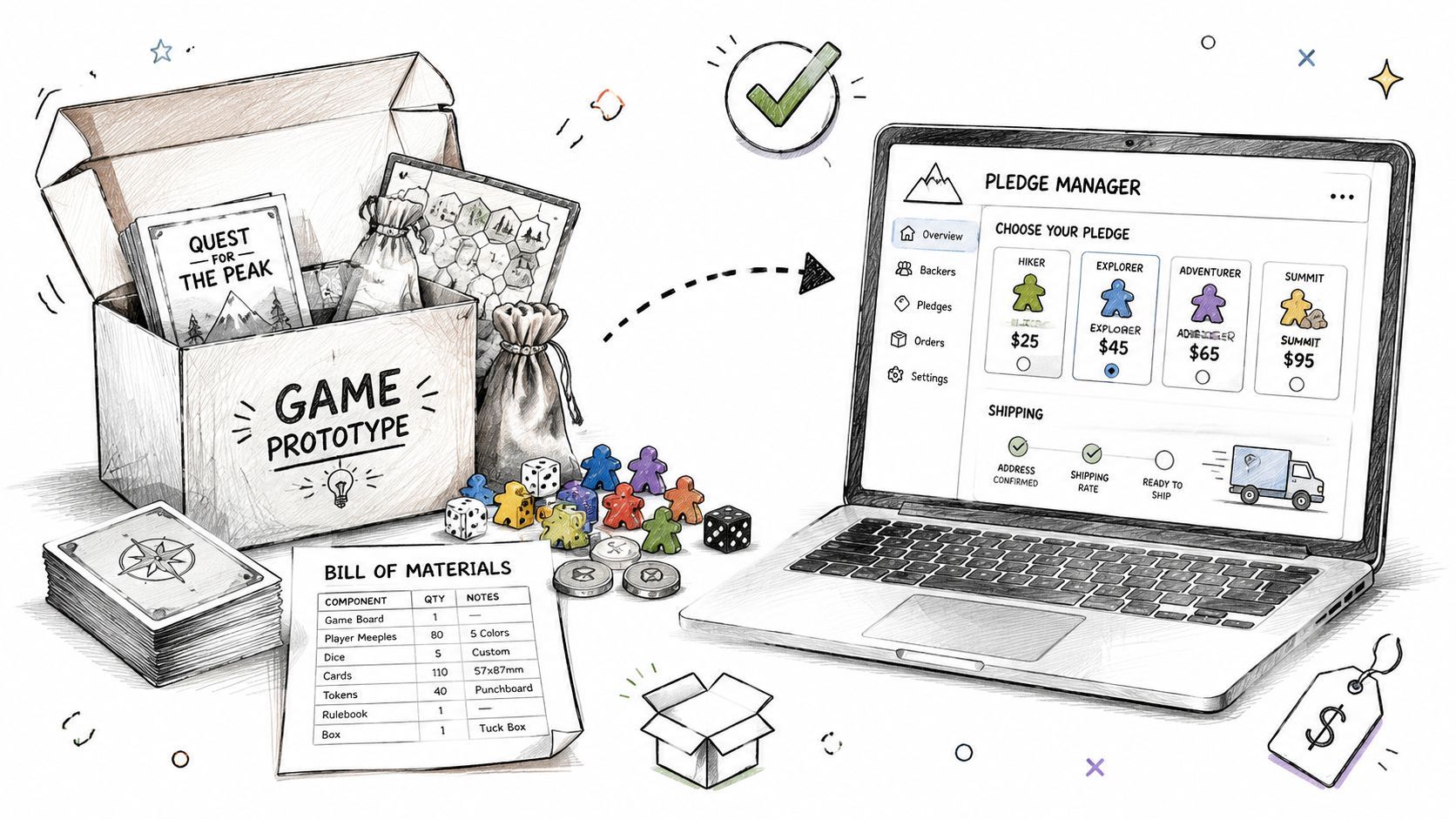
Build your complete board games kit for crowdfunding success. A step-by-step guide on prototyping, pricing, pledge managers, fulfillment, and more.
Most advice about a board games kit is aimed at players. It talks about storage trays, sleeves, component upgrades, or a nice box for game night. That's useful for customers. It's incomplete for creators.
For a publisher, a board games kit starts long before manufacturing and ends long after funding. It includes the prototype parts on your table, the media assets reviewers need, the bill of materials your factory quotes against, the SKU logic behind pledge tiers, the survey flow that collects shipping and tax details, and the fulfillment files that keep a warehouse from shipping the wrong expansion to the wrong country. If any one of those pieces is sloppy, the campaign feels it.
Most creators think of the kit as the game itself. I think that's the first mistake.
A publisher's board games kit is an operating system. The physical game is only one layer. The other layers are asset prep, pricing logic, fulfillment rules, tax handling, backer communication, and post-campaign sales. Most content still focuses on design or generic game-night bundles, while missing the post-funding stack that creators struggle with, including surveys, VAT and tax collection, shipping-rate logic, address validation, and late backer upsells, as noted in this discussion of the gap in creator guidance on post-funding board game campaign operations.

A campaign can fund and still become a mess. That usually happens when the creator treats launch day as the finish line instead of the handoff to operations.
Three gaps show up over and over:
That handoff matters even before launch. Audience capture, reminder sequences, and community building need the same discipline as the fulfillment side. If you're tightening the top of your funnel, the DMpro founder playbook for leads is a useful reference because it treats lead generation like a repeatable system instead of a one-off launch push.
Practical rule: If your board games kit doesn't include both a prototype plan and a post-campaign operations plan, it isn't a complete kit.
A working board games kit for crowdfunding usually includes:
That sounds less romantic than game design. It also decides whether the campaign stays profitable and whether backers remember your brand for the right reasons.
Good prototypes don't need to look expensive. They need to answer questions fast.
The fastest teams I know don't custom-produce every test piece. They use generic parts until the rules are stable. Atlas Games' White Box is built for exactly that kind of work, with reusable dice, meeples, cubes, other generic materials, and design essays that support iterative development in a standardized toolkit, as described on the Atlas Games White Box page. That matters because generic components let you test game flow and balance without confusing component art decisions with gameplay decisions.

A practical first prototype usually has three jobs:
If you're still in paper-first mode, this guide to paper prototype game design workflows is the right place to keep things lean before you spend time on polished samples.
Most first-time creators wait too long to build a bill of materials. That's backwards. The BOM should exist before serious quote requests, because factories price what you specify, not what you vaguely describe.
A useful BOM includes:
A prototype that can't be translated into a BOM is still a design exercise, not a production-ready game.
Custom parts are where enthusiasm burns cash. If a die face may change, don't tool it yet. If your miniatures aren't locked, don't let them dictate your box dimensions too early. If your insert only works for one exact card sleeve thickness, you're creating future support tickets.
That discipline carries into vendor selection too. The same habit that helps teams spot handling corporate gifting budget leaks applies here: break costs into small, reviewable decisions instead of treating production as one giant quote. Board games punish hidden complexity.
What works is boring. Reusable prototype parts. A BOM that gets updated after every major playtest cycle. Supplier conversations that start with manufacturable specs instead of mood boards.
What doesn't work is prettier. Hand-built prototypes full of one-off pieces, no clean part list, and a launch timeline that assumes manufacturing will "figure it out."
A campaign doesn't become healthy because the funding total looks good. It becomes healthy when the product structure survives manufacturing, pick-and-pack, and post-campaign add-ons without creating margin leaks.
That pressure is increasing because board games aren't a tiny niche anymore. One market summary estimates the global market at $12.8 billion in 2025 and says 47% of sales now come through online and e-commerce channels, which is why direct-to-fan fulfillment matters so much for crowdfunding campaigns, according to this roundup of board game market and channel statistics.

Creators often treat packaging as branding. Warehouses treat it as handling logic. Carriers treat it as dimensional weight. All three are right, but only one of them can bankrupt your shipping plan.
Packaging decisions affect:
A beautiful box that forces awkward outer cartons or requires hand-assembly at the warehouse isn't a good box. It's a support problem waiting to happen.
Most pledge tier mistakes start with generosity. A creator wants to give backers flexibility, so the campaign grows extra editions, stretch bundles, upgrade packs, and region-specific variants that look manageable on the page. Then survey setup starts, and every promise becomes a SKU or sub-SKU.
Keep your structure tight. A sane board games kit usually has:
| SKU type | What it should do | What usually goes wrong |
|---|---|---|
| Base game | Cover the core product cleanly | Too many "limited" variations |
| Deluxe version | Add clear component upgrades | Includes exclusive pieces that complicate replacements |
| Expansion | Stand alone as a separate line item | Depends on hidden compatibility rules |
| Add-on accessory | Be easy to pick and pack | Gets bundled into multiple tiers inconsistently |
A manufacturing quote is one input. It is not the pledge price.
Your pricing model has to absorb the whole stack:
Publishing reality: The pledge level that looks strongest on your campaign page can be the one that creates the most operational drag.
The cleanest campaigns usually do less. Fewer pledge tiers. Fewer edge-case bundles. Add-ons that fit existing cartons. Expansions that can ship with the base game without special handling notes. That's not less ambitious. It's more professional.
At this stage, the board games kit stops being a product plan and starts acting like a business system.
Kickstarter gives you backers and pledge data. It doesn't finish the job for most tabletop campaigns. Board game creators increasingly need a setup that behaves more like retail after the campaign closes, especially when expansions, multilingual shipping zones, and multiple fulfillment waves are involved. That operational shift is the core issue highlighted in this discussion of board-game-specific pledge management complexity.
The simplest way to explain the difference is this: Kickstarter's pledge tools are like Amazon checkout. A dedicated pledge manager is like Shopify.
Amazon-style checkout is fine when the product is fixed and the buying path is narrow. A Shopify-style system makes more sense when you need branded flows, product options, shipping logic, taxes, upsells, and ongoing post-campaign sales behavior.
Here's the practical comparison.
| Feature | Kickstarter Native Surveys | PledgeBox |
|---|---|---|
| Survey collection | Basic backer follow-up | Branded backer surveys |
| Shipping fee collection | Limited flexibility | Can collect shipping fees after campaign |
| VAT and tax handling | Simpler workflows | Can configure VAT and tax collection |
| Add-on upsells | Narrower post-campaign merchandising | Supports add-on upsells and late backer style flows |
| Address validation | Typically handled outside the survey flow | Includes Google Maps-powered address validation |
| Fulfillment exports | More manual cleanup | Downloadable reports and direct vendor exports |
| Cost model | Native to platform flow | Free to send the backer survey, and charges 3% only on upsell revenue if there is any |
That fee structure matters because it changes the risk profile. If you only need to send surveys and collect the missing operational data, you can do that without paying to ask backers for their address. If upsells happen, the fee applies to that incremental revenue.
For creators comparing tools in more detail, this guide on how to select the right pledge manager is useful because it frames the decision around workflow fit, not feature overload.
Most creators set up surveys for the normal backer. Fulfillment problems come from the exceptions.
Your board games kit should account for:
If those branches aren't mapped inside the pledge manager, your team will re-create them manually in spreadsheets, support threads, and ad hoc warehouse notes.
The survey isn't an administrative afterthought. It's the point where campaign promises get translated into shipment-ready records.
A strong setup does four things well.
First, it asks only for data you need. Long surveys create drop-off and support tickets.
Second, it separates shipping logic from product logic. A backer shouldn't need to understand your warehouse constraints to complete checkout.
Third, it leaves room for revenue after funding. Many campaigns underuse add-ons, upgrade paths, and late orders because they treat the survey as a static form.
Fourth, it produces exports your partners can trust. If a fulfillment center receives clean SKU-level data, your costs stay lower and your support queue stays smaller.
Shipping is where a sloppy board games kit becomes expensive.
Board games are a punishing category on the back end. There are lots of pieces, lots of edge cases, and a customer base that notices when one token bag or one expansion is missing. Board games also make up about 18% of all Kickstarter projects, while only about 41.98% of Kickstarter projects overall reach their funding goal. For the projects that do fund, the category serves a serious buying audience, including the reported 59% of board gamers who spend $400 or more per year on new games, which is why fulfillment quality matters so much after the campaign, according to this summary of board game crowdfunding and spending statistics.

A warehouse cannot fulfill your intentions. It can only fulfill your files.
Before inventory moves, lock these documents:
This is also where address quality starts paying off. If you validate addresses before export, you avoid a lot of avoidable returns, manual interventions, and support loops later.
The biggest mistake is handling tax and shipping as support issues. They should be system rules.
That means defining, before surveys close:
If you need a baseline for planning the handoff between survey data and warehouse execution, this overview of crowdfunding fulfillment services and workflow choices is a useful operational checklist.
A short explainer helps when teams need to align on the moving parts:
Some fulfillment pain starts months earlier. It starts when a campaign offers too many bundles, too many exclusives, or too many package shapes.
What works in practice:
What doesn't work:
Backers will forgive delays more readily than confusion. They get frustrated when the shipment logic feels inconsistent or opaque.
The best way to think about a board games kit is as a system that keeps changing shape as the project matures.
Early on, the kit is generic pieces, paper mockups, and fast playtest loops. Then it becomes a BOM, photo assets, packaging assumptions, and supplier conversations. After funding, it turns into survey logic, tax settings, shipping zones, add-on rules, and fulfillment exports. Same project, different form.
The teams that handle crowdfunding well don't treat each phase as a reset. They connect decisions across the full pipeline.
A few habits make that possible:
A fulfilled campaign isn't just inventory leaving a warehouse. It's the point where your audience decides whether they'll trust your next launch.
Media assets affect retailer confidence. Survey quality affects support load. Shipping logic affects reviews and comment sections. Add-on structure affects what you learn about demand. The creators who last in this category treat operations as part of product design.
That's why I don't use the phrase board games kit to mean only cards, dice, inserts, and a box. For publishers, the actual kit is the whole machine. Design, pricing, packaging, survey flow, tax handling, fulfillment, and backer communication all belong in it. If one part is improvised, the rest of the system has to absorb the damage.
If you want one platform to handle the post-campaign part of that system, PledgeBox is built for surveys, shipping fee collection, VAT and tax handling, add-on upsells, late orders, address validation, and fulfillment exports. For board game creators, that matters because it lets the campaign hand off into operations without turning into spreadsheet sprawl.
PledgeBox
The All-in-One Toolkit to Launch, Manage & Scale Your Kickstarter / Indiegogo Campaign