 PledgeBox
Dispute Resolution Terms for Crowdfunding Creators
Learn dispute resolution terms like arbitration, mediation, governing law and class waivers, with sample clauses and backer dispute steps for creators.

Learn dispute resolution terms like arbitration, mediation, governing law and class waivers, with sample clauses and backer dispute steps for creators.
A backer just wrote that the reward never showed up. The campaign page promised you'd "resolve disputes fairly," and that sentence is doing none of the work you hoped it would. Dispute resolution terms are the part of a pre-order that names who decides, where that decision happens, and which rules apply. Without them, a missing parcel turns into a fight about the fight itself.
A backer in Germany says a board-game reward never arrived. You're in Canada. The fulfillment vendor is in China. The campaign page says nothing about where a disagreement gets settled, or who gets to settle it. That's the moment dispute resolution terms stop being fine print and start acting like the fire-exit map printed inside a pre-order. Nobody reads it until there's smoke, and then it decides the outcome.
Every useful term answers three questions. Who decides the complaint. Where that decision happens. Which law interprets the promise you made on the campaign page. If those answers aren't written down, each side invents its own.
The complaints that usually trigger those questions are familiar:
Your terms, the platform's terms, and the backer's own consumer rights are three layers, and they don't always agree. A platform rule can govern your account while a local consumer law still lets the backer sue at home. Writing the path early, the same way you'd draft the pledge itself, keeps those layers from colliding after money has moved.

The rest of this walk-through puts plain definitions next to clause language, then routes cross-border cases, a five-stage response, and a pre-launch check.
These seven dispute resolution terms do different jobs. Miss one, and the others can't carry the case.
| Term | What It Decides | Crowdfunding Example | Risk If Missing |
|---|---|---|---|
| Arbitration | Who rules on the dispute and whether the ruling binds | A private arbitrator decides whether a late reward triggers a refund | Court access may be contested and cross-border enforcement is uncertain |
| Mediation | Whether a neutral helper can guide both sides to a deal | A mediator helps a creator and a backer agree on a partial refund | Talks stall with no structured next step |
| Jurisdiction | Which courts or forums may hear the claim | Disputes go to the courts of the creator's home country | The backer sues at home and the clause is challenged |
| Governing law | Which country's contract rules interpret the terms | Terms are read under the law of the creator's state or country | Judges apply default rules that differ from the creator's assumptions |
| Class waiver | Whether backers can join one collective claim | Each backer brings an individual claim for a missing reward | Hundreds of small claims can be combined into one class action |
| Escalation clause | Steps and deadlines before formal action | Contact within 5 business days, negotiation for 30 days, then mediation | Disputes jump straight to costly formal routes |
| Costs | Who pays fees, arbitrator charges, and re-shipping | The creator covers re-shipment of a damaged reward, the backer covers return postage | Costs are fought over after the dispute, not before |
Arbitration means a private decision-maker gets power to rule, and that ruling is usually meant to stick. Under the New York Convention, adopted in New York on 10 June 1958 and in force from 7 June 1959, courts in contracting states must recognize written arbitration agreements and generally refer valid disputes to arbitration. That's the practical consequence for a creator shipping across borders. A written clause can support both the referral and later enforcement of the award, instead of leaving you to relitigate the same promise in every backer's country.
Mediation is different. A neutral helper guides the conversation, and that person can't impose a decision. If the backer won't sign, you still don't have a deal, only a record of what was offered.
Jurisdiction answers which court or forum can hear the claim at all. Naming the courts of your home country tells a German backer where you expect the case to be filed. It doesn't guarantee a local consumer court will step aside.
Governing law answers which country's contract rules interpret the promise. A Canadian creator who assumes "late" means 90 days past the posted estimate can be surprised when another country's default rules read that estimate as a firmer delivery date.
A class waiver tries to stop backers from joining one collective claim, so a missing miniature becomes many individual cases instead of one class action. Some regions restrict or refuse that waiver for consumers, so it isn't a switch you can flip everywhere.
An escalation clause is a timed ladder. Contact, a negotiation window, then mediation, and only then a formal route. Without the clock, a frustrated backer can skip straight to a chargeback or a court filing while you're still checking a tracking number.
Costs cover the arbitrator, lawyers, filing fees, and the mundane bill for re-shipping a crushed box. If the clause is silent, you'll argue about postage after you've already argued about the reward.
One more split matters. A campaign's terms bind the creator and the backer. A platform's terms can bind you to the platform, and the backer to the platform, under a different set of promises. Those documents aren't interchangeable.
A backer says a damaged reward arrived, while the creator believes the photos show only a scratched box. The right next step depends partly on the relationship between the parties and what outcome they need. Mediation is a neutral helper guiding the parties toward an agreement, like a coach helping both sides find a workable play. Arbitration is a private decision-maker who hears each side and issues a ruling that is usually binding. Court is the public route, with a judge deciding the case and appeal rights depending on the rules that apply.
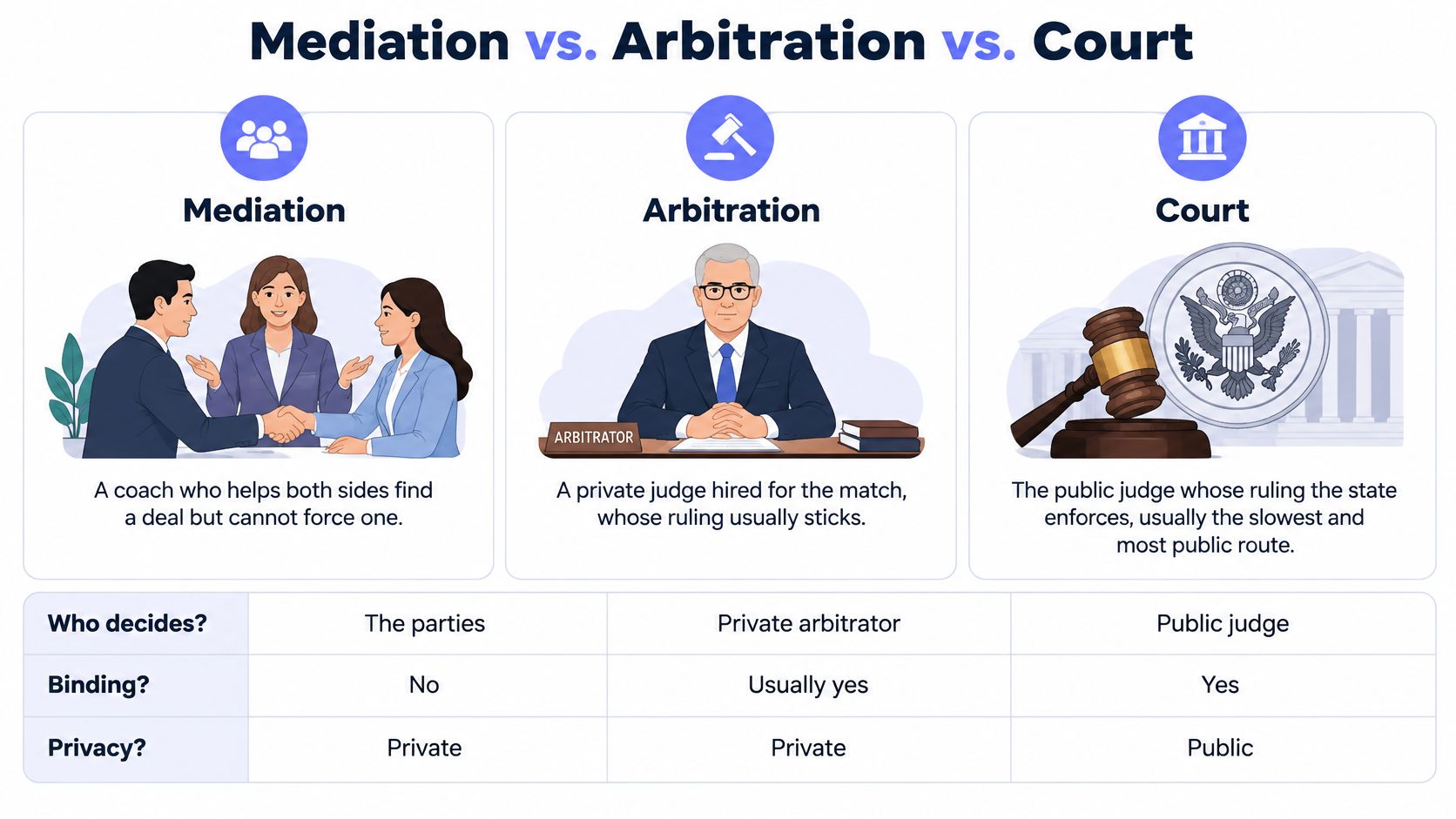
| Criterion | Mediation | Arbitration | Court litigation |
|---|---|---|---|
| Who decides | The parties, with help from a neutral mediator | A private arbitrator or panel | A public judge |
| Binding outcome | Only when the parties sign a settlement | Usually binding, with limited appeal | Binding, subject to appeal |
| Typical duration | Often measured in weeks, though programs count time differently | Varies by seat, institution, and dispute | Varies by country and claim size |
| Cost level | Usually the lowest of the three | Moderate to high, including arbitrator fees | Varies by court and claim size |
| Cross-border enforcement | Depends on the settlement and local law | May be supported by the New York Convention in contracting states | Depends on the judgment and treaty coverage |
A mediation discussion does not settle a claim by itself. The parties need to sign an agreement that records what each will do. For a scuffed gadget, that might say the creator will pay a partial refund by a stated date and the backer accepts it as resolution of the claim. An unsigned note saying “we almost agreed” leaves the dispute open.
Arbitration moves the decision from the parties to a private tribunal. Its award can be binding and enforceable, but that does not make arbitration automatically faster or cheaper for a small pledge. Fees for the arbitrator and hearing can exceed the value of a pledge or a shipping top-up. Timelines vary by seat and institution, so check the chosen arbitral rules before drafting the clause.
A settlement is a deal the parties accept. An arbitral award is a decision imposed by the tribunal. Match the route to the people involved, the amount at stake, and the countries connected to the dispute.
| Parties to the dispute | First route to try | Who makes the decision if it proceeds? | Useful evidence |
|---|---|---|---|
| Creator and backer | Contact and negotiation, then mediation if needed | The parties decide in mediation; an arbitrator or judge decides in a formal case | Pledge record, campaign promise, messages, photos, and delivery scans |
| Creator and platform | Use the platform's complaint or contract process first | The platform, arbitrator, or court, depending on the platform terms | Platform terms, account notices, payment records, and support messages |
| Backer and platform | Follow the platform's backer support process | The platform or a court, depending on the terms and applicable rules | Payment confirmation, platform notices, refund request, and campaign listing |
For a backer and creator trying to preserve the relationship, mediation can help them agree on a replacement, partial refund, or store credit. It suits disputes where both sides can compromise and want to avoid spending more than the reward is worth. Keep the request specific, such as naming the damaged item and proposing a remedy.
Arbitration may fit a cross-border creator-backer dispute when a binding decision is needed and the terms can validly require that route. Identify the seat, rules, and language so the parties know where and how the process will run. For a creator-platform or backer-platform dispute, start with the platform's own terms and procedures. The campaign's dispute clause does not automatically control a separate relationship with the platform.
Court, including small claims court where available, may be the appropriate route when a consumer right requires a local court or when a party needs a public ruling. The route that works for one relationship may not apply to another. Before choosing, match the parties, the governing terms, and the evidence you can provide.
The sentences below are starting points, not finished legal terms. Have a lawyer in each country you sell into read them before they go on a campaign page. A clause that works for a Canadian creator can fail for a backer in the EU.
Either party may notify a dispute in writing. The parties shall negotiate in good faith for 30 days from notice before any further step.
That escalation sentence creates a clock. "Good faith" alone doesn't. Thirty days from written notice gives you time to pull the pledge record and a tracking scan before anyone files.
If negotiation fails, the parties shall attempt mediation before a mutually agreed mediator within 30 days, with each party bearing its own costs and the mediator's fees split equally.
The mediation step names the helper, the window, and the bill. Without the fee split, the first argument is who pays the mediator, not whether a partial refund makes sense.
Any dispute not resolved by negotiation or mediation shall be referred to binding arbitration under the rules of [institution], seated in [city and country], in [language], before [one / three] arbitrator(s). The award shall be final and binding on the parties.
This version does the jobs a bare "we'll arbitrate" line skips. It names the institution or leaves room for ad hoc rules, fixes the seat, sets the language, states how many arbitrators sit, and says the award is final. Those details are what keep a later fight from being about the forum instead of the missing reward.
These terms are governed by the laws of [state or country], and the courts of [place] have jurisdiction, except as stated here. Nothing in this section limits a backer's right to bring a claim in small claims court or to use any mandatory consumer protection right in their country of residence.
Class-waiver language, the kind that bars a collective claim, can be unenforceable for consumers in some jurisdictions. Don't paste it in because a template had it. Each sentence needs local legal review before launch, including any waiver, fee shift, or choice of a foreign court.
Creators often treat "the dispute" as one process. Crowdfunding backers can be inside three systems at once, with different decision-makers, deadlines, and evidence.
A platform complaint is about the platform's own role. It might cover a listing, a suspended account, or how a payment was presented. A payment chargeback runs through the card issuer and the card network, on a clock the processor sets, not the one in your campaign terms. A creator–backer contract dispute is the promise to make and ship the reward, and it runs under the terms you published.
A platform's internal process may not decide that underlying promise. It can decide the platform's payment or policy role and leave the reward question untouched. That's why the first call isn't always "open a ticket with the platform."
| Relationship | First Route | Decision-Maker | Evidence to Preserve |
|---|---|---|---|
| Backer versus creator | Negotiation, then mediation, then arbitration or local court | The arbitrator or court named in the terms, or the backer's local court | Pledge record, reward description, delivery updates, survey answers, messages |
| Backer versus platform | Platform dispute process | Platform team, then the card issuer if a payment is contested | Payment receipt, campaign page snapshot, written complaint |
| Creator versus payment provider | Processor dispute response within its deadline | Payment processor and card network | Shipping proof, tracking records, refund history |
| Backer versus fulfillment vendor | Vendor terms or carrier claim | Vendor or carrier | Tracking data, customs documents, delivery confirmation |
| EU backer versus non-EU creator | Consumer ADR if the trader is covered, otherwise the backer's local consumer court | ADR body or court in the backer's country | Terms in effect at pledge time, currency paid, evidence of targeting EU buyers |
Alternative dispute resolution isn't automatically available, binding, or able to force a shipment. European Parliament research indicates that roughly 300,000 eligible consumer–trader disputes are examined by ADR entities, while resolution rates run from 17% to 100% across EU member states. Recent EU policy materials also stress access to ADR when a trader serves consumers in another member state. An ADR body may take a complaint against a trader and still lack power to compel a creator to ship a reward or refund a pledge.
Edge cases pile up once four parties sit in four countries. The process may run in a language the backer doesn't use day to day. Currency on the pledge can differ from the currency on the survey. Customs duties and VAT collected through that survey can look like an overcharge when they're a separate line. A backer's home-country consumer rights can apply even when your clause picks a foreign law, which is why international compliance belongs in the same draft as the clause.
Before launch, answer one question in writing. Which law, forum, language, and remedy apply when the creator, the payment processor, the fulfillment vendor, and the backer are in different countries?
A backer reports that their game never arrived, while your shipment record shows it was sent. A written process turns that complaint into a series of manageable decisions, rather than a scramble through email. The same steps can handle a missing reward, a wrong cable, or an unfamiliar survey fee.
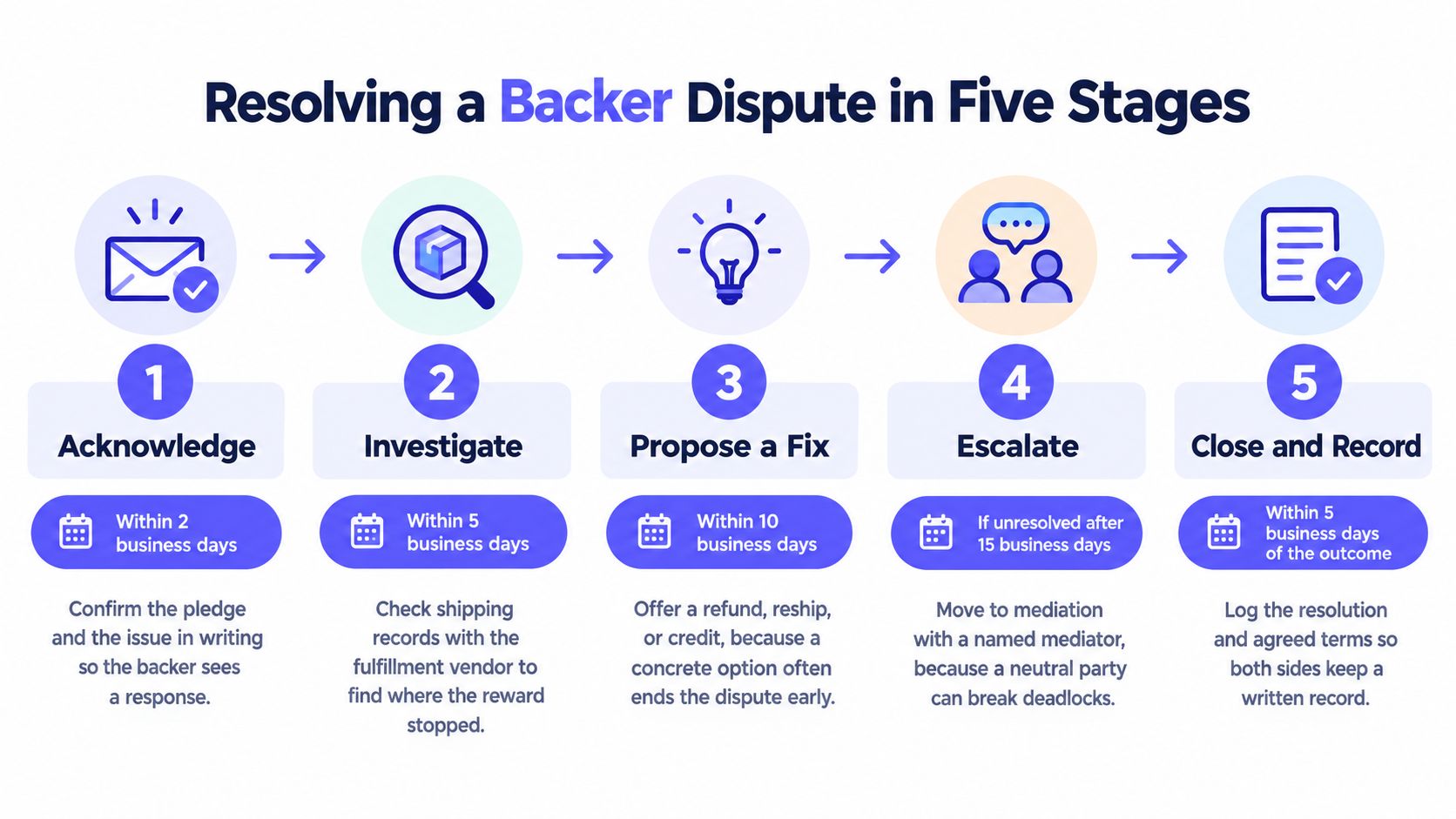
Clear steps and deadlines give both sides a practical chance to resolve a small pledge dispute before formal proceedings. They also create a record if the disagreement continues. That record matters: a mediator, arbitrator, court, or card issuer may need to understand what was promised, what happened, and how each side responded.
Some complaints call for a different route. If a pledge appears to have been made with a stolen card, use the relevant payment process rather than treating it as an ordinary delivery disagreement. And consider the cost of formal proceedings before using them for a small amount. A private hearing may cost more than a disputed $25 add-on.
Keep intake in one channel, rather than scattering it across several inboxes. Ask the backer for the pledge ID, reward tier, and supporting evidence, and record the response deadline and each update. A timestamped log makes the path from complaint to outcome easier to follow.
Any sample timeline or clause should be treated as a starting point, not ready-to-use legal advice. Have a lawyer review it for the countries relevant to your campaign before relying on it.
A German backer says the shipping charge was never agreed to. Before that complaint arrives, set up both the dispute terms and the records that can show what the backer selected.
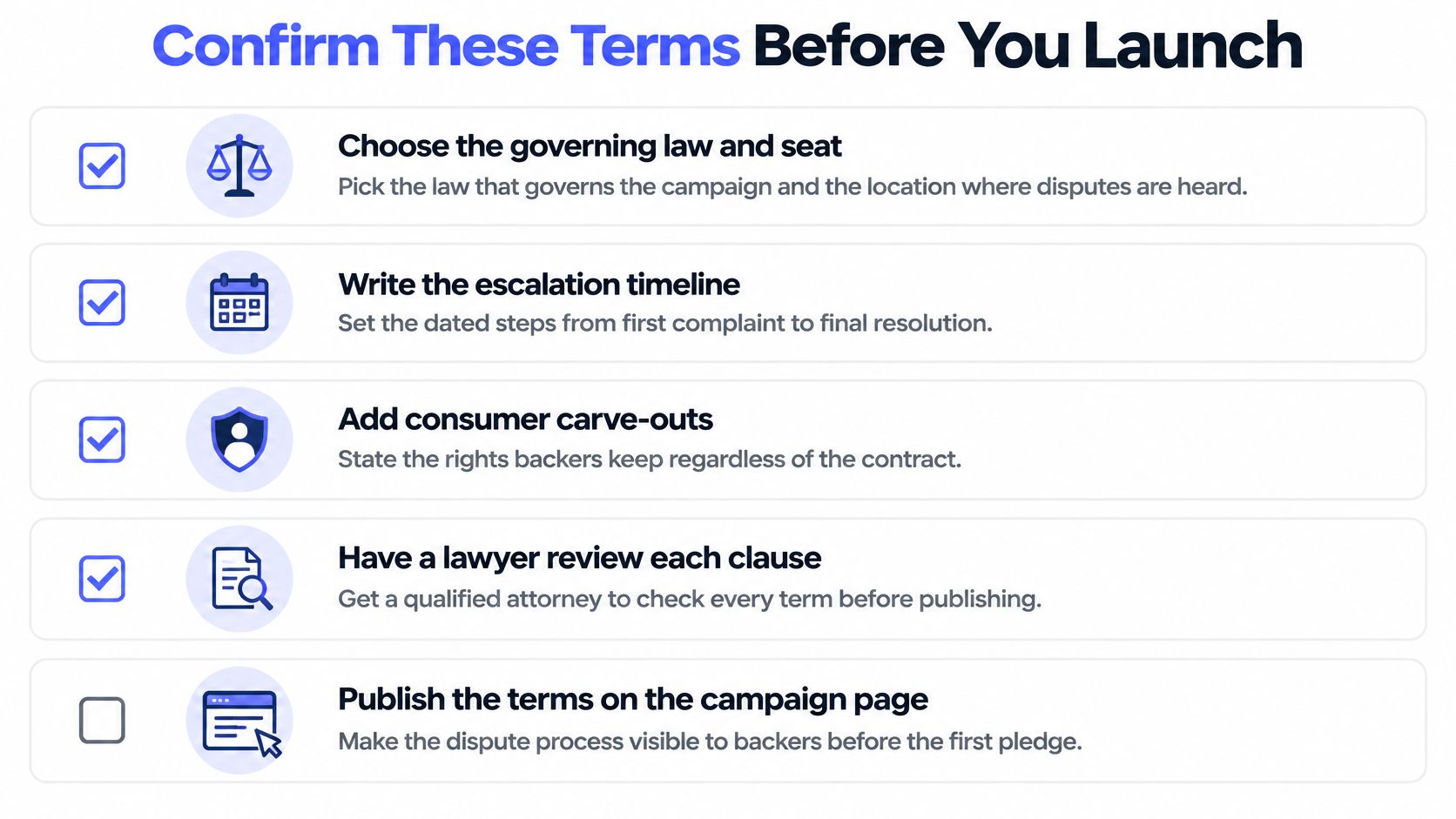
Before publishing, confirm five things:
The records used to resolve a dispute often begin with the post-campaign survey. A backer who disputes an add-on or shipping charge may ask what they selected, so keep a clear record of their choices and payments.
Kickstarter Pledge Manager collects post-campaign information, including addresses, reward choices, shipping costs, taxes, and add-ons. Its fee page lists a 5% platform fee on eligible Pledge Manager funds and payment processing fees; check the current Kickstarter fee details to confirm which charges apply to your setup.
PledgeBox's pledge manager offers a survey for collecting backer information and a performance-based fee model. Its pricing details say sending the survey is free and describe a 3% fee on upsell revenue collected through the survey, such as add-ons, shipping fees, and taxes or VAT. The fee does not apply to original Kickstarter or Indiegogo campaign funds. If the survey generates no upsell revenue, no fee is charged.
| Cost Item | Kickstarter Pledge Manager | PledgeBox Survey |
|---|---|---|
| Upfront cost | Consult Kickstarter's fee details for charges applicable to your setup | Sending the backer survey is free |
| Fee on original campaign funds | 5% platform fee on eligible Pledge Manager funds, plus payment-processing fees as listed by Kickstarter | No fee on original Kickstarter or Indiegogo campaign funds |
| Fee on survey upsell revenue | 5% platform fee applies to eligible Pledge Manager funds, not specifically to upsell revenue | 3% fee applies to upsell revenue collected through the survey |
| Fee when no upsell is collected | Fee treatment depends on whether eligible Pledge Manager funds are processed | No fee if the survey collects no upsell revenue |
Choose based on the workflow and fee terms that fit your campaign, rather than assuming the tools charge in the same way. Kickstarter may suit creators who want to keep the process within the platform they launched on and follow its Pledge Manager flow. PledgeBox may suit creators who want to send a survey without a charge when no upsell revenue is collected. In either case, make sure your records show what each backer chose and what they paid. For broader business considerations, see guidance on using Kickstarter for a business, alongside a lawyer's review.
Sample dispute clauses are starting points, not ready-to-use legal advice. Have a lawyer review them for the countries where your campaign and backers are located. A well-kept survey record can help clarify a dispute over a reward, shipping charge, or refund.
PledgeBox
The All-in-One Toolkit to Launch, Manage & Scale Your Kickstarter / Indiegogo Campaign