 PledgeBox
Kickstarter for Business Your Ultimate Launch Playbook
Is Kickstarter for business the right move? Our complete guide covers crowdfunding strategy, legal prep, marketing, and post-campaign success.
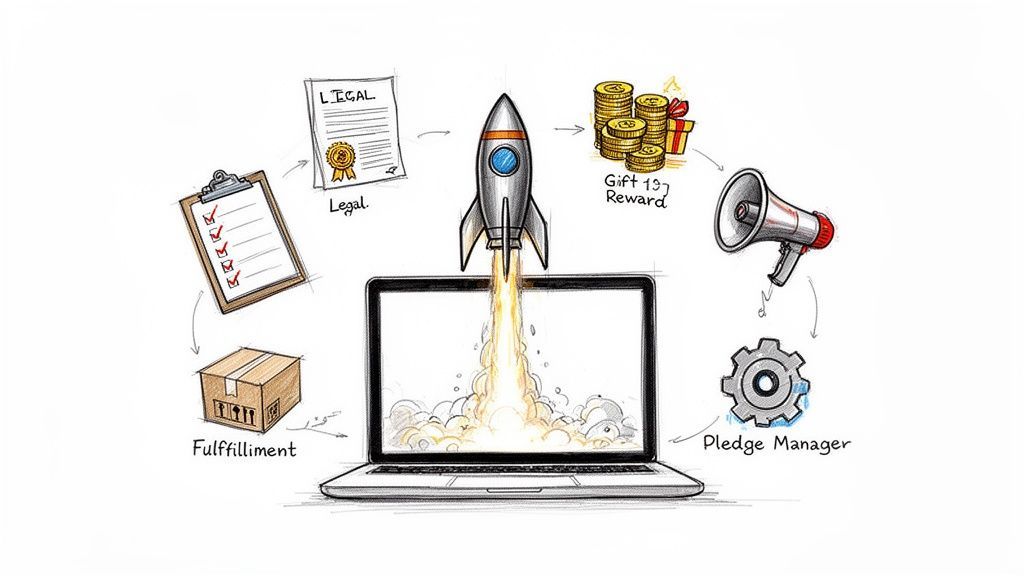
Is Kickstarter for business the right move? Our complete guide covers crowdfunding strategy, legal prep, marketing, and post-campaign success.
Using Kickstarter for business has become a go-to strategy for launching products, proving market demand, and building a loyal following before a single item even goes into production. It's so much more than a fundraising site—think of it as a powerful launchpad that dials down your financial risk while cranking up the pre-launch excitement.
Many entrepreneurs still think of Kickstarter as a playground for artists and hobbyists, but that’s an old-school view. These days, both established brands and ambitious startups are baking the platform right into their core business strategy. Instead of chasing traditional loans or giving up equity to venture capitalists, they're using crowdfunding to get capital directly from the people who will actually buy their product.
This approach completely flips the script on product launches. It shifts the dynamic from a high-stakes gamble to a smart, data-driven process. You get to put your concept in front of real people, gauge genuine interest, and gather priceless feedback before sinking a fortune into manufacturing.
A successful campaign doesn't just fund your first production run; it builds you an army of passionate advocates from the get-go.
One of the biggest wins with Kickstarter is the community you build from day one. Your backers aren't just customers; they're co-creators who are financially and emotionally invested in seeing you succeed. This gives you a direct line to your target market for feedback, fresh ideas, and powerful testimonials. If you want to dig deeper into platform differences, check out our guide on Kickstarter vs Indiegogo.
The numbers speak for themselves. Since its launch, Kickstarter has seen over 650,798 projects pull in a staggering $8.5 billion. For businesses, the key stat is the success rate: about 41.98% of Kickstarter projects hit their funding goals. That’s a huge leap compared to the average success rate of 22.4% across all crowdfunding platforms, according to stats from SearchLogistics.com.
Think of Kickstarter’s pledge manager like Amazon—a large, standardized marketplace. In contrast, a pledge manager like PledgeBox is like Shopify, giving you a powerful, customized backend to manage customer relationships and grow revenue after the campaign ends.
Before we get to the post-campaign details, let's break down how Kickstarter's model stacks up against traditional funding.
Here's a quick look at the core differences between launching your business with Kickstarter versus going the route of a traditional loan or venture capital.
| Aspect | Kickstarter Crowdfunding | Traditional Funding (Loan/VC) |
|---|---|---|
| Source of Funds | Pledges from individual backers (future customers). | Financial institutions (banks) or investors (VCs). |
| Ownership | You keep 100% of your company equity. | Often requires giving up equity or taking on debt. |
| Risk Factor | Low. If you don't meet your goal, no money changes hands. | High. You are obligated to repay the loan or meet investor expectations. |
| Market Validation | Built-in. A successful campaign proves there's demand. | None. You're betting on market research, not actual sales. |
| Community | Builds an engaged community of early adopters from day one. | No community-building component; purely transactional. |
| Marketing | The campaign itself is a major marketing and PR event. | Requires a separate and often expensive marketing budget. |
As you can see, Kickstarter offers a fundamentally different path—one that’s less about just getting cash and more about building a sustainable foundation for your business.
Getting funded is a huge milestone, but the journey is far from over. Now you have to manage thousands of backers, collect shipping info, and actually get your rewards out the door. It's a massive logistical puzzle, and this is where a dedicated pledge manager becomes non-negotiable.
While Kickstarter offers a basic survey tool, specialized platforms give you far more power and flexibility. For instance, PledgeBox is free to send the backer survey and only charges 3% of any upsell revenue generated. This model lets you manage your backer data like a pro without any upfront costs, turning the fulfillment phase into yet another opportunity to grow.
A winning Kickstarter campaign isn't born on launch day; it's forged in the weeks and months leading up to it. Think of the pre-launch phase as your mission control, where you build the foundation for success and turn a great idea into an unstoppable force. This blueprint is your pre-flight checklist, ensuring every component is primed for momentum the second you go live.
The entire process starts with one critical number: your funding goal. This figure is so much more than a hopeful target. It’s a carefully calculated sum that must cover every single cost—both expected and unexpected. A huge part of building this financial map is learning how to structure a business plan that wins funding.
Remember, Kickstarter’s all-or-nothing model is unforgiving. You either hit your goal and get the funds, or you miss it and walk away with nothing. This reality makes setting a realistic, comprehensive goal absolutely essential.
One of the most common pitfalls for creators is underfunding. To avoid this, your goal has to account for way more than just the cost to make your product. Your budget needs to be airtight, covering everything from manufacturing to the moment the package lands in your backers' hands.
Your calculation should include:
By meticulously budgeting for every possibility, you protect your business and ensure you can deliver on your promises to backers. This is the cornerstone of building long-term brand trust.
Once your numbers are solid, it's time to find out if anyone actually wants to buy your product. Guesswork is the enemy of a successful campaign; data is your best friend.
Before you pour significant time and money into a project, you need proof that people are willing to pay for what you're creating. Sharp market research isn't just about avoiding failure; it's about refining your product and messaging so it connects deeply with your target audience. You can find more tips in our detailed guide to mastering the Kickstarter pre-launch phase.
Effective market validation involves a few key steps. Start by analyzing similar products, both on Kickstarter and in the wider market. What did they do well? Where did they fall short? Reading through backer comments on their campaigns can reveal priceless insights into what customers truly want and their biggest frustrations.
Next, talk directly to your potential customers. Create surveys, run small focus groups, or jump into online communities where your audience hangs out. Use this feedback to sharpen your product’s unique selling proposition (USP) and confirm that it solves a real problem people are eager to fix. This groundwork is what turns a hopeful launch into a calculated success.
Once you've got a solid idea and a budget that makes sense, it's time to get the official stuff in order. This is all about setting up the legal and financial backbone that protects you, your new business, and the backers who believe in you. Trust me, skipping this part is a recipe for disaster, from putting your personal assets at risk to getting hit with a surprise tax bill that could kill your project right after it’s funded.
Before you even dream of hitting that launch button, you need to think about your business structure. A lot of creators just run things as a sole proprietor, but that's a seriously risky move. Why? Because as a sole proprietor, there's no legal wall between you and your business. If something goes wrong, your personal assets—your house, your savings, everything—are on the line.
That’s exactly why setting up a Limited Liability Company (LLC) or a corporation is pretty much standard practice for any serious venture.
Creating a formal business entity like an LLC is like building a legal shield. It separates your personal finances from your business operations. So if your project ever faces a lawsuit or racks up debt, this structure helps ensure that only the business's assets are at stake, not your own.
Getting a handle on the whole process of understanding business incorporation is a non-negotiable step before you launch. It dictates your liability, how you’ll be taxed, and the paperwork you'll need to keep up with. It might feel like a hassle, but it's what turns a cool project into a real, sustainable business.
Protecting your personal assets is everything. A formal business structure like an LLC isn't just paperwork; it's a legal firewall that separates your business risks from your personal life. That peace of mind is what lets you build and grow with confidence.
With your legal entity sorted, the next big hurdle is figuring out how to handle your Kickstarter funds when tax time rolls around.
Here’s a hard truth that catches a lot of first-time creators off guard: the money you raise on Kickstarter is taxable income. The IRS doesn't see pledges as gifts or donations. They see it as revenue you earned in exchange for a product (your rewards). This means a $100,000 campaign is absolutely not $100,000 in your pocket.
A big chunk of that money is going straight to taxes. The only way to prepare is to track every single penny you spend on the business from day one. You can deduct these business-related expenses from your total income, which will lower how much you owe in taxes.
Common deductible expenses include:
Finally, before you show your amazing product to the entire world, you have to think about intellectual property (IP) protection. Sharing your idea on a public platform like Kickstarter without securing it first leaves you wide open to copycats.
Depending on what you've created, this might mean getting a patent for a new invention, trademarking your brand name and logo, or copyrighting your creative work, like a book or a game. It's smart to chat with a legal pro who specializes in IP to figure out the best strategy. Taking this step ensures your unique idea stays yours, giving your business a real competitive edge long after the campaign is over.
Having a brilliant product is only half the battle when you’re using Kickstarter for business. The other half? A powerful marketing engine. Without a steady stream of excited backers, even the most innovative idea can fall flat. A successful marketing strategy is a multi-channel effort that kicks off long before you launch and doesn't stop until the final seconds of your campaign.
Think of this as your playbook for attracting backers, building trust, and absolutely smashing your funding goal. It all starts with the single most important asset in your pre-launch toolkit: your email list. Building a dedicated list of potential backers is the closest thing you'll get to a silver bullet for a strong start.
Why is it so vital? Because driving a huge wave of pledges on day one creates powerful social proof. It tells the Kickstarter algorithm and casual browsers that your project is a hot ticket, which creates a snowball effect of visibility and support.
Your main objective in the months before your campaign goes live should be capturing the emails of people genuinely interested in what you're building. This isn’t about vanity metrics; it’s about creating a warm audience you can speak to directly, cutting through the noise and unpredictable nature of social media algorithms.
Here are a few proven ways to build that list:
A strong email list isn't just a marketing tool; it's your launch-day strike team. These are the people who will fund the first 20-30% of your goal, creating the momentum needed to attract the wider Kickstarter community.
With your email list growing, the next step is to design a campaign page that turns curious visitors into committed backers.
Your Kickstarter page is your digital storefront, your sales pitch, and your brand's story all rolled into one. Every single element needs to work together to build excitement, answer questions, and make it ridiculously easy for someone to click "Back this project."
A captivating video is the star of the show. Keep it concise (ideally 2-3 minutes), make it emotionally engaging, and clearly explain the problem your product solves. Don't just list features; tell a story that connects with your audience and shows them exactly how your product will make their lives better.
Next up, focus on professional visuals. High-quality photos, GIFs showing your product in action, and clean graphics are non-negotiable. People need to see exactly what they're getting, and polished visuals build a sense of trust and professionalism.
Finally, your written copy has to be persuasive and crystal clear. Structure your page logically: start with a powerful hook, explain the product, introduce your team, and then detail the rewards. Use headings, bullet points, and bold text to make the information easy to scan. You're guiding the reader on a journey that should end with them feeling confident and excited to support you. This is the kind of meticulous prep work that separates a successful Kickstarter for business from a forgotten idea.
Your campaign crushed its funding goal. The confetti has settled, and that initial wave of relief washes over you. Congratulations! But don't pop the champagne just yet. The post-campaign phase is where the real work begins—and where a promising project truly becomes a business. This is the moment brands are made or broken, turning happy backers into lifelong fans or disgruntled customers.
Successfully navigating this period boils down to two things: flawless communication and airtight logistics. Your backers put their trust (and their money) in you, and now they’re eager to know what comes next. Keeping them in the loop with regular, honest updates isn’t just good practice; it’s non-negotiable. Radio silence is the fastest way to breed anxiety and frustration in your new community.
At the same time, you're staring down a massive logistical puzzle. You have to collect precise order details, calculate and charge for shipping, handle address changes, and somehow coordinate a global fulfillment operation. This is where so many creators stumble, completely overwhelmed by the sheer volume of data and moving parts.
Kickstarter does provide a built-in survey tool to collect information from your backers. For a super simple project—maybe one or two reward tiers with no variations—it can get the job done. But for most businesses running a serious campaign, this tool shows its limits almost immediately.
Think of it as a basic, one-and-done checkout form. Once a backer hits "submit," they can't easily go back to change their address or update their order. This simple fact creates a huge administrative headache for you, as you'll inevitably be drowning in direct messages and emails from backers needing to make changes.
Even more critically, Kickstarter's native surveys can't collect additional funds. This forces you to estimate shipping costs months in advance, which is a massive gamble in a world of fluctuating carrier rates. If you guess too low, you’ll be paying for shipping out of your own pocket, watching your profits disappear. Guess too high, and you might scare away potential backers with steep upfront costs.
This is exactly why a dedicated pledge manager is an essential tool for any business using Kickstarter. A pledge manager is a specialized platform built to handle the controlled chaos of post-campaign management. It picks up right where Kickstarter leaves off, giving you a powerful backend to manage backer relationships and nail your fulfillment.
Let's use an analogy to make it clearer. Kickstarter's pledge manager is like Amazon—a large, standardized marketplace where you have limited control. You can sell your product, but you're playing in their sandbox with their rules.
In contrast, a pledge manager like PledgeBox is like Shopify. It’s your own powerful, customized store. It's a flexible platform that puts you in complete control. You can build custom surveys, manage customer data, and even open up new streams of revenue.
A pledge manager transforms the fulfillment phase from a logistical nightmare into a strategic opportunity. It’s not just about collecting addresses; it’s about strengthening your relationship with your earliest supporters and maximizing the financial success of your launch.
Using a tool like PledgeBox gives you a whole suite of advantages that directly impact your bottom line and brand reputation. It automates the tedious stuff, cuts down on costly errors, and creates a much better experience for your backers—which is crucial for turning them into repeat customers.
One of the most compelling reasons to use PledgeBox is its pricing model. For any business launching on Kickstarter, cash flow is king. PledgeBox gets this completely.
It is free to send the backer survey, meaning you can collect all the essential information you need without any upfront cost. The platform only charges 3% on the upsell revenue you generate, if there's any. This risk-free approach means the tool literally pays for itself. You only pay when you make more money, making it an incredibly smart investment for a growing business. It allows you to manage the crucial fulfillment process professionally while turning it into an additional source of profit.
So, your Kickstarter campaign is funded. Congratulations! But don't pop the champagne just yet. Hitting your funding goal isn't the finish line; it’s the starting line for the real work: fulfillment. This is where you have to collect orders, manage thousands of backers' details, and ship rewards worldwide. It’s a logistical puzzle that can either make or break your brand, and this is exactly where a dedicated pledge manager becomes your secret weapon.
Let me put it this way. Using Kickstarter's pledge manager is like running a store on Amazon. Sure, it works. It’s a massive, one-size-fits-all system that gets the job done, but it’s rigid. You get very little control over the customer experience and zero chance to generate post-campaign revenue.
Now, think of a pledge manager like PledgeBox as your own Shopify store. It’s a powerful, flexible platform that puts you in complete control. You can customize the experience, fix backer issues on the fly, and even open up new revenue streams long after the Kickstarter clock has stopped ticking.
If you’ve ever used Kickstarter’s native surveys, you know their limits. They’re static—once a backer hits "submit," changing their address or updating their order becomes a real headache. Worse, they can’t collect any extra payments. That means you’re forced to guess shipping costs months ahead of time or just eat the cost yourself, which can seriously cut into your profits.
This is where a real pledge manager changes the game entirely. It doesn't just fix these problems; it turns them into opportunities.
This simple chart breaks down the post-campaign flow, from reaching out to backers to getting rewards out the door.
When you follow a structured process like this, backers stay happy and informed, you collect accurate data, and fulfillment becomes a smooth, manageable operation.
To really see the difference, let’s compare Kickstarter’s basic surveys with a full-featured pledge manager like PledgeBox. The gap in capabilities is pretty stark.
| Feature | Kickstarter Native Surveys | PledgeBox Pledge Manager |
|---|---|---|
| Upsells & Add-ons | ❌ Not supported. No way to add items post-campaign. | ✅ Yes. Offer upgrades and new items to boost revenue. |
| Shipping Fees | ❌ Cannot be collected. Must be included in pledge. | ✅ Yes. Charge accurate, location-based shipping fees. |
| Address Updates | ❌ Difficult. Backers have a very limited window to edit. | ✅ Yes. Backers can update their address until you lock it. |
| Order Modifications | ❌ Impossible. Pledges are locked once submitted. | ✅ Yes. Backers can easily modify their selections. |
| VAT/Sales Tax | ❌ Not supported. Creator must manage this manually. | ✅ Yes. Automatically calculate and collect taxes. |
| Customer Support | ❌ Very limited tools for managing backer issues. | ✅ Yes. Built-in tools to handle support efficiently. |
| Data Management | ❌ Basic spreadsheet export. Prone to errors. | ✅ Yes. Robust tools to segment, filter, and export data. |
It's clear that while Kickstarter is great for funding, its native tools are not built for the complex reality of fulfillment. A pledge manager fills that critical gap.
Cash flow is a constant worry for any business, especially right after a big campaign. That’s what makes the PledgeBox model so smart. It’s designed to help you succeed without adding any financial risk.
PledgeBox is completely free to send the backer survey. You only pay a small 3% fee on new revenue you generate through upsells, if there's any. This means the tool pays for itself—you only pay when you make more money.
This pricing structure makes it a no-brainer. You get a professional-grade management system without any upfront cost, turning your fulfillment phase from a cost center into a profit center.
The global crowdfunding market is growing fast, with projections showing it expanding from $1.83 billion in 2025 to $5.91 billion by 2034. This growth is being driven by creators who are finding smarter ways to fund and manage their projects.
Picking the right fulfillment partner is a decision that will directly impact your profits and your sanity. If you're looking at different options, check out our guide on how to select the right pledge manager. At the end of the day, a pledge manager isn't an expense; it's an investment in your brand's reputation, your backers' happiness, and your business's future.
When you're diving into the world of Kickstarter for your business, a few questions always pop up. Let's get them answered so you can move forward with confidence.
Once your campaign hits its goal, Kickstarter takes a 5% cut of the total funds raised. But that's not the whole picture. You also have to account for payment processing fees, which usually run another 3-5% per pledge.
It's super important to bake these costs into your budget from day one. A good rule of thumb is to set aside roughly 8-10% of your funding goal for these fees. That way, you won't be caught off guard and will have the capital you actually need for production and shipping.
Nope, you can't. Kickstarter is strictly a rewards-based platform, meaning you're offering backers a product or a unique experience—not a piece of your company.
Trying to sell company shares or offer financial returns goes directly against Kickstarter's rules. If you're looking to trade equity for funding, you'll need to look at dedicated equity crowdfunding platforms designed for that purpose.
Think of it this way: Kickstarter's pledge manager is like shopping on Amazon—it's a standardized marketplace. A dedicated pledge manager like PledgeBox, on the other hand, is like having your own Shopify store, giving you a powerful, customized platform to manage your backer relationships and grow revenue after the campaign ends.
Kickstarter runs on an "all-or-nothing" model. If your campaign doesn't hit its funding target by the deadline, it's a clean slate. No money changes hands.
Your backers' credit cards aren't charged, you don't receive any funds, and you won't owe Kickstarter a dime in fees. This model is actually a safety net—it protects you from having to fulfill thousands of rewards without enough money to actually make and ship them. It ensures you only proceed when your project is truly viable.
Ready to master your post-campaign fulfillment and boost your revenue? PledgeBox provides a professional, risk-free pledge manager that helps you collect surveys, charge accurate shipping, and sell more through add-ons. It's free to send surveys and only costs 3% on new upsell revenue you generate, if there's any.
PledgeBox
The All-in-One Toolkit to Launch, Manage & Scale Your Kickstarter / Indiegogo Campaign