 PledgeBox
Performance Based Pricing Model: The Creator’s Guide
Master the performance based pricing model. Learn revenue share, commission, and outcome-based fees with real crowdfunding examples and implementation steps.

Master the performance based pricing model. Learn revenue share, commission, and outcome-based fees with real crowdfunding examples and implementation steps.
A performance-based pricing model links payment to verified results, and in fiscal year 2001, U.S. agencies used performance-based methods for approximately $28.6 billion, or 21% of service obligations. The model works only when success is measurable, attributable, auditable, and connected to a clear payment rule.
You've finished a crowdfunding campaign, but the commercial work isn't over. Backers still need to confirm rewards, choose shipping, pay taxes, and decide whether to add another product or upgrade their pledge. At the same time, your cash flow is under pressure, and a pledge-management fee that applies before any post-campaign revenue arrives can feel like an unnecessary risk.
That's why outcome-linked payment deserves closer attention in crowdfunding operations. The right structure lets a provider share in the upside without claiming credit for sales it didn't create. The wrong structure creates arguments over attribution, weakens your margin, and rewards activity that has little connection to collected revenue.
A performance-based pricing model ties some or all compensation to a defined result instead of charging solely for time, access, labor, or delivered inputs. In a crowdfunding setting, the result might be incremental add-on revenue, a completed milestone, or another transaction that the platform can verify. The central test is simple: could both parties inspect the data and agree that the outcome happened because of the defined service?
The model became significant in U.S. federal procurement during the 1990s and early 2000s. Federal agencies had experimented with performance-based service contracting as early as 1978, but adoption accelerated after the Office of Federal Procurement Policy encouraged agencies to connect payment and contract terms to measurable results. In fiscal year 2001, agencies reported approximately $28.6 billion in performance-based service obligations, equal to 21% of total service spending, while performance-based actions represented approximately 11% of service-contract actions. The value was more substantial than the transaction count, which suggests that larger service agreements used the model more often. The Government Accountability Office's procurement review provides the historical context.
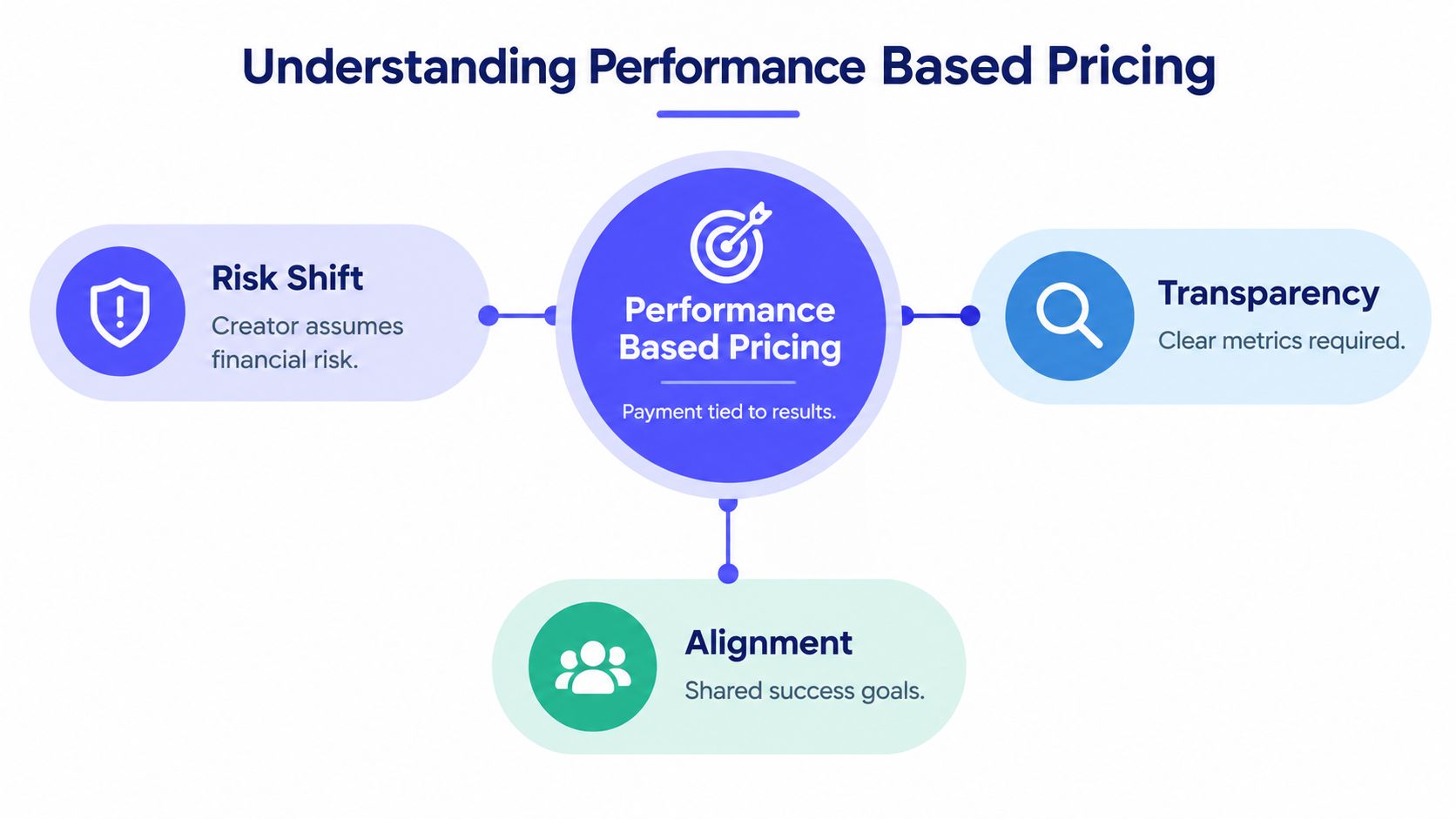
A creator should test an outcome-linked offer against four conditions before accepting it:
This structure shifts part of the financial risk from the buyer to the provider. The creator avoids paying the entire cost before value appears, while the provider accepts less predictable compensation in exchange for participation in upside. That trade-off is only fair when the provider controls enough of the delivery process to affect the metric.
Practical rule: Never pay for “performance” until you can write the event, baseline, window, exclusions, and settlement method into one unambiguous paragraph.
The history of federal contracting also offers a useful warning. A later review found that many contracts labeled performance-based lacked strong measures or effective management, with only about half estimated to have sound performance characteristics. The label itself creates no value. The contract design does.
Creators who want broader context on structuring revenue based deals can apply the same discipline to pledge management: define the revenue event first, then decide how compensation should follow it.
Crowdfunding operators usually encounter three practical forms of outcome-linked pricing. They differ in how much risk the provider carries, how predictable the creator's cost remains, and how easily both parties can reconcile the final invoice.
A pure revenue share gives the provider a percentage of an agreed revenue pool. The basic formula is:
Provider compensation = eligible collected revenue × agreed share
For a pledge manager, eligible revenue might mean add-ons and upgrades collected after the campaign. It shouldn't automatically include the original campaign funds, unrelated store sales, or revenue that the platform didn't process. The contract should also state whether the calculation uses gross collected revenue or net revenue after refunds, cancellations, taxes, and payment reversals.
This structure offers strong alignment, but it can expose the provider to uncertainty caused by factors outside its control. A creator's audience, product quality, fulfillment readiness, launch timing, and communication all influence post-campaign sales. A pure share can work when the platform has clear control over the checkout and merchandising experience, but it becomes contentious when several vendors contribute to the same result.
A commission is narrower. It applies to a specific transaction category, such as survey-based add-ons, and excludes the original campaign proceeds. The formula remains simple:
Commission = qualifying upsell revenue × commission rate
PledgeBox's pricing page states that sending the backer survey is free and that the platform charges 3% only on revenue collected through survey-based upsells, including add-ons, shipping fees, and taxes or VAT. The charge doesn't apply to the original Kickstarter or Indiegogo campaign funds, and if the survey generates no add-on or other upsell revenue, the survey service is free. The PledgeBox pricing details illustrate a tightly bounded commission structure.
A revenue sharing example can help teams compare the arithmetic of a variable fee with broader partnership structures. For creators, the important issue isn't just the percentage. It's the definition of the revenue base.
An outcome-based fixed fee pays a set amount when a milestone is achieved. Examples include completing a verified migration, delivering a reconciled backer database, or reaching an agreed fulfillment-readiness condition. This approach gives the creator more cost certainty than a pure percentage, but the milestone must reflect genuine value.
A hybrid often performs better than a single high-powered variable fee. Research on performance-based contracting emphasizes combinations of fixed compensation, risk sharing, and performance-linked compensation because hybrid terms balance incentive strength with income predictability. The Lancaster University discussion of performance-based compensation also highlights the danger of transferring too much uncertainty to one party.
For agencies, the crowdfunding consulting services offered by PledgeBox provide a useful comparison point when deciding whether strategic work should be fixed-fee, commission-based, or hybrid. Model the creator's margin before signing:
| Structure | Creator pays when | Main control needed |
|---|---|---|
| Pure revenue share | Eligible revenue is collected | Revenue scope and attribution |
| Commission | A defined transaction occurs | Transaction classification |
| Fixed outcome fee | A milestone is verified | Acceptance criteria |
| Hybrid | Base work is delivered and outcomes occur | Separate fixed and variable rules |
The strongest argument for performance-linked pricing is incentive alignment. A provider earns more when the creator produces a defined commercial result, so both parties have a reason to improve the checkout, offer structure, messaging, and follow-up process. The creator also limits upfront exposure, while a capable provider can participate in uncapped upside when the result is purely incremental.
The model can also improve commercial conversations. Instead of debating whether a service “feels valuable,” both sides can discuss the event that triggers payment. That clarity supports better budgeting, especially after a campaign when the creator's available cash depends on fulfillment costs and late backer behavior.

Attribution is the difficult part. Add-on revenue may rise because the provider improved the survey, but it may also rise because the creator launched a new product, sent a successful email, gained attention from a review, or reached backers at the right moment. If the contract assigns all post-campaign revenue to one platform, the fee may exceed the value created.
The wrong metric creates a second problem. Page views, survey completion, emails sent, and total campaign volume can indicate activity without proving commercial impact. A provider may optimize for those visible numbers while the creator needs collected, retained revenue.
A 2025 meta-regression covering 740 observations from 38 studies across 10 service areas found that outcome-focused contracts performed better than process or output contracts, but the estimated overall performance effect was positive and small, statistically nonsignificant, with a coefficient of 0.008, a p-value of 0.303, and a 95% confidence interval from −0.0076 to 0.02389. The 2025 Journal of Public Administration Research and Theory analysis supports a cautious conclusion: calling a fee performance-based doesn't guarantee better performance.
Use safeguards that reflect the actual risks:
A performance-based pricing model protects cash flow only when the payment trigger protects trust as well.
The practical choice for a creator is often between a platform-controlled pledge manager and an independently branded post-campaign storefront. Kickstarter's native Pledge Manager works like Amazon. The creator operates inside a marketplace-controlled environment, while Kickstarter provides the checkout and fulfillment-information workflow. PledgeBox's pledge manager is like Shopify, with a branded, independent storefront that gives the creator more control over the customer-facing buying environment.
Kickstarter's official Pledge Manager has no upfront cost. It lets creators collect shipping addresses, reward preferences, taxes, and shipping costs closer to fulfillment, and it supports add-ons, upgrades, and additional shipping or tax requests. Kickstarter also deducts its usual fees from payments made within the pledge manager, and shipping can be configured by weight or as a flat rate for each reward. Kickstarter's explanation of its Pledge Manager describes the native workflow.
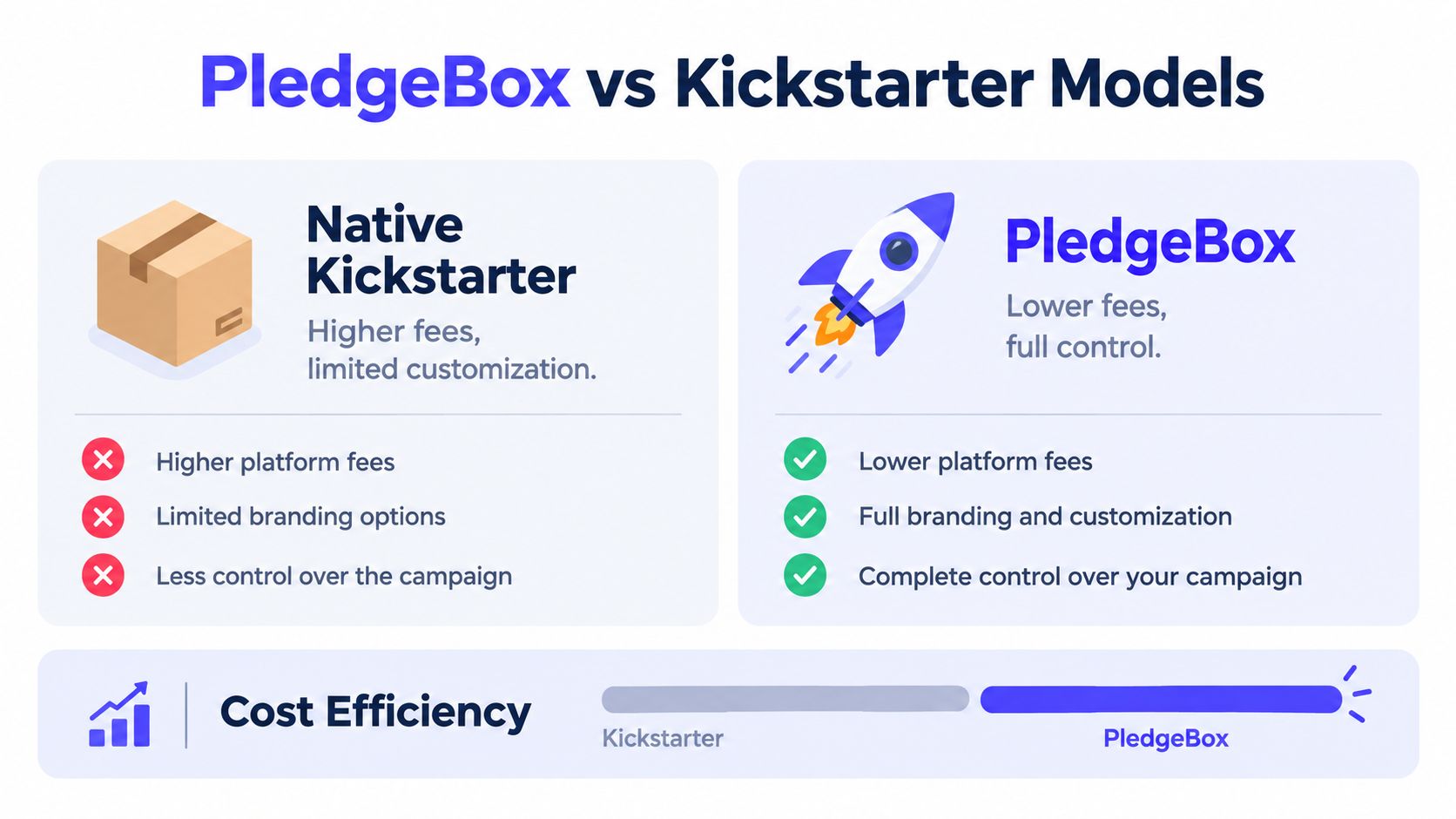
The native option reduces operational fragmentation. Backers stay within the Kickstarter ecosystem, and the creator can gather key fulfillment data in the environment where the campaign began. That convenience can matter when the team wants a centralized process and doesn't need a separate storefront identity.
The trade-off is control. A marketplace-controlled checkout limits how far the creator can shape branding, merchandising, customer ownership, and the post-campaign buying experience. Kickstarter describes its own tool primarily as a centralized fulfillment-information system, rather than an independently branded store. Its guidance on recommended pledge-management services helps clarify that distinction.
PledgeBox is free to send the backer survey and only charges 3% of upsell revenue if there's any. That means the survey itself doesn't create an upfront, campaign, or per-backer charge, while the variable fee applies to revenue collected through qualifying survey-based upsells such as add-ons, shipping fees, and taxes or VAT. For creators comparing options, the key question is whether branded control and a narrowly defined outcome fee justify using a separate pledge-management environment.
A useful side-by-side test looks like this:
The PledgeBox and Kickstarter pledge manager comparison is useful when documenting that decision for a creator team or agency client.
A workable post-campaign pricing arrangement begins before the survey goes live. Don't wait until the first settlement report to decide what counts as an upsell. Define the commercial event, data source, and payment rule while the creator, agency, and platform still have time to challenge ambiguous terms.
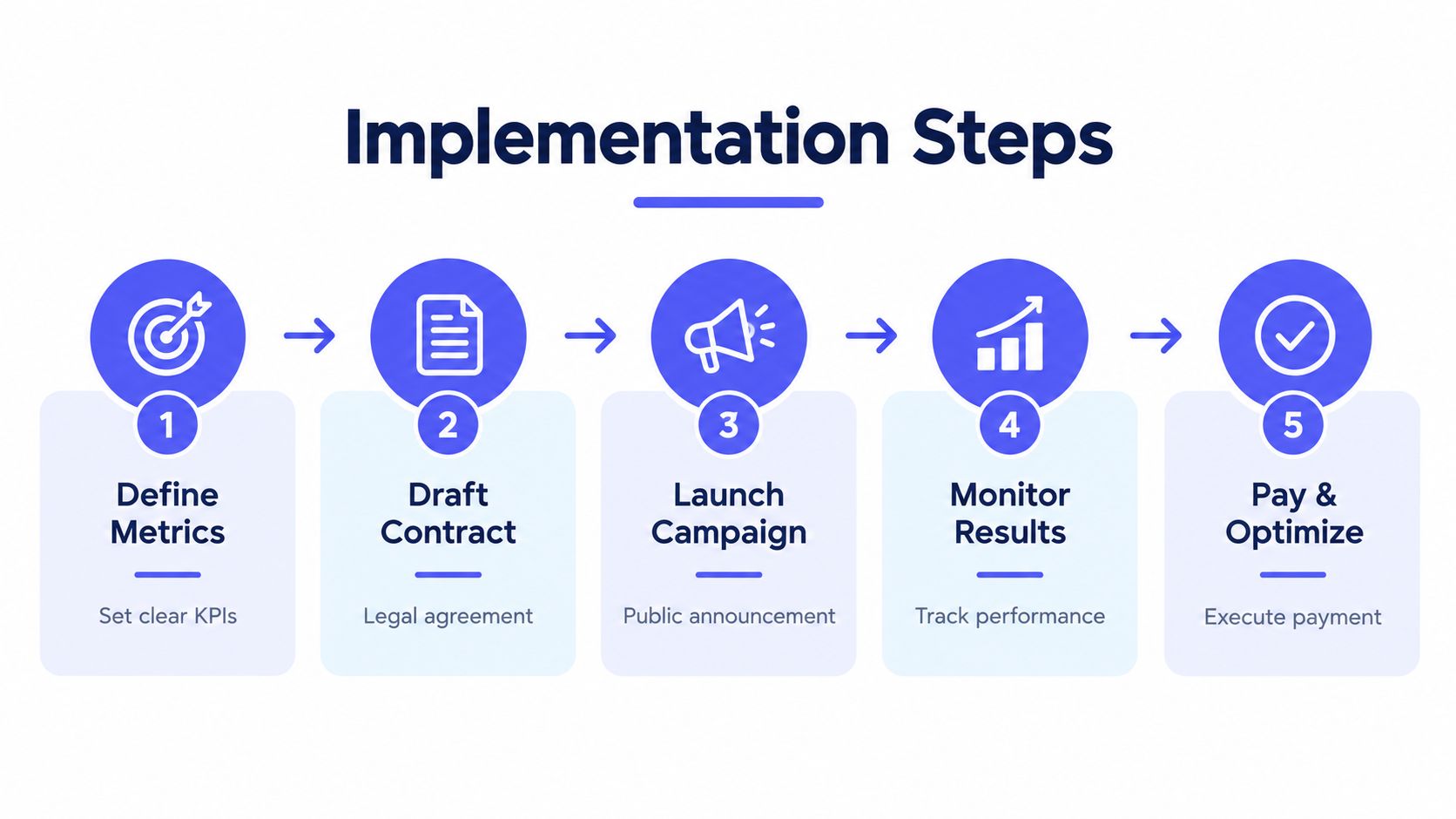
Write down the attributable baseline and measurement window. State whether the baseline is the original campaign total, the number of backers eligible for a survey, or a narrower historical level of add-on activity. For an outcome-linked pledge-manager fee, the cleanest event is usually a qualifying transaction collected through the survey environment.
Specify the metrics in operational language:
The purpose isn't to create a complex dashboard. It's to stop the parties from switching definitions after results arrive. The 2025 survey of 321 SaaS pricing decision-makers found that only 2 respondents, less than 1%, used an outcomes or performance-based model. The 2025 SBI pricing report suggests that interest in the idea doesn't remove the implementation barrier.
The agreement should identify the payment percentage or fixed amount, eligible events, settlement timing, refund treatment, taxes, currency conversion, audit rights, and a cap or floor where appropriate. It should also state who owns the customer communication and who can change offers during the measurement window.
Use transaction-level event attribution, not a dashboard estimate. Reconcile payment records from Stripe and PayPal, match order IDs to backer records, and keep gross and net incremental revenue in separate fields. A creator should be able to reproduce the invoice from the raw settlement export.
Check whether the provider controlled the offer, checkout, survey, or follow-up that produced the outcome. Review seasonality, creator mix, product changes, and selection effects before treating a revenue increase as proof of provider impact.
This short video can help teams frame the operational conversation before launch:
Pay only on reconciled, eligible revenue. After settlement, compare the result with the baseline, document exclusions, and record disputes rather than changing the formula without notice. The campaign performance metrics guide can support a broader reporting framework, but the contract remains the authority for payment.
A useful agreement can fit on a page if the definitions are precise. Adapt this clause:
Payment trigger: “The provider earns the agreed performance fee only on qualifying revenue collected through the defined post-campaign channel during the measurement window. Qualifying revenue excludes original campaign funds, cancelled orders, refunds, chargebacks, and transactions outside the agreed attribution rules.”
Add a short operating checklist:
For an agency, split fixed strategic work from variable execution work. A campaign audit, fulfillment plan, or creative package can use a fixed fee, while a narrowly defined add-on outcome can carry a commission. That arrangement protects the agency from carrying every factor outside its control and protects the creator from paying for unverified performance.
Creators should also negotiate a dispute process. Give both parties a defined period to inspect the source data, explain the calculation, and correct refunds or reversals before the invoice becomes final.
PledgeBox offers branded backer surveys and pledge-management workflows for collecting shipping, tax, and add-on information, with payment terms tied to qualifying upsell revenue rather than the original campaign funds. Visit PledgeBox to assess whether its outcome-linked structure fits your post-campaign cash-flow and fulfillment plan.
PledgeBox
The All-in-One Toolkit to Launch, Manage & Scale Your Kickstarter / Indiegogo Campaign