 PledgeBox
Data Erasure Software: How to Wipe Backer Data Safely
Learn how data erasure software works, which method fits each drive, and how to erase backer data across tools with proof of deletion.

Learn how data erasure software works, which method fits each drive, and how to erase backer data across tools with proof of deletion.
Fulfillment is done. The last rewards shipped weeks ago, the campaign page is closed, and your backer data sits scattered across a pledge manager, a payment processor, a shipping vendor, a survey tool, and at least one spreadsheet someone saved to their desktop. Then the email arrives: a backer wants their information deleted.
You open the pledge manager, find the record, and delete it. The screen says done. What you can't answer is whether that backer's name and address are gone from the other four places, or how you'd prove it if anyone asked.
The test that matters: after an erasure, could you hand an auditor a record naming what was removed, from which device or system, by which method, and when?
That's the shift worth making early. Data erasure software is the tool, but the thing you're building is proof of deletion across every system that ever touched a backer record.
No single wipe fits every device. Before you pick a tool or type a command, answer one question: where does this data physically sit, and what can that device's controller do? Match the method to the storage type and the rest follows.
Magnetic drives respond to overwriting. On a spinning hard disk, writing over the same sectors replaces the old magnetic pattern. NIST SP 800-88 Rev. 1 lists overwrite passes as an example method for magnetic media, then breaks that pattern for flash by recommending device-supported block erase or other media-specific techniques for SSDs, because flash translation layers remap logical blocks, wear leveling moves data around, and overprovisioned cells aren't reachable through ordinary host writes (NIST SP 800-88 Rev. 1). A tool that reports a successful overwrite of the sectors it can see hasn't shown that every physical location was sanitized.
| Storage type | Recommended method | Proof of erasure |
|---|---|---|
| Hard disk drive (HDD) | Overwrite passes or device sanitize command | Command log with serial number and timestamp |
| SATA or NVMe SSD | Device sanitize or block erase, not plain overwrite | Firmware sanitize status report |
| Self-encrypting drive | Cryptographic erase by destroying the key | Key destruction record |
| Cloud storage or database | Delete plus purge of backups, replicas and exports | Retention schedule and deletion log |
| Retired drive with highly sensitive data | Physical destruction | Certificate of destruction |
Self-encrypting drives take a shortcut that isn't a cheat. On a drive that encrypts everything it stores, destroying the media encryption key leaves unreadable ciphertext behind and finishes far faster than rewriting the whole surface. It only sanitizes what was encrypted from the start, so any plaintext ever written to that drive still needs overwriting. Keep the key destruction record rather than a screenshot of a progress bar.
Cloud storage and databases need deletion plus purging of backups, replicas, temporary files and object versions. A deleted database row is not a sanitized backup, and a deleted file in a shared drive is not a sanitized object version. The same NIST guidance notes that IEEE 2883-2022 defines technology-specific requirements for sanitizing both logical and physical storage, which is a formal way of saying erasure policy follows the architecture, not a universal overwrite count.
Check before you wipe: identify the drive interface and model first (SATA, NVMe, self-encrypting, removable), choose the command that drive supports, then confirm the result lands in a log with serial number and timestamp.
Retired drives that held the most sensitive data go further, to physical destruction with a certificate to match. Skipping that decision is how a decommissioned laptop turns up on a resale site with a backer list still readable.
Deleting a file is like removing a book's index entry. The chapter remains on the page, but the index no longer points to it. Data erasure software changes whether those words can be recovered.
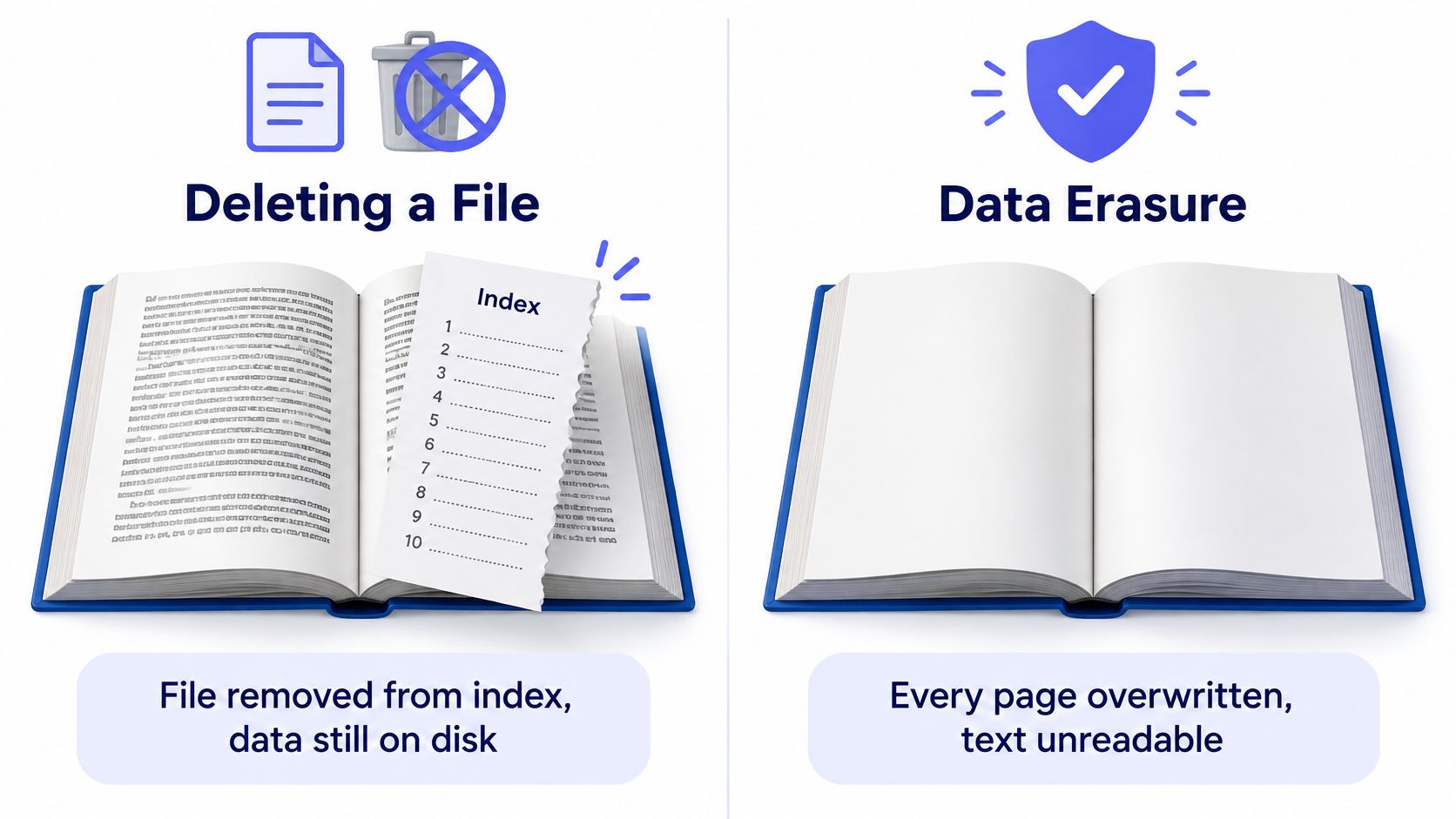
When you delete a file, the file system removes its pointer and marks the space available for reuse. The content can remain until another file overwrites it. On a lightly used laptop, that may take months. Wiping free space, purging a drive, or destroying an encryption key changes what can be recovered.
NIST's Special Publication 800-88, published in 2006, formalized media sanitization as removing data from storage so there is reasonable assurance it cannot be easily retrieved or reconstructed (NIST SP 800-88 Revision 1). Revision 1, published on 17 December 2014, refined the definition: access to target data should be infeasible for a given level of effort. It also describes Clear, Purge, and Destroy as sanitization outcomes. The Human-I-T overview of data sanitization explains the broader idea of choosing a method based on the data and storage.
Match the method to the sensitivity, not the device count. A laptop that held a backer CSV with names, addresses, and order values may need a purge with a logged result. A phone that only received a survey export may be suitable for Clear. The “defined level of effort” concept helps teams decide how difficult recovery should be, then select a method suited to that goal.
A useful erasure tool records what was erased, how it was erased, and the result. For a crowdfunding team, that record should identify the relevant device or storage location and show when the operation ran. A green checkmark without an identifier, method, or timestamp is a claim, not evidence.
The same proof-of-deletion question applies beyond a drive. Backer data may also sit in files, cloud services, and other tools, so a disk-wiping utility alone cannot establish that every copy was handled. Treat the record as a control: it should let the team trace each erasure action and its outcome, rather than show that data disappeared from view.
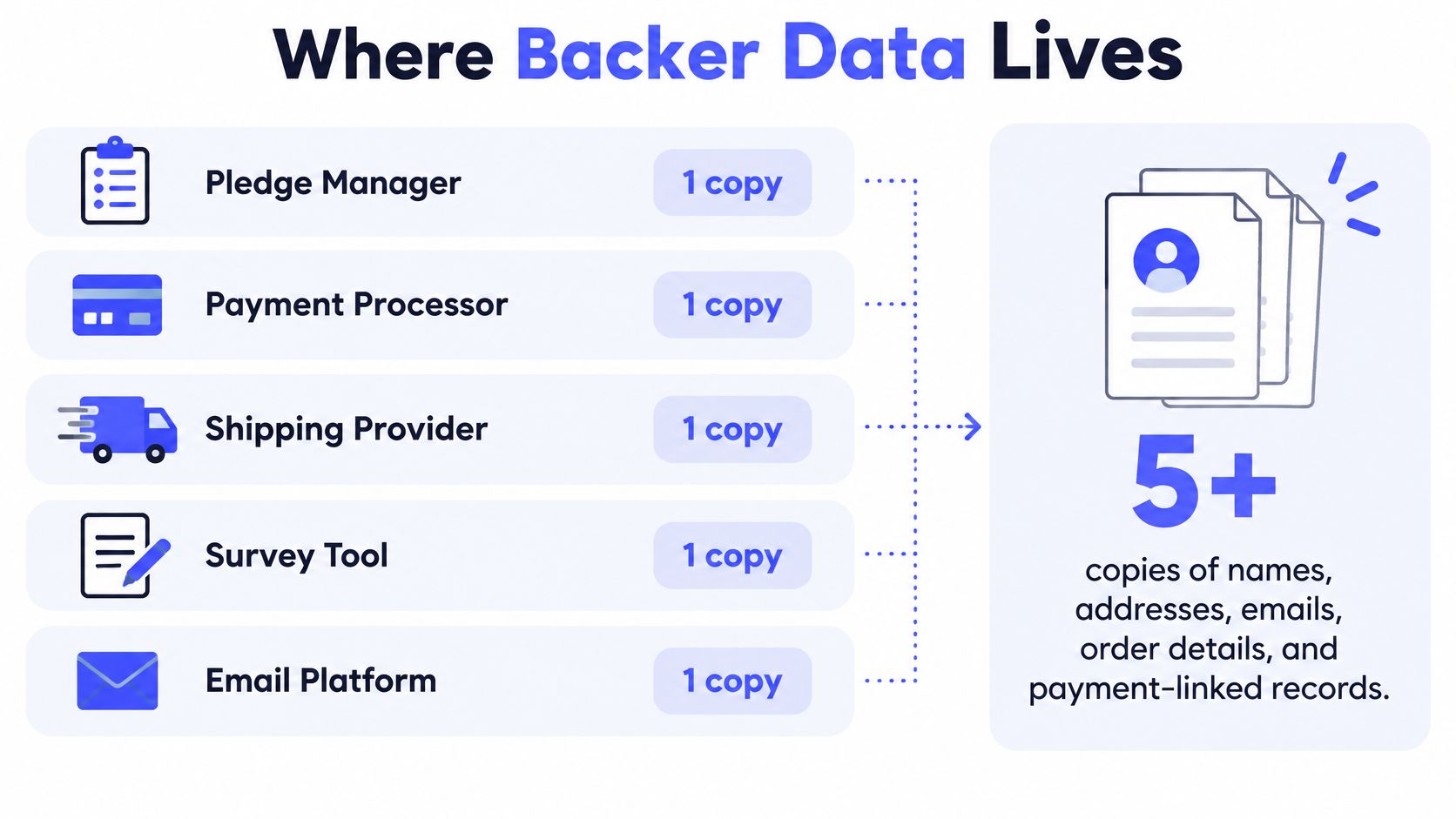
A backer list isn't one file. It's names, postal addresses, emails, reward selections, order notes and payment-linked records, and by the end of a campaign those live in at least five places. That spread is what turns a simple delete request into a compliance question.
The risks are greater than most creators assume. Blancco's 2025 survey of 2,000 enterprise IT, cybersecurity and sustainability leaders found that 86% of enterprises had experienced a data breach during the previous three years (Computerworld's coverage of Blancco's 2025 survey). Treat that as a signal rather than a crowdfunding benchmark, since the sample is large enterprises, but the pattern transfers: the data that hurts you is the data nobody is watching anymore. Blancco also reported in 2025 that organizations increased their investment in data-sanitization and related compliance activities by an average of 46% (Blancco's 2025 findings on the causes of data loss). That money usually arrives after a question nobody could answer.
Privacy rules such as GDPR give people a right to erasure, and the practical test is whether you can show what was removed and when. Say a backer asks to be deleted after their reward ships. You delete the record in the pledge manager and the request looks handled. Meanwhile a CSV export of the full list sits in a downloads folder and the shipping vendor's manifest still carries the address. The request isn't complete until those copies are addressed too.
Backer data behaves like any personal data that lives online, with the same weakness: the copies you forgot about are the ones that leak. RDE Technologies' social media privacy lessons make the consumer version of that point, that an account you stopped using still holds your details. The privacy compliance guidance for crowdfunding campaigns covers the record-keeping side of the same duty.
Erasure software only helps when the workflow reaches those copies. A perfect disk wipe on one laptop does nothing for a manifest on a vendor's system. The practical fix is a copy map, one line per system holding backer data, each with an owner and a planned erasure step.
Vendor pages all claim secure erasure, and most are telling the truth about a narrower thing than you need. Use the criteria below as a filter before you install anything on a machine that has touched real backer data.
| Criterion | What to verify | Red flag |
|---|---|---|
| Media support | Handles HDD, SATA and NVMe SSD, and self-encrypting drives | Overwrite-only operation |
| Verification | Certificate with device ID, method and result | Generic completed message |
| Logs | Exportable audit trail with operator and timestamp | No export option |
| Scope | Covers cloud copies, snapshots and exports | Local disks only |
| Automation | One-click or scheduled workflows with approval steps | Manual per-file deletion only |
| Pricing | Per-device or per-seat cost stated upfront | Fees that appear only after erasure |
A tool that looks thorough but can't show you a log isn't verifiable, and verifiability is the entire product. Certificates and exportable logs are what an auditor or a data subject receives.
A fast wipe isn't automatically safer than a slower, documented one. Speed is a convenience; a record is the deliverable. When the two conflict, take the record. The same logic applies to the rest of your stack, which is why data security best practices for campaign teams put access control and retention ahead of clever tooling.
There's a second decision behind every decommission: reuse or destroy. Verifiable erasure is what lets hardware leave your control safely. Blancco's circular-economy briefing cites the UN Global E-waste Monitor figure that the world generated 62 million metric tons of e-waste in 2022 while only 22.3% was documented as properly collected and recycled (Blancco's briefing on erasure in the circular economy). A certificate lets a laptop go to a reseller instead of a shredder, and both outcomes beat a drive that leaves with readable data on it.
Before you trust any tool with real backer data, run a test erasure on a spare device. Check that the certificate carries the serial number, the method and the result, then check that the log exports cleanly into the folder where you keep fulfillment records.
After a campaign, backer information can sit in a pledge manager, payment processor, shipping system, survey tool, spreadsheets and backups. Erasure means accounting for each copy, because deleting a record in one system does not prove that other vendors or exports have removed it.

The Amazon-versus-Shopify comparison helps explain why pledge-manager models can feel different. A marketplace such as Kickstarter sets the platform's operating rules, while a store-style service such as PledgeBox gives creators tools to configure their campaign workflow. For erasure, the practical question is not which model sounds more flexible. It is which systems hold the data, what each system's deletion function removes, and what proof it provides. PledgeBox's comparison of pledge manager fees compares pledge-manager models, but it does not establish a universal deletion process across connected vendors.
Organizations can lack written erasure procedures, backup-specific processes, staff training or clear information for people whose data they hold. The EDPB report found that roughly 70% of examined controllers received fewer than 10 erasure requests annually. Low request volume can leave a team without a practiced process, so a request may arrive while campaign fulfillment is still underway.
A small team can start with a copy map rather than enterprise automation. List each system, assign an owner for the data set, note how long records must be retained, and record how deletion is confirmed. That map is like a route through connected tools: every stop needs its own action and evidence.
| Copy location | Typical backer data | Erasure action | Proof to keep |
|---|---|---|---|
| Pledge manager | Names, addresses, order and pledge records | Delete or anonymise after retention check | Deletion log with record IDs and date |
| Payment processor | Payment-linked records | Request deletion, keep legally required records | Vendor written confirmation |
| Shipping or fulfilment vendor | Shipping addresses and manifests | Request vendor purge | Vendor written confirmation |
| Survey tool | Survey answers and any extra payment data | Delete responses after retention window | Export and deletion record |
| Spreadsheets and exports | Full backer list copies | Securely erase local and cloud files | Command log or certificate |
| Backups and replicas | Snapshots of all the above | Purge on backup schedule | Purge date record |
Ask each provider in writing, then keep the response with the relevant system's deletion record:
This map turns erasure from a single click into a traceable chain: identify every copy, request the right action from each system, and retain evidence of the result.
A fulfillment lead clicks Erase on Friday, files the ticket, and on Monday a shipping vendor still holds the same address list. The button worked on the system in front of them. Proof of deletion is a separate job: a result for every place that held the backer data, not a single disk wipe.
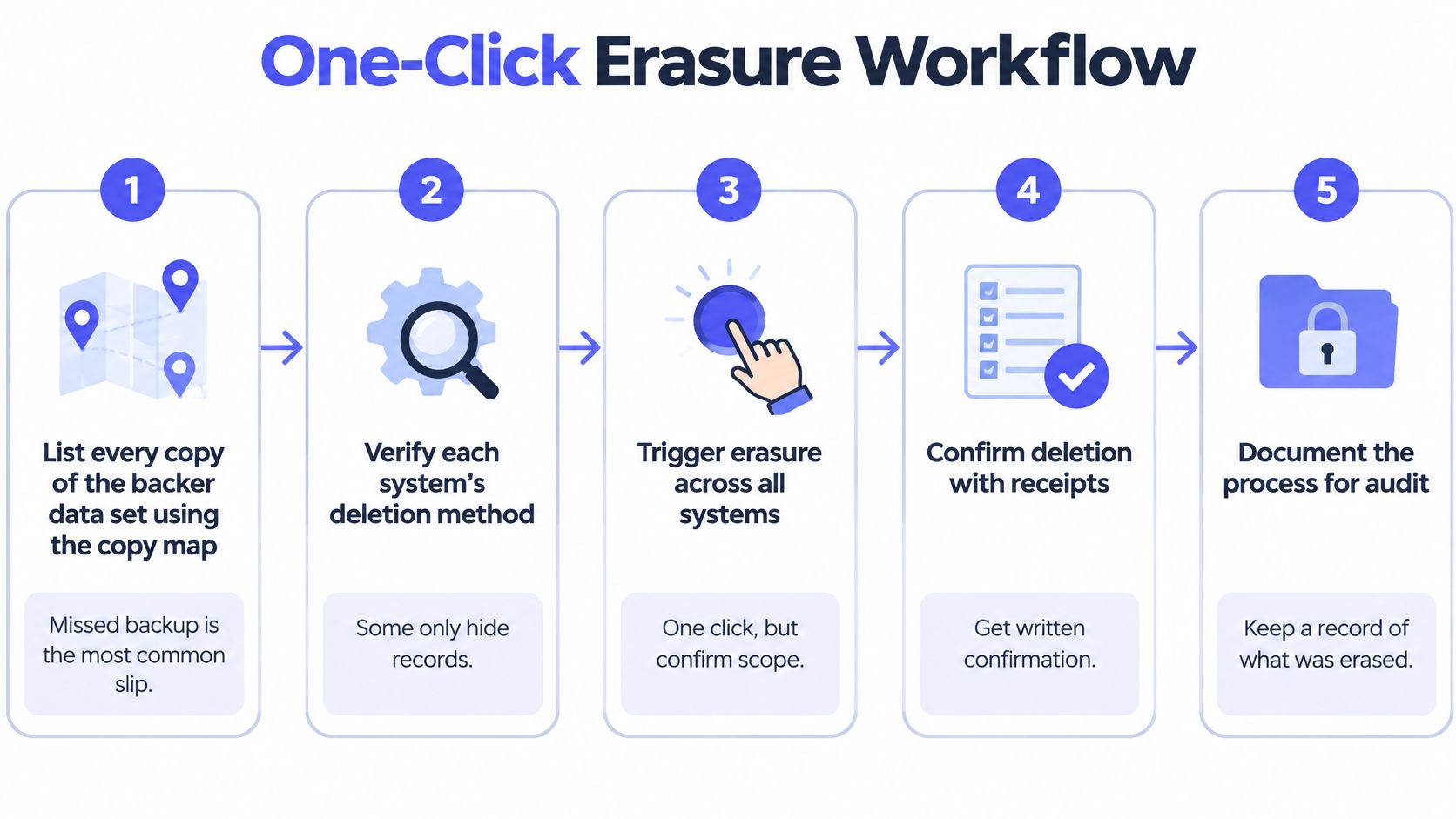
Run the seven steps in order. Skip one and the log only describes a partial cleanup.
List every copy of the backer data set. Start from the copy map, one line per system. The copy people miss is usually a backup, because backups do not appear inside the tool that holds the live record.
Assign a method per storage type. An SSD needs a device sanitize or block erase command, not a plain overwrite. A cloud export needs deletion plus a backup purge. Fulfillment teams go wrong here when they accept the software default and apply that one method to every store.
Confirm the retention exception. Financial and tax records usually have to stay for a set period, so mark them before anything is erased. Delete a payment record early and you lose the paperwork that retention rule still requires.
Run the erasure on the primary system, then trigger deletion in each connected tool. Each tool has its own delete or purge function, and each confirmation means something slightly different. A pledge manager deletion does not flow into the survey tool or the shipping vendor on its own.
Purge backups and replicas on their schedule. Record the date the purge finished, not the date you requested it. A backup that rolls off in 30 days is not deleted today.
Export the erasure log. Include device or record IDs, method, operator, timestamp, and result. Our one-click data erasure keeps campaign records intact while removing backer information after fulfillment.
Send the log to the requester or file it in the compliance folder. One copy in each place is enough. A thorough erasure with no surviving evidence is an erasure you cannot show.
What a complete record looks like: one line per copy, a result for each, and a date. Read it aloud to someone who was not in the room. If they can say what was erased, where, and when, the proof is finished.
Before the campaign closes, do one thing: add the survey data to your copy map and confirm every copy has a planned erasure step with a named owner. Survey responses are often the largest pile of personal data a campaign collects, and they're the pile most likely to be forgotten because they arrive late, in a separate tool, after the pledge manager has already been tidied.
PledgeBox is free to send the backer survey, and surveys that collect no additional payment have no platform collection fee. When a survey does collect extra money, whether that's add-ons, shipping fees or taxes and VAT, we charge a standard 3% fee on those payments. The fee doesn't apply again to the original Kickstarter or Indiegogo pledge, so a $100 survey payment produces a $3 platform fee before payment-provider charges (PledgeBox pricing).
Then finish the loop. Keep the erasure log filed alongside your fulfillment records, so the date the survey data was deleted sits next to the date the last parcel shipped. Sending backer surveys through PledgeBox takes minutes, and the deletion record you create afterward is what makes the whole campaign defensible.
When the campaign ends and the survey data starts piling up, PledgeBox gives you a place to collect it and a way to remove it. Our pledge manager handles branded surveys, shipping fees, taxes and add-on upsells, then provides one-click data erasure so backer information can be cleared after fulfillment while your campaign records stay intact. Visit PledgeBox to set up your next campaign with a deletion record built into the workflow from day one.
PledgeBox
The All-in-One Toolkit to Launch, Manage & Scale Your Kickstarter / Indiegogo Campaign