 PledgeBox
Data Privacy Compliance for Crowdfunding Creators
A practical data privacy compliance guide for crowdfunding creators covering GDPR, CCPA, consent, retention, and PledgeBox tools that simplify it all.
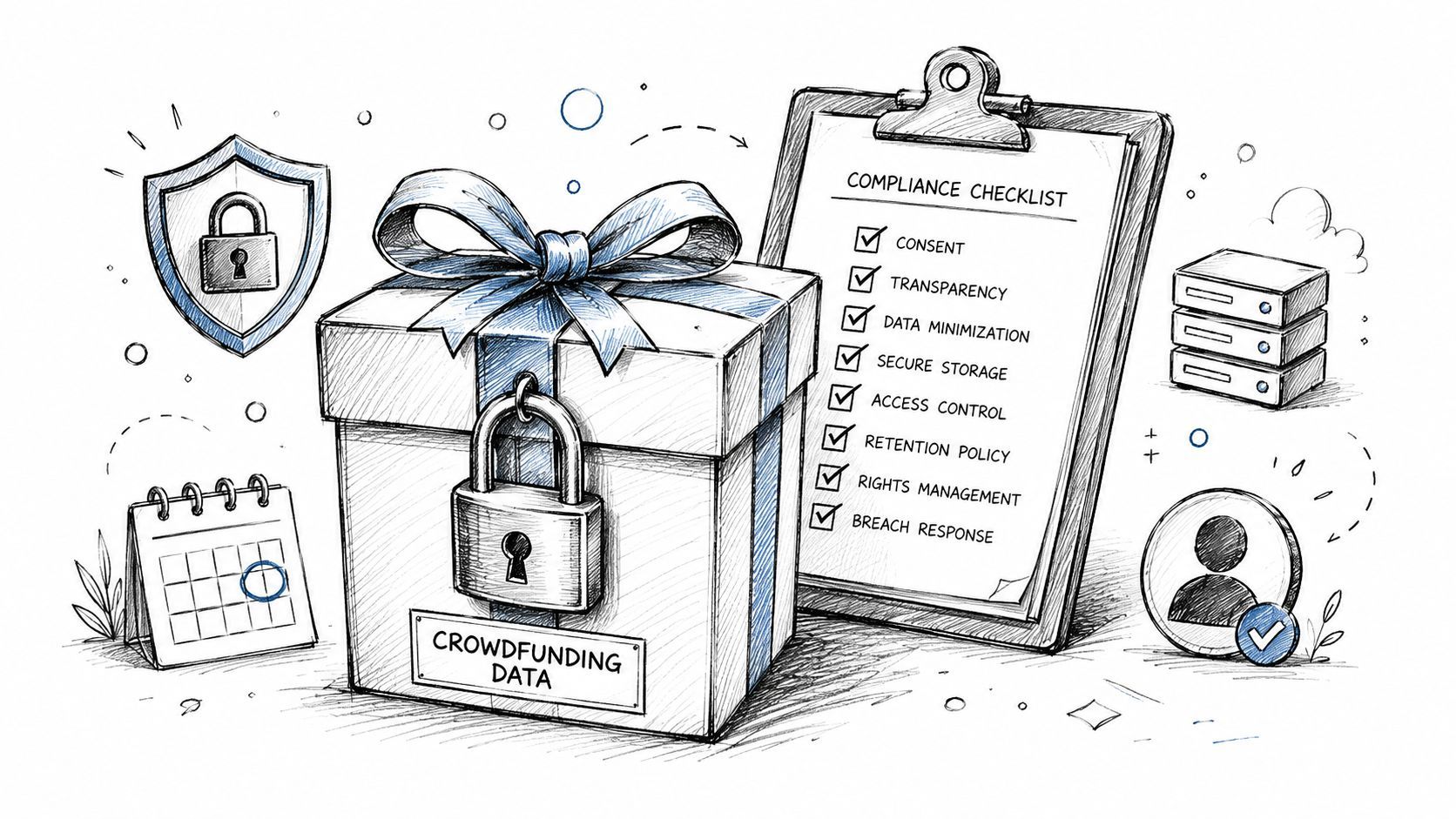
A practical data privacy compliance guide for crowdfunding creators covering GDPR, CCPA, consent, retention, and PledgeBox tools that simplify it all.
You can be halfway through a campaign and suddenly get the email every creator dreads. A backer asks what personal data you're storing, why you need it, or tells you to delete everything before fulfillment ships. That's not a side issue anymore, it's the shape of data privacy compliance for crowdfunding creators, because your campaign touches emails, addresses, survey answers, payment metadata, and shipping records all at once.
If you're running a Kickstarter or Indiegogo campaign, you're not just managing rewards. You're managing a live stream of personal data across pre-launch capture, surveys, pledge managers, fulfillment partners, and post-campaign retention. The rules around that data now stretch across borders, which means the privacy question isn't “Do I need a policy?” It's “Can I prove I handled each backer's data properly from the first signup to the final shipment?”
A creator usually feels privacy compliance the moment a backer sends a direct message that's both polite and specific. Maybe they want to know whether an old pre-launch email list is still stored. Maybe they want their shipping address removed before fulfillment. Or maybe a backer from another country asks why their data was collected at all.
That kind of request can feel disruptive when you're also chasing factories, packing labels, and late pledge add-ons. But it's exactly why privacy can't be treated like a legal afterthought. Around the world, national privacy laws have spread so widely that privacy compliance is now a standard operating condition for cross-border businesses, not a niche issue reserved for large platforms or EU-only companies major industry synthesis on national privacy laws.
A crowdfunding campaign creates several places where personal data lives at once. Pre-launch signups store emails. Surveys collect reward preferences and shipping details. Pledge manager tools may hold add-ons, VAT, and address corrections. Fulfillment vendors often see the same data again, which means every extra handoff becomes another place where a mistake can happen.
That's why the practical question is less “Am I a privacy expert?” and more “Can I trace what data I hold, why I hold it, and who can see it?” If you can't answer that cleanly, you're already behind. A useful way to think about it is this, privacy compliance is less like filing a form and more like keeping a clean shipping manifest. If the manifest is messy, the whole warehouse slows down.
Practical rule: if a backer could reasonably ask “why do you have this?” your team should be able to answer without improvising.
The rest of this guide turns that idea into campaign workflow terms. You'll see how privacy issues show up before launch, during surveys, inside pledge managers, and after fulfillment, so you can build habits that fit a creator's timeline instead of a law firm's filing cabinet.
Think of privacy like running a private event. You don't let random people into the guest list, you don't collect extra details just because you can, and you don't keep the list forever after the party ends. Data privacy compliance follows the same logic.
At the global level, the core rule is simple. Personal data should be processed lawfully, fairly, and transparently, collected for specified, explicit, and legitimate purposes, and kept no longer than necessary for those purposes World Bank privacy-law guide. In a campaign, that means your email capture form should say why you want the email, your survey should explain why you need shipping data, and your fulfillment files shouldn't sit around indefinitely after rewards are sent.
For creators, personal data isn't just a name and email address. It can include shipping addresses, payment-related metadata, survey responses, IP addresses, and even notes about size preferences or accessibility needs when those details can identify a person. Once data can point to a person, the privacy rules start to matter.
A good reference point is Disputely's explanation of how personal data is used, which shows the kind of plain-language thinking creators should copy in their own notices. You don't need dense legal prose. You need clarity.

Start with the guest-list logic and apply it to every touchpoint:
Optional questions can still be useful, but they should stay optional and tied to a clear purpose. A size preference for a T-shirt reward is different from a general marketing prompt. One belongs to fulfillment, the other needs a separate, explicit explanation.
The takeaway is straightforward. Privacy compliance is not about making your campaign feel lawyerly. It's about making the flow of personal data understandable, limited, and defensible when a backer asks for an answer.
A creator does not need to memorize every privacy statute on the planet. They do need to recognize the few rules that shape the way a campaign collects emails, runs surveys, hands off pledge data, and ships rewards. In practice, that usually means the GDPR in Europe, the CCPA and CPRA in California, and the ePrivacy rules around cookies and electronic marketing consent.
| Framework | Where It Applies | Main Trigger for Creators | Notable Obligation |
|---|---|---|---|
| GDPR | EU and related cross-border processing | Collecting data from backers in or linked to the EU | Privacy by design, access control, lawful processing |
| CCPA/CPRA | California | Serving California backers or handling their personal information | Notice at or before collection, deletion and access rights |
| ePrivacy | Cookie and electronic communication rules in applicable EU contexts | Tracking or marketing emails tied to campaign activity | Consent for cookies and certain marketing uses |
A useful way to read the GDPR is to follow the campaign workflow. Pre-launch signups, survey responses, pledge manager details, and fulfillment records all count as personal data if they can point to a person. That is why the rule reaches beyond the launch page and into the systems that store or share those records. It also embeds privacy by design, which requires technical and organizational measures from the moment you decide how data will be processed and across the full lifecycle GDPR privacy by design technical framework. The same framework also expects secure authentication, role-based access control, and encryption at rest and in transit in GDPR-compliant systems GDPR security requirements paper.
For a closer look at how pledge tools handle those GDPR duties, see PledgeBox and GDPR. That kind of guide matters because creators often assume privacy only applies at the signup form, then discover that survey exports, shared spreadsheets, and fulfillment notes are part of the same record trail.
California works differently, but the day-to-day burden looks familiar. Businesses generally need to give a notice at or before collection that explains what categories of personal information will be collected, why it will be collected, whether it will be sold or shared, and how long it will be retained or how that period is set U.S. privacy law summary. For CCPA requests, businesses generally also need at least two submission methods, including an online method and a toll-free number U.S. privacy law summary.
Creators also run into the U.S. state patchwork. There is no single federal privacy law to simplify everything, so teams usually need a layered approach instead of one notice that tries to do all the work U.S. privacy compliance analysis. If your backers come from multiple regions, that overlap matters more than any single acronym.
A privacy policy explains the rules, but it does not carry them out. The actual work happens in the controls behind it. For a crowdfunding creator, that usually means five pieces working together, consent capture, vendor agreements, data minimization, retention schedules, and access control.

Consent needs to sit right where the data is collected. If your pre-launch page asks for an email address, the form should explain whether that email will be used for launch updates, campaign marketing, or another purpose. If you use a payment processor, shipping app, or email platform, treat those vendors as processors with written obligations, not as casual tools you can plug in and forget.
Retention works the same way. Shipping addresses help during fulfillment, then they should not keep living in active systems after the job is finished. A shorter retention window leaves less exposed if a backer asks for deletion or a vendor account is compromised.
Many small teams describe data as “protected” without mapping who can open it, where it lives, or whether it is encrypted. For GDPR-style systems, secure authentication, authorization, role-based access control, and encryption in transit and at rest are the practical baseline GDPR security requirements paper. That is the difference between a private notebook and a shared spreadsheet sitting in plain view.
A working data-subject rights process matters just as much. Requests need an intake path people can find, identity verification before disclosure, and a response workflow that can meet the usual 30 to 45 day window when it applies privacy compliance operations guide. The records you keep matter too. Privacy notices, Records of Processing Activities, DPIAs, and remediation logs belong in the basic documentation stack privacy compliance operations guide. If you want a practical checklist for mapping those obligations before launch, this GDPR requirements checklist for pledge tools is a useful internal reference.
Practical rule: if only one person knows how to delete a backer record, your process is too fragile.
The breach side is where time pressure becomes real. The GDPR-style rule many creators hear about is the 72-hour notification window after becoming aware of a breach privacy compliance overview. If your data sits across five tools, that clock gets harder to meet because nobody trusts the same source of truth.
A campaign becomes much easier to manage when you treat privacy as a sequence, not a theory. The data you collect before launch is not the same as the data you need for fulfillment, so the controls should change with the stage.

Pre-launch capture should be narrow. Ask only for the email or other contact detail you need, and say exactly why you want it. During the live campaign, keep the collection tight and avoid layering extra questions into every form just because the tool allows it.
That's also the stage where cookie tracking and marketing messages can become messy. If you're using ads or email follow-ups, the consent logic needs to be separated from the reward logic so the backer can say yes to one and no to the other. If you want a practical checklist for mapping those obligations before launch, this GDPR requirements checklist for pledge tools is a useful internal reference.
Post-campaign surveys usually collect the most sensitive operational data because they combine shipping addresses, reward selections, and add-on choices. Only ask what you need for the reward, and keep the response window and retention period tied to fulfillment, not to “just in case” storage.
Pledge managers and fulfillment vendors become processors the moment they handle backer data for you, which is why contracts and access boundaries matter. The same is true for shipping platforms and address validation tools. If they see the data, they're part of your compliance map.
A backer rights request can land at any of these stages. That's why accessible intake, identity checks, and deletion routines should be built into the workflow before the campaign goes live. Teams that postpone the process until a complaint arrives usually end up rebuilding it under deadline pressure.
Most creators don't need a 40-page policy draft on day one. They need short language they can place where data is collected, then adjust for their campaign details. The trick is to make the wording clear enough for backers and specific enough for the law.
For a campaign privacy notice, start with plain purpose language: “We collect your email to send campaign updates, your shipping address to deliver rewards, and your survey answers to manage reward choices and fulfillment.” A notice like that does two jobs at once, it explains what you collect and why you collect it.
For vendor language, keep the clause focused on role and purpose. A simple version can say the vendor may process campaign data only to provide the service, must protect it with appropriate safeguards, and must delete or return it when the service ends. If you want a plain-language reference point for building that kind of document, the online privacy agreement details from Beyond Surplus offer a useful starting structure.
The most common mistake is mixing purposes together. If a field is for shipping, don't use it for marketing follow-up later. If a question is optional, don't make the reward depend on it unless it is required.
Keep sensitive preferences separate whenever possible. If a survey asks about sizing, accessibility needs, or similar reward details, explain why the question is there and avoid collecting it in the same sentence as promotional consent. That small separation helps the backer understand what they're agreeing to, and it keeps your records cleaner when someone asks for a copy or deletion later.
The easiest compliance wins come from tools that reduce the number of places where backer data is copied. PledgeBox does that by keeping campaign data isolated inside the platform and offering one-click data erasure, which lines up cleanly with privacy by design and deletion workflows that creators need under GDPR-style and California-style requests PledgeBox privacy policy.

If you're collecting backer info in a pledge manager, a tool that isolates that data makes it easier to limit access and reduce accidental sharing. If a backer asks for deletion, one-click erasure is far simpler than hunting through exports, inboxes, and spreadsheet copies. That matters because compliance usually fails in the handoffs, not in the policy text.
PledgeBox also fits the practical economics of a creator workflow. It's free to send the backer survey and only takes 3% on add-on sales during surveys if there's any, which means you can run the survey stage without adding a fee just to ask your backers for fulfillment details PledgeBox pricing and product details. The platform has been trusted since 2019 by 8,000+ creators, and it charges no upfront, per-backer, or campaign fees PledgeBox product details.
That cost model matters because creators often compare pledge managers to storefronts. Kickstarter's pledge manager tends to feel more like Amazon, where the platform sits in front of a broader transaction flow, while PledgeBox's pledge manager feels more like Shopify, where the creator keeps a more direct operational setup and can manage the workflow more deliberately. The compliance difference is practical, not philosophical, because fewer unnecessary data hops usually mean fewer places to clean up later.
Stripe and PayPal integrations help with payment processing relationships, while Google Maps address validation reduces bad-address storage by catching errors earlier. That supports the data minimization mindset from earlier sections, because bad data is still data, and storing less of it lowers your cleanup burden.
For a creator trying to connect compliance to a real tool stack, the point is simple. Use the platform buttons that support isolation, erasure, and cleaner intake, then keep your own notices and vendor records aligned with those choices. If you want to see how the product handles privacy and campaign operations together, the PledgeBox privacy policy is the place to review its own data handling language.
Privacy compliance works best when it feels like a workflow, not a panic response. Map every data touchpoint before launch, write consent in plain language at each collection point, and set scheduled deletions after fulfillment instead of letting old records linger. That's the discipline behind the legal language.
A simple launch-day checklist keeps the job manageable:
The rules will keep changing as AI, analytics, and state laws evolve, but the operating pattern won't. Creators who build small, repeatable controls now will spend less time firefighting later and more time shipping rewards on schedule.
PledgeBox gives creators a practical way to handle surveys, pledge management, and deletion requests without turning the process into a spreadsheet maze. If you want a tool that supports privacy-first data isolation, one-click erasure, and a survey flow that's free to send, visit PledgeBox and see how it fits your next campaign.
PledgeBox
The All-in-One Toolkit to Launch, Manage & Scale Your Kickstarter / Indiegogo Campaign