 PledgeBox
Early Bird Pricing Strategy for Crowdfunding Creators
Learn an early bird pricing strategy that actually converts, from goal setting and tier math to pledge manager integration and post-campaign follow-up.

Learn an early bird pricing strategy that actually converts, from goal setting and tier math to pledge manager integration and post-campaign follow-up.
You've launched your campaign, watched the first pledges arrive, and now you're deciding what to do with the early-bird tier. The temptation is to copy a familiar offer, such as 20% off for the first backers, and move on. That's how creators end up celebrating fast sales while creating a fulfillment problem in the background.
A strong early bird pricing strategy connects three decisions from the beginning: how much cash the tier should generate, how much margin each reward must retain, and how the post-campaign pledge manager will recover value through add-ons. The discount should create momentum without becoming a hole you're forced to repair after funding.
Don't choose the discount before choosing the job. An early-bird tier usually serves one of three purposes:
Each purpose requires a different cap. A cash-flow tier should be large enough to produce meaningful funding, while a fan-reward tier can be smaller and more exclusive. A validation tier should answer a specific product question, rather than chase the highest possible sales count.
Write the target in operational terms. You might define success as reaching a meaningful share of the funding target during the opening week, selling through a predetermined batch, or collecting enough paid commitments to justify a new design. The exact target depends on your break-even volume, production minimums, and available cash.
Then connect the target to the unit economics. If the tier sells quickly but leaves too little contribution per reward, it hasn't succeeded. If it protects margin but generates no useful demand signal, it hasn't done its job either.
A behavioral crowdfunding model supports treating early-bird pricing as a volume strategy rather than a margin strategy, but it also warns that the price gap and quantity limit must be calibrated carefully. An overly deep discount can weaken momentum once the discounted allocation disappears. The crowdfunding pricing model is useful here because it frames the tier as a controlled experiment in demand, not a permanent promise to sell cheaply.
Practical rule: Never approve an early-bird price until you can explain what the tier is buying for the campaign, cash, validation, or loyalty.
Use this sentence as your operating brief:
“Our early-bird tier exists to [job], with a target of [measurable outcome], while keeping each fulfilled reward above our minimum contribution floor.”
That sentence should govern the price, quantity, campaign copy, and later upsell plan.
A $60 reward with a $24 landed cost can look comfortably profitable until fulfillment, payment fees, support, and replacements enter the spreadsheet. Set the early-bird price from that complete cost picture, not from a tempting round percentage.
List every cost attached to delivering one unit:
Add those costs, then set the minimum contribution each fulfilled reward must produce. The early-bird price cannot fall below that floor. In the $60 and $24 example, $36 remains before the other expenses. That amount is not a safe discount pool until the full fulfillment model is included.
The IndieTool pricing analysis guide provides useful context for evaluating price through costs, positioning, and customer value instead of choosing a percentage in isolation. Apply the same discipline to crowdfunding, where shipping and post-campaign handling can turn an attractive campaign price into a margin problem.
Use the PledgeBox guide to developing a pricing strategy for your crowdfunding campaign to establish the standard price before reducing it. Then test the early-bird tier against actual fulfillment costs. Crowdfunding and event pricing guidance often places the discount at 15% to 25% below the standard price, but that range is a reference point, not an instruction. Your cost floor decides the acceptable price. Crowdfunding and event pricing guidance also connects moderate discounts with urgency while preserving the regular price.
| Line item | Standard tier | Early-bird tier |
|---|---|---|
| Customer price | Full planned price | Reduced price above the floor |
| Product and fulfillment costs | Same reward cost | Same reward cost |
| Contribution per unit | Target contribution | Lower, but still acceptable |
| Upsell dependence | Optional | Planned recovery channel |
| Availability | Broad allocation | Hard quantity or time limit |
At $60, a nominal 20% reduction produces $48. Charge more if the contribution floor requires it. Charge less only when the fulfillment model leaves enough room. The cost sheet, not the round number, makes the decision.
Use PledgeBox's free post-campaign survey flow to recover value without gambling on it. Ask backers about add-ons, upgrades, and shipping choices after the campaign, then use those responses to shape a relevant upsell offer. The early-bird tier should pay for itself through its launch role and sound unit economics. Survey-driven extras can improve recovery, but they must not rescue an underpriced reward.
The early-bird discount should never exceed the post-campaign upsell margin you can realistically recover.
Future add-ons are opportunities, not guaranteed revenue. Price the core reward so it remains commercially sound even when a backer buys nothing else.
A moderate discount with a real cap is stronger than the deepest price cut you can survive. Current early-bird guidance generally converges on a 15% to 25% discount, with a hard limit and a clear closing condition. Going beyond 30% can make the later price feel inflated and can teach buyers to wait for another sale. Guidance on early-bird windows and buyer trust makes the important point that the operational question isn't only how much to discount. It's how long to keep the offer open without training the audience to delay.
Set the cap from a real constraint:
Open the offer when the campaign goes live. Announce the cap immediately, show the remaining quantity accurately, and define the exact event that closes the tier. Use a date, a quantity, or both. Do not extend it just because sales are slower than expected.
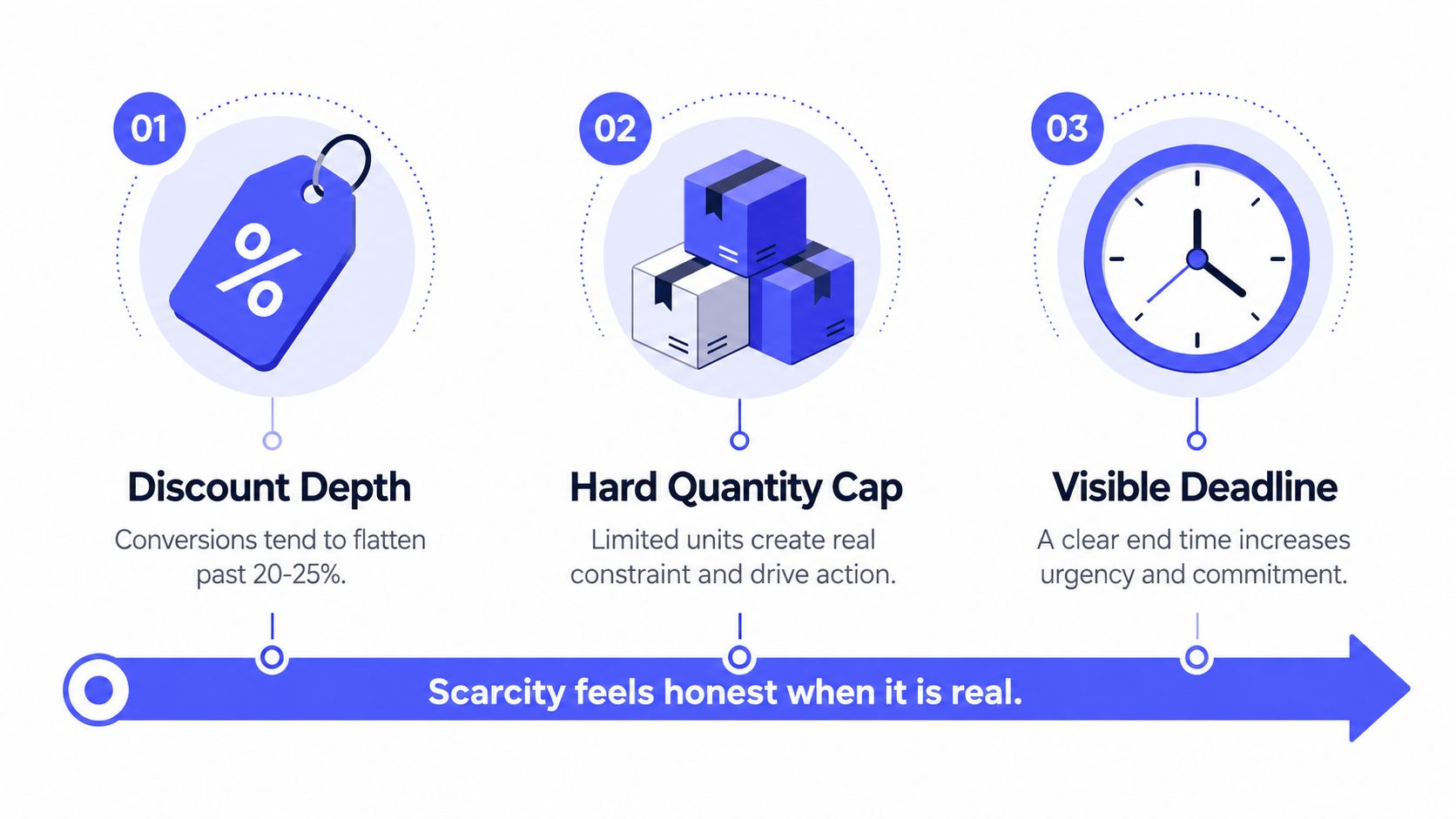
A sold-out early-bird tier can continue working after it closes. A multi-method crowdfunding study found that unavailable discounted rewards increased selection of the equivalent full-price option. The study used experiments with 512 participants and an observational sample of 676 projects, and found the effect was stronger for moderate discounts than for very high discounts. The study on sold-out early-bird rewards also connects visible adoption signals with reduced sensitivity to discount depth.
That gives you a practical sequence. Sell a limited number at a defensible price, show that real people claimed it, then direct late visitors toward the standard tier. The closed tier becomes evidence of demand rather than a dead end.
For more campaign examples and implementation ideas, see PledgeBox's guide to creating urgency and scarcity.
The video below adds another perspective on using scarcity in a launch context.
Treat the early-bird offer as a primary campaign message, not a footnote in the reward list. A visitor should understand the price, cap, and closing condition before scrolling past the hero section. If the offer is buried, the discount loses its ability to shape the first decision.
Use one clear headline that combines the benefit with the limit and timing. For example:
First 100 backers get the Standard edition for $39, regular price $59, ending Friday or when the cap is reached.
That format works because it answers the three questions a new visitor has immediately:
A bare price reduction can make the product look less valuable. Add one honest line explaining why early supporters receive the offer. Good reasons include locked-in manufacturing costs, founder pricing, or a launch event. Don't invent a fake deadline or imply that production costs change if they don't.
Place the same information in three locations:
Put a comparison row beneath the call to action so readers evaluate the early-bird price against the planned standard price, not against an unrelated reward. Test short CTA labels such as “Claim Early Bird” and “Back at Founder Price.” Keep the supporting copy concise. The reader should not have to decode a paragraph to discover the offer.
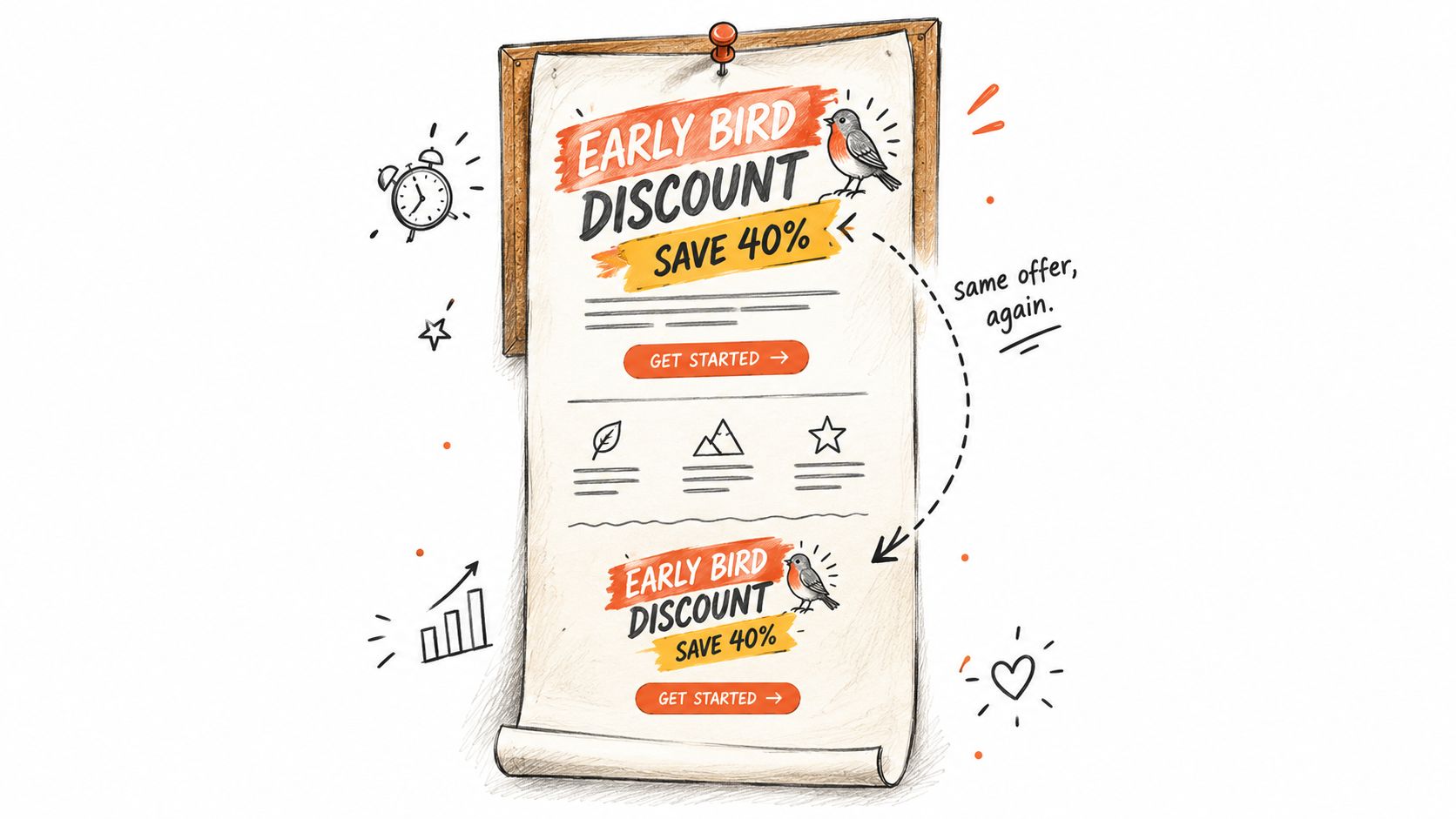
Your copy is ready when someone unfamiliar with the project can identify the early-bird price, quantity, and deadline without scrolling beyond the main campaign visual. Clarity beats cleverness here. A simple offer that backers trust will outperform a complicated promotion that needs explaining.
Run one controlled test at a time. If you change the headline, hero image, video, discount, and reward order together, you won't know what affected the result. Keep the campaign page stable except for the variable under examination.
Useful variables include:
The test should stop when the cap is reached. At that point, lock the page and route new visitors to the standard reward. Continuing to compare variants after the limited tier disappears mixes different buying conditions and makes the result unreliable.
Use Kickstarter's dashboard for campaign performance and configure Google Analytics events around the pledge button if your measurement setup supports it. Review the data consistently, but decide the winner using backer count and total raised, not clicks alone.
Track these operating metrics:
| Variable | Value A vs Value B | Primary metric | Kill switch |
|---|---|---|---|
| Discount | Moderate offer vs smaller offer | Total raised | Contribution falls below floor |
| Cap | Smaller batch vs larger batch | Sell-through speed | Higher tier risks selling out too late |
| Deadline copy | Specific date vs relative timing | Conversion rate | Backers misunderstand the close |
| CTA | “Claim Early Bird” vs “Back at Founder Price” | Backer conversion | Clicks rise without pledges |
| Reward order | Early bird first vs standard first | Tier mix | Standard tier becomes invisible |
A test that produces more clicks but fewer pledges is not a winner. A test that increases early-bird sales while weakening total raised may also be wrong for the campaign. Your decision should reflect the original job statement, whether that was cash, validation, or fan recognition.
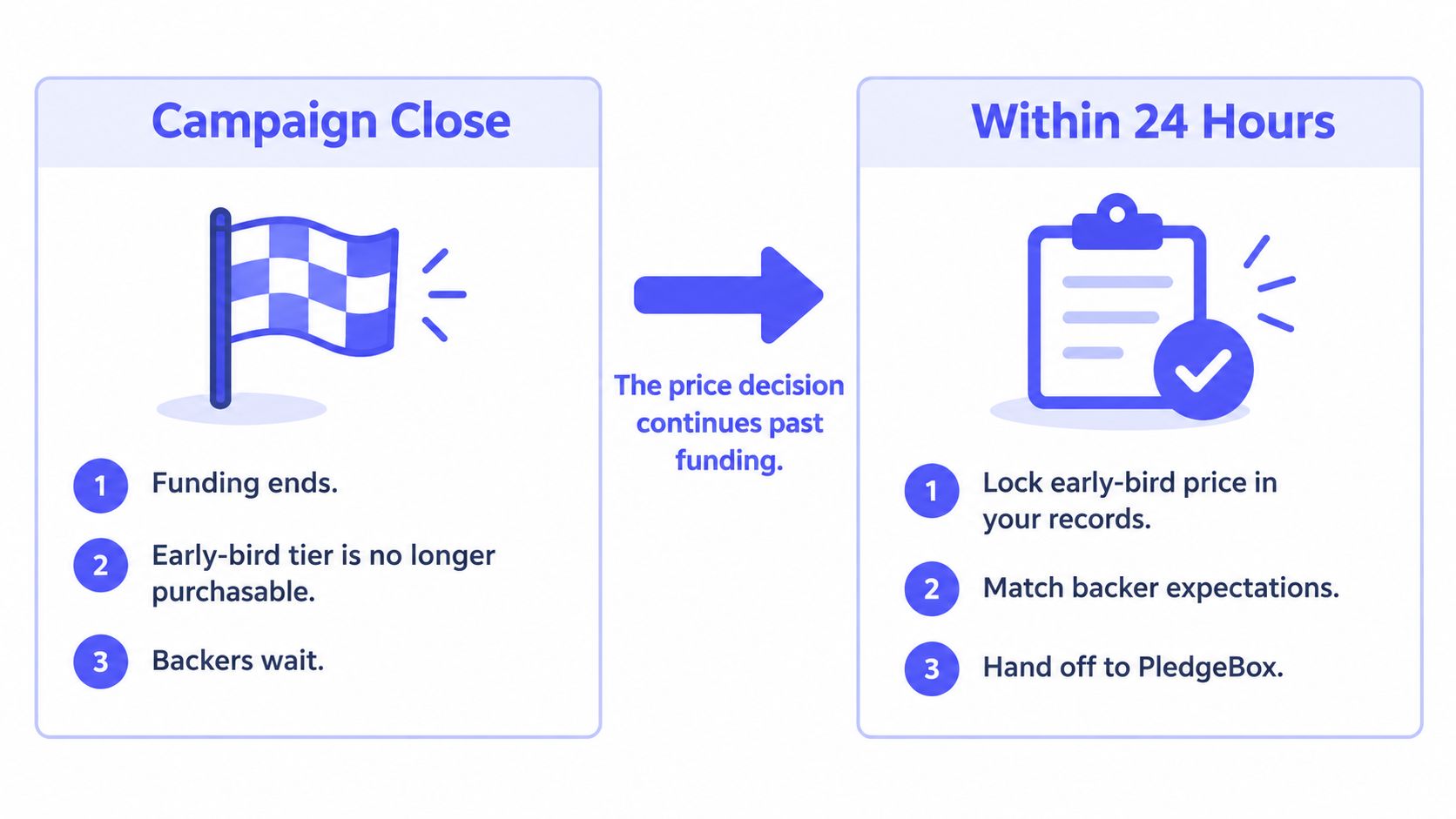
Campaign close is a handoff, not the end of the early-bird decision. Within 24 hours of funding, lock the early-bird price in your records, including the reward name, SKU, contents, shipping treatment, and any eligibility rule. Backers should see the same promise in the survey that they saw on the campaign page.
Kickstarter's built-in pledge manager is convenient for basic address collection and add-ons, but it offers less customization than a dedicated post-campaign system. The simplest mental model is this: Kickstarter's pledge manager is like Amazon, a marketplace layer where the platform sits between the creator and the transaction. PledgeBox's pledge manager is like Shopify, a storefront layer that gives the creator more control over the post-campaign buying experience.
PledgeBox is free to send the backer survey and only charges 3% of upsell revenue if there's any. If the survey generates no upsell revenue, the survey itself carries no charge. That makes the post-campaign calculation straightforward: preserve the early-bird promise, then use optional add-ons and upgrades to recover margin where the backer sees genuine value. PledgeBox's pricing details describes the free survey flow and the 3% fee on revenue collected through survey upsells.
Use this sequence after funding:
The survey should feel like fulfillment administration, not a second campaign that asks backers to reinterpret what they bought. The early-bird reward must appear as a locked line item. Add-ons should be visibly optional, with clear descriptions and realistic fulfillment implications.
Kickstarter's native tool and PledgeBox also represent different economic models. Kickstarter's built-in layer keeps the workflow simple, while PledgeBox states that its survey is free and charges only 3% on upsell revenue, with no setup, campaign, or per-backer fee when no upsell revenue is generated. This comparison of Kickstarter and PledgeBox explains the Amazon-style and Shopify-style distinction from the creator's perspective.
Send the survey after the initial campaign excitement has cooled, while the project is still familiar. Use a clear email, repeat the expected fulfillment window, and explain why each add-on exists. A backer who understands the use case is more likely to choose an accessory than someone shown a random list of products.
Your post-campaign model should answer three questions:
PledgeBox's post-campaign workflow is designed around free survey distribution and payment only when creators collect through upsells. Its crowdfunding pledge manager overview provides the relevant operational context. The important strategic point is that the pledge manager should support the original price architecture, not conceal a weak one.
Most early-bird failures start before launch. Creators choose a discount because it looks familiar, publish vague scarcity copy, and postpone the survey plan until hundreds of backers need fulfillment. The campaign may gain early attention, but the team inherits avoidable margin and support problems.
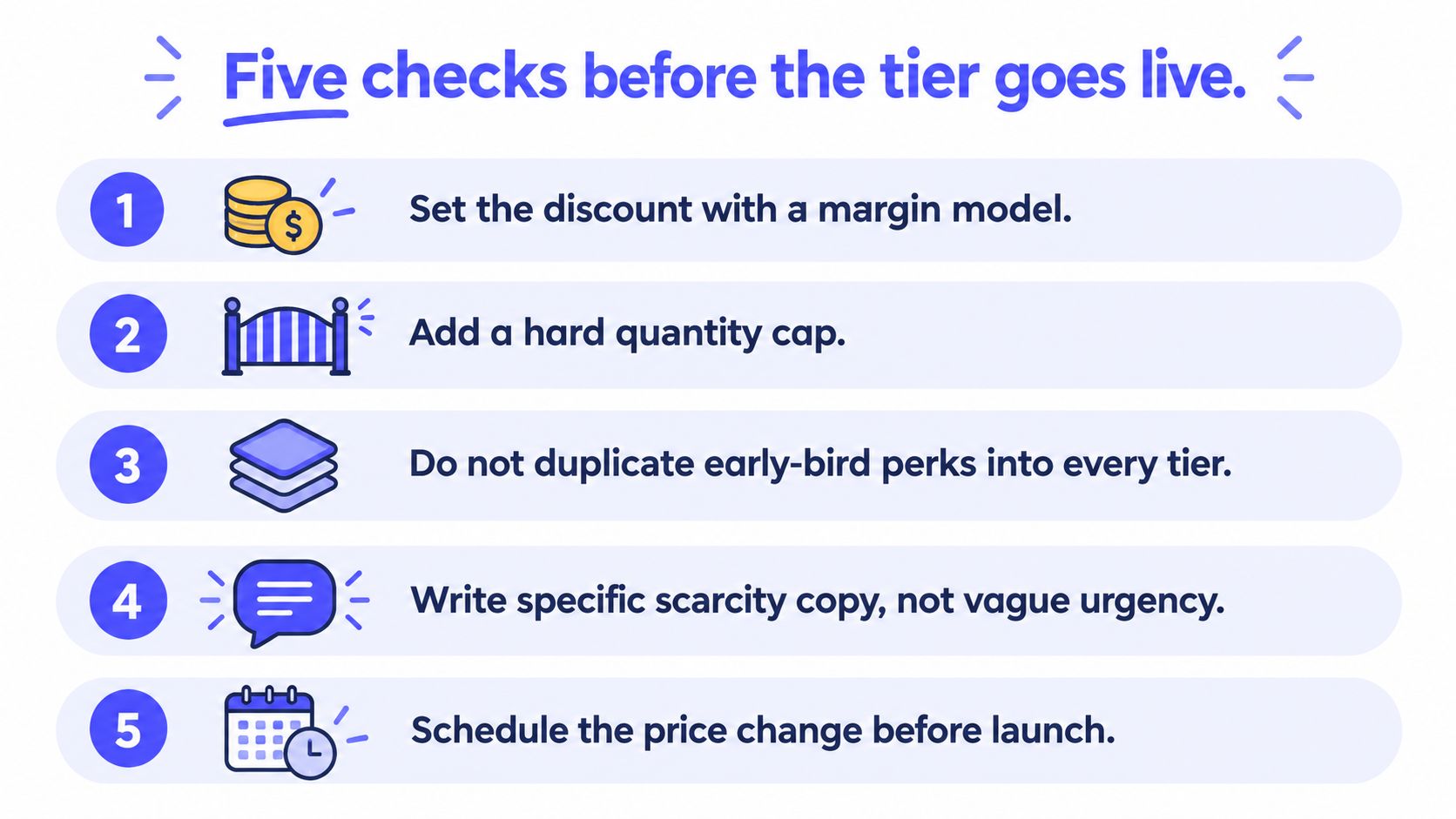
Two weeks before launch
One week before launch
On launch day
One overlooked problem deserves special attention. Early-bird backers may expect to receive their rewards before retail customers, even when your production schedule doesn't support that assumption. State the expected ship window directly in the reward description, and repeat it in the survey confirmation. Clear timing protects trust better than an aggressive discount.
A disciplined early-bird pricing strategy doesn't ask you to discount blindly. It asks you to trade a controlled amount of margin for a specific campaign outcome, then use clean fulfillment and relevant upsells to protect the economics after funding.
PledgeBox gives creators a free way to send the backer survey, then charges only 3% of upsell revenue when an upsell occurs. Visit PledgeBox to connect your early-bird reward records with a post-campaign survey and a clearer add-on flow.
PledgeBox
The All-in-One Toolkit to Launch, Manage & Scale Your Kickstarter / Indiegogo Campaign