 PledgeBox
Email Marketing Lead Generation: A Step-by-Step Playbook
Learn how email marketing lead generation works in practice: benchmarks, pre-launch funnel steps, nurture sequences, deliverability and backer upsells.

Learn how email marketing lead generation works in practice: benchmarks, pre-launch funnel steps, nurture sequences, deliverability and backer upsells.
Roughly one in six legitimate marketing emails fails to reach the inbox, according to Validity's global deliverability benchmark. For a crowdfunding creator, that's not just an email problem. You can pay to acquire interested subscribers, build a convincing launch sequence, and still lose the chance to ask them to pledge.
Effective email marketing lead generation connects permission, subscriber quality, inbox placement, and incremental revenue. The useful question isn't how large your list became. It's how many additional backers you acquired because you emailed it.
Surveyed UK marketers reported that email generated just over £42 for every £1 spent in the DMA's 2019 Marketer Email Tracker. About two-thirds of respondents measured email ROI.
Treat that figure as a historical reference, not a crowdfunding forecast or a ceiling. Acquisition costs, subscriber intent, segmentation, deliverability, and the reward offer all affect whether email brings in profitable pledges.
Use benchmarks to spot where a funnel may be losing potential backers, not as universal pass marks. CartFlows' benchmark compilation provides the landing-page and broad B2B engagement figures below. The other figures are deliverability references from Validity's global benchmark.
| Metric | Benchmark | What It Tells You |
|---|---|---|
| Email return per £1 spent (UK, DMA 2019) | Just over £42 | Historical channel reference, not a guarantee or ceiling |
| Email-traffic landing page conversion | About 19.3% in a 41,000-page dataset | A directional comparison for a focused signup offer |
| Click-through rate (broad B2B email) | About 3.25% | Whether content and its next action interest subscribers |
| Microsoft inbox placement | 75.6% | Why inbox placement may differ by mailbox provider |
| Legitimate marketing emails missing the inbox globally | Roughly one in six | The delivery risk before subscribers can respond |
These numbers describe different stages and populations. The landing-page conversion rate is not a pledge-conversion target, and broad B2B click-through rates do not predict crowdfunding sales. Compare your own acquisition sources and campaign stages over time.
A strong click rate alongside rising unsubscribes can signal a mismatch between the signup promise and later emails. Check which source brought those subscribers in and whether the messages match what they expected before changing subject lines.
Practical rule: Fix the earliest broken stage before buying more traffic.
Use conversion funnel analysis to connect each stage, then judge email by incremental pledges and revenue rather than list growth alone. Record cost per subscriber, delivery rate, click rate, lead-to-backer conversion, revenue per recipient, and post-campaign revenue. Where possible, compare emailed subscribers with a holdout group to see whether the messages generated additional pledges.
Build the automation before opening acquisition campaigns. Otherwise, you'll collect interested people while deciding what to send them, and your earliest subscribers will receive a different experience from later arrivals.
The sequence needs clear entry conditions, useful content, and exit rules. Someone who has pledged shouldn't keep receiving messages asking them to become a backer.
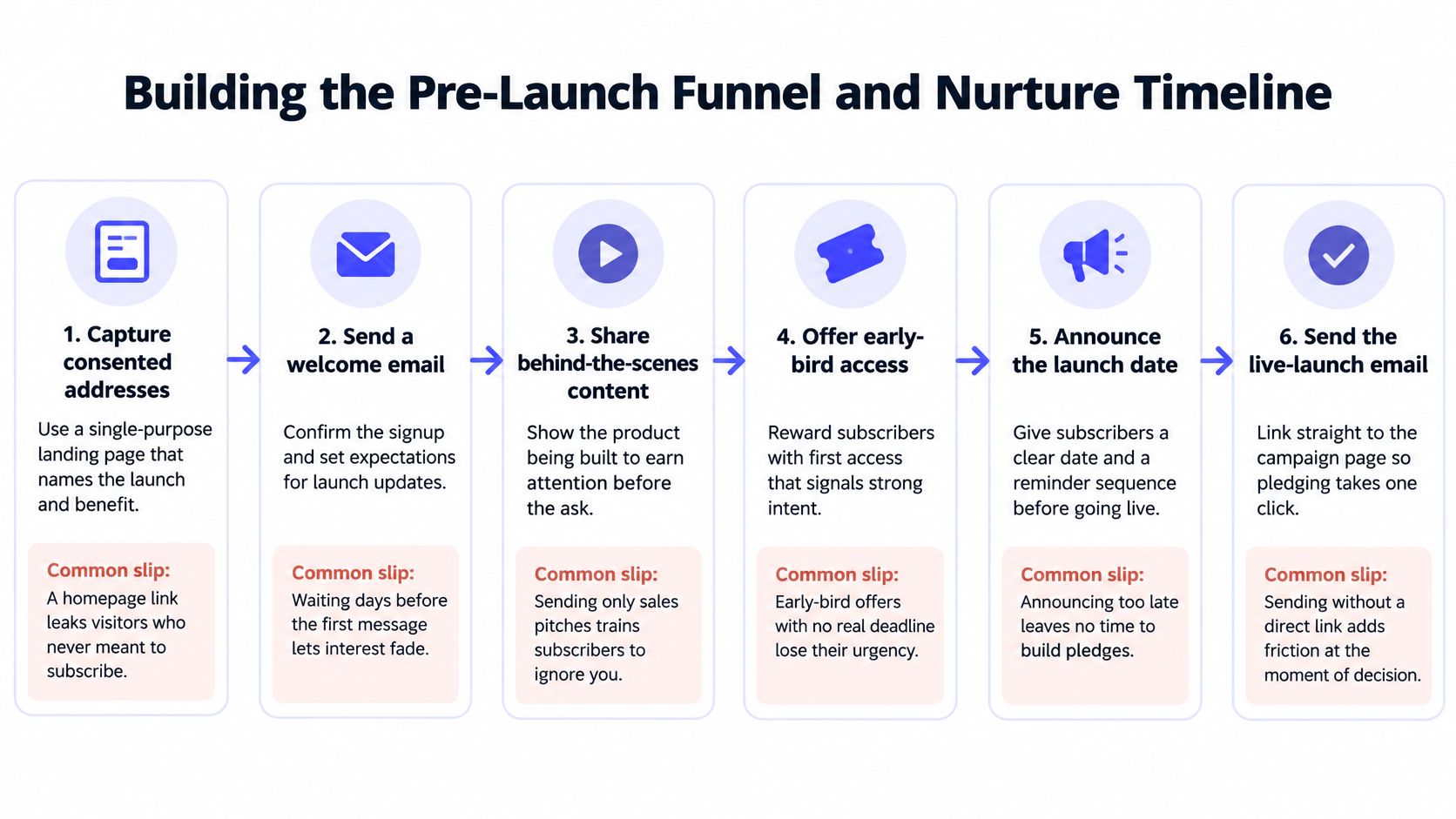
Capture consented addresses on a single-purpose landing page. Name the product, intended audience, and signup benefit above the form. A hardware creator might offer prototype demonstrations and launch-access updates, rather than a vague newsletter. Don't send acquisition traffic to a homepage with competing navigation.
Tag subscribers when they arrive. Record acquisition source, campaign interest, and consent details. Add device category where available and appropriate, then update engagement tags from clicks and declared preferences. Keep unknown values rather than guessing, and don't collect information you won't use.
Deliver the promised value immediately. Your welcome email should contain the asset or access explanation that motivated signup. Introduce the sender, explain what updates subscribers should expect, and give them a useful next action. Starting with an unrelated sales pitch breaks the agreement before nurture begins.
Test the complete journey on a phone, including confirmation, asset delivery, and destination links. Use your email platform's preview and test-send tools, but also submit the live form yourself. A polished template doesn't compensate for a broken confirmation page.
The visual sequence below shows how to move from permission to a direct launch invitation.
Nurture with evidence that answers a buying objection. Show the prototype operating, explain a design compromise, or demonstrate the product in its intended setting. Label prototypes accurately. A beautiful rendering doesn't establish that hardware works, and an unsupported testimonial doesn't resolve manufacturing concerns.
Trigger reminders from behavior. A subscriber who reads a prototype update but hasn't explored rewards needs a different message from someone repeatedly viewing pricing. Give the first person a reward comparison. Give the second person a concise explanation of value, shipping assumptions, or the concern that may be delaying their decision.
Measure each stage separately. Track accepted delivery, inbox placement where measurable, clicks, signup-to-pledge conversion, unsubscribes, bounces, and complaints. Accepted delivery doesn't prove inbox placement. Use your email provider's reporting, tagged campaign links, and pledge records together rather than expecting one dashboard to explain everything.
Keep the behavior rules manageable. Start with declared product interest, meaningful clicks, and permitted pricing-page activity. If you can't explain why someone entered a segment, the automation is probably too complicated.
Use this as a starting schedule to test, not a proven optimum. Shorten or extend it to fit your launch date, available proof, and stated signup expectations.
| Timing | Content | Goal | |
|---|---|---|---|
| Welcome | Immediately after confirmation | Promised asset and what comes next | Set expectations and encourage the first click |
| Origin story | Day 2 | Why the product exists, with a photo or short video | Build trust before an ask |
| Social proof | Day 5 | Genuine testimonials, prototype test results, or press | Move curiosity toward intent |
| Feature vote | Day 9 | A question about colour or add-on preference | Segment by stated interest |
| Launch announcement | Launch day, first hour | Pledge link, early-bird terms, and deadline | Convert the warmest segment |
| Behaviour reminder | 48 hours before the deadline, for non-pledgers | Relevant reason to back and a direct link | Recover intent without repeating the pitch |
Let the feature vote change the substance of the next message. If someone chooses portability, show the product being packed and carried. If they choose performance, explain the relevant test rather than merely inserting their preference into a greeting.
A segment is useful only when it changes what you send, when you send it, or whether you send anything.
Before retiring inactive contacts, try a short re-engagement sequence: a useful product update, a preference check, and a final invitation to stay subscribed. Judge activity through meaningful clicks or replies, not opens alone.
Don't treat silence as proof that someone will never pledge. Equally, don't keep sending indefinitely because an old subscriber might return.
For the first acquisition test, compare early-bird access with prototype updates using equivalent traffic and a fixed seven-day acquisition window. Treat those settings as an experiment design, then follow both groups through the same pledge-conversion window. Choose the winner by qualified backers and acquisition economics, not by whichever form collects the most addresses.
Choose a lead magnet that a future backer would value, not whatever your team can produce fastest. A broad giveaway can attract people who want the prize but have no interest in funding the product.
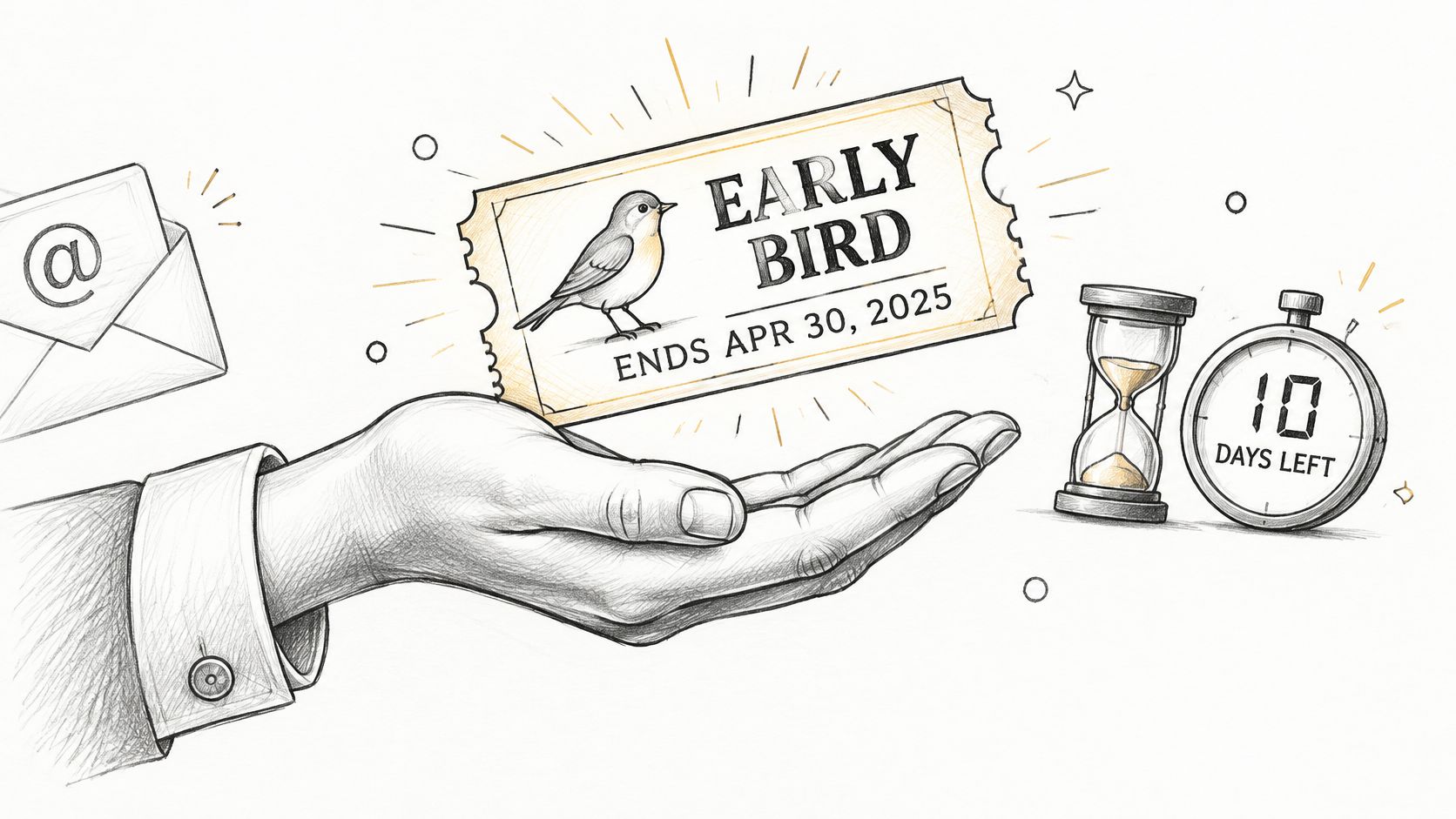
Early-bird positioning works only when the benefit and its limits are genuine.
| Lead Magnet | Best For | Main Watch-Out |
|---|---|---|
| Early-bird access | Projects with a firm launch discount | Discount without a deadline trains subscribers to wait |
| Prototype update series | Hardware and gadget startups | Needs regular photos or video to stay credible |
| Campaign-exclusive reward preview | Products with a clear reward ladder | Can reveal pricing before launch day |
| Build log or behind-the-scenes series | Board games and creative projects | Can take longer to produce pledge intent |
| Stretch-goal or feature poll | Projects still deciding add-ons | Participation doesn't necessarily signal buying intent |
| Waitlist with a launch date | Projects needing a simple signup offer | Collects interest without much qualification |
An early-bird signup is a more explicit expression of purchase interest than a general update request, but it still isn't a pledge. Show enough product and reward information that people understand what they're joining.
Build logs suit projects where the making process is part of the appeal. For tabletop projects, explain a playtesting decision or show how a component changed, rather than sending a production diary with no relevance to the eventual player.
For an adjacent approach to behavior-based education, Bazzly's inbound nurture flows for SaaS leads offer a useful comparison. Borrow the progression from interest to relevant proof, not software-specific qualification assumptions.
Compare creator communities, focused paid social campaigns, partner newsletter swaps, event signups, and your pre-launch page by confirmed engagement and eventual pledges. Keep each source identifiable when you capture your audience.
A partner should invite readers to your signup page, not hand over its subscriber database. At events, use a form that explains the launch updates people are requesting rather than treating every scanned badge as marketing permission.
Use the following video as an additional resource while planning your acquisition approach.
Don't increase spending on a source that produces cheap signups but little confirmed interest. Check the targeting, signup promise, and welcome experience before concluding that you need more volume.
Growing your list at any cost can reduce the number of prospective backers you reach. Mistyped addresses, unclear permission, and inactive recipients create problems that a better launch-day offer won't fix.
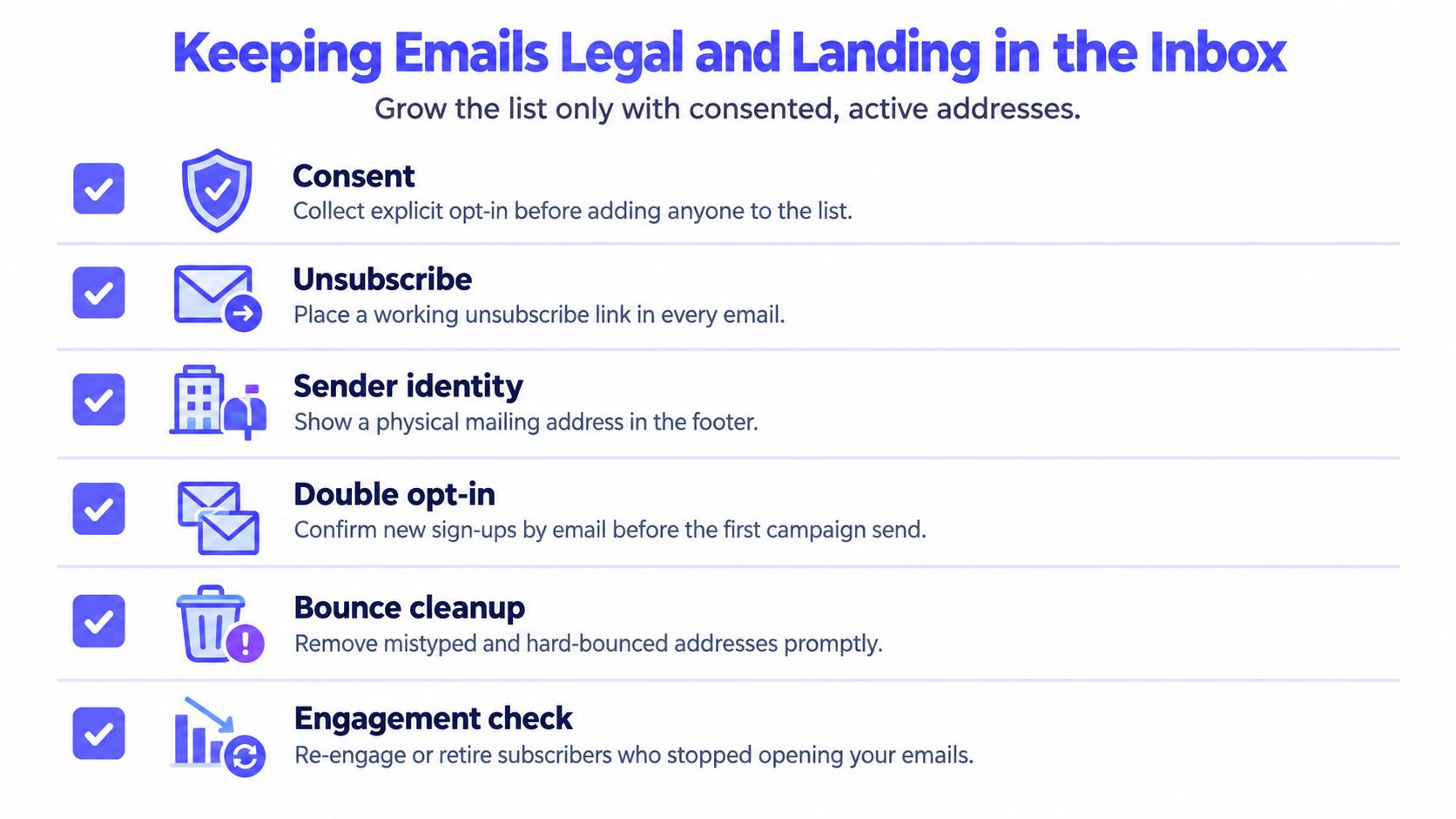
The U.S. CAN-SPAM Act took effect on January 1, 2004 and requires accurate header information, non-deceptive subject lines, identification of commercial messages as advertising, a valid physical postal address, and a clear opt-out mechanism. That mechanism must work for at least 30 days after sending, and valid opt-out requests must be honored within 10 business days.
CAN-SPAM isn't a complete international permission standard. Use transparent signup language and retain appropriate consent records, then review jurisdiction-specific obligations with the GDPR requirements checklist.
When documenting how subscriber information moves between forms, email tools, and exports, Linkboost's personal data handling practices provide a concrete example to compare with your own disclosures. Your policy must describe your actual workflow, not another company's promises.
Use this checklist as an operational reminder, while assessing inactivity through reliable engagement signals rather than opens alone.
Gmail's average inbox placement fell from 89.8% to 84.2% during 2024, according to Validity's deliverability report. Treat sender preparation as campaign work, not a technical task to postpone until launch.
Create a list-quality scorecard, not an arbitrary blended score. Review verified opt-in, activation within your chosen first-week window, complaints, and inbox placement side by side.
Pause volume increases when a provider's bounce or complaint performance deteriorates against your baseline or approaches its published limits. Investigate acquisition-source changes and authentication before resuming. Don't try to compensate for falling inbox placement by sending more.
In Validity's 2025 State of Email report announcement, 22% of respondents said they struggled to measure or prove email ROI. Privacy features, automated activity, and mailbox presentation also make opens a weak standalone measure of human attention.
Attribution asks which messages preceded a pledge. Incrementality asks whether the pledge would have happened without those messages, accounting for direct visits, retargeting, and organic discovery.
Assign each subscriber a stable lead identifier and retain the consent source and campaign. Randomly assign eligible subscribers to an emailed group and a holdout before sending launch-specific promotions.
For example, you might hold out about 10% as an experimental starting allocation, not an industry benchmark. Balance acquisition sources and engagement across groups, and keep essential transactional communications outside the test.
Compare:
Suppose the emailed group converts at 4.0% and the holdout at 2.5%. In this hypothetical example, the estimated lift is 1.5 percentage points, not 1.5%.
Multiply that lift by the emailed group's size to estimate additional pledges among recipients assigned to receive email. Applying it to the full eligible list estimates a full-send scenario, not the pledges actually added during the experiment.
Don't label every email-attributed pledge as an additional pledge.
A holdout sacrifices some launch reach and may be inconclusive on a small list. Run a baseline experiment, assess uncertainty, and choose the next allocation based on what the test can realistically detect.
Choose a survey workflow based on fulfillment needs and the costs of collecting add-on revenue. PledgeBox's pricing has no upfront, per-backer, or campaign fees. It charges 3% only on add-on sales collected during surveys. Kickstarter's Pledge Manager has no additional upfront cost and supports surveys, dynamic pledge-specific questions, automated SKU management, flexible address collection, upgrades, and add-ons.
Kickstarter Pledge Manager works like Amazon, while PledgeBox Pledge Manager works like Shopify: the former keeps the workflow within Kickstarter's ecosystem, while the latter offers a separately configurable, branded survey and post-campaign workflow. This comparison describes their operating models, not ownership of backer relationships or equivalence to either commerce platform.
Before adding a separate tool, check whether its branded surveys, shipping and VAT collection, subscriptions, Stripe and PayPal support, shipment tracking, and Google Maps-powered address validation fit your fulfillment process. Extra features have a cost in integration and reconciliation time, so choose a separate system only when its workflow justifies that work.
The table applies the stated platform rate to add-on sales collected during surveys. It excludes payment-provider charges.
| Survey Add-on Sales | Platform Fee (3%) | Creator Receives Before Provider Charges |
|---|---|---|
| $50 | $1.50 | $48.50 |
| $100 | $3.00 | $97.00 |
| $500 | $15.00 | $485.00 |
Send an address-only survey first. That gives backers a clear way to provide fulfillment details before seeing a sales offer. Then email confirmed backers about a relevant add-on, with a genuine deadline and a direct purchase link.
Measure the email's incremental revenue against a post-campaign holdout. Deduct product and fulfillment costs, refunds, and payment charges before judging profitability. Add-on receipts alone do not show whether the offer increased margin.
PledgeBox
The All-in-One Toolkit to Launch, Manage & Scale Your Kickstarter / Indiegogo Campaign