 PledgeBox
8 Case Study Examples for Crowdfunding Success
Explore 8 case study examples from crowdfunding campaigns, with tactics, failure points, metrics, and PledgeBox strategies for better post-campaign results.
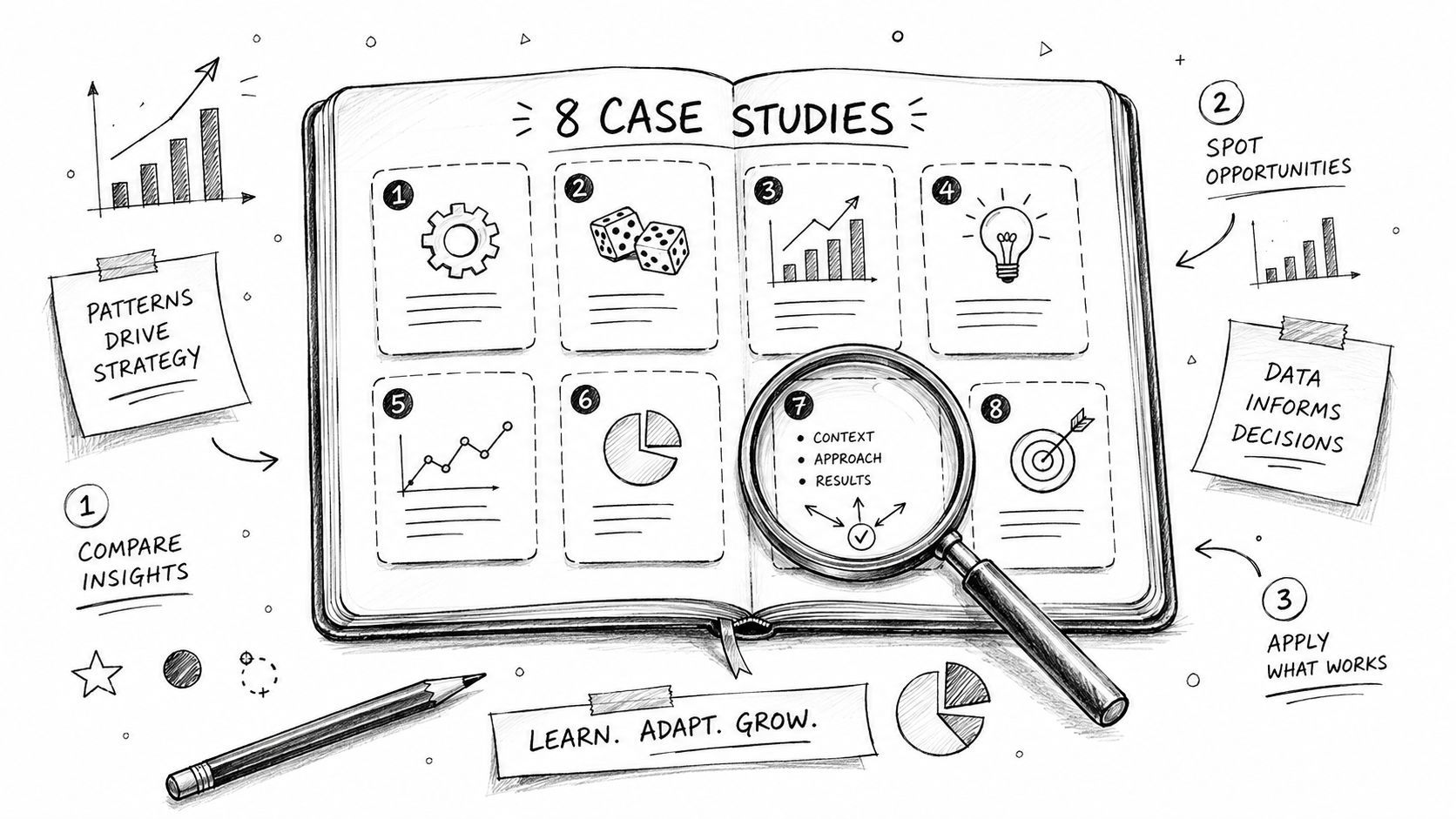
Explore 8 case study examples from crowdfunding campaigns, with tactics, failure points, metrics, and PledgeBox strategies for better post-campaign results.
The strongest case study examples do not behave like testimonials, they behave like operating logs. In crowdfunding, that matters because the campaign does not end at launch, it moves through audience building, validation, surveys, upsells, fulfillment, and long-tail support, and each stage creates a different decision for the creator. This analysis looks at eight niche-specific examples across Kickstarter and Indiegogo contexts, then translates each lesson into a PledgeBox workflow, with one practical distinction in mind, Kickstarter's pledge manager is like Amazon, while PledgeBox's pledge manager is like Shopify, and PledgeBox is free to send the backer survey and charges only 3% of upsell revenue if there's any.
The point isn't to admire big numbers in isolation. It's to see what those numbers imply about audience preparation, reward logic, address collection, and post-campaign communication. Where the evidence supports it, the takeaway is simple, use the campaign to prove demand, use surveys to make decisions, and use upsells to recover margin without making the backer experience feel transactional. The examples below show how those choices play out in hardware, home goods, tabletop, fashion, games, and agency operations, with a consistent lens on results, tactics, failure points, and what a creator can replicate inside a PledgeBox workflow.
Nothing's pre-launch play is a clean example of what happens when a creator treats audience building as a separate operational phase, not a marketing afterthought. The campaign reportedly captured 500,000+ email addresses before launch and converted that warm list into 250,000 backers in the first 12 minutes, with email-sourced backers showing 3.2x higher average pledge value than other sources. Those are not vanity metrics, they signal that the team had already done the hard work of separating curiosity from intent before the Kickstarter page went live.
The strategic decision here was to build a queue, not just traffic. Email capture, segmentation, teaser content, and early-bird incentives gave the team a way to match message to intent, which is exactly why the PledgeBox pre-launch approach is relevant to creators trying to reduce launch-day risk. If you only rely on launch-day discovery, you're asking a cold audience to absorb the product story, make a financial commitment, and act fast, all at once.
Practical rule: pre-launch leads should be treated like a launch asset, not a mailing list.
The repeatable tactic is straightforward. Capture interest well before launch, segment by intent, then send different content to people who are merely curious versus people who are ready to back. For a hardware creator, that could mean feature teasers for one segment, founder updates for another, and a final countdown sequence for the most engaged group.
For PledgeBox users, the lesson is to use pre-launch pages and email integration to turn launch day into a conversion event instead of a hope-and-pray spike. Nothing shows that the earlier you qualify intent, the less you have to depend on the algorithm, and the more predictable the campaign becomes.
OXO's survey-driven approach is a good reminder that backer feedback is most valuable when it changes production decisions, not when it merely decorates a case study. The campaign example here validated 5+ product iterations, with Design A preferred by 73% versus 27% for Design B, and bundle combinations generating $1.2M in add-on revenue. The operational choice was to test variants before committing manufacturing volume, which is the sort of risk reduction many home goods creators need but often skip.
The common mistake in kitchen and home goods is to treat surveys as a shipping form. That misses the actual value. When a team asks backers to weigh in on design variants, price points, or accessory bundles, the survey becomes a live market test, and the result can guide tooling, sourcing, and inventory decisions. The post-campaign survey workflow matters because it turns backer preferences into structured data instead of scattered comments.
A Shopify-like system is better suited to this than a rigid marketplace model because it lets you bundle, conditionally display options, and collect feedback without forcing every backer into the same flow. That flexibility matters for products like spatulas, measuring sets, or modular kitchen tools, where the right combination can change by segment.
A strong survey does two jobs, it confirms what people want and exposes what they'll actually pay for.
If you're building a PledgeBox workflow, keep the survey tight and visual. Show 3 or 4 variants, make the trade-offs visible, and let open-text fields capture the why behind the vote. Then use those answers to decide whether to run a single production line or split into multiple variants.
The practical takeaway is that validation should lower manufacturing anxiety, not create more noise. OXO's example shows how surveys can support design decisions, while PledgeBox gives creators the infrastructure to collect those responses cheaply and use them before production hardens.
Pebble Time shows how post-campaign operations can function as a revenue stage. The campaign is known for its scale, and the verified data here shows $2M+ in post-campaign add-on revenue, while survey data revealed that 40% of backers wanted color variants that were not initially offered. That points to a gap between what the campaign page sold and what the audience still wanted once the project moved into fulfillment.
The operational choice was to ask for preferences while excitement was still high, then use those answers to offer premium add-ons like bands, variants, and warranties. Timing mattered because a delayed form gives backers time to disengage, while a prompt survey can still turn campaign momentum into structured fulfillment data and incremental sales. The broader pledge-manager model makes that possible, especially when it is free to send surveys and only charges on upsells. For a practical framework, see our quick-starter guide to post-campaign workflows.
Kickstarter's pledge manager works more like a closed marketplace, while PledgeBox works more like Shopify, where the creator controls the survey flow, the add-on logic, and the presentation of options. That difference matters when the upsell menu needs to be customized instead of standardized, because the creator can shape the offer around the pledge rather than force every backer through the same path.
Useful constraint: keep the survey short, or the add-on revenue you wanted can turn into abandonment.
A PledgeBox workflow should move fast. Send the survey quickly, validate shipping information early, then surface only the add-ons that fit the original pledge. If you are offering tiers, keep them readable, budget, mid-range, premium, rather than burying the backer in choices.
Pebble Time's lesson is straightforward: post-campaign communication belongs inside the monetization plan. PledgeBox supports that approach by keeping survey distribution free and tying its fee to actual upsell activity, which keeps cost aligned with revenue.
Exploding Kittens is the kind of campaign that shows why a pledge manager cannot just be a checkout extension. The campaign handled 150,000+ backers, 30+ reward tiers, and add-on combinations, then collected 500,000+ survey responses across the backer base. Expansion pack upsells generated $1.2M+ in incremental revenue, and 40% of backers purchased add-ons through post-campaign survey offers. That combination of volume and complexity is exactly where a flexible fulfillment system earns its keep.
The core operational issue was not only selling the game, it was translating a huge fanbase into clean fulfillment data. Different tiers, stretch goals, geography-based shipping, and late-backer pre-orders all create different logic paths. A rigid system tends to flatten those differences, which is why the Shopify-like flexibility of PledgeBox is a better fit than a take-it-or-leave-it structure when the reward tree gets complicated.
For a tabletop creator, the tactic is conditional logic. Show only the questions that matter to each backer. A person who backed a base game doesn't need the same survey as someone who pledged for expansions and accessories. That's not just cleaner, it reduces support friction and makes the data more reliable.
When reward structures get wide, the survey has to get narrower.
The PledgeBox workflow here is to treat every add-on as a routing decision. Late backers get one path, international backers get another, and expansion buyers get relevant accessories only. That keeps the form shorter and the warehouse handoff cleaner.
Exploding Kittens proves that scale rewards structure, not improvisation. When the reward tree gets dense, the best system is the one that keeps the backer experience simple while still capturing enough detail to fulfill correctly.
Critical Role's campaigns show how fulfillment becomes a relationship management problem when the audience is passionate, global, and willing to wait. Across multiple projects, the campaigns raised $11.6M+, with 60,000+ backers spanning diverse international locations, and add-on upsells contributing 25%+ of post-campaign revenue. That mix matters because long-cycle projects can't rely on a one-time burst of enthusiasm. They need sustained communication and reward logic that keeps fans invested across months of production.
The main operational trade-off was between complexity and transparency. Fans wanted digital versus physical options, exclusive item selections, and shipping choices, but the team also had to keep the process understandable enough that thousands of people could complete it. A pledge manager that behaves like Amazon's closed ecosystem can feel limiting here. A Shopify-like setup, such as PledgeBox, gives creators more room to customize survey experiences, add tiers, and evolve offers as production changes.
The strategic lesson is that long timelines demand a communication schedule, not just a shipment plan. Monthly updates, segmented messaging, and milestone-based surveys help maintain trust. That's especially useful when add-ons are only available for a short window and the team wants to convert anticipation into revenue without overcomplicating fulfillment.
Practical rule: the longer the project runs, the more the survey has to double as a trust-building tool.
If you're translating this into PledgeBox, use reward-tier segmentation to keep backers informed without sending everyone the same update. Digital-only backers don't need the same shipping notices as physical backers, and high-engagement supporters may be interested in recurring offers or exclusive extensions.
Critical Role shows that the post-campaign phase is where fan relationships get tested. The teams that handle it well make the process feel curated, not bureaucratic, and that's where a flexible pledge manager matters most.
Everlane's apparel campaign is a useful example because fashion introduces a different kind of risk, fit, inventory, and taste. The campaign collected 50,000+ detailed preference responses, 70% of designs were chosen through backer voting, and add-on accessory sales reached $800K+ in the post-campaign phase. That means the survey did more than confirm interest. It shaped the product.
In apparel, creators often assume that launch assets do the persuasion work and surveys handle sizing logistics later. Everlane's approach shows a broader use for backer feedback. It can shape colors, fits, and materials before production, which lowers design risk and helps inventory match demand. The methodology for narrowing the case study unit of analysis is relevant here because it keeps the study focused on a specific campaign, a bounded product line, and a clear outcome.
The trade-off is choice overload. Fashion creators can flood backers with options and then read indecision as engagement. The better move narrows the palette, makes measurements visible, and uses bundles to steer customers toward combinations that are wearable.
Good survey design in apparel narrows the decision. It does not expand it.
For a PledgeBox workflow, that means surfacing only the most useful variants, then using a bounded add-on window to preserve urgency. You can also reuse survey data later for collection marketing, since the answers show how customers think about fit and style.
Everlane's campaign shows that the best fashion case study examples do not stop at “we sold out.” They show how customer feedback shaped the inventory plan. PledgeBox supports that same logic with a flexible survey layer that lets creators ask questions without paying just to collect answers.
Hollow Knight shows how a long-cycle game campaign can keep backers engaged without relying on constant novelty. Team Cherry's crowdfunding approach had to sustain attention over 30+ months with 60,000+ backers, and the campaign's DLC upsells generated 20%+ of total post-launch revenue. Even with delays, 91% backer satisfaction held across development. The team didn't just manage expectations. They managed cadence.
A game project changes while it is still being built. Features move, timelines stretch, and backers need updates that preserve trust without turning into noise. The tactic that stands out is milestone-based communication, where updates and surveys are tied to progress markers instead of arriving in random bursts. That structure works well when a studio can offer cosmetic DLC, soundtrack content, or backer-only extras as the project matures.
The PledgeBox angle follows from that operating model. A flexible pledge manager lets a studio change survey offerings over time, which matters when the product itself changes during development. Instead of freezing the backer experience inside a fixed add-on menu from day one, the studio can introduce new options as content gets closer to release.
Practical rule: if your project takes years, your survey logic has to stay active long after launch day.
The operational benefit has two parts. First, the team keeps a revenue channel open without affecting game balance. Second, the backer community gets a visible reason to stay connected. For a game studio, surveys do more than collect shipping details. They also create a structured engagement layer that can carry the campaign through long development cycles.
Hollow Knight's lesson is straightforward. Delays do not have to break trust if the communication system is disciplined. PledgeBox fits that workflow because it supports ongoing updates, evolving offers, and backer-specific logic without forcing a rigid marketplace model. Kickstarter's pledge manager works more like a closed marketplace, while PledgeBox gives creators Shopify-like flexibility. That matters in long projects because PledgeBox is free to send the backer survey and charges only 3% of upsell revenue when upsells occur.
The agency example is where the operational story becomes clearest. Teams managing 12 concurrent campaigns with a 3-person team used a unified system to reduce average campaign setup time from 4 weeks to 1 week, while the combined portfolio raised $28M+ annually. The commission-only model generated $840K in annual agency revenue, and the operational gain came from eliminating tool sprawl across pre-launch, campaign, and fulfillment stages.
This is the most actionable of the case study examples for agencies because it shows that the value is in repeatability. If every campaign needs a custom process, staffing costs balloon. If the team can reuse email sequences, survey templates, reporting dashboards, and fulfillment SOPs, the agency can serve more clients without turning every launch into a custom build.
The Shopify-versus-Amazon comparison matters here too. Agencies need flexibility because each client's reward tree, brand voice, and fulfillment logic are slightly different. PledgeBox gives that kind of customization while keeping survey distribution free and charging only on upsells, which can make the service model more profitable for mid-sized campaigns.
Useful constraint: standardize the workflow, not the client's brand.
A practical PledgeBox setup for agencies would include industry-specific survey templates, role-based access, and downloadable reports that can be shared with clients and vendors. That reduces setup time and keeps everyone looking at the same data.
The agency example proves that crowdfunding operations can scale if the system is built for variation. The cost of flexibility drops when the workflow is standardized, and that is exactly where PledgeBox's structure becomes useful.
| Example | Implementation Complexity | Resource Requirements | Expected Outcomes | Ideal Use Cases | Key Advantages |
|---|---|---|---|---|---|
| Consumer Electronics Pre-Launch: Nothing Phone Campaign | High, 2–3 months of coordinated pre-launch planning | High, large email capture, segmentation, creative and analytics teams | Massive day-one conversion, 500k+ emails → 250k backers, funded in 12 min | High-profile consumer electronics and founder-led product launches | Very high ROI, strong momentum and media attention |
| Kitchen & Home Goods: OXO Campaign | Medium, survey design and variant testing required | Moderate, survey tools, detailed analytics, minimal field costs | Validated variants, $1.2M+ add-on revenue, statistically significant feedback from 15k+ backers | Product-market validation before tooling and manufacturing | De-risks manufacturing, improves product fit and design decisions |
| Kickstarter Hardware: Pebble Time Smartwatch | Medium, post-campaign survey and upsell workflow setup | Moderate, pledge manager, payments, address validation | Significant upsell revenue, about $2M+, clearer production plans from preference data | Hardware campaigns with accessory and variant upsell potential | Raises average backer value with low upfront costs |
| Board Game: Exploding Kittens | Very High, 150k+ backers, 30+ reward tiers and conditional logic | Very High, complex fulfillment, international shipping, large support team | High incremental revenue, expansions about $1.2M+, 40% upsell participation | Large-scale games with many tiers, stretch goals, and add-ons | Scalable reward management, dynamic bundling, detailed analytics |
| Tabletop RPG: Critical Role | High, multi-language surveys, subscriptions, exclusive tiers | High, translations, global fulfillment, subscription ops | Strong engagement and revenue, $11.6M+ total, 25%+ from add-ons | Fan-driven entertainment projects with global audiences | Strengthens fan relationships, automated tracking reduces support |
| Fashion & Apparel: Everlane Kickstarter Expansion | Medium, survey-driven design choices and size collection | Moderate, measurement guides, production coordination, survey design | Improved sell-through, 50k+ responses, 70% design participation, about $800K accessory sales | Direct-to-consumer apparel pre-orders and limited collections | Reduces inventory risk, data-informed production planning |
| Video Game Indie: Hollow Knight Sequel Funding | Medium, long-term timeline management and milestone surveys | Moderate, community portal, update cadence, DLC marketplace integration | Sustained engagement over years, DLC adds 20%+ post-launch revenue | Multi-year game development with ongoing content monetization | Maintains backer engagement, enables incremental DLC revenue |
| Agency Case Study: Multi-Client Campaign Management | High, role-based access, reusable templates, multi-client workflows | Moderate, platform consolidation, reduces staff time by about 40% | Operational efficiency and scale, $28M+ portfolio, $840K revenue from 3% commissions | Agencies running 8–12+ concurrent crowdfunding projects | Scalable operations, unified reporting, faster campaign setup |
The clearest pattern across these case study examples is not just that the strongest campaigns raise more money. It is that they make earlier decisions at the points where uncertainty is cheapest to resolve.
Nothing Phone shows that audience building before launch can compress the first hours of demand into a public signal. OXO shows that surveys are not only for shipping data, they are a decision tool for product variants and add-on selection. Pebble Time shows that upsells work best after intent is already proven, when backers are ready to add accessories without rethinking the core pledge.
Strategic lesson: the best campaigns move one layer at a time, audience first, then validation, then upsells, then fulfillment, then retention.
The operational trade-off changes by category. Exploding Kittens accepts reward complexity because its audience can handle many tiers and conditional paths, while Critical Role uses multi-language surveys and exclusive tiers to serve a fan base that expects ongoing engagement rather than a one-time checkout. Everlane pushes the same logic into apparel, where size input and design feedback reduce inventory risk before production starts. Hollow Knight extends it over a longer timeline, where milestone communication and DLC planning matter more than a short launch burst.
A second pattern is cost efficiency. Campaigns that use surveys to shape the product, like OXO and Everlane, tend to spend less correcting mismatches later. Campaigns that use upsells well, like Pebble Time and Exploding Kittens, grow revenue without forcing every backer to re-enter the main purchase flow. That is also where the platform choice matters, because Kickstarter's pledge manager works like an Amazon-like closed marketplace, while PledgeBox gives creators Shopify-like flexibility for reward logic and campaign flow. PledgeBox is free to send the backer survey, and it charges only 3% of upsell revenue when upsells occur.
For agencies, the synthesis is different again. The value is repeatability across client types, not a single clever launch tactic. Standard survey templates, reusable fulfillment emails, and shared reporting cut setup time, which is why the agency example belongs in the same comparison table as consumer electronics and games.
The practical conclusion is that PledgeBox workflows should be chosen by where the campaign creates the most uncertainty. Use surveys early when the team needs product validation. Use upsells after intent is established. Use multi-language and role-based workflows when the campaign crosses markets or teams. The campaigns above do not succeed for the same reason, but they all improve when the system matches the decision that has to be made next.
The patterns across these case study examples are consistent. The creators who perform best build an owned audience before launch, use surveys to make decisions as well as collect shipping data, simplify complex reward logic, keep communication alive during long production cycles, and treat add-ons as a measured revenue channel instead of a distraction. That is the same logic behind strong case study writing in general, it should show background, problem, method, results, and takeaway, not just a polished success story, as outlined in workflow standardization guidance.
A practical PledgeBox workflow follows the same sequence every time. Capture and segment pre-launch leads. Configure a conditional backer survey. Collect shipping fees and applicable VAT or tax. Validate addresses. Offer relevant add-ons or late-backer pre-orders. Export fulfillment data. That sequence works because it reduces friction at each stage, and it lets the creator see which actions are driving response rather than guessing after the fact.
The most important operational lesson is that the pledge manager should fit the campaign, not the other way around. Kickstarter's pledge manager behaves like an Amazon-like closed marketplace, which works for some use cases, but creators who need custom survey logic, add-on control, and multi-stage flexibility usually need something closer to Shopify. PledgeBox matches that model, and it does so with a specific cost structure, it's free to send the backer survey and charges only 3% of upsell revenue if there is any. That matters because it aligns the platform fee with actual post-campaign activity instead of charging just to collect data.
If you're building a launch plan now, treat these examples as templates for decisions, not as success stories to admire from a distance. Start with pre-launch capture, build a survey that reflects real operational choices, and make sure your fulfillment layer can handle the edge cases before they show up in your inbox. The campaigns above show that the best results come from systems that stay usable when the backer count, reward logic, and production timeline all get messy.
If you want a pledge manager that supports pre-launch capture, conditional surveys, add-on upsells, and fulfillment exports in one workflow, visit PledgeBox. It's built for creators and agencies that need more control than a rigid marketplace flow can offer, and it keeps survey setup free until upsells happen.
PledgeBox
The All-in-One Toolkit to Launch, Manage & Scale Your Kickstarter / Indiegogo Campaign