 PledgeBox
Your Kickstarter Pre Launch Playbook for a Massive Funding Win
Discover the essential Kickstarter pre launch strategies to build a massive audience, create winning assets, and smash your crowdfunding funding goals.
Discover the essential Kickstarter pre launch strategies to build a massive audience, create winning assets, and smash your crowdfunding funding goals.
The success of your Kickstarter campaign is almost always decided months before you even think about hitting that launch button. Seriously. A well-planned Kickstarter pre launch period is the single biggest factor in building the momentum you need to get funded. It turns casual browsers into an army of day-one backers.
This groundwork is what separates campaigns that smash their goals from those that fizzle out.
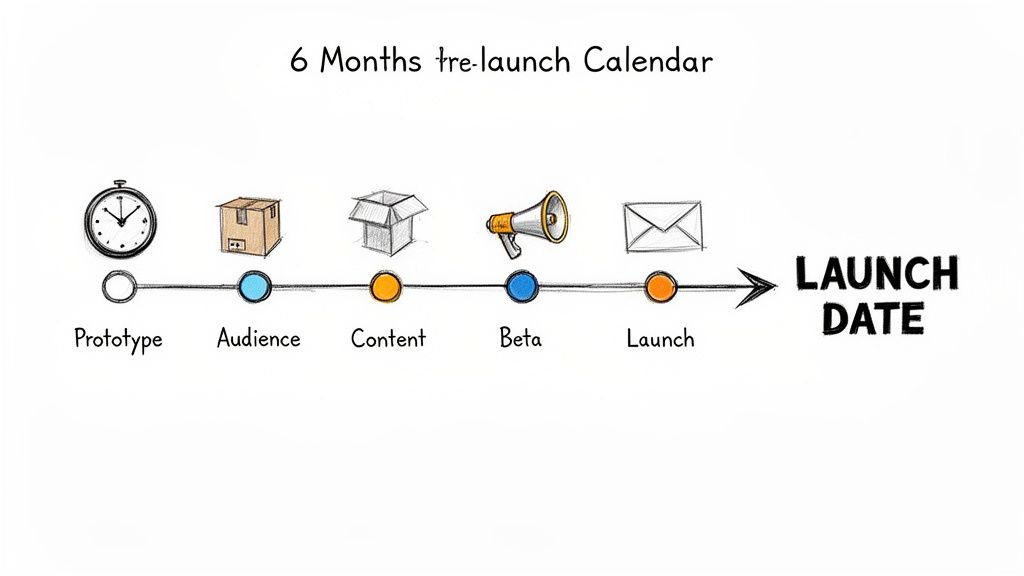
Your journey doesn't start on launch day; it begins with a carefully mapped-out timeline. From my experience, most creators need a good 3 to 6-month pre-launch window. This gives you enough breathing room to build an audience, polish your product, and get all your campaign assets ready without the last-minute chaos.
This isn't just about avoiding panic. It's about methodically building anticipation so people are genuinely excited when you go live.
The best way to tackle this is to work backward from your ideal launch date. This simple mental trick turns a huge, intimidating list of tasks into a clear, manageable path. Want to launch in May? Okay, that means your prototype needs to be locked in by February, and your community-building has to be in full swing by March. It forces discipline and makes sure every single thing you do has a purpose.
Believe it or not, the calendar is one of your most powerful tools. Timing your launch can dramatically shift the odds in your favor, as some months are just better for crowdfunding than others.
Data consistently shows that January, February, and April are prime time for launching, while the summer slump hits hard in July and August. This isn't just a hunch; detailed research has confirmed "highly significant statistical differences" between launch months and success rates. It's worth digging into the data to see how timing can impact your outcome.
This visual breaks down a typical three-month pre-launch into focused, actionable stages.
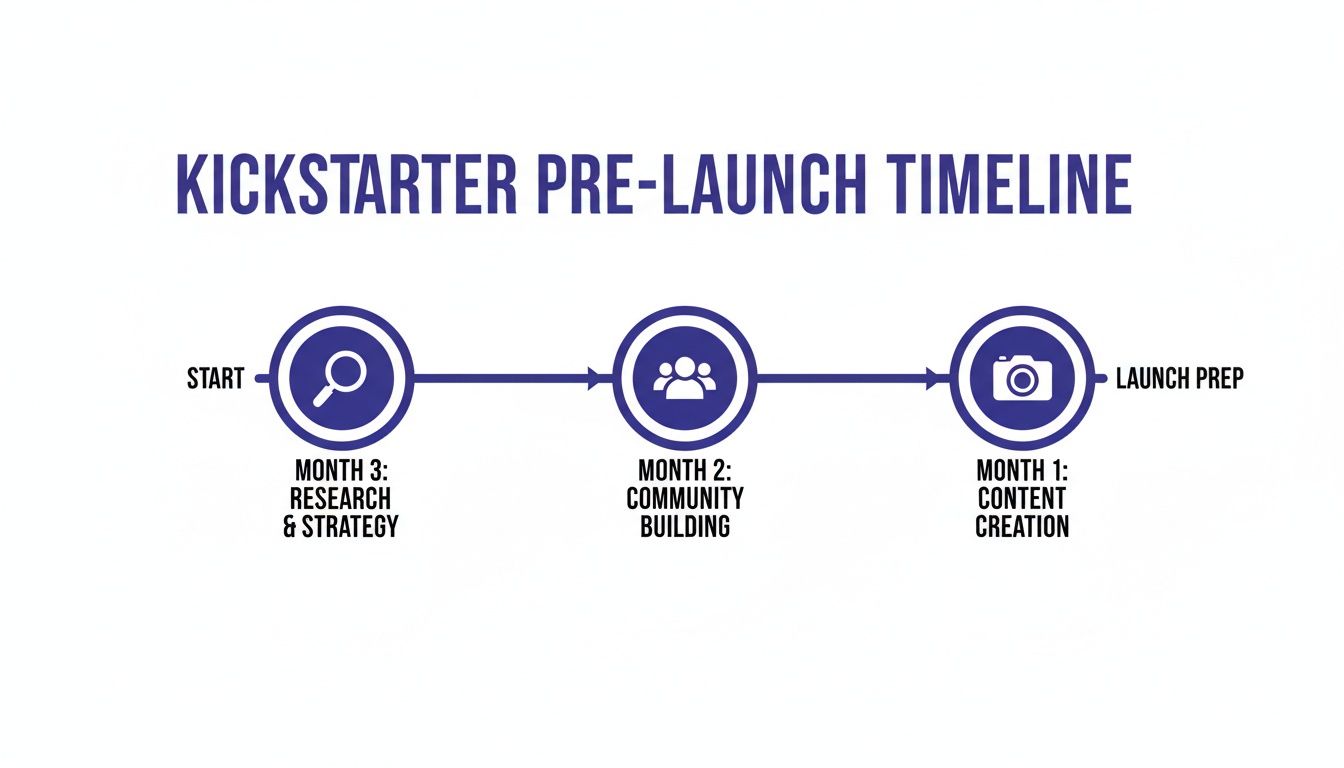
As you can see, each month has a clear goal—starting with research, then moving into aggressive community building, and finally focusing on creating amazing content. It’s all about building momentum, one step at a time.
To make this even more practical, here’s a sample roadmap that breaks down a three-month pre-launch into a high-level checklist.
This table gives you a bird's-eye view of what to focus on each month as you gear up for your big day.
| Month Before Launch | Core Focus | Key Milestones |
|---|---|---|
| Month 3 | Validation & Planning | - Finalize product prototype - Define target audience & core messaging - Set a preliminary funding goal - Research competitors & similar campaigns |
| Month 2 | Audience & Community Building | - Launch pre-launch landing page - Start building your email list - Engage daily in relevant forums & social groups - Begin outreach to influencers & media |
| Month 1 | Content Creation & Hype | - Shoot campaign video & product photos - Write all campaign page copy - Prepare press kit & ad creatives - Run final feedback surveys with your community |
This roadmap helps you stay on track, ensuring you’ve checked all the critical boxes before you go live.
Let's dig a little deeper. That first month is all about validation. You're finalizing the prototype, figuring out exactly who your customer is, and nailing down your core message. You need solid answers to the big questions: Who is this for? What problem does it solve? And why should they care?
The second month is all about finding your people. This is when you launch your email list, dive into online communities where your audience hangs out, and start sharing your journey on social media. The goal here isn't just to rack up followers; it's to build real relationships with people who believe in what you're doing. If you need some ideas, we have a great guide on how to build a list of potential backers before your campaign launches.
An engaged community is your most powerful asset. A list of 1,000 true fans who actually open your emails is worth infinitely more than 10,000 passive followers on social media.
The final month is a full-on sprint to create your content. This means shooting the campaign video, getting professional product photos, writing every word of copy, and designing all the graphics for your page. Having that community you built in month two is a huge advantage here, as you can share behind-the-scenes stuff and get their feedback, which builds even more hype.
And while you're doing all this, start thinking about life after the campaign. Choosing a pledge manager early will save you from a world of hurt later. Kickstarter's built-in survey tool is fine, but it’s a closed system, kind of like shopping on Amazon. A platform like PledgeBox is more like your own Shopify store—it lets you manage backers, upsell add-ons, and handle complex shipping.
Best of all, PledgeBox is free to send the backer survey and only charges 3% on funds you raise from upsells. It's a no-brainer for boosting your total funding after the campaign is over. Planning for this from the start creates a seamless handoff from funding to fulfillment.
Let's get one thing straight: the “build it and they will come” mindset is a recipe for disaster in crowdfunding. Your community is your single greatest asset, and you absolutely have to build it before you launch. These are the people who will become your day-one backers, your social media amplifiers, and your most honest source of feedback during the entire Kickstarter pre launch phase.
Think of it this way: launching without an audience is like opening a store in the middle of a desert. You might have the best product in the world, but if nobody knows you exist, all you'll hear is crickets. The effort you put in now is what fuels your funding momentum later.
First things first, you need a central place to gather your tribe. This is your pre-launch landing page—a simple, focused webpage with one job and one job only: capturing email addresses.
This isn't just about collecting contacts. It's about opening a direct line of communication with people who have raised their hands and said, "I'm interested." Social media algorithms are unpredictable, but an email list? That's an asset you own and control.
To make your landing page work, you need a few key ingredients:
This page is your teaser trailer. It builds anticipation and makes people want to see the main event, without giving everything away.
You'll need a tool to build this page and manage the email list you're about to grow. This is also a great time to start thinking ahead to your post-campaign strategy.
Platforms like PledgeBox offer pre-launch landing page builders specifically for crowdfunding creators. This is a huge advantage because it keeps all your audience data in one place, from the first email signup all the way through fulfillment. It connects your lead capture directly to your post-campaign surveys and upsell opportunities, making your life a whole lot easier.
The real power comes after your campaign. Think of the standard Kickstarter pledge manager like Amazon—a closed marketplace with limited control. In contrast, a tool like the PledgeBox pledge manager is like Shopify, giving you complete freedom to customize the backer experience.
Best of all, you can set this up with zero upfront risk. PledgeBox is free to send the backer survey and only charges a 3% fee on any funds you successfully raise from upsells. This model means you only pay when you make extra money, making it a no-brainer for maximizing your total funding.
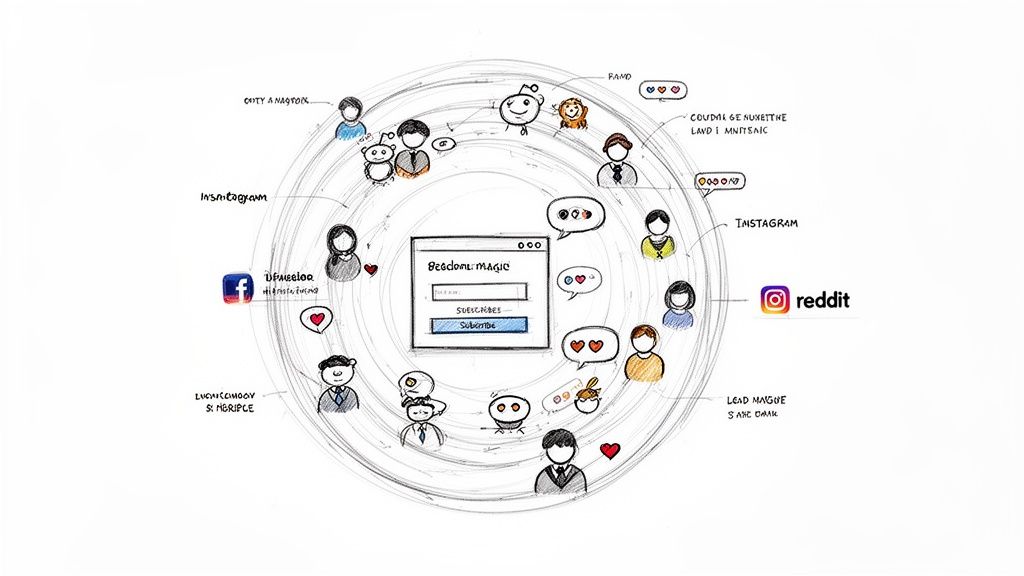
With your landing page live, it's time to get people to it. The key is not to be everywhere at once. Instead, figure out where your ideal backers hang out online and go there.
Across all platforms, the goal is engagement, not just broadcasting. Ask questions. Respond to comments. Make your followers feel like they're part of the journey. One of the most powerful ways to build a community is through effective Word of Mouth Marketing Techniques, which can turn early interest into an army of advocates.
This early effort pays off big time. For example, one creator with just 520 pre-launch followers saw 178 of them convert into backers—that's an insane 34% conversion rate. Projects that build this pre-launch traction often get funded in minutes, not days. Just look at the Tanares campaign, which raised over $1M on the back of 12,000 followers.
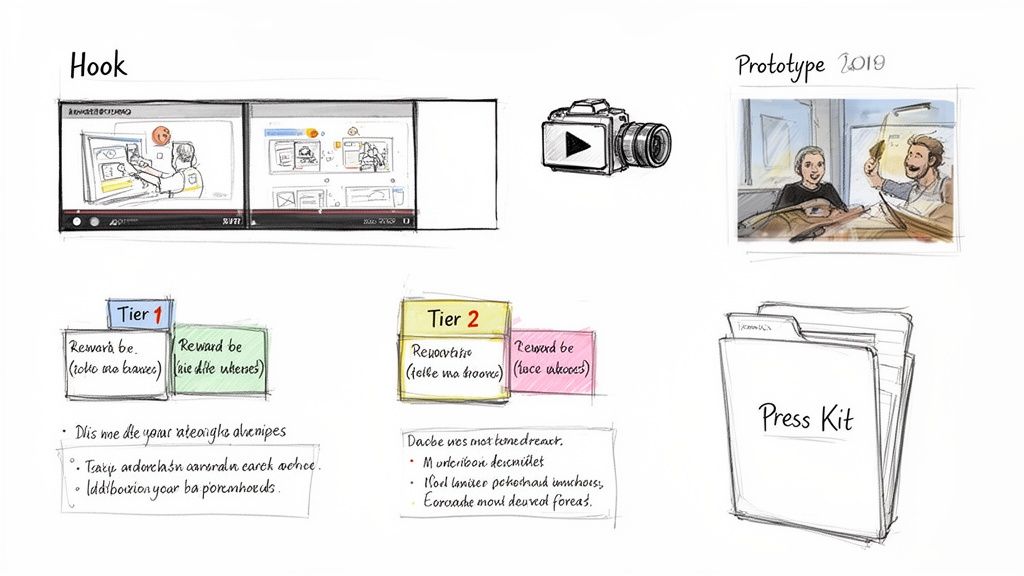
A killer story and professional visuals are often what separate a funded project from a forgotten idea. Once you’ve started gathering a community, the next piece of the puzzle in your Kickstarter pre launch is creating the core assets that will actually convince them to pledge. This is where your idea starts to feel real—and exciting.
Think of your campaign page as your digital storefront, investor pitch, and personal story all rolled into one. Every single element has to work in harmony to build trust, show value, and spark an emotional connection with your potential backers.
Let's be clear: your campaign video is the single most important piece of content you will create. It’s your one shot to speak directly to your audience, let your passion shine through, and show your product in action in a way that text and photos never could.
A great video isn't about Hollywood-level production; it's about being authentic and clear. Here’s a simple, proven structure that just works:
Keep it tight—ideally under three minutes. If you're looking for more guidance, we've put together some fantastic budget-friendly tips for creating a winning crowdfunding video to help you get professional results without breaking the bank.
The text on your campaign page is there to back up your video, filling in the details and answering the questions that will pop into backers' heads. Don't just list features; talk about the benefits. How does your product make someone's life better, easier, or just more fun?
Use clear headings, short paragraphs, and plenty of visuals to break up the text so it's easy to scan. Weave a story throughout the page, guiding the reader from the initial problem to your ultimate vision. And be totally transparent about your timeline, your team, and any potential risks. Honesty builds trust faster than any marketing slogan ever will.
Your pre-launch page should be a movie trailer—it builds anticipation and leaves your audience eager for more. Save the deep dive, full specs, and detailed storytelling for your live campaign page.
Beyond your video, you need a whole collection of high-quality visuals to make your page look legit. Cluttered, low-res images can kill your credibility in a heartbeat.
These assets do more than just make your page look good; they make it incredibly easy for backers to quickly understand your project and pick the pledge level that’s right for them.
Finally, you need to make it ridiculously easy for media, bloggers, and influencers to write about you. The best way to do this is with a simple press kit, available as a downloadable link right on your page.
Include your best photos, your campaign video, a tight project summary, and your contact info. This removes all friction and seriously increases the odds that a busy journalist will actually feature your campaign. It's a small step that shows you're a pro who is ready for success.
While building an organic community is absolutely essential, smart paid advertising is like pouring gasoline on your pre-launch fire. Ads give you the power to reach thousands of potential backers who would never have found you otherwise, letting you rapidly scale your email list and build that critical mass before going live. The goal isn't to spend a fortune; it's to spend smart.
The whole point of your Kickstarter pre-launch ad campaign is simple: get qualified email sign-ups at a reasonable cost. You aren't selling a product just yet. You're selling the idea of your product and inviting people to come along for the ride. That distinction is the key to crafting ads that actually work.
Your ad budget doesn't need to be huge, but it has to be deliberate. Many first-time creators find success starting with a budget of $500 to $1,500 for that final month before launch. This is often just enough to test different audiences and ad creatives to see what sticks.
The most important number you'll be watching is your Cost Per Lead (CPL). A good target for a crowdfunding campaign is a CPL somewhere between $1 and $3. If you can get an email for less than $3, you're generally in a pretty healthy spot.
Remember, a small, well-managed budget is way more effective than just throwing a bunch of money at untargeted ads. Think of it as running a series of small, controlled experiments to find your perfect backer.
Facebook and Instagram are incredibly powerful for finding your audience because of their deep targeting options. But don't just target "Kickstarter" as an interest—that's way too broad. Instead, you need to build a detailed profile of your ideal backer.
Start with a few different audience profiles and test them against each other. Let the data tell you which group is most excited about what you're building. For more specific tactics, check out our detailed guide on running Facebook ads for Kickstarter.
You have about three seconds to grab someone's attention in their feed. Static images can work, but short videos or GIFs that show your product in action are almost always better.
Your creative should hammer home a single, powerful benefit. What's the "wow" factor of your project? Show that immediately. Your ad copy should then echo that benefit and lead to a clear call-to-action like "Get Notified on Launch."
A/B testing isn't optional; it's essential. Always run at least two different ad visuals and two different versions of ad copy against each other. You'll be surprised by what actually performs best.
To get the most out of your ad spend during the pre-launch phase, it’s worth brushing up on the Best Practices for Optimising Google Ads Campaigns.
Getting an email address is only half the battle. Now you have to turn that cold lead into a warm, engaged community member who's ready to back you on day one. A simple, automated email welcome sequence is perfect for this.
This sequence builds a real connection and makes sure that when your launch day email finally arrives, they'll know exactly who you are and be excited to support you. Planning for what happens after the campaign is just as crucial. Remember, the native Kickstarter pledge manager is like Amazon—a closed marketplace. A tool like the PledgeBox pledge manager is like your personal Shopify, giving you full control. Better yet, PledgeBox is free to send the backer survey and only charges 3% of upsell if there's any, making it a risk-free way to boost your total funds raised.
The final weeks of your Kickstarter pre launch are a blur. It's an adrenaline-fueled sprint to the starting line where all your hard work—audience building, content creation, and strategic planning—finally comes together. This is where you obsess over the details, transforming your draft campaign page into a conversion machine and mapping out launch day down to the minute.
You’re shifting gears now. It’s less about finding new people and more about making sure the audience you've already built is ready to hit that "Back this project" button the second you go live. Every last detail, from your funding goal to your post-campaign fulfillment plan, needs to be locked in and ready to go.
Your funding goal is more than just a number; it’s a powerful psychological trigger for backers. If you set it too high, you risk the campaign failing to fund, which kills momentum. But set it too low, and you might not even cover your costs.
The sweet spot is the absolute minimum you need to manufacture and fulfill your core rewards. This number should cover production, shipping, and Kickstarter's fees—nothing more.
I've seen countless successful campaigns aim to get 100% funded in the first 24-48 hours. Pulling this off creates an incredible wave of social proof and signals to anyone on the fence that your project is a guaranteed success. Hitting that milestone is almost entirely dependent on the pre-launch community building you’ve already done.
Your reward tiers need to be dead simple and incredibly compelling. Use descriptive, easy-to-understand names that make it obvious what backers are getting at each level.
Don't forget clean graphics for each tier. Visuals help backers see exactly what they're getting, making the rewards feel more tangible and helping them decide faster. The goal is to remove every ounce of friction from the pledging process.
Thinking about fulfillment before you’ve even launched might feel like getting ahead of yourself, but trust me, it’s one of the smartest things you can do. A solid plan for managing surveys, collecting shipping info, and handling add-ons after the campaign is non-negotiable. This is where a pledge manager comes in.
Sure, Kickstarter has a built-in survey tool, but it's pretty basic. A dedicated pledge manager platform gives you way more control and opens up new revenue opportunities.
Think of the Kickstarter pledge manager as Amazon—it's a closed, one-size-fits-all marketplace. A dedicated tool like the PledgeBox pledge manager is like having your own Shopify store, giving you complete control over your backer experience, upsells, and fulfillment process.
This isn’t just a small difference—it’s a fundamental shift in how you manage your project. A dedicated manager lets you create a branded, seamless experience that can seriously increase your total funds through strategic upsells. Best of all, PledgeBox is free to send the backer survey and only charges 3% of upsell if there's any. It's a no-risk way to maximize your project's potential.
Before we go further, let's break down the core differences. This table makes it pretty clear why thinking about a pledge manager during your pre-launch is a total game-changer.
| Capability | Kickstarter Pledge Manager (The Amazon Model) | PledgeBox (The Shopify Model) |
|---|---|---|
| Upsell Add-ons | Not supported. You can only collect basic info. | Fully supported. Easily offer new items to backers. |
| Late Pledges | Not available. Once the campaign ends, it's closed. | Create a pre-order storefront to capture late backers. |
| Shipping Fees | Basic collection. No complex calculations. | Advanced shipping rules by weight, item, and region. |
| Backer Support | Limited to Kickstarter's system. | Dedicated support portal for backer questions. |
| Cost Structure | Included in Kickstarter's 5% fee. | Free for surveys. Only 3% on new funds from upsells. |
Choosing your pledge manager early creates a single, unbroken workflow from pre-launch lead capture all the way through post-campaign fulfillment. It's a foundational decision that will save you from massive headaches down the road and help you build a more profitable, professional campaign.
As you get closer to hitting that launch button, a lot of questions start bubbling up. It's completely normal. Let's tackle some of the most common ones I hear from creators gearing up for their big day.
For most projects, the sweet spot for a pre-launch is 3 to 6 months. This gives you a realistic runway to build a solid email list (I always say aim for at least 1,000 engaged subscribers), nail down your campaign video and page assets, and actually build relationships in communities that care about what you're making.
Now, if you’re coming in with a massive, hyped-up audience from a previous launch or an established brand, sure, you might be able to pull off a successful launch in just 1-2 months. But for most first-timers, taking that extra time is what builds the unstoppable momentum you need for a huge day-one funding surge.
Forget vanity metrics like social media followers or page views. The one number that truly matters is the size and quality of your email list. I can't stress this enough.
Your email list is your direct line to your most loyal fans—the ones who are genuinely ready to back you. These subscribers will convert into backers at a dramatically higher rate than anyone you reach on social media. This list is the engine that will power your campaign past its funding goal in those critical first 48 hours. Make it your top priority.
The real power of your pre-launch is turning passive interest into an owned, engaged audience. An email list of 1,000 true fans is far more valuable than 10,000 unengaged social media followers.
While it's true Kickstarter has a basic survey tool, a dedicated pledge manager is one of the smartest investments you can make for maximizing your total funds and avoiding fulfillment headaches. Here's a simple way to think about it.
The built-in Kickstarter survey is like Amazon—a closed system with limited flexibility. A dedicated platform like the PledgeBox pledge manager is like having your own Shopify store, giving you full control over the entire post-campaign experience.
This control is huge. It lets you easily offer upsells and add-ons, handle complex international shipping rates, and even capture sales from late backers who missed the campaign window. It transforms the post-campaign phase from a simple data collection task into a serious revenue opportunity.
Best of all, you can get started without any upfront cost. PledgeBox is free to send the backer survey and only charges 3% on funds raised from upsells. This makes it a no-brainer for boosting your project's bottom line and ensuring a smooth, professional fulfillment process for your backers.
At PledgeBox, we provide the tools you need to manage your campaign from pre-launch to fulfillment. Streamline your surveys, boost your funding with upsells, and give your backers a professional, seamless experience. Learn more and get started at https://www.pledgebox.com.
PledgeBox
The All-in-One Toolkit to Launch, Manage & Scale Your Kickstarter / Indiegogo Campaign