 PledgeBox
Cork World Map Guide: Materials, Mounting, and Creative Uses
Discover how to choose, install, and use a cork world map for travel tracking, decor, or education. Covers materials, DIY vs ready-made, and creator tips.
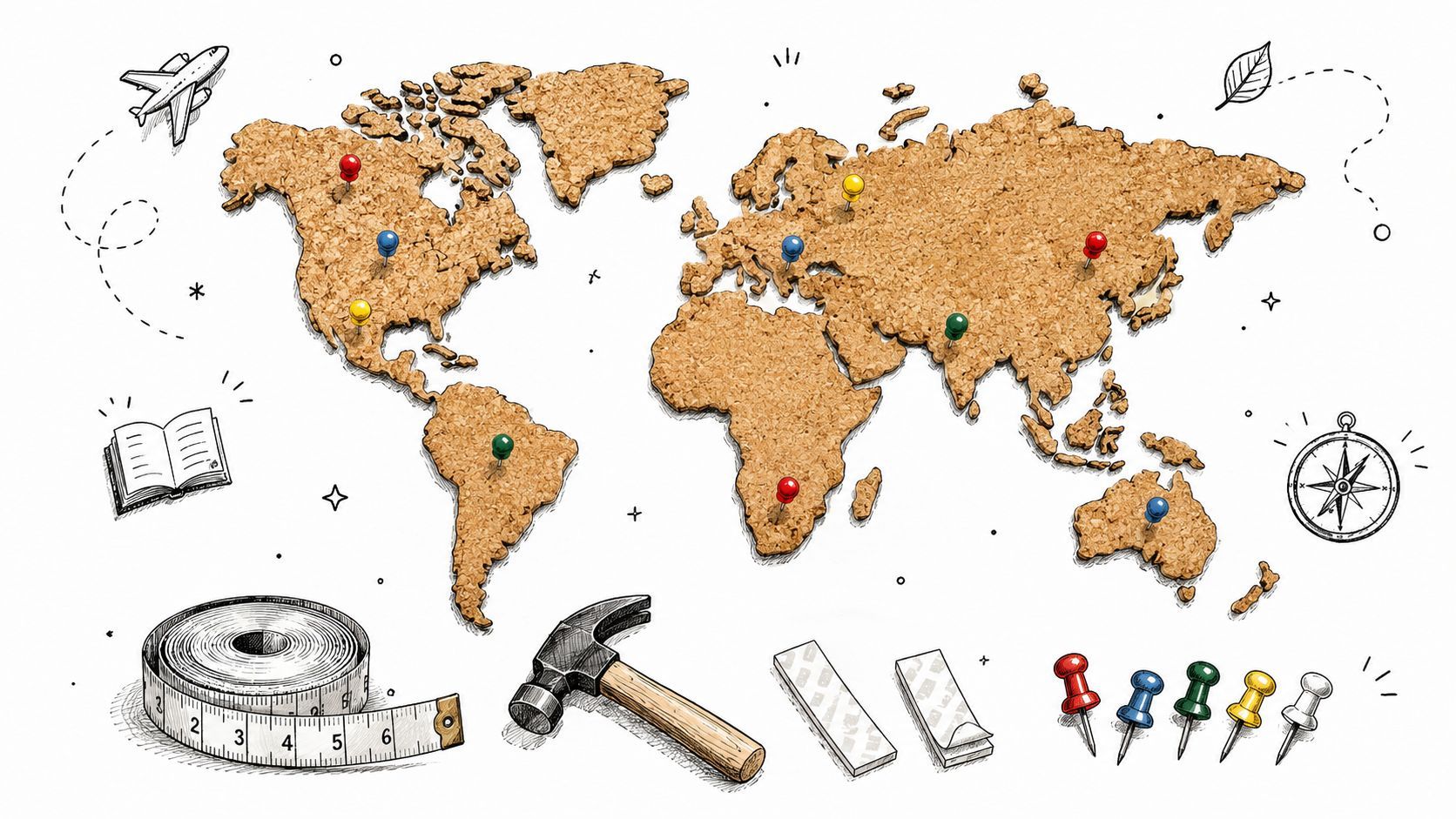
Discover how to choose, install, and use a cork world map for travel tracking, decor, or education. Covers materials, DIY vs ready-made, and creator tips.
You're standing in front of a blank wall, a tape measure in one hand and a browser tab full of maps in the other. Maybe you want something that looks good in a home office, maybe you're trying to find a gift that doesn't feel generic, or maybe you're planning a wall that will earn its place by holding pins, notes, and travel memories. A cork world map sits right in that overlap, part decor, part tool, part keepsake, and part teaching aid.
The tricky part is that people often buy one before they've decided what job it needs to do. A map meant for occasional decoration can be lighter and simpler than one built for frequent pinning, and a DIY version can be satisfying or frustrating depending on how the backing, thickness, and mounting are handled. If you're a creator, there's a second layer too, because after the campaign page goes live, the survey and add-on setup decide whether fulfillment feels calm or chaotic.
A cork world map makes sense the moment a room needs one object that can do more than just sit there. A home office gets a visual anchor. A dorm room gets a wall piece that doesn't feel temporary. A classroom gets a board that students can use instead of just looking at.
At its simplest, this product is a corkboard surface shaped, printed, or assembled to resemble a world map. That means it can work as a functional pin board, but it also reads as art, especially when the continents are cut cleanly and the finish is neat. People use it to track travel, display keepsakes, mark locations for events, or give a wall some structure without turning it into a full gallery.
A couple planning a wedding guestbook might pin postcards from guests beside the countries they've visited. A teacher might use the same format to point out continents, cities, or routes. A remote worker might just want a quiet way to mark places they've lived, visited, or want to visit next.
That flexibility is why the product keeps showing up in travel decor, classrooms, and offices. It's also why the same phrase can mean very different things, from a small desktop piece to a large wall installation. If you're shopping, the key question isn't just whether you like the look, it's whether you want a decorative panel, a board you'll pin often, or a map that helps you tell a story over time.
Practical rule: buy the map for the job it needs to do, not the photo that sold it to you.
For buyers and makers alike, that choice shapes everything else, from thickness to mounting style to whether a ready-made option is safer than a build-it-yourself approach.
Cork starts as bark, which is why it has the light, forgiving feel people expect from a pin surface. It's also the reason the material is so popular for boards and wall displays, because it can take pins without behaving like brittle wood or thin plastic. Commercial products usually aim for 6 to 7 mm cork thickness, a range that stays light enough for wall mounting while still giving pins something firm to grab.

A listing might describe a self-adhesive cork sheet, a framed board, a die-cut wood-and-cork map, or a larger wall piece with a fiberboard backing. Those details matter because the cork layer alone doesn't tell you how the product will hold up once it's on the wall. Some products use adhesive installation, others use a backing panel, and others lean on a frame to keep the shape stable.
Thin cork can curl or feel flimsy, while a thicker block can be harder to pin cleanly. That's why the middle range shows up so often in commercial products, including 6 mm boards with fiberboard backing and 7 mm boards with adhesive installation. Smaller wall formats also appear in 5 to 6 mm versions, which can make sense when the map isn't meant to be the main physical object in the room.
Some maps keep countries or regions separate so they can be removed and pinned individually. Others print the geography as a single panel, which gives a cleaner visual but less flexibility. A buyer who wants the map to behave like a living pin board should read past the headline photo and look for the backing, the mounting method, and whether the cut pieces are meant to be handled often.
The product listing tells you the style. The construction tells you the lifespan.
If you can identify the cork thickness, the backing material, and the print method, you're already reading the listing the way a serious buyer should.
A ready-made map is the simpler choice when you want the print lined up, the edges finished, and the mounting matched to the weight. You open the box, check the hardware, and spend your time on placement instead of fabrication. For a gift, a classroom, or a room that needs to look polished on day one, that convenience matters.
A DIY map gives you control over the details. You can choose the size, the backing, the shape, the country labels, and the frame style. That helps when the wall has an awkward dimension or when the map needs to match a very specific room style. It also lets you build around the use case instead of accepting a one-size-fits-all design.

A lot of DIY tutorials focus on the fun parts, cutting, gluing, and hanging. They often use different materials too, including 0.5 cm corkboard, adhesive tape, cardboard backing, plywood, masonite, spray adhesive, seam taping, and wall-safe tape, which shows there is no single agreed method for making one last. The choice is usually not whether DIY costs less in theory. The question is whether the finished board will keep holding up after repeated pinning, moving, and wall stress.
For a decorative display, a lighter build can be enough. For a travel-planning wall, a sturdier backing and better adhesion start to matter more. For frequent pinning, durability stops being optional, because the surface has to survive the small damage that comes with real use.
If you are choosing between the two, ask which one is safer for the room, the wall, and the way you will use it. For a creator selling a cork map on Kickstarter, that same choice also affects the post-campaign survey, the add-on setup, and how cleanly extras can be sent, because PledgeBox only charges 3% on upsells.
The wall should decide the size, not the catalog photo. Measure the space first, then leave breathing room around the piece so the map can read clearly instead of crowding the room. A large panel that looks elegant online can feel overwhelming if it's squeezed between furniture or hung too close to a door swing.
Viewing distance matters too. A map that sits across a big office wall needs enough scale to be seen from a chair or doorway, while a smaller format can work better above a desk or in a tighter room. The same product can feel balanced in one space and oversized in another.
Small maps can work with adhesive strips, especially in rental spaces where wall damage matters. Medium wall maps often do better with heavy-duty adhesive pads, which spread the load more evenly than simple picture hooks. Large-format panels, especially anything over a meter wide, should be treated like real wall installations and fixed with screws or a French cleat.
A map can fail because the wall is wrong, not because the map is wrong.
The wall surface matters as much as the hardware. Drywall, plaster, and painted masonry all behave differently, and a heavy panel hung with the wrong hardware can shift, sag, or pull away. If the map is substantial, assume the mounting system is part of the product, not an afterthought.
| Map Size | Best Mounting Method | Best Wall Type |
|---|---|---|
| Small | Adhesive strips | Smooth painted wall |
| Medium | Heavy-duty adhesive pads | Drywall or similar interior wall |
| Large | Screws or French cleat | Stud-backed wall or reinforced surface |
A good rule is simple. The smaller the map, the more likely adhesive can work. The larger the map, the more the mounting method has to be engineered like furniture rather than decor.
Start by unrolling the map flat and letting it sit. One supplier recommends resting it for about 72 hours so the cork can acclimate to room temperature and humidity, because skipping that step can lead to warping or peeling in larger installations world map cork board 107x200cm. That waiting period feels boring, but it's the kind of step that saves you from a bad install.
Once the map has settled, mark the wall with a level and confirm the placement before anything touches the surface. If the piece is large, line up the mounting points carefully and check that the support method matches the wall type. The right alignment at the start keeps the whole thing from looking slightly off every time you walk past it.

Use flat-head map pins if you want the cleanest hold, because they sit well and are easier on the surface. When removing a pin, pull it straight out rather than rocking it side to side, which reduces tearing around the hole. Dust the board lightly instead of soaking it, since moisture can change how the cork behaves over time.
If one area gets a lot of use, rotate the pins across the board so the same spot isn't taking every puncture. That small habit helps the map age more evenly, especially in a travel-planning setup where certain regions get used over and over.
For a display-focused finish, readers who want a cleaner framed presentation can also look at resources on elevate maps with custom framing, since framing changes both the look and the long-term handling of the piece.
Bubbling edges usually point to weak adhesion or a wall surface that wasn't prepared well enough. Sagging corners often mean the support points are too few or too light for the panel weight. Color fade near a window is usually a placement issue, so moving the map away from direct sunlight can help preserve the finish.
The short version is this. Install carefully, handle gently, and don't treat the board like it's indestructible.
A cork world map works well when it becomes part of daily routines, not just a wall decoration. A couple returning from a honeymoon can turn it into a shared memory wall by pinning old flag markers into the countries they visited, keeping plane tickets in a small tray below the frame, and letting the board record the places they stood together. That feels more personal than a plain print, because the map holds evidence, not just color.
A remote-work team can use a smaller map in a meeting room and place pins where each person joined from. A teacher can do something similar with continents, capital cities, or route exercises, so the wall supports the lesson instead of sitting behind it. A food blogger can pin ingredient origins and spice sources beside recipe notes, which turns the map into a visual index for the kitchen.
More compact versions are getting attention, including hexagon tiles, condensed country layouts, and mini desktop maps. These formats trade literal geographic scale for a cleaner footprint, which matters in apartments, studios, and giftable pieces that need to fit a shelf or narrow wall. The choice is less about perfect accuracy and more about whether the map feels at home in the room.
A cork map does not have to act like an atlas. It can act like a memory system.
That is why the same object fits a classroom, a hallway, a study, or a kitchen. It adapts to how the space is used, and that is often what makes one version feel right while another feels out of place.
If you are building a small creative corner, the same thinking shows up in DIY white board setups, where the wall becomes a working surface instead of a static decoration. A cork map does something similar, but it uses travel, place, and memory instead of notes and sketches.
For creators planning to sell a map, that same adaptability matters after the campaign too. A flexible add-on setup and a clear post-campaign survey help buyers choose the right size, extras, or region version without turning fulfillment into a guessing game, which is where tools like PledgeBox fit naturally for organizing those decisions.
If you are turning a cork map into a product, the build is only one part of the job. You still need prototype photos, a campaign page that explains the material choices, and reward tiers that make sense once shipping begins. Those pieces get most of the attention before launch, but the post-campaign setup is where many physical products start to slip.
The survey is where backers confirm shipping, sizing, and add-ons. If that step is unclear, inboxes fill quickly and fulfillment slows down. A good pledge manager keeps the order data organized so you are not piecing it together from scattered messages.

PledgeBox lets you send the backer survey without an upfront fee, and it only charges 3% of upsell if there is any. That matters when your map has options like sizes, frames, extra pins, or region-specific versions, because the survey becomes the place where each backer confirms the final order. For a closer look at how the setup works before launch, the guide on how to create a Kickstarter is a practical starting point.
The key point is simple. A pledge manager and a survey are not the same thing. The survey collects the details. The manager organizes post-campaign buying and add-ons. For a physical product like a cork map, that separation can keep fulfillment from turning into a manual spreadsheet exercise.
If you are planning a launch, the way you set up extras and late purchases matters almost as much as the product itself. PledgeBox fits naturally here because it keeps the survey and add-on layer organized after the campaign, which is especially useful when the map has multiple configurations and you need the backer data to stay clear from the start.
The business lesson is straightforward. If your cork map has variants, extras, or shipping complexity, the post-campaign system matters as much as the prototype. A clean survey and add-on flow can save time, reduce confusion, and make fulfillment feel manageable instead of improvised.
Start with purpose. If the map is mostly decorative, focus on finish and fit. If you'll pin on it a lot, prioritize cork thickness, backing quality, and mounting strength. If it's going on a real wall, measure the space first and match the hardware to the wall, not just the map.
Then check the listing for the details that matter. Look for the cork layer, the backing, the way the pieces are cut, and whether the map is built as a single panel or a modular display. Those choices tell you more about long-term satisfaction than a polished photo ever will.
For creators, the same logic applies after launch. The product might be a map, but the survey and add-on layer are what keep orders organized. If you're selling a cork map through crowdfunding, PledgeBox gives you a way to handle that part without turning the backer list into a pile of emails.
PledgeBox helps creators manage the survey and upsell layer after a campaign, which is especially useful for physical products like a cork world map with size, framing, or add-on choices. If you're planning one as a gift, a decor piece, or a product to sell, visit PledgeBox to see how the post-campaign flow can stay organized.
PledgeBox
The All-in-One Toolkit to Launch, Manage & Scale Your Kickstarter / Indiegogo Campaign