 PledgeBox
10 Best Tools for Email Marketing in 2026
Compare the best tools for email marketing for crowdfunding creators, including features, trade-offs, pricing considerations, integrations, and workflows.
Compare the best tools for email marketing for crowdfunding creators, including features, trade-offs, pricing considerations, integrations, and workflows.
You're preparing a crowdfunding campaign, and your email list is already spreading across too many places. Prelaunch subscribers sit in one system, campaign updates in another, Kickstarter backer data somewhere else, and fulfillment details arrive in spreadsheets just when you need to send a precise update. The campaign may be exciting, but the operational reality is fragmented.
The best tools for email marketing aren't identical for every creator. The right choice depends on your audience size, automation complexity, ecommerce needs, integrations, and whether backer data must stay connected to pledge levels, survey responses, upsells, shipping, and post-campaign sales.
This comparison evaluates email platforms across the full crowdfunding lifecycle, from prelaunch audience capture and campaign updates to surveys, add-ons, fulfillment, and repeat purchases. It also separates general-purpose, creator, ecommerce, and integrated workflows. Kickstarter's pledge manager is like Amazon, with a native and tightly integrated buying experience. PledgeBox's pledge manager is like Shopify, giving creators more branding, flexibility, and control through a third-party platform. PledgeBox's explanation of the difference uses that same distinction.
PledgeBox is free to send the backer survey and only charges 3% of upsell revenue if there's any. If no add-on upsells are collected, the platform is free to use, as stated on its pricing page. Let's get to the tools.
PledgeBox Email Marketing is the strongest fit when email needs to remain connected to crowdfunding operations instead of becoming another isolated marketing database. It combines a drag-and-drop editor with HTML support, campaign analytics, A/B testing, team collaboration, custom fields, and list filters.
The important difference is the data layer. A creator can build audiences around pledge level, survey responses, add-ons, fulfillment status, shipping information, or other campaign attributes without exporting a list, cleaning a spreadsheet, and re-importing contacts into an ESP. That matters when a campaign has different reward tiers, delayed shipments, missing addresses, or backers who bought add-ons after the original pledge.
PledgeBox also supports Amazon SES connectivity and custom sending domains. Those options give teams more control over sending infrastructure, branding, and delivery setup than a basic newsletter tool.
The practical advantage is the ability to connect messages to campaign states. A creator can send a reminder to backers who haven't completed a survey, a fulfillment update only to people awaiting shipment, or an add-on message to backers who haven't purchased a relevant accessory.
That approach is more useful than treating every subscriber as part of one general newsletter audience. Crowdfunding email marketing workflows need different messages before launch, during the campaign, after funding, and during fulfillment.
The limitation is equally clear. PledgeBox is optimized for crowdfunding and commerce workflows, so a company looking for the broadest enterprise ESP functionality, complex sales orchestration, or a large non-campaign marketing ecosystem may prefer a specialist platform. The free plan's contact and send limits also mean larger campaigns will need a paid plan. Its Business plan is listed at $19 per month per 5,000 contacts, while larger operations can use an Agency tier, according to the product plan.
For creators who want prelaunch capture, campaign communication, surveys, upsells, and fulfillment in one environment, this is the most coherent choice on the list.
Intuit Mailchimp suits creators who need familiar newsletter tools, templates, integrations, and basic automation without adopting a crowdfunding-specific system. Independent usage data places it at 44.3% share among detected email marketing platforms, ahead of Klaviyo at 17.2% and OneSignal at 6.1% in the cited dataset. The usage data is available from WMTips.
Its Customer Journey Builder connects signup events, purchases, abandoned carts, and follow-up messages in a visual workflow. Integrations with Shopify, WooCommerce, Salesforce, Meta, TikTok, and Google lead generation become useful when a campaign develops into a conventional ecommerce business.
For a crowdfunding project, Mailchimp can manage a prelaunch waitlist, campaign updates, survey reminders, and post-campaign store promotions. Teams planning those sequences can also review this campaign email marketing guide. The setup requires care at the integration boundaries. Kickstarter and a pledge manager may not provide every backer attribute in the format Mailchimp needs, so define fields, consent status, and event mapping before importing contacts.
Practical rule: Don't move backer data into Mailchimp until you know which fields must trigger future messages.
Mailchimp is easy to hand off to freelancers because its interface is familiar and its ecosystem is large. Landing pages, basic CRM functions, segmentation, and an optional SMS add-on cover common campaign needs.
The trade-off is pricing complexity. Costs can depend on contact counts and send limits, which makes growth harder to forecast. Advanced testing and personalization may also trail specialist platforms at similar price points. Mailchimp fits campaigns that need a broad marketing toolkit. It is less suitable when fulfillment status and survey responses must stay natively connected to every email.
Klaviyo is the strongest choice for a crowdfunding creator whose campaign is becoming an ecommerce business. Its core strength is granular customer data, detailed segmentation, and lifecycle automation across email, SMS, WhatsApp, and RCS.
After a campaign ends, Klaviyo can be particularly effective for a Shopify, WooCommerce, or BigCommerce store. A creator can build flows around product interest, purchase history, repeat purchases, and store behavior. That makes it useful for launching a second product, selling replacement parts, or bringing back customers who purchased during the campaign.
Klaviyo also offers an app marketplace and 350+ turnkey integrations, according to its product information. Its AI Composer and Customer Agent tools support campaign planning and optimization, but those features don't remove the need for clean event tracking and sensible audience definitions.
Klaviyo's segmentation depth is valuable when the audience has moved beyond “backer” and “non-backer.” You may need separate paths for people who bought a base reward, added an accessory, abandoned a post-campaign order, or purchased from the store after fulfillment.
That flexibility comes with operational demands. Active-profile counts can drive costs upward, and SMS billing requires close budgeting. The platform's billing policies for email and other channels should be reviewed before importing a large campaign database.
Klaviyo isn't the natural first choice for a simple prelaunch newsletter. It becomes more compelling when ecommerce revenue, product catalogs, and repeat-purchase automation matter more than campaign administration. For the latter, a pledge manager with native survey and fulfillment data can reduce the manual work that Klaviyo would otherwise require.
Kit, formerly ConvertKit, is designed for creators who build an audience through newsletters, content, education, and digital products. Its clean interface and creator-focused automations make it a good fit for a founder who wants to grow a prelaunch list through content before asking subscribers to support a campaign.
Kit includes visual automations, broadcast tools, landing pages, forms, commerce features, templates, and educational resources. A creator can use a landing page to collect interest, tag subscribers by product preference, and send a short education sequence before directing people to Kickstarter.
The platform's creator orientation is also useful after the campaign. A founder can continue publishing product updates, behind-the-scenes content, tutorials, and announcements without turning every email into a sales message. That ongoing relationship can matter when the creator plans another campaign or sells digital products alongside physical rewards.
Kit is less suited to complex fulfillment communication. It doesn't natively know which backers completed a survey, paid shipping, selected a reward variant, or received a shipment unless those details are synchronized through another system.
Its editor and layout flexibility are also more limited than those of design-heavy platforms. That's often a benefit for personal newsletters, but it can frustrate teams that need highly branded product announcements or detailed transactional-style updates.
Kit works best as the audience-growth layer of a crowdfunding stack. It's a strong choice for prelaunch storytelling and creator-led content. It's a weaker choice as the central system for pledge operations, backer surveys, fulfillment segmentation, and add-on management.
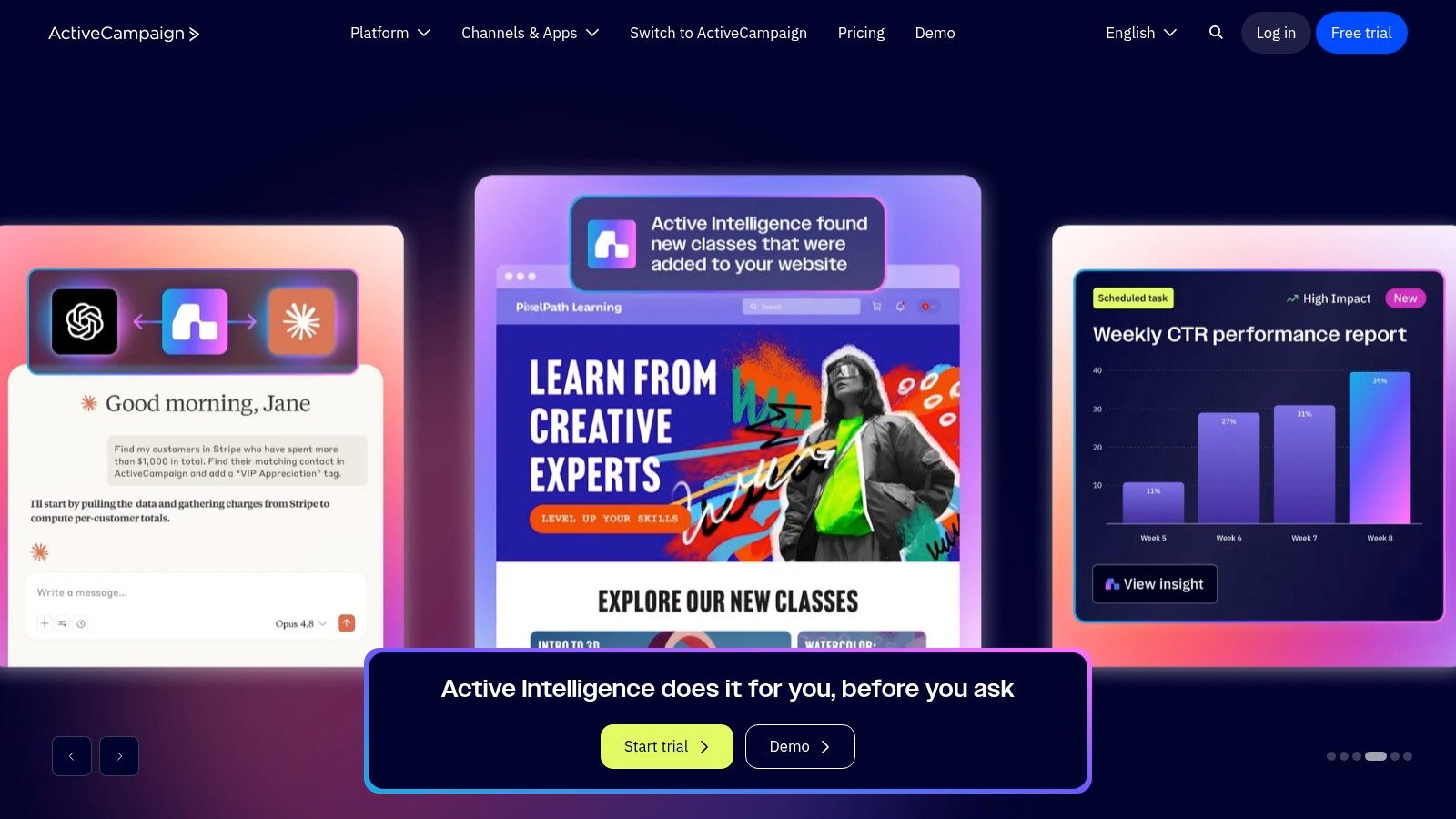
ActiveCampaign is built for complex, multi-branch customer journeys. Its visual automation builder supports conditional paths, goal tracking, site and event tracking, and CRM connections, making it a strong fit when a crowdfunding campaign has several audience states and follow-up sequences.
A campaign might need one path for a new prelaunch subscriber, another for someone who clicked a campaign announcement, and a third for a backer who purchased but hasn't completed a survey. ActiveCampaign can model those branches if the required events and fields reach the platform reliably.
The CRM option is useful for agencies, sales-led launches, and teams working with retail or distribution partners. It can reduce hand-offs between marketing and sales when campaign activity needs to inform outreach.
ActiveCampaign's power is also its main risk. Teams can build elaborate automations that are difficult to audit, especially when several tags, goals, wait conditions, and integrations overlap. Before launch, document entry conditions, exit conditions, suppression rules, and the event that marks a backer as fulfilled.
The platform is a good fit for teams with someone responsible for automation governance. It's less attractive for a solo creator who needs to send a survey reminder quickly or create a fulfillment segment without engineering support.
Use email workflow automation guidance to map the journey before building it. ActiveCampaign is excellent when the journey itself is the competitive advantage. It's unnecessary complexity when a native crowdfunding platform already contains the data you need.
Brevo combines email, SMS, WhatsApp, chat, marketing automation, transactional SMTP, and team permissions. Its pricing is primarily tied to monthly email sends, while contacts are unlimited, which can suit a crowdfunding team with a large historical audience that doesn't email every contact frequently.
The platform is useful for campaign announcements, backer reminders, order-related messages, and post-campaign updates. Keeping marketing and transactional email under one roof can simplify operations, although teams should still separate message types carefully and configure authentication correctly.
Brevo's collaborative features also help agencies and campaign teams. User roles and permissions make it easier to give a contractor access to campaign production without giving that person unrestricted control over the entire account.
Brevo can be a sensible budget-conscious choice when the campaign needs multiple communication channels but doesn't require the deepest ecommerce segmentation. Its send-based structure may be easier to understand than contact-based billing for a list that grows substantially during a successful campaign.
The limitations appear in advanced workflows. Some features, branding removal, and higher-level capabilities may require add-ons or higher tiers. Automation depth and polish can also trail ecommerce-first platforms such as Klaviyo and Omnisend.
Brevo is best when the team wants a broad communications suite and predictable control over sending volume. It won't replace a pledge manager's native knowledge of survey completion, reward selection, or fulfillment status. Those attributes need to be synchronized or maintained elsewhere.
MailerLite is a lightweight option for creators and small teams that want a modern editor, straightforward automations, and ecommerce triggers without adopting a large marketing suite. It's particularly useful for prelaunch pages, signup forms, campaign newsletters, and simple post-purchase communication.
The visual automation builder supports triggers such as abandoned checkout and post-purchase activity. Native ecommerce integrations and an ecommerce API allow teams to connect custom stores, which makes MailerLite more useful once a crowdfunding campaign transitions into direct sales.
Its automation template library can shorten setup time. A small team can start with a welcome sequence, campaign announcement, launch reminder, and post-purchase message rather than building every workflow from an empty canvas.
MailerLite has fewer enterprise-grade analytics and testing capabilities than advanced platforms. It may also need third-party extensions for complex CRM workflows. That's not a serious problem for a creator running a focused campaign, but it can become limiting when the audience includes retailers, affiliates, customer service cases, and multiple product lines.
MailerLite is a good starting point when the list is small and the campaign communication plan is simple. It's also a practical choice for a creator who values speed over deep operational modeling. If backer status must drive fulfillment-specific messages, keep that data in the pledge manager or build a reliable integration before relying on MailerLite segments.
HubSpot Marketing Hub makes sense when email is part of a larger CRM, sales, service, and reporting operation. Its email tools connect to HubSpot CRM, forms, ads, attribution, content, and cross-team reporting.
That setup can help a hardware startup that needs to coordinate campaign supporters, wholesale leads, distributors, press contacts, and customer service records. A campaign email can sit alongside contact activity, deal stages, lifecycle data, and sales follow-up instead of living in a separate newsletter account.
HubSpot also offers AI-assisted campaign creation, governance features, and paid tiers that expand sending and remove branding. The free tier has capped monthly sends, so teams should compare the actual campaign calendar with the included allowance before treating it as a long-term solution.
HubSpot's strength is data coordination. Its weakness is that the platform may be far more than a creator needs. Seat-based and contact-based pricing can become complicated, especially when marketing contacts, sales users, and service teams all share the system.
A crowdfunding creator should choose HubSpot when CRM-level orchestration is genuinely required. If the primary need is prelaunch capture, campaign updates, backer surveys, and fulfillment notices, a focused email tool paired with a pledge manager will usually involve less configuration.
HubSpot is the right choice for a multi-team organization that expects the campaign to feed a broader sales and customer lifecycle. It's not the efficient choice for a single campaign where backer operations are the center of gravity.
Omnisend is designed for ecommerce brands that want ready-made flows, product feeds, email, SMS, push notifications, and ad-audience integrations. It can help a crowdfunding creator move from one launch into an ongoing store without rebuilding every customer journey manually.
The platform supports Shopify, BigCommerce, and WooCommerce workflows. Product recommender AI, dynamic content, and send-time optimization can help turn a campaign audience into a repeat-purchase audience, particularly when the creator has accessories, replacement products, or future releases.
Omnisend's ready-made ecommerce playbook is its main practical advantage. A team can adapt welcome, post-purchase, cart recovery, and win-back flows instead of designing every sequence from scratch.
Omnisend is less suitable for campaign-specific backer operations. Kickstarter reward choices, survey answers, address validation, shipping status, and add-on eligibility usually originate outside the store platform. Without a clean integration, the team will still need exports or middleware.
Costs scale with contacts, and advanced reporting is reserved for higher tiers. SMS pricing also varies by country and volume, so a campaign with an international audience needs a channel budget before enabling multi-channel follow-ups.
Choose Omnisend when the campaign's next phase is a serious ecommerce store. Choose a native crowdfunding email workflow when the immediate job is to collect missing information, coordinate fulfillment, or segment backers by pledge activity.
Drip focuses on ecommerce lifecycle automation, personalization, and revenue tracking across Shopify, WooCommerce, and BigCommerce. It's a strong choice for merchants who want product-aware content blocks, event-driven flows, and revenue dashboards without adopting a full CRM.
For crowdfunding, Drip becomes useful after the campaign has a catalog and a direct sales channel. A creator can build post-purchase education, accessory recommendations, replenishment reminders, and win-back campaigns around product and customer events.
Its visual workflows help teams map those journeys without writing code. Revenue attribution dashboards also give marketers a clearer connection between campaigns and store activity than basic newsletter reporting.
The trade-off is scope. Drip is primarily ecommerce-oriented, so it's less useful for a prelaunch audience that hasn't entered a store or for backer operations that depend on survey and fulfillment records. It also offers fewer suite extras than a full CRM.
Use Drip when the campaign has matured into a product business and the store is the main source of customer events. Keep pledge management and fulfillment data in the system built to handle them, then pass the relevant purchase and engagement events into Drip.
| Tool | Core features | 👥 Target audience | ✨ Unique selling points | 💰 Pricing & value | ★ Rating |
|---|---|---|---|---|---|
| 🏆 PledgeBox Email Marketing | Native drag+HTML editor, A/B testing, advanced segmentation tied to pledge manager, Amazon SES | 👥 Crowdfunding creators & campaign teams | ✨ Native link to pledge/fulfillment data; survey-driven upsells & pre-orders; 24/7 Support GPTs; privacy-first data controls | 💰 Free (1k contacts / 2k emails); $19/mo per 5k; no per-backer/campaign fees; 3% on add-on sales | ★★★★★ |
| Intuit Mailchimp | Templates, Journey Builder, basic CRM, ecommerce integrations | 👥 Small→mid businesses, general marketers | ✨ Large ecosystem & templates; easy starter automations | 💰 Freemium → contact + send limits scale with usage | ★★★★ |
| Klaviyo | Granular ecommerce segmentation, deep flows, SMS & multichannel | 👥 DTC brands & post-campaign Shopify/Woo stores | ✨ Revenue-tied automations, 350+ integrations, AI tools for optimization | 💰 Higher cost with active profiles; strong ROI for ecomm | ★★★★ |
| Kit (formerly ConvertKit) | Visual automations, landing pages, commerce for creators | 👥 Solo creators, newsletter publishers, digital-product sellers | ✨ Simple UX, creator monetization tools, strong educational resources | 💰 Creator-focused tiers; pricing scales with subscribers | ★★★★ |
| ActiveCampaign | Visual automation builder, CRM option, event/site tracking | 👥 SMB → mid-market teams needing advanced journeys | ✨ Powerful multi-branch automations, lead scoring, goal tracking | 💰 Modular pricing; add-ons increase cost | ★★★★ |
| Brevo (Sendinblue) | Email, SMS, chat, transactional SMTP, unlimited contacts model | 👥 Startups & volume senders wanting predictable sends | ✨ Send-based pricing with unlimited contacts; transactional + marketing in one | 💰 Competitive entry cost; pay-per-send model | ★★★★ |
| MailerLite | Modern editor, visual automations, ecommerce triggers | 👥 Small teams & growing creators | ✨ Fast setup, clear UI, strong value for feature set | 💰 Affordable tiers for growing lists | ★★★★ |
| HubSpot Marketing Hub | Email + automation integrated with HubSpot CRM, reporting & ads | 👥 Mid→enterprise teams needing CRM-marketing alignment | ✨ Tight CRM coupling, cross-team reporting, governance | 💰 Free tier limited; paid tiers costly (seats & marketing contacts) | ★★★★ |
| Omnisend | Ecommerce flows, product feeds, push & ad audience integrations | 👥 Ecommerce merchants (Shopify, BigCommerce, Woo) | ✨ Ready-made revenue flows, product recommender AI, omnichannel sends | 💰 Mid-priced; SMS/advanced features add cost | ★★★★ |
| Drip | Lifecycle email, product-aware content blocks, revenue attribution | 👥 Ecommerce merchants focused on LTV & lifecycle | ✨ Ecommerce-first reporting and event-driven personalization | 💰 Mid-priced; scales with list size | ★★★★ |
The best tools for email marketing should be judged by the campaign they need to survive, not by the size of their template library. Crowdfunding has several distinct phases, and each phase creates different data requirements.
Before launch, the priority is audience capture and permission-based list growth. Kit is a natural fit for creator-led newsletters and education. MailerLite works well for a small team that wants a fast editor and basic automation. Mailchimp is useful when the team needs broad integrations and familiar marketing functions.
During the campaign, reliability and message timing matter more than visual novelty. You need to distinguish subscribers from backers, avoid sending launch reminders to people who already pledged, and communicate changes to the right audience. ActiveCampaign can handle complex branching, while Brevo provides a broad multi-channel environment for teams that value send-based budgeting.
After funding, the data problem changes. Backers are no longer just email contacts. They have pledge levels, reward selections, survey answers, shipping details, add-ons, and fulfillment states. A general-purpose email platform can communicate with them, but it may need exports, custom fields, or integrations to understand those states.
That's where PledgeBox has a structural advantage. Its email marketing sits alongside the pledge manager, surveys, add-ons, fulfillment, and campaign data. PledgeBox is free to send the backer survey and charges only 3% of upsell revenue if there's any. Kickstarter's pledge manager is like Amazon, a native and integrated experience. PledgeBox's pledge manager is like Shopify, a branded and flexible environment that gives creators more control.
For post-campaign ecommerce, Klaviyo, Omnisend, and Drip are stronger when the store becomes the main operating system. They can use product catalogs, purchase events, dynamic content, and lifecycle flows to support repeat sales. HubSpot is the better fit when the campaign must connect to sales pipelines, service records, attribution, and multiple internal teams.
Deliverability should shape the decision from the beginning. A cited 2025 benchmark reported global inbox placement at 87.2%, compared with 83.5% in 2024, and DMARC adoption reached 61% in 2025, while enforcement still lagged. The benchmark coverage explains the authentication context. Configure a custom sending domain, authenticate it, suppress disengaged contacts, and judge campaigns through clicks and conversions rather than opens alone. Apple Mail Privacy Protection makes open rates less reliable, while click activity gives a more useful view of intent.
The right stack may include more than one tool, but every added system creates another synchronization problem. If pledge, survey, fulfillment, and upsell data already live together in PledgeBox, keeping email close to that data can reduce operational errors. If the business has clearly moved into ecommerce or CRM-led growth, a specialist platform may earn its place.
Use the B2B video strategy resources when your campaign also needs a stronger content and video plan for partners, retailers, or business audiences. Then choose the platform that matches the next workflow you must run, not the biggest feature list you can find.
PledgeBox brings prelaunch audience capture, email marketing, pledge management, backer surveys, upsells, fulfillment, and post-campaign operations into one crowdfunding toolkit. If you want to send the backer survey for free and pay only 3% when upsell revenue exists, visit PledgeBox and build a campaign workflow that keeps your backer data connected.
PledgeBox
The All-in-One Toolkit to Launch, Manage & Scale Your Kickstarter / Indiegogo Campaign