 PledgeBox
How to Launch an Electric Bicycle Kickstarter the Right Way
Learn how to launch an electric bicycle Kickstarter campaign that funds, ships, and scales. A practical playbook from validation to fulfillment.
Learn how to launch an electric bicycle Kickstarter campaign that funds, ships, and scales. A practical playbook from validation to fulfillment.
The most popular advice about an electric bicycle Kickstarter is also the most dangerous: hit the funding goal, celebrate publicly, and figure out delivery afterward. That approach confuses demand with readiness. A campaign can attract attention, collect pledges, and still collapse under battery certification, supplier delays, unclear configurations, tax errors, or a reward tier that costs more to ship than it earns.
A funded campaign proves that people want the product as presented. Delivery proves whether the company can operate. The practical work starts when the funding meter stops moving. You need a validated prototype, a page that makes precise promises, a pledge manager that captures usable order data, and a fulfillment system that can move batteries and bikes through multiple markets without improvisation.
Launch-day momentum is a poor proxy for delivery readiness. Backer counts rise, social posts spread, and the funding bar creates an easy story for customers and press. It says nothing about stable frame tolerances, charger compatibility across destinations, or whether a shipping partner can legally transport the battery configuration you sold.
Faraday Porteur showed how a differentiated electric bicycle could be framed as a premium urban-mobility product. Its Kickstarter campaign launched on July 17, 2012, and ended after 25 days with 368 backers and $177,268 raised against a $100,000 goal, according to the Faraday Porteur Kickstarter campaign. GoCycle later demonstrated demand for a folding format, while Super73 pushed electric bicycles toward lifestyle and moto-inspired positioning. These campaigns offer positioning lessons, not proof that a visually compelling bike can be manufactured reliably.
The funding meter answers one question: do enough people want this offer? It doesn't answer whether you can build, certify, ship, support, and repair it.
Clear differentiation, strong visual demonstrations, and limited early-backer offers can validate demand. They do not resolve the operational work after pledges arrive. That work determines whether backers receive usable bikes rather than delayed explanations.
I judge an e-bike campaign through four connected systems:
A viral launch makes every weakness more expensive. More backers create more batteries, variants, addresses, customs documents, and chances to discover that reward tiers were priced around hope instead of landed cost. The funding bar is only the first operational test. These four systems determine whether the campaign becomes delivered ownership, manageable support, and repeatable fulfillment.
Before you design reward tiers, define where your bike belongs. A rear-hub commuter, a folding utility bike, a conversion wheel, and a moto-style fat-tire model compete for attention differently. If you benchmark all of them as one product class, you'll choose the wrong price, message, and production assumptions.
An independent dataset of 110 Kickstarter e-bike campaigns reported a 50% success rate, an average raise of $183,738, and an average base price of $1,436. Campaigns receiving at least one public-relations mention had a 72% success rate, compared with 38% for campaigns without such mentions, as reported in this analysis of electric-bike Kickstarter campaigns. These figures don't guarantee performance, but they give you a category reference point before you mistake an ambitious target for a realistic one.
Look at comparable campaigns as operating documents. Record the product architecture, base price, reward inclusions, motor placement, battery format, visual proof, press activity, and the number of decisions a backer must make. Then ask why a customer would choose your bike instead of the closest alternative.
A product can borrow a positioning lesson without copying a design. Faraday Porteur made premium urban utility legible. GoCycle made folding central to the offer. Super73 connected the product to a lifestyle identity. Your page needs one dominant reason to exist, not a list of specifications competing for attention.
| Campaign | Backers | Raised | Goal | Avg Pledge |
|---|---|---|---|---|
| Faraday Porteur | 368 | $177,268 | $100,000 | Approximately $482 |
| GoCycle | 182 | $456,716 | $250,000 | Approximately $2,510 |
| Super73 | Not specified in the verified data | More than $441,000 | $25,000 | Not calculable from the verified data |
Faraday Porteur's average pledge in the table is calculated from its reported raised amount and backer count. GoCycle's figure is calculated the same way. Don't use those averages as recommended prices. They reflect each campaign's reward mix and customer profile, not a universal e-bike price point.
A base price near the category average may help customers understand the offer, but it doesn't make your margin viable. Model the complete landed cost before publishing an early-bird tier. Include the battery, charger, frame, motor, controller, packaging, inspection, payment fees, taxes, duties, dangerous-goods handling, replacement parts, warranty units, and customer support.
The strongest public-relations result also doesn't rescue a weak offer. Visibility can bring people to the page, but the page must convert attention into a reward that you can build and deliver. Secure evidence for every major claim, then use outreach to put that evidence in front of the right riders.
A beautiful specification sheet isn't a production-ready e-bike. I want to see evidence that the motor, controller, battery, charger, frame, brakes, display, wiring, and software work together under conditions that resemble ownership. A bench test that confirms the motor spins is not enough.
Start with a requirements traceability matrix. Every promise on the campaign page should connect to a test record, including range, payload, speed, charging time, ingress protection, hill performance, and safety statements. Define the rider weight, terrain, assist level, weather, tire pressure, and battery state used for each test. Without those conditions, a range claim is marketing, not engineering evidence.
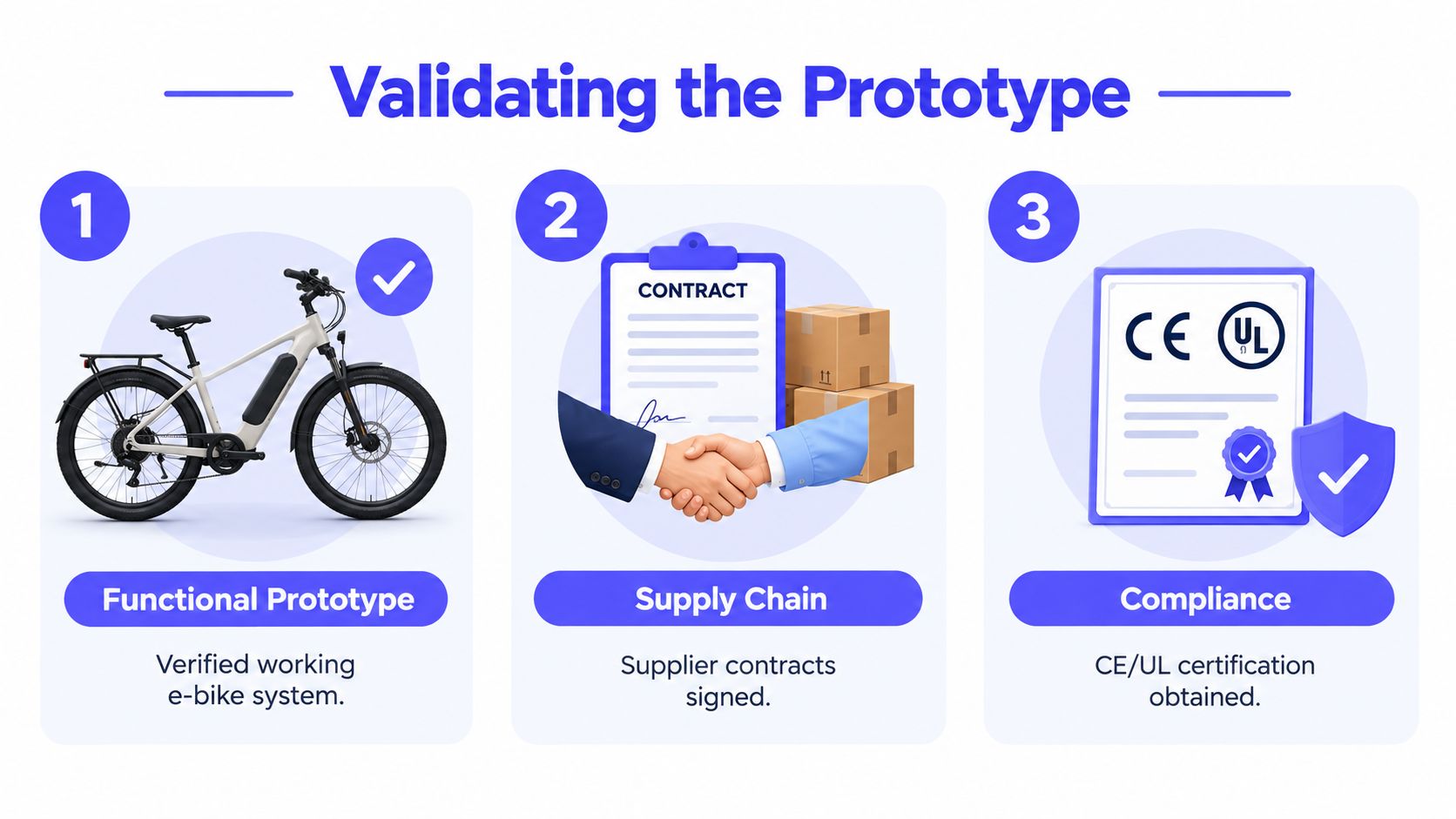
Run a design-for-assembly review across frame welds, motor mounts, cable routing, battery enclosure, connectors, service access, and fasteners. Ask an assembler to build the bike without relying on the designer's memory. If the process depends on special handling, undocumented adjustments, or a component arriving perfectly aligned, your design still carries production risk.
A rapid prototype can expose fit and assembly problems early. For teams that need an external reference for prototype methods, American Additive Manufacturing prototyping provides a useful way to evaluate how physical iterations can support design decisions before tooling and volume commitments.
Then build pilot units. Check supplier variation, torque settings, weld consistency, connector fit, battery seating, brake alignment, and packaging damage. Test the complete bike under representative load, hills, rain, vibration, braking, and thermal conditions. Test the charger and controller with the exact battery revision you intend to ship.
Your production gate should include:
A prototype planning guide for crowdfunding creators is useful at the planning stage, but no article replaces testing your own hardware.
Don't publish a delivery month while suppliers are still quoting unconfirmed lead times. Freeze the bill of materials, obtain written lead times, identify second sources where possible, and define which substitutions require a new test. Battery certification and dangerous-goods shipping deserve their own review because an approved cell, an assembled pack, and an export-ready shipment are different operational questions.
The delivery record for crowdfunded hardware should make creators cautious. Historical research summarized in this review of why crowdfunded hardware projects fail reports that successful hardware campaigns averaged 602% funding, compared with 18% for failed campaigns, yet only 32% delivered on time, 43% were delayed by more than a year, and 26% had not delivered at the time of analysis. Funding can be strong while delivery remains broken.
Practical rule: Don't let demand dictate your first production quantity. Let your validated assembly rate, supplier capacity, inspection process, and cash reserve dictate it.
Show the page draft to three riders who are not engineers before you write a single reward tier. Ask what they think the bike does, what arrives in the box, and which claim they distrust. Their answers expose conversion problems before those problems become fulfillment mistakes.
Open with a short riding sequence that proves the product's job. A commuter bike should move through a realistic commuting environment. A folding bike should show folding, carrying, storage, and unfolding. A conversion product should make installation and compatibility obvious.
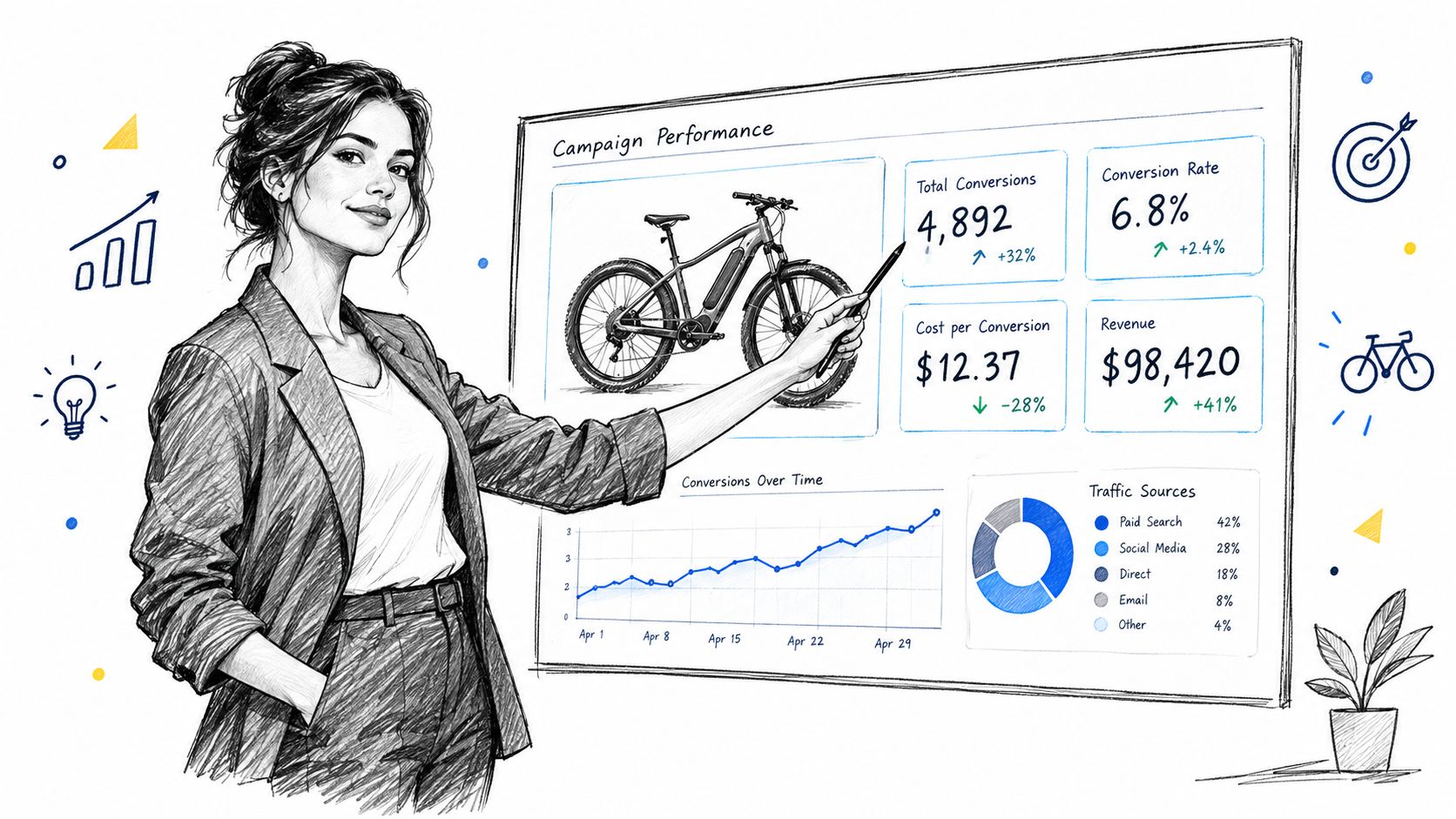
Build the page around buyer questions:
Put limitations beside the claims they qualify. If rider weight, terrain, weather, or assist mode changes range, show those conditions next to the range statement. If a frame-size choice becomes difficult to change after production, make that clear before the pledge is finalized.
Keep the core product separate from optional revenue. An early-bird tier should create urgency without making the standard reward unprofitable. Limited colors can signal a launch edition, but colors that create supplier minimums, extra inspection, or stranded inventory add operational risk. Include them only when the margin supports that complexity.
The GeoOrbital campaign illustrates why conversion products need clear economics and demonstration. Its 45-day Kickstarter campaign in May 2016 raised more than $1.26 million from over 1,600 backers, sold more than 1,400 wheels, and produced an average pledge of approximately $787, according to the GeoOrbital Kickstarter campaign page. Use the lesson, not the outcome. Show installation, the intended use case, and the value proposition without making visitors work for the explanation.
A page that earns pledges must also prepare the order. Test the reward flow with non-engineering riders, then revise unclear options before launch. Confusion over variants, accessories, or what ships with the bike becomes a support queue and a fulfillment error after the campaign closes.
A pledge manager isn't a form you send after the applause. For an e-bike, it's the order system that turns a general pledge into a buildable SKU. You need structured answers for frame size, battery variant, charger plug, accessories, destination, tax status, shipping payment, and any upgrade that changes procurement.
Kickstarter's native Pledge Manager is integrated into the Kickstarter ecosystem. It supports reward upgrades, add-ons, post-campaign purchases by new backers, shipping and tax collection, and quantity or price limits for rewards and add-ons. It has no upfront cost, but Kickstarter deducts its usual fees from payments made within the manager, as explained in its Pledge Manager guidance.
PledgeBox is free to send the backer survey. There is no upfront fee, campaign fee, or per-backer fee, and it remains free when the survey generates no additional payment. If the survey produces add-on or other upsell revenue, PledgeBox charges 3% only on the new funds collected through the survey, while payment-processor fees are separate, according to PledgeBox pricing.
Kickstarter's Pledge Manager is like Amazon. It keeps the transaction close to the marketplace where the campaign began, which can reduce ecosystem friction and suit a simple reward structure. PledgeBox's pledge manager is like Shopify. It gives the creator a more dedicated post-campaign storefront for branded surveys, add-ons, late-backer pre-orders, shipping and tax collection, and order operations.
That analogy matters because e-bike projects often have more configuration than a simple reward. A bike may need a frame choice, battery selection, charger variation, accessory bundle, regional shipping rule, and replacement-parts path. The manager must capture those choices cleanly enough for procurement and fulfillment, not merely collect a response that someone later interprets in a spreadsheet.
| Feature | Kickstarter Pledge Manager | PledgeBox |
|---|---|---|
| Platform role | Native Kickstarter checkout | Dedicated third-party pledge and survey platform |
| Backer surveys | Integrated with Kickstarter campaign flow | Branded survey and backer portal |
| Reward upgrades | Supported | Supported through configured order options |
| Add-ons | Supported | Supported, with upsell revenue subject to the stated fee |
| New post-campaign buyers | Supported | Supports late-backer and pre-order workflows |
| Shipping and tax | Supported | Supports shipping, VAT and tax collection workflows |
| Fee structure | Usual Kickstarter fees apply to manager payments | No upfront, campaign, or per-backer fee, plus 3% on new survey funds from upsells |
The comparison should be based on operations, not brand preference. Choose Kickstarter's native option when ecosystem continuity and a relatively simple reward catalog matter most. Choose PledgeBox when you need a structured post-campaign store, broader add-ons, late-backer sales, regional order logic, or a workflow that separates survey collection from your campaign page. This comparison of PledgeBox and Kickstarter's Pledge Manager helps frame the choice around mechanics rather than launch-day excitement.
Shipping is where an attractive margin gets exposed. Model landed cost by destination before you publish rewards. Include the bike, battery transport, duties, VAT, packaging, payment fees, inspection, warranty reserve, replacement parts, and any regional handling that applies to dangerous goods.
Your survey should create a clean procurement record. Capture:
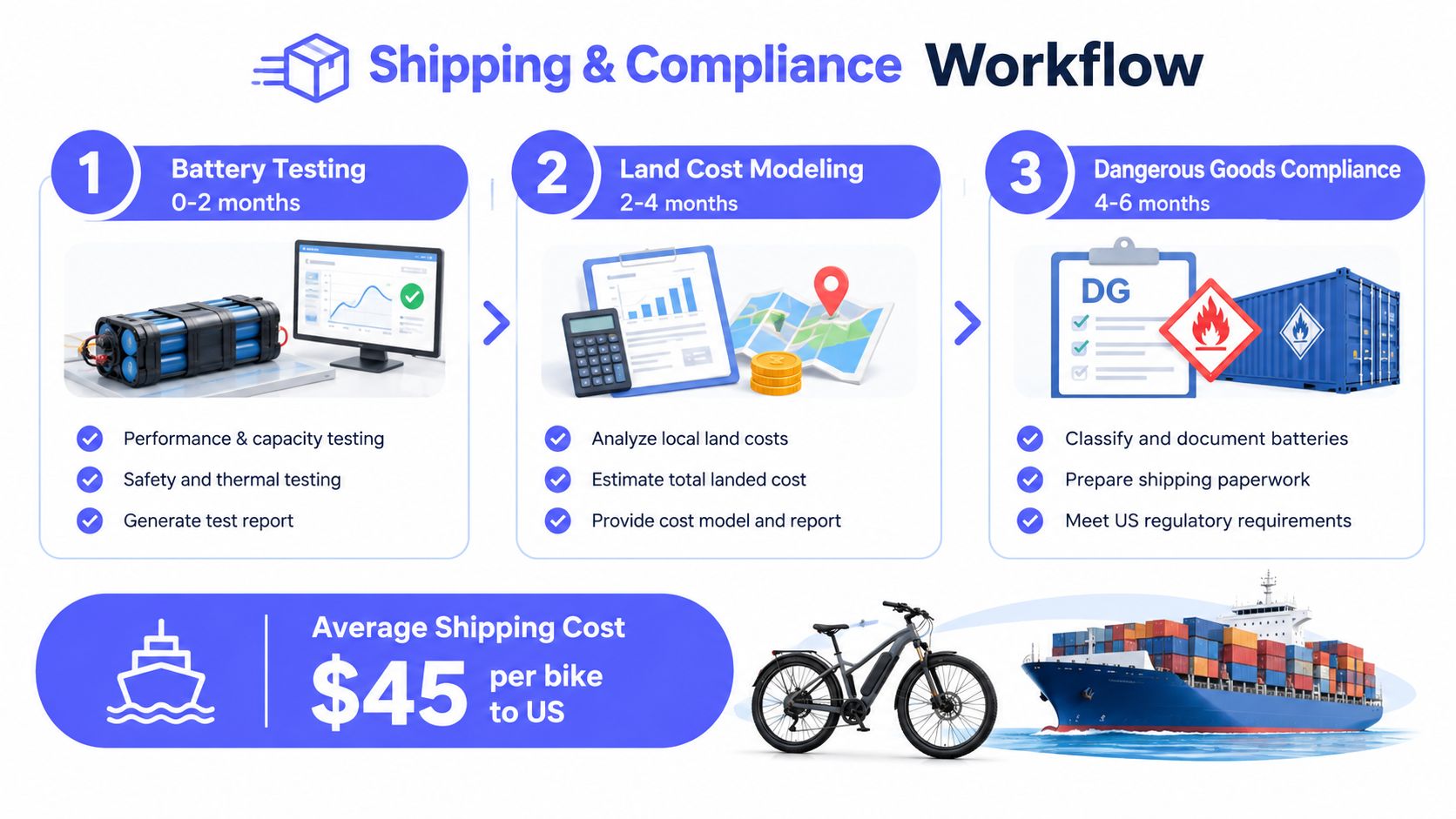
In April 2025, the U.S. Consumer Product Safety Commission proposed mandatory lithium-ion micromobility-battery requirements after identifying 227 incidents involving fires, explosions, overheating, smoke inhalation, or related events, resulting in 39 deaths and 181 injuries, according to this overview of micromobility battery safety standards. The United Kingdom has also published statutory guidance stating that e-bike batteries should include mechanisms capable of preventing thermal runaway.
European rules are being introduced in stages. Article 11 is scheduled to require batteries and individual cells to be designed for removal and replacement from February 18, 2027, as described in the same regulatory overview. New South Wales introduced mandatory lithium-ion standards for e-mobility batteries in February 2025, with recognized requirements including EN 50604-1, IEC 62133-2, UL 2271, and electrical-system standards such as UL 2849.
Don't treat one certificate as a universal passport. Maintain a destination-specific evidence file containing test reports, battery traceability, charger documentation, transport classification, labels, warranty parts availability, and service contacts. Before sending final orders to vendors, use a structured workflow such as this guide to VAT and tax compliance for crowdfunding fulfillment.
The pledge isn't the end of the customer relationship. Backers will need replacement batteries, compatible chargers, firmware support, repair access, recycling guidance, and clear information about how long parts will remain available. A bike with a lower headline range but replaceable components can create less lifetime risk than a bike built around a proprietary pack with no published service path.
Export survey data only after responses are validated. Then connect configuration records to vendor purchase orders, shipment tracking, customer notifications, warranty registration, and support history. That chain prevents a common failure: delivering the first batch while losing the exact battery or charger information needed to support it later.
Use this launch gate before you open pledges:
Warning signs include changing core components after launch, publishing a delivery month before supplier confirmation, accepting battery variants without transport documentation, and collecting addresses without structured configuration data. Funding is useful. Delivered bikes, supported owners, and available replacement parts are the true scorecard.
PledgeBox gives electric-bicycle creators a free way to send the backer survey, with no upfront, campaign, or per-backer fee, and charges only 3% of new upsell funds collected through the survey if there are any. If you're preparing an e-bike campaign, visit PledgeBox to plan the survey, capture configurations, collect shipping and tax details, and turn pledges into fulfillment-ready orders.
PledgeBox
The All-in-One Toolkit to Launch, Manage & Scale Your Kickstarter / Indiegogo Campaign