 PledgeBox
Address Validation International
Master address validation international workflows for crowdfunding. Learn how to prevent failed deliveries, handle global formats, and streamline backer
Master address validation international workflows for crowdfunding. Learn how to prevent failed deliveries, handle global formats, and streamline backer
A crowdfunding campaign can feel finished when the funding period closes. In fulfillment, that's often when the difficult work starts. Backers may have entered apartment details in the wrong field, omitted a region, used a local script, or supplied an address that looks complete but can't be matched to a postal reference. By the time those problems appear in shipping exports, labels, customs paperwork, and support tickets, the campaign team is already paying for the mistake.
International address validation is the control that catches those failures before they become parcels. For crowdfunding teams, it also protects upsell revenue, shipping-fee collection, tax handling, and the credibility earned during the campaign.
A creator has just funded a hardware gadget on Kickstarter with 3,000 backers across 40 countries. The product is ready, the warehouse has inventory, and the first shipment file goes out. Then the exceptions arrive: a missing apartment number in Canada, an incomplete locality in Brazil, a transliterated address that doesn't match the carrier format, and several backers whose country field conflicts with their postal code.
The warehouse can't print labels and hope. Some parcels are held for clarification, some return to the sender, and others reach a regional carrier that can't interpret the original formatting. The creator now has to pay for rework, contact backers, update customs information, and explain why delivery is late. The operational problem started in a survey field, but the damage spreads through every downstream process.

Domestic fulfillment usually operates within one familiar addressing convention and one carrier network. International crowdfunding doesn't. Each destination can have different rules for postal codes, administrative areas, street order, building identifiers, scripts, and delivery-point references.
Campaigns also collect addresses after the main purchase decision. Backers might return to the survey months after pledging, move home, enter an address on a mobile device, or assume that a familiar local format will be understood by an overseas warehouse. A form that merely accepts text creates the appearance of completion without confirming whether the data is usable.
The operational evidence is stark. A 2021 industry study reported that 47% of businesses rated accurate physical address data as critical for first-time delivery, while 74% said bad address data caused up to a quarter of failed deliveries. The same study reported that inaccurate or incomplete addresses were associated with 41% of deliveries being delayed and 39% failing outright. The study's delivery findings are summarized by Loqate through PR Newswire.
Practical rule: Treat the shipping address as a structured fulfillment record, not as a comment box.
A useful validation workflow checks the address while the backer is entering it, then checks the final normalized record again before label creation. That second checkpoint matters because data can change during exports, manual edits, warehouse imports, or carrier mapping.
Address validation also protects commercial decisions. If shipping fees depend on destination, an unresolved country or postal code can produce the wrong charge. If a campaign offers regional add-ons, taxes, or delivery methods, inaccurate location data can undermine the checkout logic. The guidance on international shipping fees belongs in the same operational conversation because address quality affects the cost assigned to each reward.
The right standard is simple: every address should be captured, normalized, checked, reviewed when uncertain, and exported in a form the carrier and customs workflow can use.
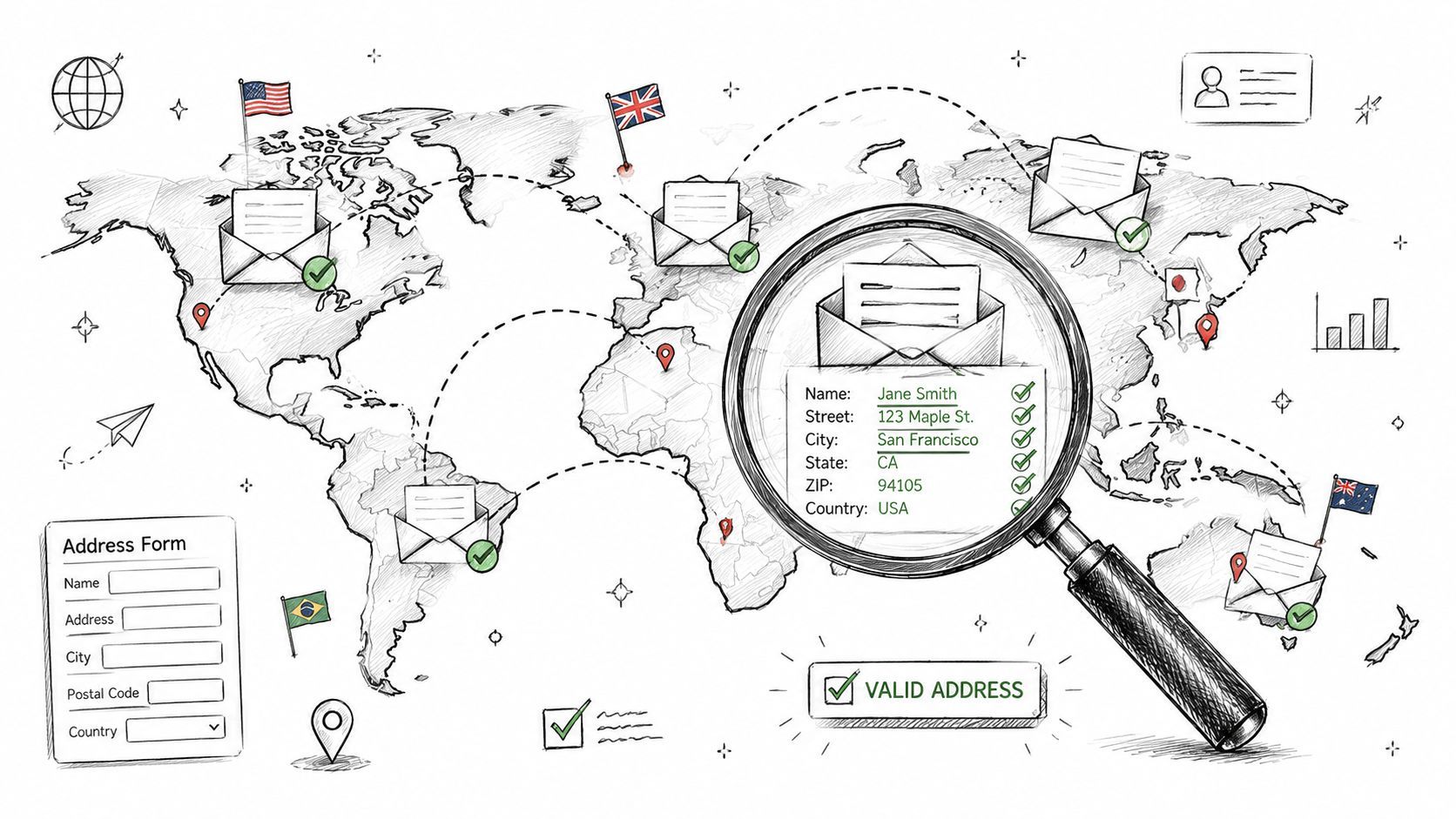
A backer can enter a complete address in one field, split it across several fields, paste accented characters, or omit a field that appears optional. International validation turns that inconsistent entry into a shipping record that a pledge manager, warehouse, carrier, and customs process can use. The workflow separates components, standardizes them, checks postal references, and returns either a deliverable candidate or a record requiring review.
The Universal Postal Union's addressing work reflects this approach. Its material describes a shift from the industrial era, centered on postcodes and sorting machines, to the information era, using delivery-point databases and GIS during data capture or before mail production. UPU S42 was approved by the UPU Standards Board on 3 February 2002 in Brussels, then published as a structured international template for address components and rendering rules. The UPU presentation documents that development.

Capture the raw input. Preserve the backer's original entry, including local characters and punctuation, while creating a separate copy for processing. The original can help resolve an uncertain match later.
Parse the components. The engine identifies likely building number, street, unit, locality, region, postal code, and country values. A single line can represent different components in different destinations, so field rules need to account for local conventions. Pair this logic with form-field validation for address entry so obvious omissions are caught before the record reaches the validation service.
Normalize the data. The system standardizes casing, abbreviations, spacing, character forms, country codes, and field placement. It may retain both native-script and transliterated values when a carrier or customs partner needs a particular version.
Verify against postal references. The engine compares the structured record with relevant, country-specific postal data. A strong result requires the address to exist in the applicable official database, not merely to resemble a familiar pattern. Smarty explains international address validation in those terms.
Render the destination format. The system returns a country-appropriate version for labels, customs documents, and exports. Element-based standards matter because there is no single global address format. Addresses should follow the destination country's designated operator standards, as described in the UPU's addressing solutions guidance.
A syntactically valid postal code does not confirm the street, locality, or building number. Coverage also varies by validation depth. One vendor guide describes postal-code validation for 141 countries and full address element validation and correction for about 86 countries, showing why “global coverage” needs a precise definition before a provider is selected. The Spectrum Addressing Guide details that distinction.
For reward shipping, “postal code accepted” is an incomplete output. The pledge manager should receive normalized country, city, region, street, building, unit, and postal information, plus a confidence state that tells fulfillment staff when automation should stop and manual review should begin. That status protects both the shipment and the revenue attached to each pledge.
The most dangerous address is not always the obviously incomplete one. A blank field gets noticed. A plausible address with the wrong ordering, script, or administrative locality can pass a basic form and fail later inside a carrier or customs system.
Country conventions create the first layer of difficulty. Japan commonly uses postal-code-first ordering and may present addresses in vertical writing. Germany often places the street before the building number and can contain long, specific street names. Brazil has neighborhood references and its own CEP postal-code system. Ireland's addressing model has also evolved, which makes a rigid assumption about postal codes unsafe.

Backers may enter addresses in Arabic, Chinese, Cyrillic, or another non-Latin script. A system that accepts only Latin characters forces the user to improvise, while a system that transliterates can create a record that no longer matches the official postal reference.
The safer pattern is to separate identity of the address from display format. Preserve the original script when it has operational value, create a normalized element record, and generate the version required by the destination carrier or warehouse. Don't ask a backer to solve transliteration manually if your validation layer can offer a recognized suggestion.
Classic database matching works best where postal references are maintained consistently and delivery points are formally defined. Some emerging or fast-changing markets don't offer that certainty. Street names can change, local landmarks may carry more practical weight than formal fields, and rural delivery may depend on additional directions.
A low-confidence result shouldn't be forced into a green “valid” state. It also shouldn't automatically reject the backer.
Use a review path:
Customs creates another failure point. A normalized address may still need a recipient name, contact number, country code, or other shipment metadata. The workflow should connect validation with customs documentation, rather than treating the label and declaration as separate administrative tasks.
There are three practical layers to consider: client-side autocomplete, server-side verification, and a dedicated address API. They solve different parts of the problem, and choosing only one usually leaves a gap.
Client-side autocomplete improves the backer experience. As someone types, the form can suggest a recognized address, reduce spelling mistakes, and expose missing components before submission. It's especially useful on mobile, where typing a long international address into separate fields is frustrating.
Server-side verification is the control before fulfillment. It checks the saved record after the survey closes, catches changes introduced by imports, and prevents unreviewed records from reaching label generation. A dedicated API gives the team more control over parsing, normalization, batch cleansing, and confidence handling, but it requires technical ownership.
| Approach | Best For | Coverage | Cost Model | Integration Effort |
|---|---|---|---|---|
| Client-side autocomplete | Reducing entry friction and catching obvious errors during the survey | Depends on the provider and destination coverage | Usually usage-based or bundled with the form platform | Low to moderate |
| Server-side verification | Final checks before shipping labels and warehouse exports | Depends on the reference databases and validation depth | Usually per request, record, or service tier | Moderate |
| Dedicated address API | Custom workflows, batch cleansing, confidence routing, and multi-system exports | Can range from postal-code checks to full element validation by country | API usage, volume tier, or negotiated plan | Moderate to high |
Google Maps Address Validation is often considered for user-facing suggestions and location recognition. Loqate, Experian, and Addressy are relevant when a team needs broader address-data services, country-aware formatting, or enterprise integration. The comparison should focus on actual destination coverage and validation depth, not the size of a marketing map.
Ask each provider:
A good implementation doesn't hide uncertainty. It makes uncertainty actionable.
For a small campaign with limited technical capacity, built-in autocomplete plus a manual exception queue may be enough. A larger hardware campaign shipping through multiple warehouses will usually benefit from layered checks, an API, and a clear “ready for label” status. The wrong choice is a form that accepts every string and leaves the warehouse to discover which records are usable.
A modern pledge manager behaves more like a commerce storefront than a simple survey. It may collect shipping details, taxes, reward changes, and add-on products in one checkout-like flow. That distinction matters because address validation has to run before the system calculates a destination-dependent charge and before fulfillment receives the record.
Kickstarter's pledge manager supports integrated tax collection for item-level U.S. sales tax and EU/UK VAT, according to Kickstarter's announcement about its pledge manager. PledgeBox is free to send the backer survey and charges a 3% platform fee only on upsell sales generated during the survey, with no upfront, per-backer, or campaign fees, as stated in its published pricing.
The useful analogy is that Kickstarter's pledge manager is like Amazon, with a marketplace-style campaign environment, while PledgeBox's pledge manager is like Shopify, giving the creator more control over the storefront, branding, offers, and post-campaign checkout experience. The comparison isn't about which model wins. It helps you understand where validation rules, tax logic, upsells, and exports live.

Define required fields by destination. Don't make every field globally mandatory. Configure the form so country-specific requirements can appear when the backer selects a destination.
Validate during entry. Use autocomplete or a real-time check to suggest standardized addresses. Let the backer confirm the suggestion instead of automatically rewriting their original text.
Recheck before export. Run server-side validation against the final saved record. Mark each address as validated, corrected, uncertain, or blocked for review.
Separate commercial and logistics status. A backer may have paid for an add-on while still needing to resolve a delivery address. Don't erase revenue records because shipping data requires clarification.
Export normalized fields. Your warehouse needs discrete columns for country, postal code, locality, region, street, building, unit, and any permitted delivery notes. Customs documents and carrier labels shouldn't depend on parsing a single free-text field.
Test the handoff. Send sample exports to the shipping provider and inspect the rendered label, not just the database record.
If your fulfillment operation connects field activity, warehouse systems, or delivery workflows through software, a practical overview of API integration for field teams can help your team think through the handoffs beyond the pledge manager itself.
An address is more than a delivery instruction. It can identify a person's home, reveal geography, and connect a backer to a purchase, reward, tax record, or payment history. Teams should collect only what the fulfillment process needs, explain why the data is requested, restrict internal access, and define how long operational copies remain in survey, warehouse, support, and analytics systems.
For European backers, GDPR considerations should shape the workflow from the start. That means documenting the processing purpose, limiting retention, using appropriate processor agreements, and providing a practical route for correction or erasure where applicable. A privacy policy doesn't fix careless exports. Address data copied into spreadsheets, carrier portals, and shared support channels needs the same governance as the original pledge record.
A low-value, domestic reward may need basic syntax and postal checks. A high-value international shipment, a regulated payment workflow, or a campaign with complicated tax obligations may justify full element validation, manual review for uncertain matches, and an audit record of the decision.
Don't assume that more checks always create a better experience. Overly aggressive rules can reject valid local formats, frustrate backers using non-Latin scripts, and push support volume upward. Use a confidence-based path instead:
Cost planning should follow the same logic. Review whether the provider charges per lookup, per corrected record, by volume tier, or through a platform bundle. Then estimate the number of survey attempts, rechecks, batch cleanses, and manual reviews, without treating the first successful lookup as the entire lifecycle cost.
Address data is becoming a compliance concern beyond physical delivery. Major providers note that ISO 20022 is moving cross-border payment messaging away from fully unstructured addresses, with structured or hybrid address data required for outbound payment messages by November 2026. KPMG's discussion of the payments evolution explains this transition.
Crowdfunding teams that retain legacy free-text addresses may face rejection risk, remediation work, and governance gaps if those records later support payment or financial operations. The practical response is to store reusable structured components now, preserve the source value for auditability, and document how corrections were made.
Test the workflow before real backers receive the survey. Use representative addresses from at least ten countries, including destinations with different field orders, scripts, postal systems, and rural delivery conventions.
Create a spreadsheet with columns for country, raw input, expected outcome, returned suggestion, confidence status, exported fields, and reviewer decision. Don't aim for a perfect acceptance rate. Aim for clear behavior that accepts good records, corrects recoverable mistakes, and escalates ambiguous cases without producing false positives.
On launch day, watch the validation error queue and support inbox together. Give support a short response template that asks for the missing component in plain language, and define who can override a result, who approves a shipment hold, and how corrected addresses flow back into the final export. That discipline keeps a small form issue from becoming a warehouse-wide rework cycle.
PledgeBox lets creators send the backer survey free of charge and charges only 3% of upsell sales when upsells occur, while supporting structured shipping data and address validation in the post-campaign flow. Visit PledgeBox to set up a fulfillment workflow that checks international addresses before they reach your shipping labels.
PledgeBox
The All-in-One Toolkit to Launch, Manage & Scale Your Kickstarter / Indiegogo Campaign