 PledgeBox
Address Validation API Guide for 2026
What an address validation API does, how to integrate one, and how it cuts shipping errors. Includes response fields, status models, and cost considerations.

What an address validation API does, how to integrate one, and how it cuts shipping errors. Includes response fields, status models, and cost considerations.
Improving address accuracy can raise successful first-delivery attempts by as much as 23%, with a median lift of 5.4% across postal operators, while poor address quality can cut delivery success by up to 14%, according to the Universal Postal Union Think Tank Brief. Those numbers reframe what an address validation API is supposed to do for a team that ships physical goods. Most engineering teams wire up an address check as a quick spellchecker that returns a boolean valid or invalid flag, then wonder why boxes still bounce back from warehouses weeks later.
A clean string is not a deliverable destination. A street can exist, carry a valid postal code, and still fail delivery because the building has forty apartments and the customer skipped the unit number. Treating validation as a five-status model backed by authoritative deliverability evidence, rather than a pass/fail gate, stops those exceptions before a shipping label ever prints.
Every integration decision in this stack, from which response codes you persist to when you revalidate an order list before carrier handoff, ties straight back to avoiding return-mail fees, reshipment postage, and manual support tickets.
Modern address validation APIs did not start as lightweight cloud utilities. They grew out of postal address-matching infrastructure built to sort physical mail at national scale. In the United States, the USPS Address Matching System API pulls together foundational postal datasets including City State, ZIP+4, five-digit ZIP, eLOT, Delivery Point Validation (DPV), and LACSLink, as detailed in the USPS Domestic Mail Manual archive. Each dataset handles a distinct processing job: standardizing street and locality spelling, appending extended postal codes, confirming whether a real delivery point exists, sequencing carrier routes, and converting older rural-style addresses into current street formats.
That lineage matters because it separates formatting from proof of deliverability. Under USPS Publication 28, a standardized address contains required address elements and official Postal Service abbreviations, and the agency advises validating records at data entry followed by ongoing list maintenance. Meanwhile, DPV operates alongside CASS-certified address-matching software to answer a sharper question than whether a string looks tidy. It checks whether the postal system recognizes an actual deliverable destination.
When a checkout form or fulfillment pipeline calls an address validation API, the service accepts either structured fields or free-text input, runs it through those matching layers, and returns a structured payload. Using a dedicated address standardization tool at entry cleans casing and abbreviations, yet the operational value lives in the deeper fields the API returns alongside the formatted address.
| Capability | What the response gives you | Cost of ignoring it |
|---|---|---|
| Standardization | Corrected street, abbreviation, and element casing | Carrier systems reject odd formatting; manual fixes at the warehouse |
| Postal code completion | Five-digit ZIP, ZIP+4, and extension codes | Sorting and rate errors, misrouted parcels |
| Delivery point confirmation | Deliverable point indicator such as DPV | Labels printed for addresses that never receive mail |
| Secondary unit match | Apartment, suite, unit confirmation footnote | Parcels refused or returned for a missing unit number |
| Rural route conversion | LACSLink-style converted address | Legacy rural addresses fail after conversion changes |
| Geocoding | Latitude and longitude for the matched point | No route planning, no delivery-time estimation |
| Country-aware formatting | Rendered address in the destination's template | Domestic rules corrupt valid international addresses |
If your code only reads the standardized street line and drops the footnotes, you throw away the exact signal that prevents failed shipments. A response can return a perfectly capitalized street name and a fresh ZIP+4 code while simultaneously carrying a DPV footnote warning that the secondary unit number wasn't found.
Never overwrite the customer's original input with the API's normalized output. Keep a structured validation snapshot next to every shipping record so support teams and export jobs can audit what happened:
Storage rule: Treat the API response as an audit artifact, not a one-time string transformation. If a parcel goes missing two months after checkout, those stored flags tell you in ten seconds whether the buyer omitted a unit or an automated rule changed a postal code.
Provider documentation mixes postal jargon, mapping terms, and API design concepts, often using two words interchangeably when they mean very different things in code. Keeping these definitions straight prevents costly misreadings of response payloads.
A validated address is not a guaranteed delivery, and a geocoded address is not a validated one. Coordinates can land in the middle of an empty lot, and even a DPV-confirmed building won't receive a parcel if the recipient moved last week.
A solid integration never collapses an API payload into is_valid: true or false. Look at how the Google Maps Address Validation API overview structures its output: it separates component identification, correction and completion, formatting, validation status, geocoding, and postal-services data. USPS's Address Validation API follows a similar discipline for US and Puerto Rico addresses, returning DPV footnotes that separate a complete delivery-point match from a matched building with an unmatched secondary number, alongside CASS indicators showing whether the input matched the ZIP+4 file.
Your application layer should map whatever raw diagnostics your provider returns into a clean, internal five-status model so checkout UI, warehouse rules, and support queues all speak one language.
Every lookup should resolve to exactly one of five operational statuses, paired with the provider's raw diagnostic codes:
standardized: The address was reformatted cleanly to postal rules with minor casing or abbreviation adjustments and no material element changes.deliverable: Authoritative postal data confirms the full delivery point, including any required secondary unit.secondary-unit-unconfirmed: The street and building matched, but an apartment, suite, or unit number is either missing or unrecognized.ambiguous: Multiple plausible postal matches exist, or the API had to guess at a major component like street direction or locality.undeliverable: No valid delivery point exists in the postal dataset, or critical components conflict beyond safe recovery.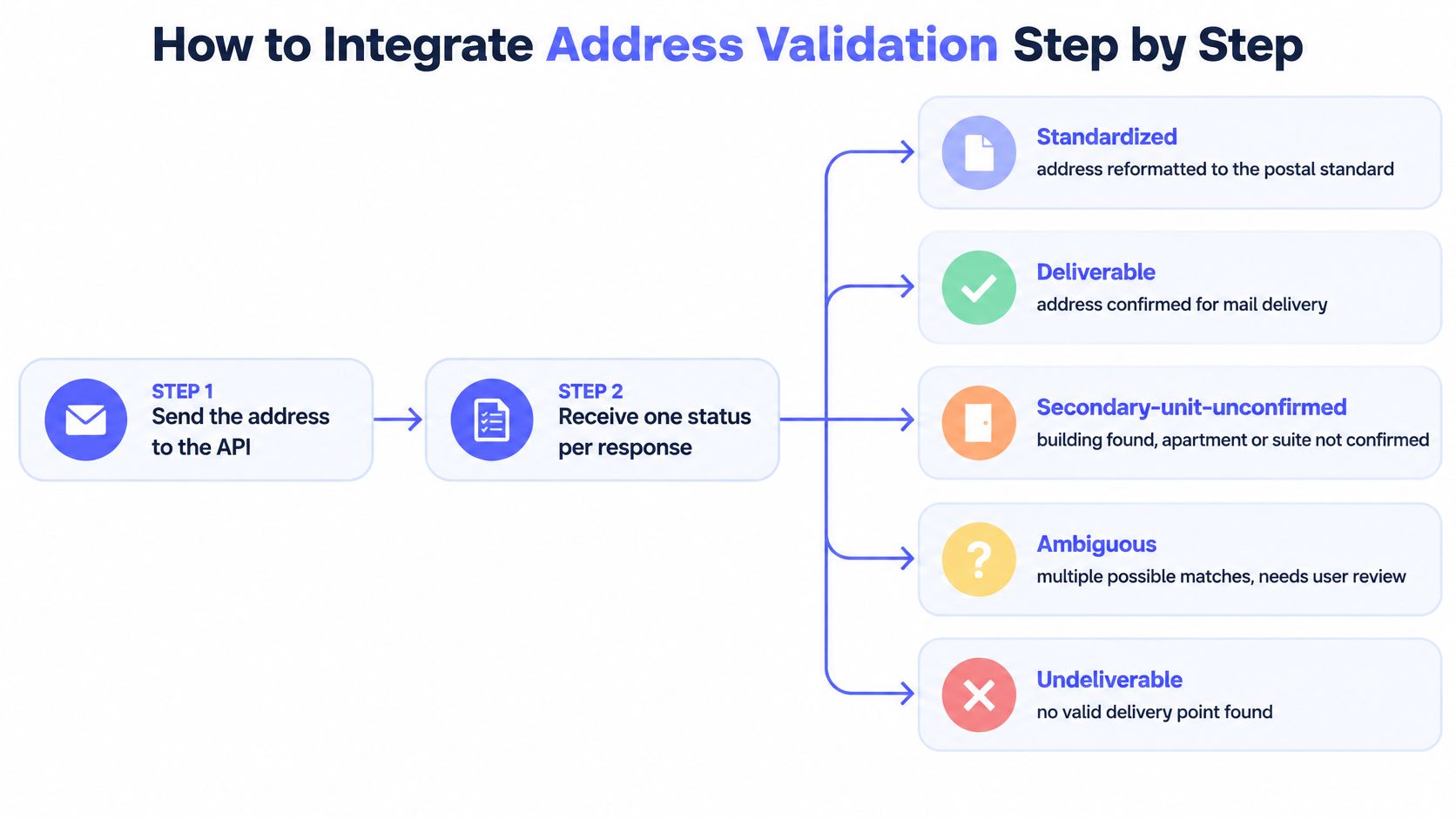
Follow this sequence to wire the five-status model into checkout, CRM forms, or post-campaign surveys without frustrating legitimate buyers.
Require the destination country first. Place the country selector at the top of your address form, not the bottom. Field labels, postal code formats, and validation templates all depend on the destination country, so running validation before you know the market guarantees broken parsing on international orders.
Capture structured components alongside raw input. Split form storage into recipient, organization, building or premise, street, locality, administrative area, postal code, and secondary unit. Retain the exact unedited payload the customer submitted so you can always reconstruct what they meant if a downstream parser misfires.
Call the validation endpoint on submit, and debounce any live suggestions. If you pair validation with autocomplete, pause requests briefly after the user's final keystroke (say, a few hundred milliseconds) so rapid typing doesn't fire unnecessary network calls or spike response latency. Keep the authoritative validation call tied to form submission or field blur once the complete address is present.
Diff the returned correction against the user's input. Compare the normalized response component by component against what the user typed. Accept cosmetic edits like expanding St to ST or appending a ZIP+4 code, because asking shoppers to approve trivial punctuation fixes kills conversion rates.
Prompt for explicit confirmation on material changes. Whenever the API alters a house number, apartment or suite, postal code, or locality, show a side-by-side highlight of the proposed edit and ask the user to confirm. Silent "fixes" on major fields regularly redirect parcels to a neighboring town with a similar street name.
Block missing secondary units instead of letting them slide. When DPV footnotes or component flags indicate a multi-unit building with a missing or unrecognized suite number, return secondary-unit-unconfirmed and surface a required unit input before letting checkout finish. Let users explicitly check a "no apartment or unit number" box only if they verify it's a single-family entrance.
Persist the status, diagnostics, and timestamp. Write the resolved status enum and provider metadata into the order's stored validation snapshot right away. Downstream warehouse scripts should query this status column directly rather than re-parsing raw JSON blobs during label printing.
Schedule bulk revalidation before shipment export. Postal reference files update constantly, and customer addresses age quickly when fulfillment happens months after purchase. Run a batch validation pass right before generating carrier manifests so newly flagged exceptions get caught while you can still email the recipient.
I would wire step 5 and step 6 on day one even if you defer batch revalidation until your first major ship window. Those two UI prompts eliminate the bulk of avoidable carrier returns on their own.
Returning five clean statuses only pays off when your order pipeline acts differently on each one. If your system logs secondary-unit-unconfirmed into a database column and still prints the label anyway, you built an expensive audit log instead of a fulfillment safeguard.
The table below maps each status to the exact system behavior and customer prompt that balances conversion speed against failed-delivery risk.
| Status | System action | Customer prompt |
|---|---|---|
| Standardized | Accept normalized address, continue checkout | None |
| Deliverable | Proceed to label and export | None |
| Secondary-unit-unconfirmed | Hold order, flag missing unit | Required apartment, suite, or unit field |
| Ambiguous | Block export until resolved | Up to three ranked candidates with a highlighted diff |
| Undeliverable | Route to manual review with provider diagnostic | Ask for a corrected address, show reason in plain language |
For a concise visual walkthrough of how real-time validation flags incomplete entries before they reach a warehouse queue, watch the overview below.
Teams often hesitate to pause checkout on secondary-unit-unconfirmed or route undeliverable orders to manual review because they worry about cart abandonment. That fear is misplaced. Letting a bad address slip through checkout doesn't save the sale; it trades a ten-second fix while the buyer is engaged for a multi-week return loop after the parcel leaves your dock.
Consider a common scenario: a shopper enters 410 Oak Ave for a forty-unit condo tower and leaves the apartment box blank. The street and postal code exist, so a naive validator marks it green. Holding the order with a focused, required unit prompt fixes the record on the spot. Similarly, when a response comes back undeliverable, translating the provider's cryptic diagnostic code into plain English ("We couldn't verify house number 4109 on Oak Ave, please double-check the street number") lets the buyer spot a transposed digit immediately instead of seeing a vague red error banner.
The same logic governs your confirmation threshold. Any automated adjustment that changes a house number, unit identifier, postal code, or locality must require an active human click. Swapping 94107 to 94103 or altering N Main St to S Main St without review can send a high-value shipment miles away from the buyer's actual door.
Cross-border fulfillment breaks the tidy assumptions of domestic postal matching. Provider documentation explicitly warns that reference data quality varies widely from one country to the next, and helpful metadata like residential versus commercial classification is only available in selected markets. A deliverable flag in the United States or Germany carries deep premise-level backing, while a green response in another market might only confirm that the postal code and town match.
That gap raises a practical question global sellers rarely get a straight answer to: does a validated international address prove the exact apartment or building entrance, and what should your workflow do when it doesn't? The honest answer is no. A broader country list on a vendor's marketing page matters far less than transparent confidence scores and readable failure reasons that separate syntactic formatting from true premise or unit confirmation.
Build explicit fallback paths for edge cases that strict postal databases handle poorly:
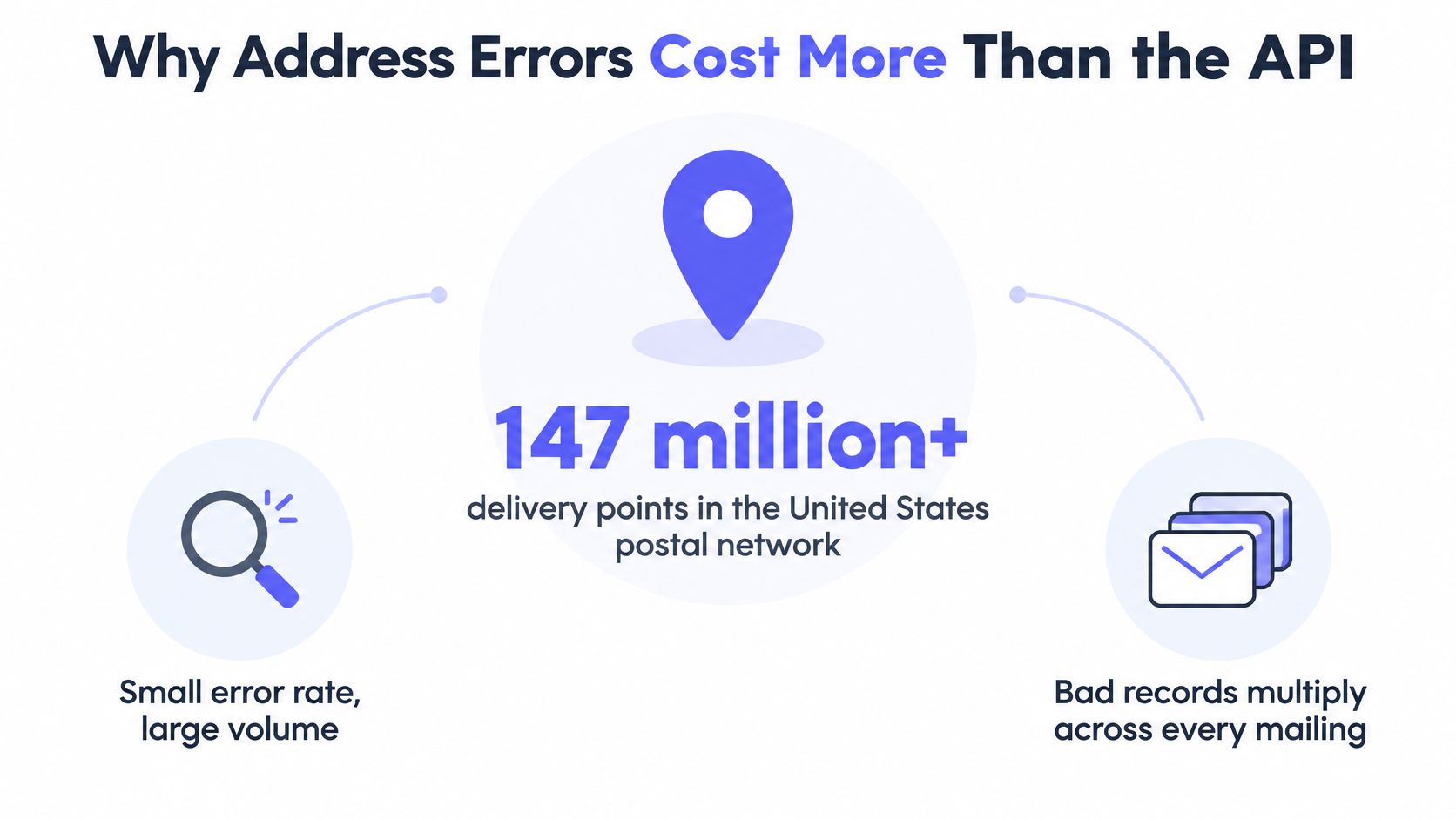
The economics of address validation make immediate sense once you look at postal scale. The United States postal network spans more than 147 million delivery points, according to the postal-industry infrastructure documentation summarized on the USPS Address Information API page. At that scale, even a tiny percentage of incomplete, misspelled, or ambiguous records turns into a painful stack of delivery exceptions across a full production run.
The single biggest culprit is missing sub-premise data, not misspelled city names. Mail missing secondary-address information such as apartment, suite, or unit numbers is a leading cause of undeliverable mail and returns, and it is exactly the failure a binary valid-or-invalid check lets slip through. That is why modern endpoints like USPS's public Verify API go beyond basic spellchecking to standardize abbreviations, append ZIP and ZIP+4 codes, and flag missing elements before postage is bought. An address can parse cleanly, match a real building, and still be undeliverable because Apt 4B never made it into the record. Treating validation as a five-status outcome rather than a pass/fail gate is what exposes that gap: a confirmed premise with an unconfirmed unit is a different cost profile than a confirmed unit, and your workflow should price them differently.
Comparing an API lookup fee against the price of a single shipping label hides most of the financial damage. Unwind one failed delivery parcel by parcel and six separate costs stack up fast:
Apt 4B; they leave a one-star review or open a payment dispute.One returned international box routinely wipes out the margin on several clean orders, and easily exceeds the cost of running thousands of API validations. That asymmetry is the entire business case. You are not buying cleaner data; you are buying out of the correction surcharge, the second freight leg, and the dispute.
Careless typing gets the blame, yet four structural failure points create the majority of bad records:
State dropdown or five-digit postal regex pushes international customers to shove provinces, building names, and postal codes into random text boxes just to submit the form.Each of these maps to a different status in a five-status model. Thumb-typing errors are usually correctable, missing units are partial matches, moved recipients come back as unconfirmed, and mangled input often returns no match at all. If your integration collapses all four into "invalid," you cannot tell a cheap fix from a lost parcel.
Stop judging your integration by raw API match rate alone. A provider that aggressively forces fuzzy matches will boast a high match rate while shipping boxes to the wrong street, because a forced match counts as a pass in their dashboard and a return in yours. Track actual delivery outcomes by country, carrier return rate, and customer correction rate after each dispatch wave. Those three numbers tell you whether validation lowered exceptions. The match rate only tells you the API answered.
Vendor comparison pages love to advertise country counts and sub-second response times. Those metrics rarely predict how many parcels land on the right doorstep. Before looking at pricing sheets or SDKs, rank your evaluation criteria by their direct impact on delivery accuracy.
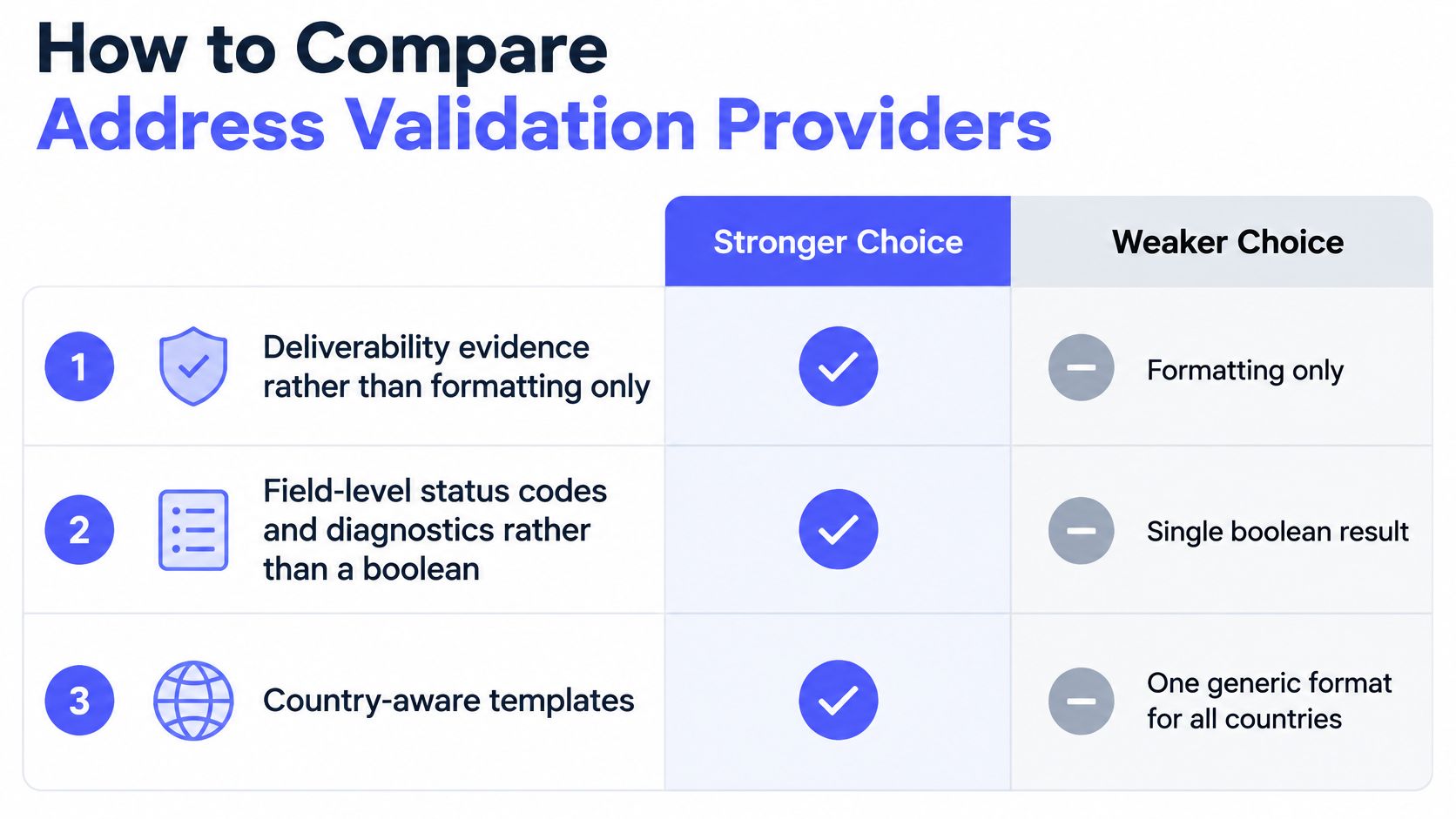
Start at the top of this list and disqualify any provider that fails the first three checks:
| Provider route | Status evidence returned | Coverage reality | Best fit |
|---|---|---|---|
| National postal API (USPS Address Validation, Verify) | DPV and CASS-style indicators, ZIP+4 | US and Puerto Rico only | US-heavy shipping with CASS compliance needs |
| Global commercial API (Google Address Validation) | Component identification, validation status, geocoding, postal data | Broad country list, unequal quality, residential/commercial metadata in selected markets | Multi-country storefronts with autocomplete |
| Fulfillment or pledge-management platform with built-in validation | Platform-defined pass or flag on the stored address | Matches the underlying postal or mapping provider integrated by the platform | Creators and ops teams who want validation inside the shipping flow, not in code |
Whichever provider route you choose, never model your internal address database as one or two generic free-text lines. Base your canonical schema on the S42 standard maintained under the Universal Postal Union Addressing Solutions program. S42 defines a shared dictionary of postal-address elements along with country-specific templates, published in both human-readable and XML computer-readable formats, that specify required versus optional fields, element ordering, and presentation rules.
Storing clean S42-aligned components (recipient, organization, premise or building, street, locality, administrative area, postal code, country, and secondary unit) pays dividends well beyond the initial lookup. Postcode validation can verify actual structure and component composition instead of relying on a brittle regular expression. When it's time to export manifests to regional 3PLs, S42 supports deterministic rendering into each carrier's preferred layout while simplifying deduplication, tax calculation, and shipment reconciliation. For teams shipping across borders, pairing an S42 schema with a dedicated international address validation workflow keeps US normalization logic from corrupting valid European or Asian addresses.
Speed-optimized autocomplete is the wrong default for most address forms. Almost every checkout guide treats instant keystroke suggestions as an automatic win because it shaves seconds off typing, yet that convenience hides two serious risks: silent personal-data leakage and broken accessibility for users who don't fit a provider's template.
Every keystroke typed into an aggressive autocomplete widget transmits partial, highly sensitive location data to a third-party server before the customer has intentionally clicked submit. On top of that, provider terms such as the Google Maps Places Web Service policies carry strict data-use, attribution, terms-of-service, and privacy-policy obligations that your legal and engineering teams must uphold.

Collecting shipping details months after an initial purchase, common in pre-orders and crowdfunding pledge managers, raises the stakes further. Recipients may open a survey link on a shared family computer, a workplace tablet, or a mobile browser while updating sensitive household information. Your form architecture should minimize exposure by design:
Modern UI libraries increasingly ship ARIA labels and keyboard navigation inside autocomplete widgets because accessibility is now a baseline engineering requirement, not polish. Even well-built dropdowns, though, can trap screen-reader users or break down when someone lives in a brand-new apartment complex absent from the provider's index.
Always build the form around plain manual entry first, treating live suggestions as an optional progressive enhancement. Every field needs explicit screen-reader labels, clear live-region announcements when validation flags an error, visible focus rings for keyboard-only navigation, and localized field hints that match the chosen country. When a user updates an already-stored address months later, require an explicit confirmation click before overwriting the previous destination.
Measurement balance: Judge your address form on completion rate, correction rate, accessibility failures, deletion requests, and delivery outcomes by country together. A widget that cuts typing time by three seconds while locking out rural buyers or triggering privacy complaints is a net loss.
A backer who entered a clean street in March can live in a different building by the time the container arrives. Months pass between campaign close and carrier handoff. People move, change jobs, and forget the unit number they typed. One check at survey open will not hold. I run validation as five statuses across the order life, because an unresolved undeliverable, ambiguous, or secondary-unit-unconfirmed record turns into a failed delivery and a return-mail charge.
Trace one reward from the survey form to the dock. Each stage has a job, and skipping one freezes bad data into the manifest.
secondary-unit-unconfirmed, ambiguous, or undeliverable. Clean rows do not belong in the same email. Exception mail gets a fix. A generic nag does not.Collect early. Validate at entry. Revalidate immediately before lock and export. Do not clean the list after the lock.
Small creator teams rarely have spare hours to wire USPS DPV footnotes, international S42 schemas, and bulk revalidation jobs themselves. The post-campaign tool decides whether those checks sit inside the survey or wait for a spreadsheet.
Kickstarter's built-in Pledge Manager runs at no upfront cost inside the creator dashboard. Creators collect addresses, reward preferences, taxes, shipping fees, add-ons, and upgrades, and survey questions update when a backer changes a reward, as the Kickstarter Pledge Manager overview describes. Payments processed through it carry Kickstarter's usual fees, including roughly 3% to 5% payment processing fees. The Kickstarter Help Center notes that the platform emails backers at launch and sends reminder emails every three days until the survey closes, and that it handles tariff surcharges by request. Checkout, tax collection, and the transaction stay on Kickstarter's platform.
PledgeBox's Pledge Manager is the creator-side workflow for the same stretch of the campaign. It runs the backer survey, upsells, shipping fees, and tax/VAT collection together. PledgeBox is free to send the backer survey with no upfront, per-backer, or campaign fees, and only charges 3% of upsell sales if there are any. An AI Setup Wizard auto-imports campaign data and suggests survey settings. Google Maps-powered address validation and shipping vendor integrations sit in that same flow, so a small team can store a verified address at survey entry without maintaining a custom validation service. Revalidation before lock still matters. The built-in check does not replace the batch sweep in stage four.
A single-country store does not need a multi-provider routing engine. A global fulfillment pipeline cannot survive on a US-only regex. Both mistakes show up the same way: a failed delivery, then return mail you pay for twice.
I would match the architecture to the shipping mix and stop there. Extra providers do not buy deliverability if nobody owns the failure statuses.
Mostly US domestic volume with postal compliance needs starts with a CASS-certified postal API. Wire the five-status model directly to DPV footnotes and ZIP+4 matches, and queue pre-ship batch sweeps around rate caps. A confirmed deliverable stays shippable. A missing secondary unit, an unconfirmed correction, or a vacant or no-stat result stays out of the carrier file until someone acts on it.
Multi-country ecommerce needs a commercial provider with country-aware templates and component-level diagnostics you can store. Keep every record in S42-aligned components. Use strict unit prompts where the response carries high-confidence street data, and a manual-confirmation fallback where only locality validation is reliable. Treating those partial results as a binary valid address is how international return mail piles up.
Lean teams with no custom engineering capacity should run validation inside the fulfillment or pledge-management workflow, beside automated shipping notifications and shipping vendor integrations. Backers contact the project creator about rewards, delivery, shipping charges, or refund requests, so a bad address caught in the survey is a ticket you never open.
Ship these three upgrades before the next fulfillment batch. A platform rewrite can wait.
If you want survey collection, address checks, and fulfillment exports together without maintaining a custom validation client, Pledge Manager handles backer surveys, upsells, shipping fees, and tax/VAT collection in one workflow, with Google Maps-powered address validation and shipping vendor integrations. The backer survey has no upfront, per-backer, or campaign fee. PledgeBox charges 3% only on upsell sales when they happen. See how that path fits the next launch at PledgeBox.
PledgeBox
The All-in-One Toolkit to Launch, Manage & Scale Your Kickstarter / Indiegogo Campaign