 PledgeBox
Address Standardization Tool for Crowdfunding Fulfillment
Discover how an address standardization tool cleans, validates, and normalizes backer addresses so crowdfunding creators ship rewards faster, cheaper
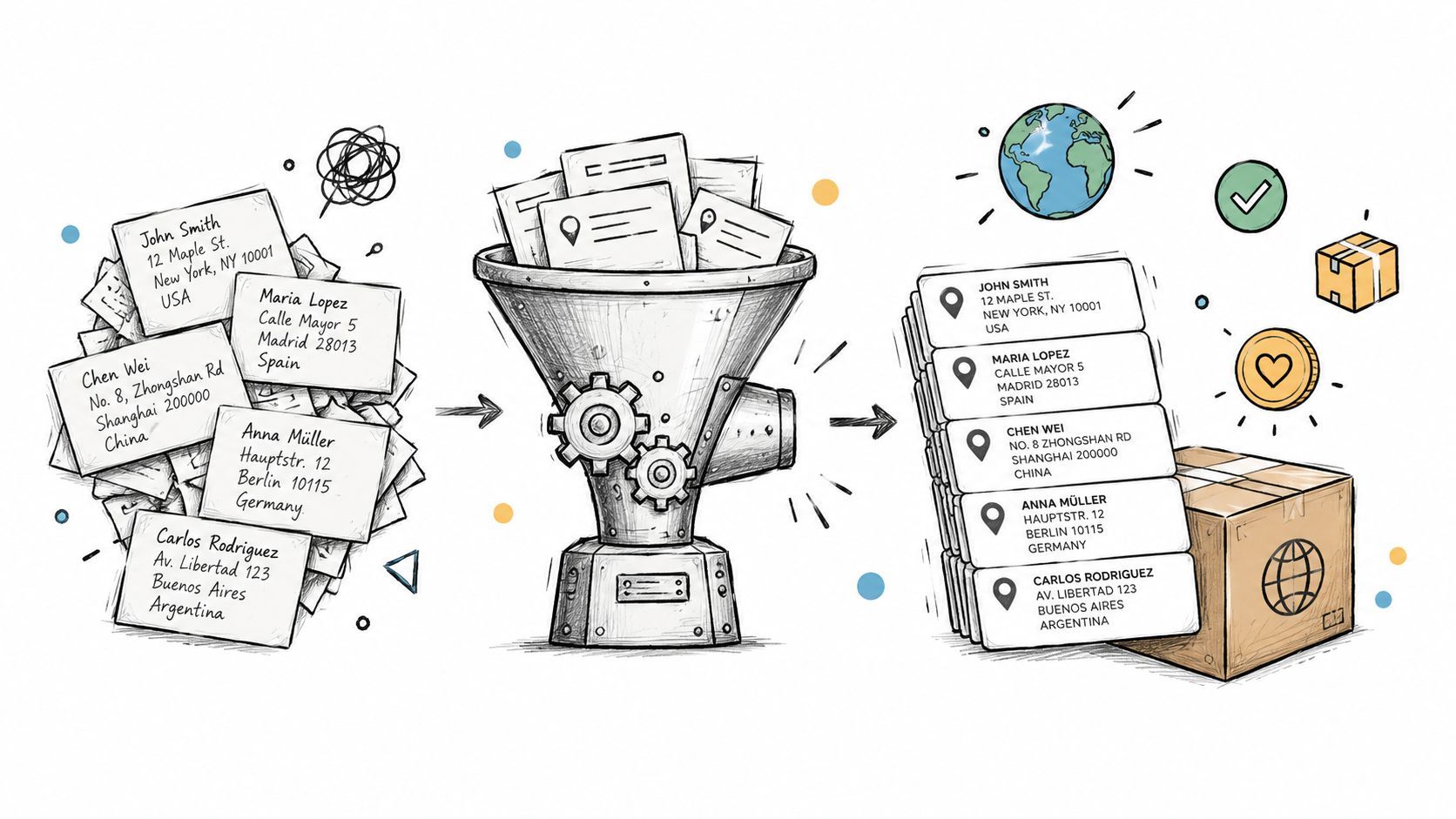
Discover how an address standardization tool cleans, validates, and normalizes backer addresses so crowdfunding creators ship rewards faster, cheaper
The campaign funded. The celebration lasted a day, maybe a weekend. Then work showed up in a CSV.
This is the point where a lot of creators learn that fulfillment problems don't start at the warehouse. They start when backers type shipping details on a phone, skip apartment numbers, switch between “UK” and “United Kingdom,” paste names into address lines, or enter something that looks close enough to a real address that nobody catches it until cartons come back.
An address standardization tool matters here because crowdfunding margins are usually fragile. One bad row can turn into a returned parcel, a support thread, a manual invoice fix, and a second shipment you didn't budget for. If you're also collecting late add-ons, taxes, and region-based shipping, messy address data spills into revenue too, not just logistics.
You export your survey data and the spreadsheet looks fine for about thirty seconds. Then the cracks appear.
One backer wrote “123 main st apt 4b brooklyn ny.” Another used all caps. A third entered a company name in the street field. Someone in Germany omitted the postal code. Someone in Japan used a local format your shipping team can't read at a glance. Two backers pledged twice and now you're not sure whether they wanted separate shipments or accidentally duplicated their order.

This is also when packaging decisions stop being aesthetic and start becoming operational. If you're quoting inserts, mailers, or retail-ready boxes, a supplier for Custom Printed Packaging, Personalised & Branded can help frame the unit economics. But none of that planning helps if the shipment never reaches the right door.
Kickstarter's post-campaign flow exists to collect fulfillment data. Its help center says creators can use a Pledge Manager or a Backer Survey, and the survey can collect mailing addresses, item variant preferences, shipping, and taxes through the post-campaign process when the survey is sent at launch of the pledge manager. That makes the address field one of the most consequential boxes your backer fills out, not an administrative afterthought. You can see how that fits into the broader post-campaign workflow in this guide on what to handle after your crowdfunding project ends.
Bad address data rarely arrives looking catastrophic. It arrives looking almost usable.
USPS has been treating standardization as an operational requirement for decades, not a cosmetic cleanup step. Its standards were built out of mail automation efforts dating back to the 1950s, and the Postal Service says standardized address information improves processing and delivery, reduces undeliverable-as-addressed mail, and lowers costs through greater efficiency in USPS Publication 28 background materials.
The expensive part isn't the typo itself. It's the chain reaction.
Creators often think the challenge begins when cartons hit the dock. In practice, handoff happens earlier, when raw survey entries become shipping-ready records.
Most creators hear “address verification” and assume one tool will solve everything. That's where avoidable mistakes begin.
A real address workflow has separate jobs. Validation asks whether the address is recognizable and deliverable. Standardization reformats it into the structure a postal authority expects. Deduplication checks whether two slightly different records belong to the same backer. Some tools add enrichment too, such as finer delivery coding or mapping context, but that still doesn't replace the other jobs.
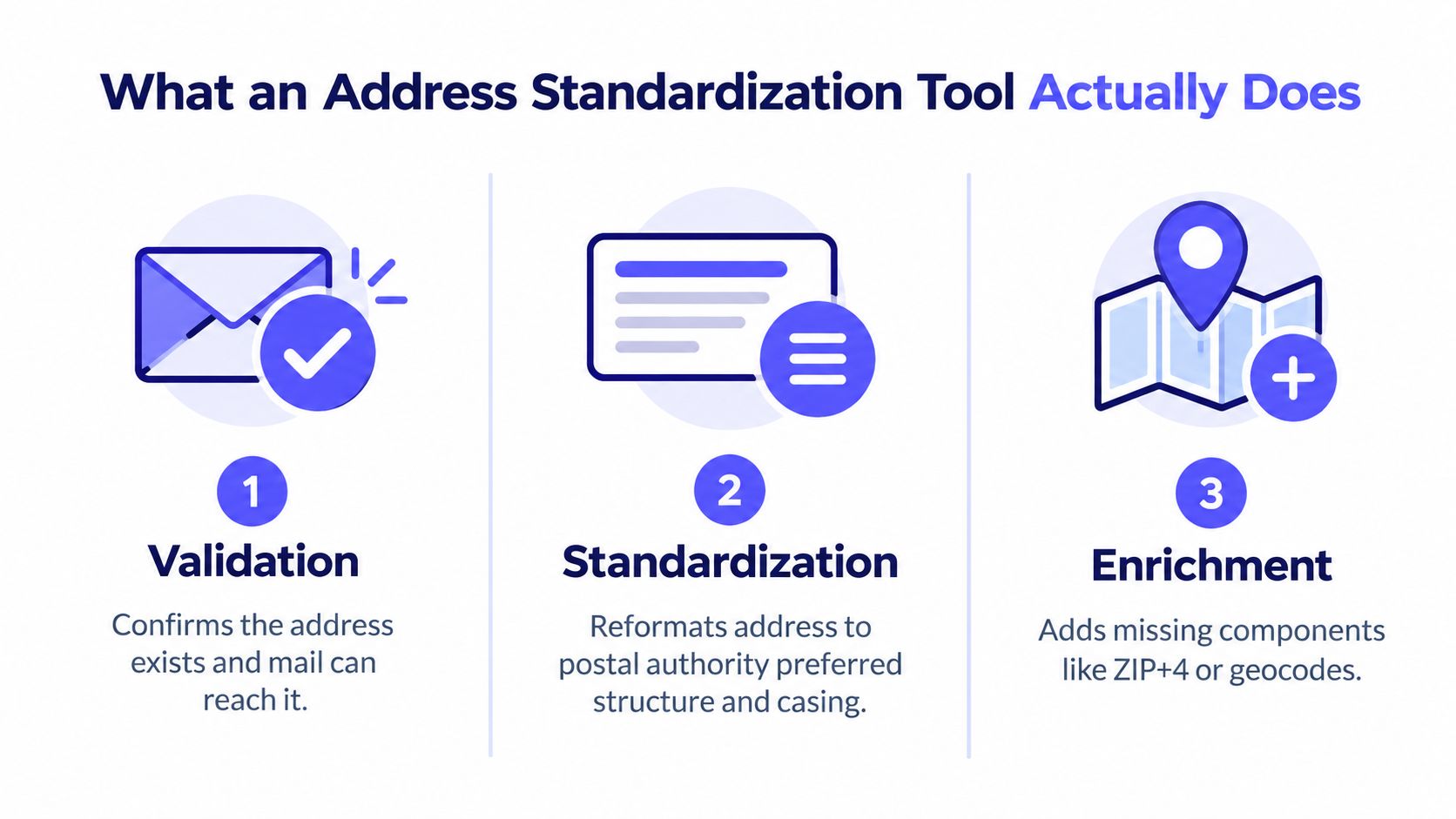
Take this survey entry:
123 main st apt 4b brooklyn ny
A standardization tool can change casing, abbreviations, line order, and field separation. It can split that string into street number, street name, unit, city, state, and postal code. USPS defines a standardized address as one that includes all required elements and uses Postal Service standard abbreviations, and says the Delivery Address Line and Last Line should be complete, standardized, and validated against the ZIP+4 and City State files in Publication 28.
Validation is different. The address might be cleanly formatted and still fail because the apartment is missing, the postal code doesn't match, or the delivery point can't be confirmed. USPS also states that complete addresses should be validated against ZIP+4 and City State files to obtain the finest delivery-point coding, which is why formatting alone doesn't get you all the way to deliverability in its standardized-address guidance.
Later in the workflow, a duplicate check might catch this row against “123 Main Street #4B, Brooklyn, NY” submitted under a second pledge.
Address parsing is the foundation. In a literature review of address-parsing research, an HMM-based large-scale parser achieved 95.6% F-measure on mixed-source data, and another benchmark reported that standardizing addresses before record matching raised address-field match accuracy from 68% to 91% across 1.2 million patient records in the reviewed research summary. That matters in crowdfunding because free-form survey input has to become structured data before any useful cleanup can happen.
Here's a short demo of how creators think about this in practice:
A lot of “address verification” products are really just one of these:
If your survey captures international addresses, the distinction gets sharper. The Universal Postal Union says S42 was designed to avoid custom parsing for each country, support a list of international address elements, and use country-based templates that can be tested systematically in the UPU addressing manual. In other words, a U.S.-centric cleanup tool may make your domestic rows prettier while still failing on the records most likely to create support tickets.
Creators often file address cleanup under admin. That's the wrong bucket. It belongs in margin management.
Every campaign has a set of costs that feel fixed until bad addresses expose how variable they really are. Reprints. relabels. replacement picks. extra support hours. carrier exceptions. customs delays tied to incomplete consignee information. None of those show up in your campaign page, but all of them hit after funding.
When address records arrive standardized and reviewed at the point of collection, fulfillment gets simpler in boring but valuable ways. The export maps more cleanly into warehouse software. Carrier labels need fewer manual edits. Zone and region logic works the way you priced it. Your team spends less time deciding whether a row is “probably fine.”
Kickstarter's own help documentation makes clear that the backer survey is where creators gather shipping and tax information in the post-campaign flow through the backer information workflow. If that data is weak, the cost impact shows up before the carton leaves your building.
Address quality also affects upsells and shipping pass-throughs. If a backer adds accessories, expansions, or late items, your platform needs the right country and destination logic at checkout. A wrong or incomplete address can break the shipping quote, undercharge the order, or trigger manual intervention right when the backer is most willing to buy more.
Operational reality: The cleaner the survey input, the more confidently you can automate shipping charges and add-on flows.
The marketplace-versus-storefront comparison is useful here. Shopify describes itself as a platform where merchants build their own online store, while Amazon is a marketplace. That difference explains why people say Shopify is like building your own storefront and Amazon is like listing inside a larger marketplace in Shopify's comparison of Shopify vs. Amazon. The same logic applies to post-campaign tools. Kickstarter pledge manager is the like Amazon and PledgeBox pledge manager is like Shopify. One feels platform-managed. The other is closer to a creator-controlled checkout and fulfillment environment.
| Address Quality Outcome | Operational Effect | Cost or Revenue Lever |
|---|---|---|
| Standardized domestic address | Cleaner label generation and fewer manual edits | Protects labor margin |
| Complete unit or apartment data | Fewer failed last-mile deliveries | Reduces reshipment cost |
| Correct country and region fields | Accurate shipping charge logic | Preserves pass-through revenue |
| Parsed duplicate backer records | Earlier merge or refund decision | Prevents duplicate fulfillment |
| Internationally normalized record | Better customs and export readiness | Lowers exception handling |
The point isn't that an address standardization tool makes fulfillment perfect. It reduces the number of expensive surprises that happen after your campaign has already spent most of its cash.
Tool selection goes wrong when creators buy for a feature list instead of a workflow. The right rubric is simple. Score the tool against the moments where your team handles address data.
If your backers are spread across North America, Europe, Asia, and Latin America, domestic formatting support isn't enough. The Universal Postal Union's address data materials say its Universal POST*CODE DataBase covers 192 member countries and 37 country territories and subdivisions, and is used for validation of international addresses. The same materials describe S42 as a generic list of address elements plus country-specific templates that software can use in address management, and ISO 19160 extends this work into terminology, quality, conceptual data models, and international postal addressing in UPU address data materials.
For a crowdfunding campaign, this means your tool should handle more than U.S. abbreviations. It should cope with country-specific field order, postcode logic, and script variation without forcing the backer into a U.S.-style form.
Batch cleanup after survey close is useful. It isn't enough on its own.
What works better is live in-form assistance plus export-time review. Backers make fewer mistakes when the form suggests structure while they type. Batch cleanup still matters for late fixes, imports, and external syncs, but it shouldn't be your first line of defense. A practical reference point is this guide to international address validation in crowdfunding workflows.
| Criterion | What to Look For | Crowdfunding Impact |
|---|---|---|
| International coverage | Country-aware templates, postcode logic, script tolerance | Fewer cross-border failures |
| Integration mode | Live form support, batch upload, export compatibility | Less manual cleanup |
| Survey UX | Autocomplete, mobile-friendly fields, country-specific forms | Higher completion quality |
| Pricing model | Clear billing for lookups, seats, or shipments | Better margin control |
| Privacy handling | Data retention controls, deletion options, processor clarity | Lower compliance risk |
Creators sometimes underrate UX because they assume serious backers will “just fill it out correctly.” They won't, at least not consistently.
Look for:
Per-lookup pricing can look cheap until you run retries, corrections, and support-side checks. Subscription pricing can be cleaner if your campaign has complex add-ons and a long survey window. Hidden fees become especially painful when you validate the same backer more than once across reminders and late pledge edits.
Privacy is just as practical. Addresses are personal data. If your process uses one tool to collect, another to clean, and a third to export, you've increased handoffs, retention questions, and deletion work. The less fragmented the workflow, the easier it is to manage.
Even a solid address standardization tool can fail if the rollout is sloppy. Most address problems I see are implementation errors, not software errors.
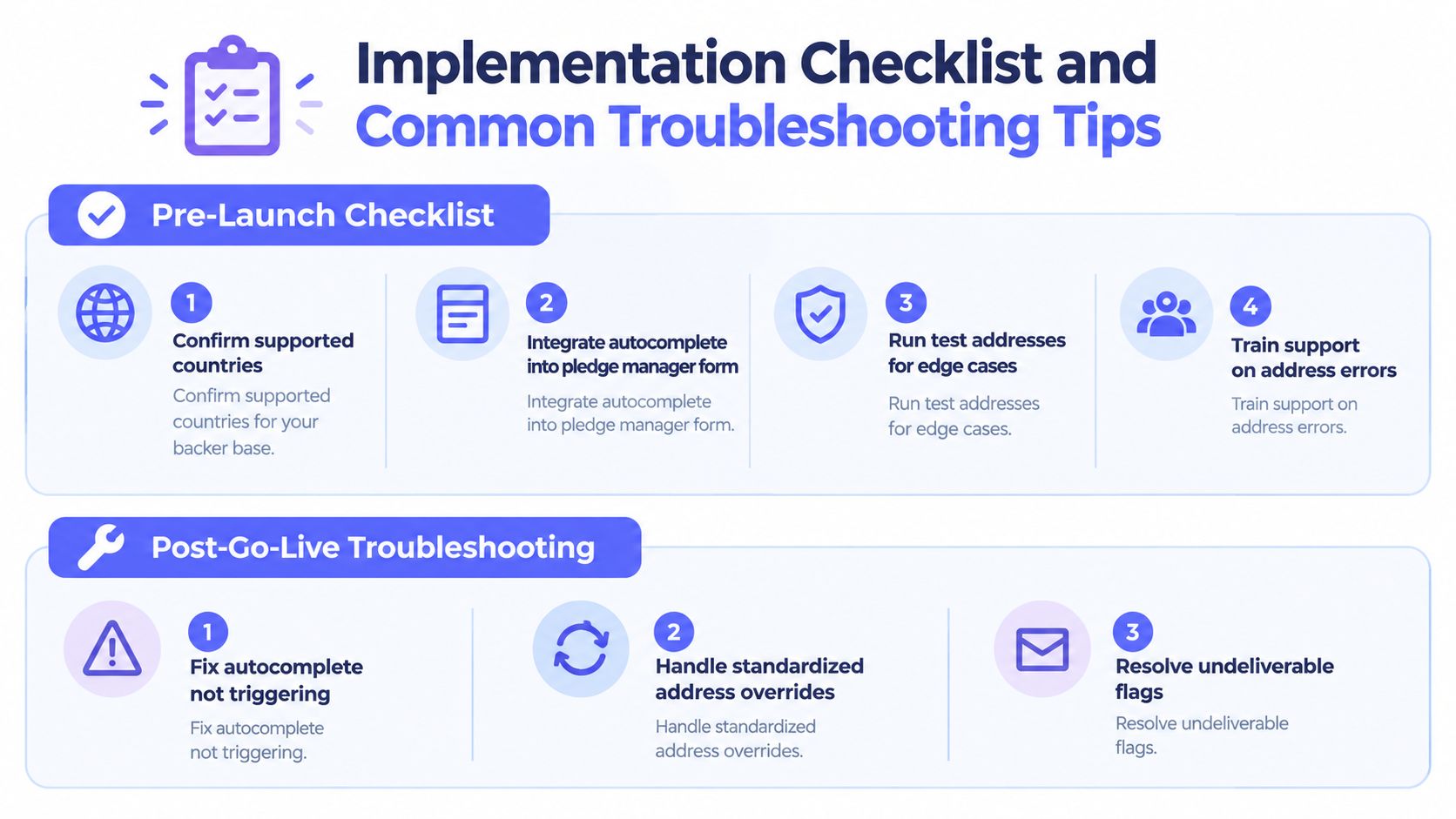
Before you open the survey, tighten the form.
A practical implementation pattern is to start with a form-level service and then review exceptions. Many creators use address suggestion layers similar to those described in Google Maps address validation for crowdfunding surveys because they reduce free-text chaos at entry time.
Don't let the form accept “close enough” data and expect ops to clean it later. Ops never gets that time back.
If rejection rates look high in the first days, inspect the form before blaming backers. The usual causes are simple.
| Problem | Likely Cause | What the team should do |
|---|---|---|
| Too many invalid addresses | Country selector buried or missing | Move country selection earlier and retrain support |
| Strange character errors | Field rules too rigid for local scripts | Create a manual review queue for affected regions |
| Deliverable addresses still fail validation | Data source mismatch or local formatting edge case | Approve by exception with notes |
| Duplicate address rows | Backer pledged twice or edited via multiple channels | Merge manually before export |
| Late address edits missing from files | Export timing mismatch | Lock a final cutoff and rerun export only once |
During survey open, review exceptions daily. Near cutoff, review them more often because that's when backers rush.
After cutoff, freeze edits, rerun your final export, and compare exception notes against the shipping file before releasing it to the warehouse. That last comparison catches a surprising number of manual mistakes, especially when support agents have been making one-off corrections in parallel systems.
The biggest difference between tools isn't just validation quality. It's where the address workflow lives.
Kickstarter's pledge manager sits in a more platform-managed world. That's useful for many creators, but it also means your post-campaign experience follows the platform's structure. PledgeBox pledge manager is closer to the Shopify side of the comparison. Kickstarter pledge manager is the like Amazon and pledgebox pledge manager is like shopify. The creator owns more of the branded survey, the add-on flow, and the downstream export logic.
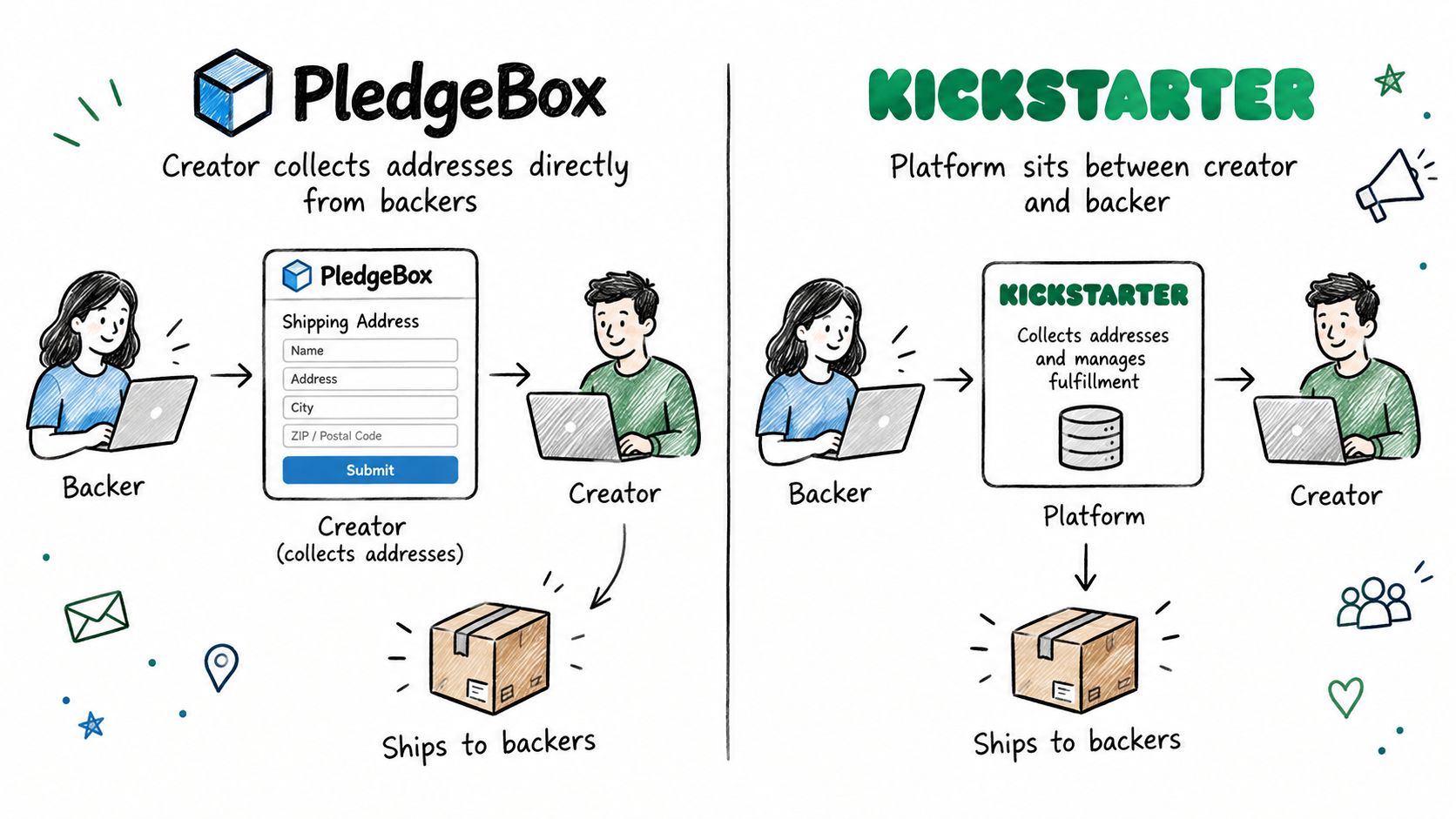
An address standardization tool works best when it sits inside the form where the backer is typing, not after the fact in a separate cleanup step. That means fewer handoffs, fewer exports, and fewer chances for one corrected record to get overwritten by an older one.
Kickstarter says the survey can collect mailing addresses, item variants, shipping, and taxes when the pledge manager launches in its backer survey setup guide. In practice, that makes the pledge manager the natural place to solve address quality, not a disconnected spreadsheet pass later.
PledgeBox is one option that places address collection inside the creator-side survey workflow, with live address checks as backers enter shipping information and the same dataset feeding add-ons, messaging, and exports. It's free to send the backer survey and only charge 3% of upsell if there's any. That structure matters because survey collection itself doesn't add a platform fee, while upsell revenue shares only apply if backers buy extras.
If your survey, upsell store, shipping collection, and address cleanup live in different tools, your team becomes the integration layer.
That's the trade-off. A separate batch-cleaning vendor may still be useful in some setups, especially if you inherit legacy files. But for most crowdfunding campaigns, the safer workflow is to catch address issues where the backer enters them and keep the corrected record tied to the same order record all the way to export.
A lot of teams stop measuring once tracking emails go out. That's too early.
Address work doesn't end at carrier handoff because the consequences don't end there. Returns, disputes, duplicate shipments, replacement requests, and support reopen rates all tell you whether your collection and standardization process worked. If you don't measure those, you won't know whether your next campaign needs a form redesign, better live suggestions, or a stricter cutoff.
Use a simple KPI table and attach an action to each metric. Even if you don't have mature reporting, you can still review campaign outcomes consistently.
| KPI | Target Range | Operational Action Triggered |
|---|---|---|
| Undeliverable-as-addressed rate | As low as possible and trending down campaign to campaign | Review form logic and validation exceptions |
| Return-to-sender cost per campaign | Stable or declining | Reprice replacement policy and support workflow |
| Chargeback ratio tied to address disputes | Near zero and investigated case by case | Save address change logs and delivery notes |
| Re-engagement conversion for corrected late addresses | Improving over time | Build reminder sequences before final lock |
| Per-backer shipping cost variance between clean and corrected records | Narrowing over time | Tighten country and postcode rules |
International delays are real, and external conditions do affect transit. For context on that side of the equation, the Cobra DTF 2026 guide is a useful operational read. But creators sometimes use carrier delays as a blanket explanation for parcels that were never set up cleanly in the first place.
What matters is separating transit risk from data-entry risk. If standardized records consistently perform better in your own exports and support queue, that's the signal to keep investing in the intake process.
The long-term payoff is simple. Better address data makes every other campaign metric more trustworthy, from shipping forecasts to repeat-backer retention by region.
If you want the address workflow to be cleaner before fulfillment starts, PledgeBox gives creators a pledge manager that collects shipping data, supports live address validation in the survey flow, and keeps that data connected to upsells, taxes, and export files. It's free to send the backer survey, and the platform only charges 3% on upsell revenue if backers buy add-ons, which makes it a practical fit for campaigns that need tighter control after funding closes.
PledgeBox
The All-in-One Toolkit to Launch, Manage & Scale Your Kickstarter / Indiegogo Campaign