 PledgeBox
Address Verification Form for Backer Surveys
Use this address verification form to confirm backer details before shipping, reduce failed deliveries, and keep your crowdfunding campaign running smoothly.

Use this address verification form to confirm backer details before shipping, reduce failed deliveries, and keep your crowdfunding campaign running smoothly.
Your campaign ended three weeks ago. The cartons are packed, your fulfillment partner wants a clean export file by Friday, and half your survey responses have addresses typed as one long line with no unit number, no postal code, or a city in the wrong field. That's the moment an address verification form stops feeling like admin and starts protecting your margin.
A stretch goal is reached, you add thousands of extra units, and shipping looks straightforward on a spreadsheet. Then week two of fulfillment brings the first reship requests, returned parcels, and backers asking why tracking stopped at a sorting depot. In most campaigns, address capture is where that damage starts.
An address verification form is cheap insurance because it catches errors while the backer is still in front of you. Once a parcel leaves, you're paying for replacement product, second postage, support time, and possible refunds to fix a typo that cost nothing to catch earlier.
Most guidance stops at postal validity, whether an address exists in a postal database. That isn't the same as delivery sufficiency, whether a driver can reach the right human in the right building. A verified street can still fail without a unit, dorm room, access code, or correct recipient name.
The scale is not theoretical. A USPS Office of Inspector General report found 6.6 billion pieces were classified as undeliverable as addressed in fiscal year 2014, representing 4.3% of total volume, in the USPS OIG report on undeliverable as addressed mail. For a creator shipping thousands of rewards, even a low single-digit error rate creates real exposure.
Practical rule: Treat a green verification tick as a starting point, not proof the parcel will arrive.
This is why verification belongs inside the backer survey, not in a cleanup spreadsheet later. With PledgeBox, sending the backer survey is free, and it only charges 3% on upsell revenue if there's any, so you're not buying a separate collection step just to validate addresses.
The same discipline applies beyond crowdfunding. Teams sourcing promotional products for election season face the same problem, since a campaign deadline doesn't move when a delivery address is wrong. Whether it's rewards or merchandise, the form has to do the work before anything ships.
Start with country. Every label, required field, postal code pattern, and address order below it depends on that choice. If country comes last, you've already forced a backer in Germany, Japan, or Brazil into a U.S. layout that doesn't fit.
This isn't just preference. The Universal Postal Union began developing international address standards in 2001 and approved standard S42 in 2002, later splitting it into generic components and country-specific templates, as described in the UPU overview of international addressing solutions. Your form needs that same country-aware structure.
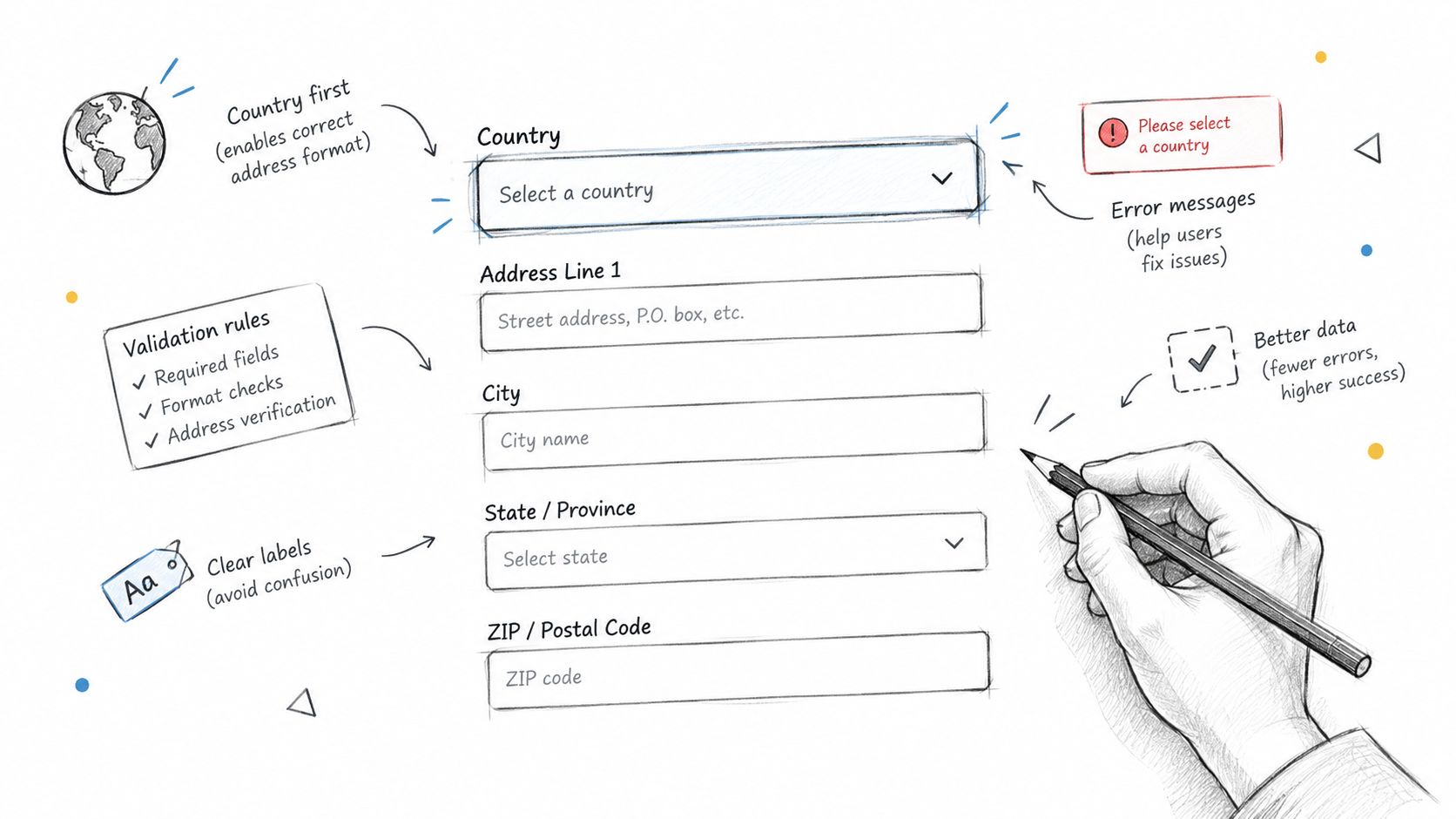
Take a hardware campaign shipping to backers in many countries. If unit is optional free text inside street line one, export sorting breaks, autocomplete overwrites local order, and your fulfillment partner can't reliably flag missing sub-premises. One field choice cascades into manual review for hundreds of orders.
Good form field validation practice for backer surveys keeps components separate so you can normalize, check, and export them without guessing. PledgeBox follows this country-aware pattern in its survey editor, which means you don't need a custom build to apply these rules.
The same logic shows up anywhere structured ordering matters. When teams order custom gear from Dirt Cheap Product, a clear order form prevents the production team from interpreting free text. Your backer form should give your shipper the same clarity.
Creators usually evaluate three categories, and they don't do the same job. Autocomplete speeds up typing. Verification checks a record. Delivery point validation checks whether mail can go to that specific point. Confusing those three is how teams overpay for speed and still ship to bad addresses.
Kickstarter's own tool helps frame the choice. Kickstarter describes its Pledge Manager as collecting addresses, reward preferences, taxes, and shipping after a campaign, with no upfront cost but usual fees deducted from payments made through it. Think of it this way. Kickstarter Pledge Manager is like Amazon, a built-in marketplace option. PledgeBox Pledge Manager is like Shopify, a separate storefront you configure around your campaign. Neither analogy tells you how deep the address check goes, so you still need to ask what the provider returns.
| Option | Best For | Limitations |
|---|---|---|
| Built-in pledge manager validation | Creators who want verification inside the survey without another subscription | Depth varies, so confirm what statuses you get back |
| Google Maps or Places autocomplete | Faster entry and fewer typos across many countries | A suggestion isn't proof of a deliverable point or correct unit |
| USPS-grade CASS-certified services | U.S. heavy campaigns needing ZIP+4 and delivery point coding | Strong in the United States, thin or irrelevant elsewhere |
For U.S. software, CASS certification is a useful benchmark. CASS-certified systems are tested for coding accuracy, including 98.5% minimum accuracy for five-digit ZIP, carrier-route, and ZIP+4 coding, according to Precisely documentation on USPS CASS certification requirements. That matters for a U.S. heavy tabletop campaign. It matters much less if half your backers are in Europe and Asia.
Don't buy coverage maps. Buy returned statuses you can act on, such as deliverable, missing unit, ambiguous, and unverifiable.
PledgeBox integrates Google Maps powered address validation into its survey flow, giving creators without a separate subscription a baseline check at collection. Match the tool to your backer geography first, then to volume. A mostly domestic campaign can lean on CASS depth. A global hardware launch needs broader country templates, local scripts, and confidence states, even if no single provider is equally strong everywhere.
Verification shouldn't be one API call behind a submit button. Run it as a staged workflow so the backer fixes problems while they still remember what they meant.
The five stages below show where each check belongs and why confirmation comes last, not first.
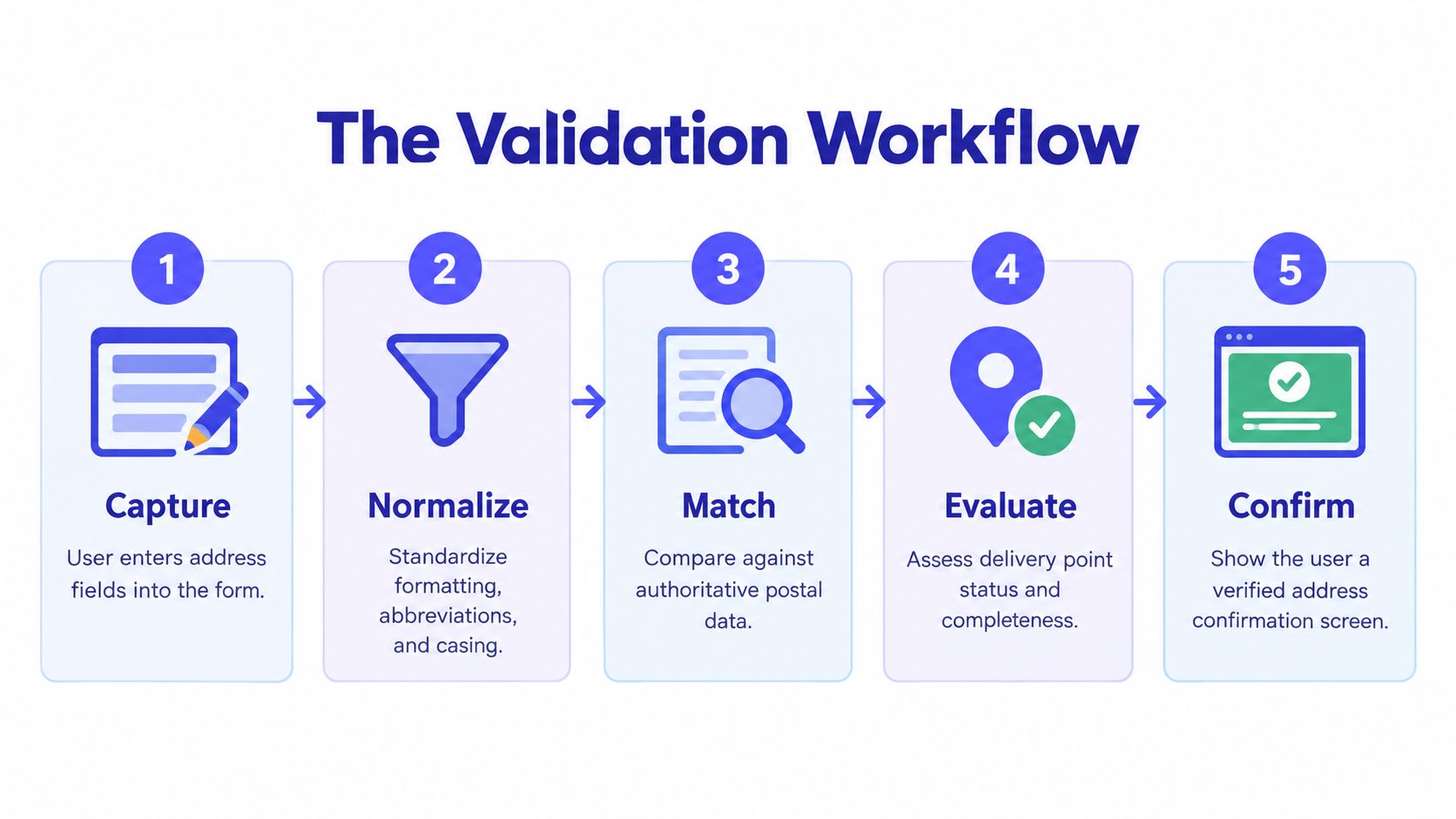
In the United States, Delivery Point Validation checks whether an address exists as an active delivery point, while basic range validation can accept a house number that falls in a street range but doesn't exist, as explained in USPS material on Delivery Point Validation. That distinction catches the address that looks right and still fails.
Read DPV style results in plain English. Y means confirmed, D means a missing sub-premise, S means a supplied secondary number isn't confirmed, and N means not confirmed. Don't accept D or S without question. Prompt for the apartment or unit, explain that the building matched but the unit didn't, and let the backer fix it.
This short walkthrough shows how a confirmation step can surface that problem without making the survey feel like an error page.
Always store two versions, the raw text the backer entered and the normalized deliverable version. Support needs the first to understand intent. Fulfillment needs the second to print labels. If you overwrite one with the other, you've lost either auditability or usability.
Operational point: A confirmation screen isn't friction for its own sake. It's the last cheap chance to stop a parcel shipping to a building with no unit attached.
A verified address can still be undeliverable in practice. Verification usually confirms a postal record. It doesn't prove the named person lives there, receives parcels there, or can be reached by your courier. That gap is where experienced creators lose money after trusting autocomplete.
The cost of that gap is documented. Poor address quality can reduce successful delivery rates by as much as 14%, while improving accuracy produced a median first-delivery improvement of 5.4%, according to USPS addressing standards material referenced for delivery performance. Database validity alone doesn't close that gap.
These are the cases your address verification form needs supplemental fields or human review to handle.
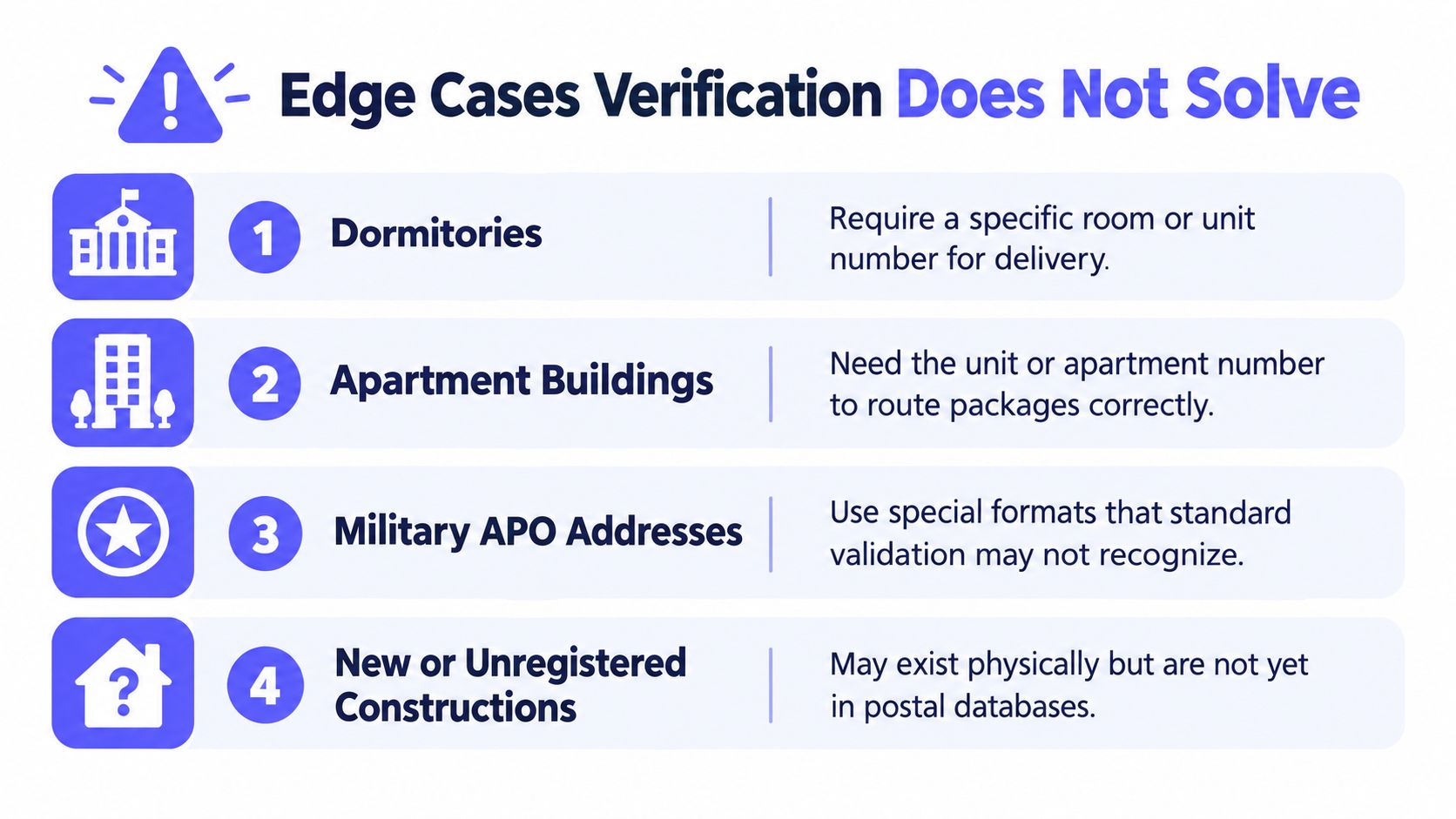
Collect supplemental delivery data narrowly. Ask for unit and access details where they're operationally relevant, and phone only when the carrier needs it. Don't turn an address form into a general personal data harvest.
Our guidance on international address validation for crowdfunding fulfillment goes deeper on country variation, but the operating rule is simple. Route ambiguous, unverifiable, and missing-unit cases to manual review before export. PledgeBox confidence states help you flag those cases for follow-up instead of discovering them after labels print.
Backers will give you a home address if they trust what you'll do with it. They get suspicious when a survey asks for phone, access codes, and extra identifiers with no explanation. Your form copy has to earn that data.
Don't silently overwrite what a backer submitted. Show the standardized version, explain what changed, and preserve the original alongside it. That protects the backer from a wrong unit substitution and protects you when support needs to reconstruct what happened.
For international campaigns, preserve local format and non-Latin scripts where your fulfillment chain can handle them. Transliteration can change meaning, drop diacritics, or turn a locally clear address into something a domestic courier can't read. If a carrier requires Latin characters, keep both versions and tell the backer why you're asking them to confirm the converted one.
Even mature systems shift. German address research found the share of deliverable addresses declined from 90.9% to 90.4%, cited in the UPU think tank brief on addressing and delivery. When no authoritative database exists for a country, don't fake certainty. Mark the address unverifiable, keep the backer's original text intact, and review it manually.
USPS makes the trust boundary clear in principle. Address verification can confirm mail delivery at an address, but it doesn't establish that the customer resides there or received the mail. Don't use survey address data for purposes backers didn't agree to.
Following data privacy best practices for creator surveys makes those choices easier to implement consistently. PledgeBox uses privacy-first data isolation and one-click erasure, which gives you a defensible process without inventing your own data handling policy from scratch.
Take a backer in São Paulo completing your survey on a phone. She selects Brazil first, so the form labels and postal code format adjust before she starts typing. She enters a street and building number, skips the apartment field, and submits.
Your address verification form matches the building but returns a missing-unit state. Instead of accepting it, the survey asks whether she has an apartment or unit number and shows the normalized address for confirmation. She adds it, confirms the cleaned version, and you save both her original entry and the canonical address.
The confidence state still flags the record for a quick human glance before vendor export because the unit was added after a prompt. Your VA clears it in seconds. That small pause is cheaper than a returned international parcel.
For creators learning the wider model, this breakdown of reward crowdfunding for creators is useful context on why fulfillment promises shape backer trust long after funding ends. Address quality is part of keeping that promise.
None of this requires a separate paid collection step. PledgeBox's pricing page states that sending a backer survey is free, with only 3% charged on revenue generated through survey-based upsells including add-ons, shipping fees, and tax or VAT. If there's no upsell revenue, there's no survey fee to recover.
Build your next backer survey with country-aware fields, address validation, and confidence flags that keep ambiguous addresses out of your fulfillment export. PledgeBox lets you send that survey free and only charges on upsell revenue, so you can fix delivery data before postage turns a typo into a reship.
PledgeBox
The All-in-One Toolkit to Launch, Manage & Scale Your Kickstarter / Indiegogo Campaign