 PledgeBox
Floating Mug Shark Tank: What Really Happened After the Deal
Curious about the Floating Mug Shark Tank deal? Discover the full story, from its promising start to why it failed, and learn key post-campaign lessons.
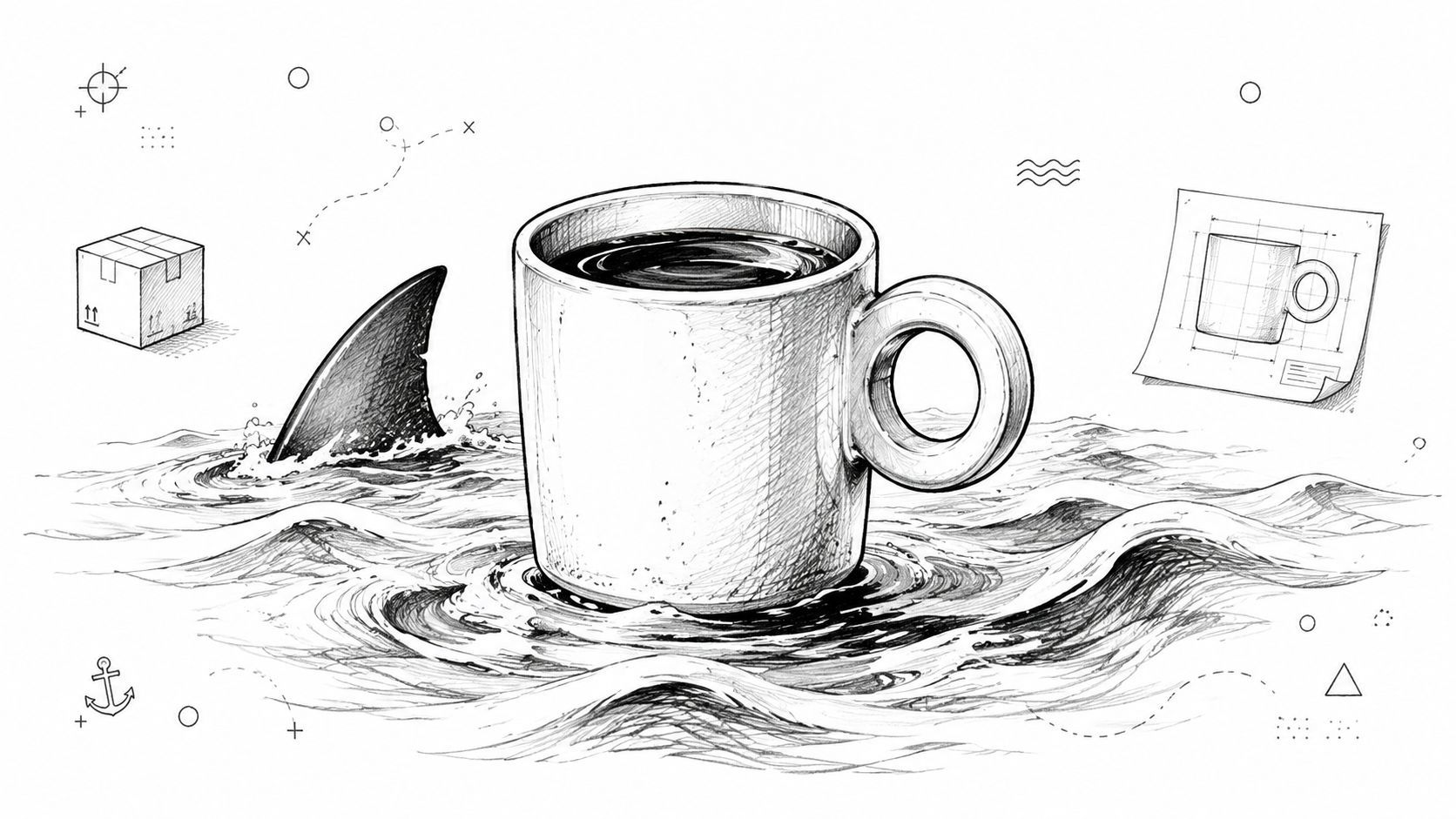
Curious about the Floating Mug Shark Tank deal? Discover the full story, from its promising start to why it failed, and learn key post-campaign lessons.
A coffee mug walked onto Shark Tank, appeared to hover above the table, and made the room stop. Years later, the more interesting part of the Floating Mug story isn't the visual trick. It's how a product with obvious appeal, TV exposure, and early demand still disappeared.
The first time many viewers saw the Floating Mug, the reaction was immediate. It looked like a magic prop, but it solved an ordinary problem. The handle doubled as a built-in coaster, lifting the mug slightly off the surface so it wouldn't leave a ring behind.
That's why the product stuck in people's memory. It wasn't only clever. It was the kind of object that felt easy to demonstrate, easy to gift, and easy to picture on a kitchen counter or office desk. For founders in consumer products, that kind of instant comprehension is rare.

For café owners, that immediate visual hook matters too. A signature mug can become part of the customer experience, which is one reason practical resources like Afida's coffee shop guide are useful when thinking about product presentation, merchandising, and what customers remember.
The Floating Mug fit television perfectly because the demo did the selling. No long explanation was required. A founder could set it down, let people stare for a second, then explain the function.
That combination matters because many products have one of these strengths but not both:
A strong launch product often wins attention in seconds. The hard part starts after that, when orders, packaging, and delivery all have to work at the same time.
That's what makes the floating mug Shark Tank story so compelling. The product looked tailor-made for retail, social sharing, and impulse buying. It had the sort of validation founders chase for years.
Yet the company is now gone.
That gap between promise and outcome is where the key lesson sits. The rise was visible on television. The fall happened in operations.
On television, Tigere Chiriga looked like the kind of founder investors hope to see. He was not selling a napkin sketch or a novelty with no proof behind it. He walked into the tank asking for $75,000 for 15% equity, a valuation that suggested he believed the Floating Mug had already crossed from invention into business.

That distinction mattered. Plenty of Shark Tank pitches rise on excitement alone. Chiriga came in with sales, a price point, and a manufacturing story that sounded more mature than the product's novelty might suggest.
The strongest part of his case was not the visual trick. It was the margin story.
During the pitch, Chiriga said the mug sold for $29.99 and that he had cut production from a $12 landed cost to about $4, a shift that made the company sound far more investable than a one-hit gift item. In company materials on Fundable, the handle was also presented as sturdy enough to support the weight of a half-gallon of water, while the business outlined plans for a 19,500-unit production run and a retail target of $19.99.
A Shark listening to that pitch could hear four encouraging signals at once:
| Signal from the pitch | Why it mattered |
|---|---|
| Existing sales | Showed customers were already buying |
| Lower landed cost | Suggested healthier margins |
| Strength claim on the handle | Helped answer durability concerns |
| Large planned production run | Showed intent to scale beyond a novelty launch |
That combination helps explain why Lori Greiner made sense as a partner. Her reputation rested on turning visual consumer products into repeat retail sellers, and the Floating Mug looked built for that machine. It photographed well, demonstrated instantly, and had a founder who could talk about unit economics instead of only design.
The pitch still holds up as a TV moment:
What makes the segment more interesting in hindsight is what it did not prove. A lower landed cost is encouraging, but it does not confirm a company can manufacture consistently, pack fragile goods at scale, or keep delivery promises once attention spikes. Crowdfunding creators and product inventors run into that gap all the time. They solve for demand first, then discover too late that fulfillment is a separate business.
So the Lori Greiner handshake meant something. It validated the product, the founder, and the sales story on camera.
It did not solve operations off camera.
For a brief window, the Floating Mug looked like the kind of Shark Tank story that writes itself. A founder leaves the set with a Lori Greiner handshake. Viewers search for the mug, share the clip, and picture the product on store shelves by the holidays. On television, that arc feels almost automatic.
Off television, it rarely is.
The period after an episode airs can be the most deceptive stage of a product business. Attention arrives first. Systems arrive later, if they arrive at all. A small company can look much larger than it is while orders stack up, customer emails multiply, and fragile processes get tested all at once. That gap between public excitement and private capacity has wrecked more than one crowdfunded invention, including projects that looked unstoppable in their first burst of publicity. The pattern showed up in other buzzy launches too, as seen in the Air Umbrella Kickstarter postmortem on crowdfunding fulfillment problems.
The expectation after the episode was straightforward. A product this visual, paired with Lori Greiner, should have had a clean path into broader retail and repeat sales.
Instead, the post-show story grew murkier. Later coverage described a business that faded from public view. The website went offline, the mugs were no longer available on Amazon, and, as The Daily Meal later reported, there was no public sign that the Lori Greiner deal ever materialized.
That matters because the handshake created a perception of certainty. Customers see validation. Founders feel momentum. But a televised deal is still the start of another process, one that includes diligence, manufacturing follow-through, packaging discipline, and dependable shipping.
The handshake on television is one moment. The real company has to survive every moment after it.
The Floating Mug case is useful because the warning signs were never likely to appear in the pitch itself. A founder can prove people want the product and still run into trouble once the work shifts from selling to fulfillment. Ceramic drinkware is fragile. Packaging has to protect the illusion and the object. Shipping costs can change the margin story quickly. A delay that looks minor on a spreadsheet can turn into refund requests and lost trust in real life.
That middle chapter often gets skipped in startup storytelling. The camera catches demand. It rarely catches the warehouse, the breakage report, or the late-night email thread about missed delivery dates.
For a while, hype can hide those problems. It cannot fix them.
A founder can survive a quiet launch. Surviving success is harder.
The Floating Mug looked like the rare consumer product that had already cleared the first brutal test. People instantly understood it. They wanted it on their desks, in gift boxes, and in Instagram photos. The trouble seems to have started after that moment, when the company had to do the unglamorous work of turning fascination into repeatable delivery.

One detail from the company's later chapter matters more than the Shark Tank handshake. As noted earlier, the business later returned to crowdfunding with a glass version and still appears to have run into packaging and shipping problems.
That shifts the story. Lack of interest does not seem to be the cleanest explanation. People were still willing to back the idea. The harder problem was delivering a fragile, design-driven product at a level that kept customers confident.
The pattern looks familiar to anyone who has watched a hardware or design brand stumble after a splashy launch.
The product wins attention fast
The Floating Mug had a built-in demonstration. One glance explained the appeal.
Operations become the core business
After orders arrive, the work changes. Sourcing, protective inserts, carton strength, breakage rates, customer emails, and replacement shipments start deciding the company's future.
Delays change the customer relationship
Early buyers may forgive a wait. They forgive silence and damaged shipments far less often.
Sales channels begin to disappear
Once a company falls behind, every missed delivery can trigger refunds, support costs, and weaker word of mouth. Over time, the storefront goes quiet and the brand slips out of view.
That same arc appears in other crowdfunding failures. The Air Umbrella Kickstarter postmortem on missed post-campaign execution shows how a product can generate real excitement and still collapse once manufacturing and fulfillment start slipping.
Practical rule: Early demand proves people want the idea. It does not prove the company can ship it reliably.
A mug is not forgiving. A floating mug is even less forgiving because the product has to arrive intact and still feel magical when the box opens. A glass version raises the stakes again.
That is where many crowdfunded products break down. Packaging is treated like a final detail, even though it sits at the center of cost control and customer trust. If the insert is weak, units arrive broken. If units arrive broken, replacements eat margin. If replacements pile up, support volume rises and delivery dates slide. A business that looked healthy on launch day can get pinned down by damage claims a few weeks later.
The Floating Mug remains a useful case because the front end worked. The audience was there. The design had pull. What appears to have failed was the system behind the product, the part customers never see until it misses a deadline.
Crowdfunding creators often think the campaign is the mountain. It isn't. The campaign is the promise. Fulfillment is where the company proves it can keep that promise.
The Floating Mug story is a clean example of what happens when a product wins attention before the back-end operation is ready for stress. That doesn't make the launch a mistake. It means the founder solved the front-end problem first and got trapped by the back-end one later.

Post-campaign operations are full of details that look administrative until they start causing delays:
A lot of creators learn this too late. They focus on launch assets, campaign copy, and stretch-goal excitement, then treat surveys and fulfillment as paperwork.
There's a useful analogy here. Kickstarter's native pledge manager is like Amazon. It's convenient and standardized. A dedicated pledge manager is more like Shopify. It gives creators more control over branding, logic, add-ons, and the post-campaign customer experience.
That matters when a project has complexity. If you're managing shipping details, late pledges, upgrade paths, and backer communication at the same time, the system you choose shapes how many errors your team has to clean up by hand.
For teams comparing options, it helps to study what crowdfunding fulfillment services are supposed to support after the campaign closes, especially when product variations and shipping coordination start to pile up.
Crowdfunding doesn't end when funding closes. That's when operational credibility begins.
For founders evaluating tools, one practical detail stands out from the publisher brief for this article. PledgeBox is free to send the backer survey and only charges 3% of upsell if there's any. That pricing model changes the risk calculation for creators who need more control without adding upfront survey costs.
The broader lesson is bigger than any one tool. If your campaign succeeds, your business turns into an operations business overnight. Founders who plan for that shift have a better chance of surviving it.
The Floating Mug is easy to remember because the product was smart. It should also be remembered because the company's disappearance teaches a harder lesson than the pitch ever could.
A founder can have a product people understand instantly. He can generate sales, improve unit economics, attract national attention, and still lose the business if fulfillment keeps slipping. That's the main takeaway from the floating mug Shark Tank story.
The useful blueprint looks like this:
If you're building a hardware or design-led product, the smartest move is to assume success will create new problems. Then build the systems before the attention arrives.
A practical place to start is a post-campaign operations checklist like this after-the-crowdfunding-campaign guide, because the companies that last usually plan the boring parts earlier than everyone else.
The Floating Mug didn't fail for lack of imagination. It failed, as many promising products do, in the gap between being wanted and being delivered.
If you're preparing for that post-campaign gap, PledgeBox is built to help creators manage it with less friction. It handles backer surveys, shipping data, upsells, and fulfillment workflows in one place. Backer surveys are free to send, and PledgeBox only charges 3% on upsell revenue if there's any, which makes it a practical option for teams that want more control after funding without adding upfront survey fees.
PledgeBox
The All-in-One Toolkit to Launch, Manage & Scale Your Kickstarter / Indiegogo Campaign