 PledgeBox
VAT Tax Example: Calculating VAT on Crowdfunding Pledges
Work through a clear VAT tax example for a €100 crowdfunding pledge with shipping, plus rates, import rules and who collects the tax.
Work through a clear VAT tax example for a €100 crowdfunding pledge with shipping, plus rates, import rules and who collects the tax.
Your campaign closed on a high, the pledge manager is open, and you're staring at the tax field wondering what number belongs there. A backer in Dublin pledged €100 for the reward, shipping is €20, and the survey wants to know whether to add VAT on top, fold it in, or leave it for the courier to sort out at the door. Get it wrong and you either eat the tax out of your margin or hand a supporter a surprise bill weeks after they thought they'd paid.
Most VAT explainers stop at "price times rate" and never touch the parts that decide the answer: who imports the parcel, which country's rate applies, and who is legally on the hook for remitting the money. This VAT tax example walks the whole receipt, line by line, then follows the parcel to the door.
The backer pays €147.60. That's the finished number, and every cent of it comes from four lines you can rebuild yourself. Take a €100 reward, €20 of shipping charged to the backer, and Ireland's 23% standard rate used for this example.
Here's the full calculation, including the mistake most creators make on their first survey.
| Line item | How it is calculated |
|---|---|
| Reward price (net) | Price before tax: €100.00 |
| Shipping charged to backer | Added to the taxable base: €20.00 |
| Taxable base | €100 + €20 = €120.00 |
| VAT at 23% | €120.00 × 0.23 = €27.60 |
| Total backer pays | €120.00 + €27.60 = €147.60 |
| VAT if shipping is left out | €100.00 × 0.23 = €23.00 |
| Understated by leaving shipping out | €27.60 minus €23.00 = €4.60 |
You only need three, and they're the same three whether you're pricing a board game or a gadget.
That third formula is the one people skip, and it's the one that saves you from taxing a price twice. If you've already quoted a VAT-inclusive figure, dividing by 1.23 tells you what's net and what's tax. Multiplying that same inclusive figure by 0.23 again invents tax that nobody owes.
When you charge the backer for shipping as part of the sale, that charge normally rides along with the goods for VAT purposes. The tax base is what the backer pays you for the transaction, not just the sticker price of the reward.
Leave shipping out and you calculate €23.00 instead of €27.60. The backer's receipt shows a €4.60 gap, and depending on how your survey is configured, that gap comes out of your fulfilment budget or out of a second charge the backer didn't expect.
Practical rule: multiply your taxable base by the rate and check the result against the VAT line to the cent, then check that base plus VAT equals the amount the survey actually charges.
Run that two-part check on a single test order before you send anything to your backer list. If the base times the rate doesn't match the VAT line, your shipping or add-on settings are sitting outside the taxable amount. If the total doesn't match the charge, something is being rounded or applied twice, and you want to find it while it's still one test order instead of several thousand live ones.
The rate follows the backer's delivery country, not yours. A creator in Berlin shipping to Budapest charges the Hungarian rate, and a creator in Austin shipping to Madrid charges the Spanish one. Your own country's rate is irrelevant to that parcel.
To make the difference concrete, here's the same €120 taxable base run through the standard rates commonly quoted for these destinations. Treat it as a worked comparison, not a filing reference.
| Destination country | Standard rate | VAT on €120 | Total backer pays |
|---|---|---|---|
| Luxembourg | 17% | €20.40 | €140.40 |
| Germany | 19% | €22.80 | €142.80 |
| France | 20% | €24.00 | €144.00 |
| Netherlands | 21% | €25.20 | €145.20 |
| Spain | 21% | €25.20 | €145.20 |
| Italy | 22% | €26.40 | €146.40 |
| Ireland | 23% | €27.60 | €147.60 |
| Hungary | 27% | €32.40 | €152.40 |
The same reward costs a Luxembourg backer €140.40 and a Hungarian backer €152.40. That's a €12 difference on identical goods and identical shipping, created entirely by the destination. If you publish one flat "international price" on your campaign page, someone is either overpaying or you're absorbing the difference.
This is why per-country tax rules in a pledge manager matter more than a single global percentage. Set the rate by destination, let the backer's address pick it, and the arithmetic sorts itself out.
Not every reward is a standard-rated product. Under the EU's VAT framework in force since April 2022, Member States may apply reduced VAT rates as low as 5% to eligible goods and services, according to the European Commission's VAT rates guidance. A printed book bundled into a tabletop campaign can sit in a different bracket from the plastic miniatures shipped in the same box.
Rates also move. Governments change them in budgets, and a table like this is a snapshot for arithmetic practice rather than a live rate feed.
Verify the current rate with the destination country's tax authority before your survey goes live, and re-check it if fulfilment slips by several months.
The cheapest insurance is a test backer per destination country. Create one order for each of your main markets, walk it through the survey, and compare the VAT line against the rate you expect. Ten minutes of testing catches a mis-set country rule that would otherwise repeat across every order in that market.
Arithmetic is the easy half. The half that generates angry comments is the parcel arriving from outside the EU with a tax demand attached to it.
For EU-bound low-value goods imported from outside the EU, the Import One-Stop Shop (IOSS) can be used for consignments valued at up to €150, and VAT is collected at checkout rather than from the backer upon delivery, as set out in the UK government's VAT Import One-Stop Shop registration guidance. Without IOSS or an equivalent compliant process, the backer can face VAT collection and handling at import, which means a second payment and a parcel sitting in a depot until they pay it.
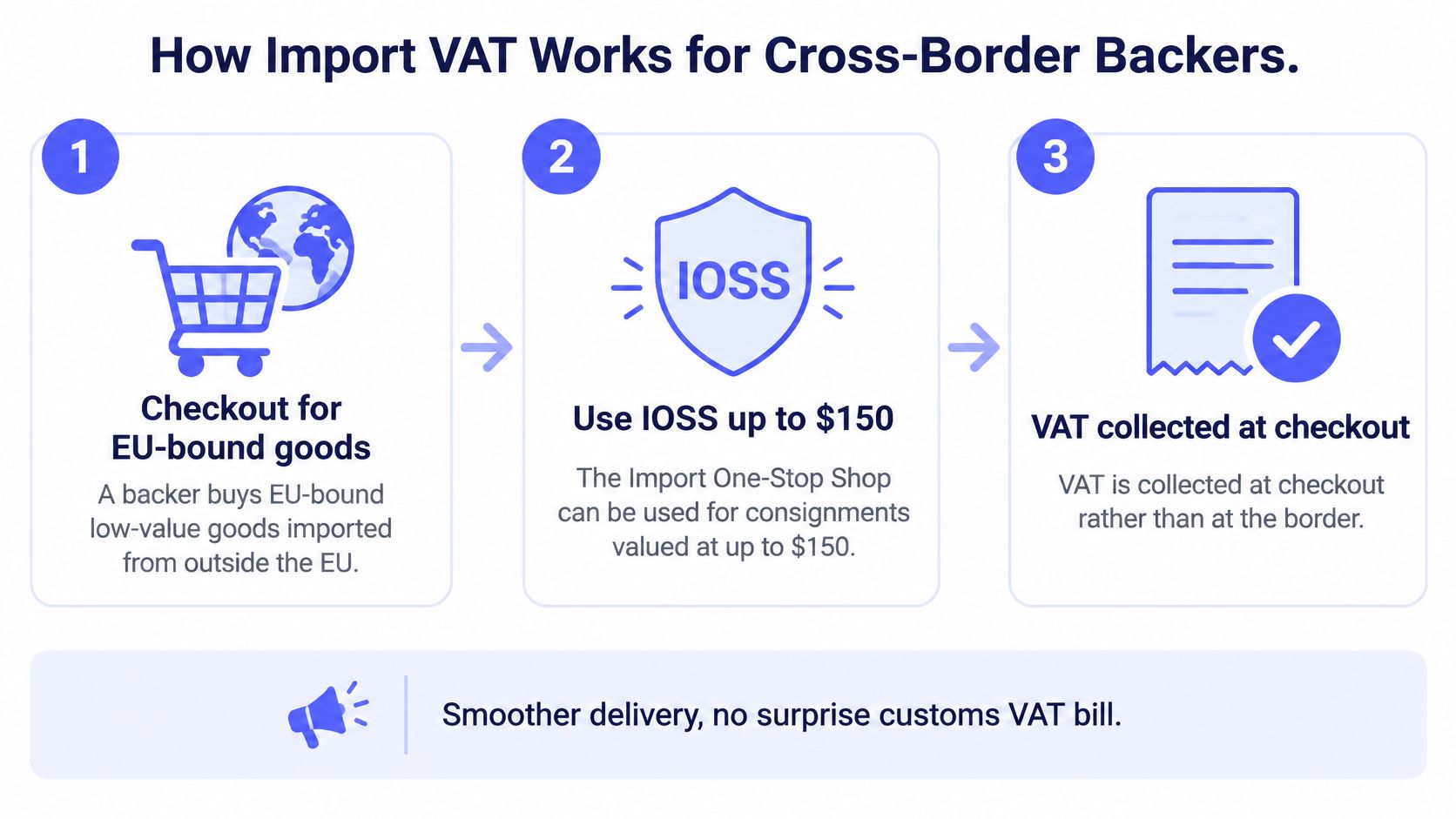
Step five is the one creators skip. It's also the only step you control after the money has been collected.
The EU IOSS ceiling is €150 per consignment. The UK operates a separate £135 threshold in its own guidance. They're different currencies, different regimes, and different numbers, and mixing them up is a common cause of mispriced UK pledges.
The threshold applies to the consignment, not the pledge. Say a backer orders three rewards and you ship them together in one box: the combined value can push the shipment over the ceiling even though each item is comfortably under it. Split fulfilment across warehouses does the reverse, turning one pledge into several consignments that each need their own assessment. Our guide to international shipping fees for crowdfunding fulfilment covers how those split routes affect what you charge.
Put money on it. A €120 EU-bound consignment sitting under the IOSS ceiling collects €27.60 at checkout, and the parcel arrives with nothing further owed. The same parcel arriving without IOSS is met by a €27.60 customs demand plus a carrier handling fee, say €10 to €15 in this scenario, so the backer pays well above the checkout price and waits days longer.
Some creators solve the structural side by establishing an EU entity to anchor registrations and fulfilment. If that's your situation and you're based outside Ireland, Chern & Co (RegisterCompany.ie) explains how to set up a company in Ireland from abroad, which is worth reading before you commit to a warehouse location. Confirm the registration and intermediary requirements with a tax adviser for your specific structure, because entity location alone doesn't settle who owes the VAT.
The party that takes the money isn't always the party that remits the tax. That single sentence resolves most of the confusion creators have about platforms and pledge managers.
Irish Revenue's deemed supplier guidance states that, in qualifying cases, an electronic interface assumes the conventional supplier's VAT obligations, including collection and remittance, with examples including imported consignments with an intrinsic value not exceeding €150 and certain sales by non-EU suppliers. The role depends on what the interface facilitates and where the underlying seller is located, so a payment processor sitting behind your survey doesn't automatically become the supplier for VAT purposes.
| Party | Typical VAT role | What the creator should verify |
|---|---|---|
| Creator | Sets prices, keeps records and files where registered | Which registrations and invoices you owe |
| Pledge manager (PledgeBox) | Calculates and collects VAT in the backer survey | Its collection does not by itself mean it files or remits |
| Marketplace or platform | May act as deemed supplier in qualifying EU cases | Whether the interface facilitates the sale |
| Carrier | Delivers the parcel and may collect import charges | Whether duties and VAT are prepaid |
| Tax representative | Handles registration where local law requires one | Whether the destination country requires it |
Our tax calculation and collection settings do not by themselves mean we file or remit taxes for you. We calculate the amount from the backer's location and collect it with the order. The registration, the return and the payment to the tax authority stay with whoever holds that obligation under the rules above, and our walkthrough of sales tax collection in a pledge manager shows where the collection settings sit in that chain.
Even where a platform collects, you still need invoices that show the right rate and base, registrations in the countries where you owe them, records you can produce on request, and a process for correcting an order that was taxed wrongly.
Keep backer-level records, not just totals. For each order you want the delivery country, the taxable base, the rate applied, the VAT amount, and whether the consignment fell inside an import scheme. When a tax authority asks a question eighteen months after fulfilment, a campaign-level sum won't answer it. Ask a tax professional in each of your main destination countries to confirm your specific position, and give them that order-level export rather than a summary.
A Kickstarter pledge manager works like a marketplace checkout. The platform runs that checkout, so the creator has less to configure. PledgeBox works more like a store the creator sets up, including tax rules, shipping, add-ons and survey payments. The analogy is useful for one reason only: it shows where the configuration work sits. Before promising a tax-inclusive price, know which model you are operating and what the survey will charge.
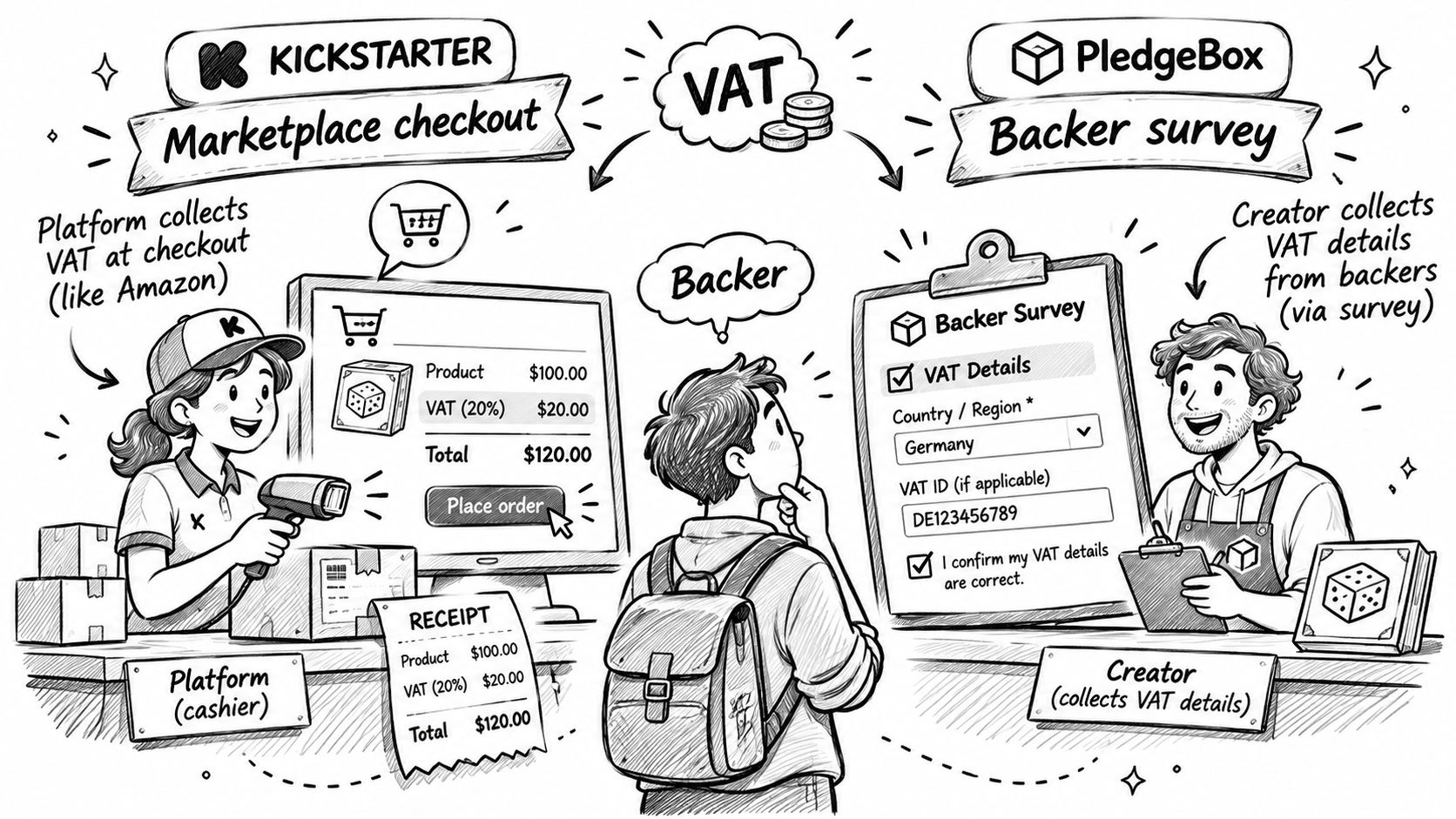
Read that sequence like a receipt. The pledge on Kickstarter or Indiegogo sits in one column. Anything paid in the survey sits in another. The delivery address decides the VAT line, the shipping choice decides the shipping line, and any add-on or reward upgrade adds its own amount. Get Invoice belongs to the survey column, not to the whole campaign history.
An invoice is only available for payments made through PledgeBox. A payment made only on Kickstarter or Indiegogo doesn't qualify for a PledgeBox invoice, so a backer who paid their pledge on the platform and nothing in the survey won't find a downloadable document in their portal.
That matters for business backers who need a VAT invoice to reclaim the tax. Tell them plainly in your survey copy: the invoice covers what they paid through the survey, and their platform receipt covers the original pledge. Put the instruction in the survey confirmation email, because a missing invoice turns into support mail quickly.
On cost, sending the backer survey is free when it only collects addresses and product choices without additional payment. Payments collected through surveys carry the standard platform fee, including add-ons, shipping and tax, and shipping-only or tax-only payments also carry that collection fee. Payment-provider processing fees are separate, and those fees can vary by account, country, payment method and currency. PledgeBox uses a simple flat rate for its own platform fee, while payment-provider fees stay in the creator's receiving account.
The expensive mistake is quoting a VAT-inclusive price and then adding VAT again. Take the €147.60 inclusive total from the worked example and apply 23% on top: you get €181.55, which overcharges the backer by €33.95. Nothing in the survey flags it, because both numbers look like plausible prices. Only the divide-by-1.23 check catches it.
The second error is quieter. Rounding VAT per line instead of per order leaves a cent-level gap between the survey charge and the invoice, and at a few thousand backers those cents turn into a reconciliation job nobody budgeted for. Pick one rounding point, apply it consistently, and make sure the invoice uses the same one.
Steps one and five are the ones creators skip when they're tired, and they're the two that catch the errors above. A test order that produces a correct invoice proves your rates, your base, your rounding and your document template in a single pass.
Sending the backer survey is free, and the fee applies only to what the survey collects. PledgeBox's pricing page states that surveys collecting no additional payment have no platform collection fee and there's no campaign fee on the original Kickstarter or Indiegogo funds, while the standard platform fee is 3% of additional payments including add-ons, upgrades, shipping and tax, so $25,000 in eligible upsell revenue would produce a $750 fee.
There's no financial reason to postpone the test. Set up one survey with your real tax and shipping rules while the campaign is still live, run a single backer through it in your largest EU market, and read the invoice against the arithmetic. Fixing a rate now is a settings change. Fixing it after fulfilment is a refund queue.
We built PledgeBox to handle the parts of this that shouldn't be manual: per-country tax and VAT rules, automatic calculation from each backer's address, shipping and add-on collection in one charge, and invoices your backers can download themselves. Sending the backer survey is free and we only charge 3% of upsell if there's any, so you can configure your rates and run a test order in every destination country before you spend a cent. Set up your survey at PledgeBox and check that VAT line to the cent before your backers do.
PledgeBox
The All-in-One Toolkit to Launch, Manage & Scale Your Kickstarter / Indiegogo Campaign