 PledgeBox
Mastering VAT Tax Compliance for Crowdfunding 2026
Simplify global VAT tax compliance for crowdfunding. Get EU/UK rules, US sales tax, pledge manager setup, and a complete checklist for 2026.
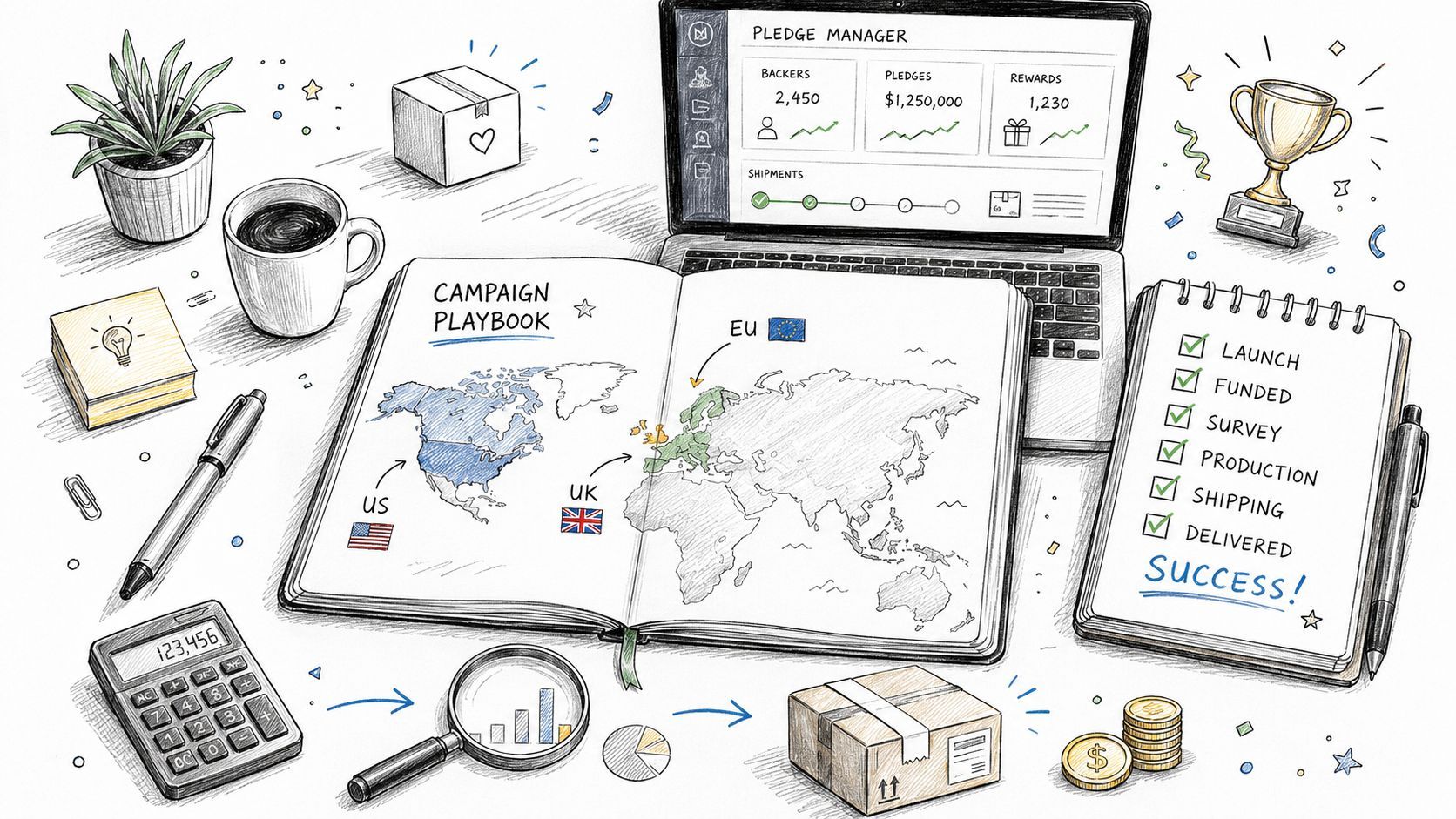
Simplify global VAT tax compliance for crowdfunding. Get EU/UK rules, US sales tax, pledge manager setup, and a complete checklist for 2026.
Your campaign funded. The comments are full of congratulations. Backers are asking when surveys go out, what add-ons they can still buy, and whether shipping is included.
Then the hard question lands. How are you handling tax for backers in the EU, the UK, and the US?
That's the point where many creators realize fulfillment isn't just packing boxes. It's a tax workflow. If you treat VAT as something to sort out after manufacturing, you usually end up making expensive decisions under pressure. Good vat tax compliance starts before surveys go live, because tax logic affects pricing, backer communication, reporting, and even which pledge manager you can trust with your data.
The stressful part of post-campaign operations isn't usually one giant mistake. It's a stack of small assumptions.
A creator sets one shipping price for everyone. Another bundles product, shipping, and add-ons into a single survey total. Someone else assumes the platform already handled VAT because the campaign page looked polished. Those choices feel harmless when funding just closed. They become painful when rewards start moving across borders.
In crowdfunding, tax trouble hits in very practical ways. Backers get asked to pay fees they didn't expect. Parcels stall. Your margin shrinks because you collected too little. Or you over-collected and now need to explain why.
Governments care because the sums are large. In the EU alone, the VAT compliance gap was estimated at €128 billion in 2023 according to the European Commission's VAT gap data. That number explains why tax authorities pay attention to under-collection, late registration, and weak reporting.
Practical rule: If your campaign ships internationally, tax can't be an afterthought attached to fulfillment. It has to be built into fulfillment.
The good news is that this is manageable. VAT work feels chaotic when it lives in spreadsheets, scattered platform exports, and half-remembered shipping rules. It becomes manageable when you treat it as a sequence: classify what each backer bought, decide where tax applies, collect it correctly, then keep records clean enough to file without rebuilding the entire campaign by hand.
Once the campaign ends, your tax questions become operational:
If you've already felt that creeping panic, you're not overreacting. You're seeing the true work. The hidden costs show up fast in international campaigns, especially once you move from funding to delivery, which is why many creators get blindsided by the VAT dilemma after Kickstarter closes.
A campaign can raise six figures and still create a tax mess if every backer payment is treated as one lump of revenue.

Tax authorities usually start with a simple question. What did the backer buy? For crowdfunding creators, that question matters more than abstract VAT theory. If a payment is directly linked to a specific reward, that payment is often treated as consideration for a taxable supply.
This is the first classification to get right.
A genuine donation, where a supporter gives money and receives nothing specific in return, usually sits outside VAT scope. A reward-based pledge is different. If the backer expects a game, accessory, book, miniature, add-on, or another defined benefit, you should usually treat that payment as part of a taxable sale analysis.
In practice, creators often get tripped up. A campaign page may call a tier “support,” but if that tier includes a product, early access, exclusive content, or physical extras, the label does not control the tax result. The substance does.
Shipping can complicate this further. So can optional add-ons. So can mixed tiers that combine a donation-style contribution with a reward. If you want a cleaner fulfillment phase, separate those elements early and keep your pledge data structured from the start. Our guide to international tax compliance for crowdfunding campaigns walks through the operational side of that setup.
If a pledge functions like a pre-order, build the tax setup as carefully as you would for any other cross-border sale.
VAT is common across international commerce, so creators shipping outside their home market run into it quickly. The issue is rarely whether tax exists at all. Instead, the challenge is whether the campaign has been set up to identify taxable rewards, apply the right treatment to each order component, and keep enough records to support filing later.
For reward-based crowdfunding, the pressure point is usually not the campaign page. It is the handoff between funding, pledge management, and fulfillment. If those systems do not separate product value, shipping, upgrades, and donation amounts clearly, the tax work becomes manual fast.
A workable setup usually starts with four checks:
Classify each payment element
Break the order into its real parts. Donation amount, reward value, add-ons, and shipping may not all receive the same treatment.
Match the backer to the destination country
VAT often depends on where the goods are consumed or delivered. That makes accurate address capture more than a fulfillment task.
Check whether registration may be triggered
Thresholds and registration rules exist, but they are not uniform across jurisdictions. For creators, the practical takeaway is simple. Do not assume you can wait until fulfillment is underway to ask whether registration is required.
Know the tax point for the transaction
Timing matters. In reward-based campaigns, payment collection, invoicing, and delivery obligations can affect when VAT becomes due.
Creators often export campaign data as if every pledge were one product sale with one tax answer. That shortcut causes trouble later.
A backer might pledge for a core reward, add two expansions, pay separate shipping, and include a small extra amount that is closer to support than purchase. If those pieces are merged into one number, tax collection becomes guesswork. Refund handling gets harder too. By the time goods are ready to ship, the team is often rebuilding orders by hand.
The fix is not complicated, but it does require discipline. Treat each pledge as a set of components, not a single amount, and make sure your pledge manager can store those components in a way you can use.
Your campaign funds on Friday. By Monday, backers in France, the UK, and California are asking about late pledges, add-ons, and shipping timelines. The tax question hits right after that. Can one setup cover all three?
No. That assumption creates expensive cleanup work later.
EU VAT, UK VAT, and US sales tax can all apply to the same crowdfunding campaign, but they are different systems with different triggers, registrations, and reporting rules. Creators get into trouble when they copy one rule set across every destination and hope the pledge manager sorts it out.
For EU orders, the delivery country drives the VAT treatment. A shipment to France may require a different handling approach than the same reward going to Germany or Spain. The products may be identical. The tax logic is not.
The UK needs its own review. Post-Brexit, UK VAT should be treated separately from EU VAT in your campaign planning. I have seen creators build clean EU workflows, then discover too late that UK orders were sitting in the wrong bucket because the team treated the UK as just another European destination.
That usually affects more than filing. It can change how you register, what you collect at checkout, and how you document the sale for fulfillment and accounting.
The US system is a sales tax system, not a VAT system.
That distinction matters because VAT experience does not transfer neatly into US compliance. In Europe, creators usually think in terms of destination-based VAT rules. In the US, the first question is often whether the campaign has created state-level sales tax obligations, which can depend on economic nexus rather than physical presence. Avalara explains that mismatch well in its article on why VAT-compliant UK businesses fail US audits.
For crowdfunding teams, the practical takeaway is simple. Do not treat the US as "VAT, but with different rates." It is a separate compliance track.
| Attribute | EU/UK VAT | US Sales Tax |
|---|---|---|
| Core structure | Value-added tax | Retail sales tax |
| Main trigger | Consumption and destination-based VAT rules | Economic nexus and state-level rules |
| Geographic complexity | Country and regional VAT treatment | State, county, and city layers |
| Registration logic | Depends on VAT rules and thresholds | Depends on nexus in each relevant state |
| Common creator mistake | Assuming one VAT setup covers all destinations | Assuming VAT experience transfers directly |
A careful team can still make mistakes here, especially during the jump from campaign funding to fulfillment planning.
What works better is separating your thinking into three tracks from the start:
That structure keeps operational decisions clearer. It also makes system setup easier later, because your tax rules can follow real jurisdiction boundaries instead of one global shortcut. For a practical crowdfunding-specific breakdown, see this guide to international tax compliance for crowdfunding creators.
Tax strategy fails or succeeds inside the survey setup.
Most creators don't get into trouble because they misunderstood the law in theory. They get into trouble because their pledge manager was configured around convenience. One blended total. One shipping rule. One tax toggle. That's how bad filings start.

An effective compliance framework requires a destination-based logic flow where tax calculation is triggered by the backer's delivery address. Campaigns using this granular approach show a 95% reduction in filing errors compared to aggregated totals, according to this international tax compliance benchmark for crowdfunding workflows.
That should shape your survey from the first screen. You're not asking where a backer lives for shipping convenience alone. You're using that destination to decide which tax rules apply.
At this stage, many surveys break.
You need separate line items for the core reward, any add-ons, and shipping. Late pledges and post-campaign extras should also be treated deliberately rather than folded into one subtotal. The tax treatment may differ by category, and shipping can be especially tricky in some jurisdictions.
Creators often ask why their tax reports look messy even though they “charged the right percentage.” The answer is usually that they taxed the wrong base.
A clean setup usually includes:
Working habit: If a backer can see one total, you should still be able to see the tax anatomy underneath it.
Kickstarter's pledge manager is like Amazon, while the PledgeBox pledge manager is like Shopify. One leans toward a more standardized marketplace-style experience. The other gives you more control over how the post-campaign storefront behaves.
That difference matters for vat tax compliance because tax isn't just a checkout percentage. It's product mapping, shipping treatment, destination logic, data cleanliness, and reporting quality.
The patterns that create preventable cleanup work are familiar:
Using aggregated totals
This hides what was sold and makes tax treatment harder to defend.
Importing messy backer data
Incomplete country data and mismatched pledge levels spread errors across the whole calculation flow.
Testing only domestic orders
International logic often breaks on the first non-domestic edge case.
Before you lock the survey, run test orders that reflect different geographies and different pledge compositions. That's the fastest way to catch hidden assumptions before backers do.
Manual tax handling breaks down fast once the survey opens. One creator might be able to hand-check a small domestic campaign. That approach doesn't survive hundreds of backers, mixed add-ons, and multiple destinations.
Automation matters because it forces consistency. If tax rules are set by destination and product category, the system can apply the same logic every time instead of relying on a tired founder checking orders late at night.

For crowdfunding creators, the tool needs to do more than collect addresses.
It should let you map tax rules to destinations, keep product and shipping values distinct, and export records you can work with at filing time. If the platform only gives you a lump-sum revenue view, someone on your team will eventually need to reconstruct the truth by hand.
A practical setup should help you:
PledgeBox is free to send backer surveys and only charges a 3% platform fee on upsell revenue. Unlike Kickstarter's native manager, which can take 5% of all pledge manager revenue, that model means creators can manage fulfillment and tax compliance for $0 if they have no upsells, based on the current PledgeBox pricing details.
That pricing model changes the math for campaigns that mainly need accurate surveys, shipping collection, and tax handling rather than aggressive post-campaign monetization.
PledgeBox is free to send the backer survey and only charges 3% of upsell if there's any. That matters because many campaigns don't want the pledge manager fee attached to every dollar collected. They want the platform cost tied to extra revenue, not to basic operational cleanup.
Automation doesn't remove responsibility. It removes repetitive calculation.
You still need to decide which jurisdictions you're collecting for, how products are categorized, and when to get tax advice for edge cases. The strongest setup pairs software with a short pre-launch or post-campaign review by someone who understands your fulfillment model.
If you want a practical walkthrough of how creators use software to reduce manual tax work, this article on tax compliance automation for crowdfunding is a useful next read.
The tax trouble usually starts long before the first filing. A creator launches, funding closes, surveys go out, and only then does someone ask the question that should have been settled earlier: what part of this money was the product, what part was shipping, and what part was a donation or post-campaign add-on?
That is the point where cleanup gets expensive.
This checklist is the one I use to keep campaigns under control from launch through fulfillment, especially when orders will cross into the EU, the UK, and US states with their own rules.

Define what each tier represents Separate true donations from reward-bearing tiers before the campaign goes live. That decision affects whether you are dealing with taxable goods, mixed transactions, or something that needs a closer review.
Map destinations early
List where you expect to ship and flag the jurisdictions that need separate handling, especially the EU, the UK, and US states where sales tax may apply differently.
Choose a workflow you can report from later
If your campaign data, survey data, and add-on data will live in different exports with inconsistent labels, reconciliation will be slow and filing will be riskier.
Split the order into clear line items. Keep the base pledge, add-ons, shipping, and any tax collected in separate fields.
Creators often skip this because it feels like admin work. In practice, it is one of the few setup decisions that makes customs paperwork, VAT review, and end-of-campaign reconciliation much easier. It also helps avoid a common crowdfunding problem: treating one blended pledge total as if it were a single taxable item when it is really several different charges.
Validate shipping addresses early
Wrong destination data leads to wrong tax treatment. Catch it before charges are finalized.
Review unusual orders by hand
Mixed bundles, replacement items, late add-ons, and manually edited backer records deserve a second check.
Keep records current while the campaign is active
Reconcile collections and changes as they happen. If your finance process needs work, this guide on the importance of clean accounting records is worth reading because accurate books make tax reporting and audit questions much easier to handle.
Good vat tax compliance comes from getting the order data right at the start and keeping it clean through fulfillment.
Reconcile three things together: what you charged, what you shipped, and what still sits in exception queues. Refunds, split shipments, failed address corrections, and replacement parcels can all change the tax story after the survey closes.
This is also where crowdfunding creators need to stay clear on terminology. EU VAT, UK VAT, and US sales tax do not work the same way, and your records should make those differences visible instead of burying them in one combined total. If your reporting cannot show destination, product value, shipping charged, and tax collected by order, you will feel that pain at filing time.
Backers see the operational result. Clear charges, accurate landed costs, and support replies based on real order data build trust fast.
If you want a simpler post-campaign workflow, PledgeBox gives creators a way to send backer surveys for free, collect shipping and tax with more granular control, and only pay a 3% fee on upsell revenue if any upsells happen.
PledgeBox
The All-in-One Toolkit to Launch, Manage & Scale Your Kickstarter / Indiegogo Campaign