 PledgeBox
New Game Strategy: Master Your Kickstarter Launch
Master your new game strategy for Kickstarter. This guide covers pre-launch audience, campaign tactics, and post-campaign revenue. Launch successfully in 2026!
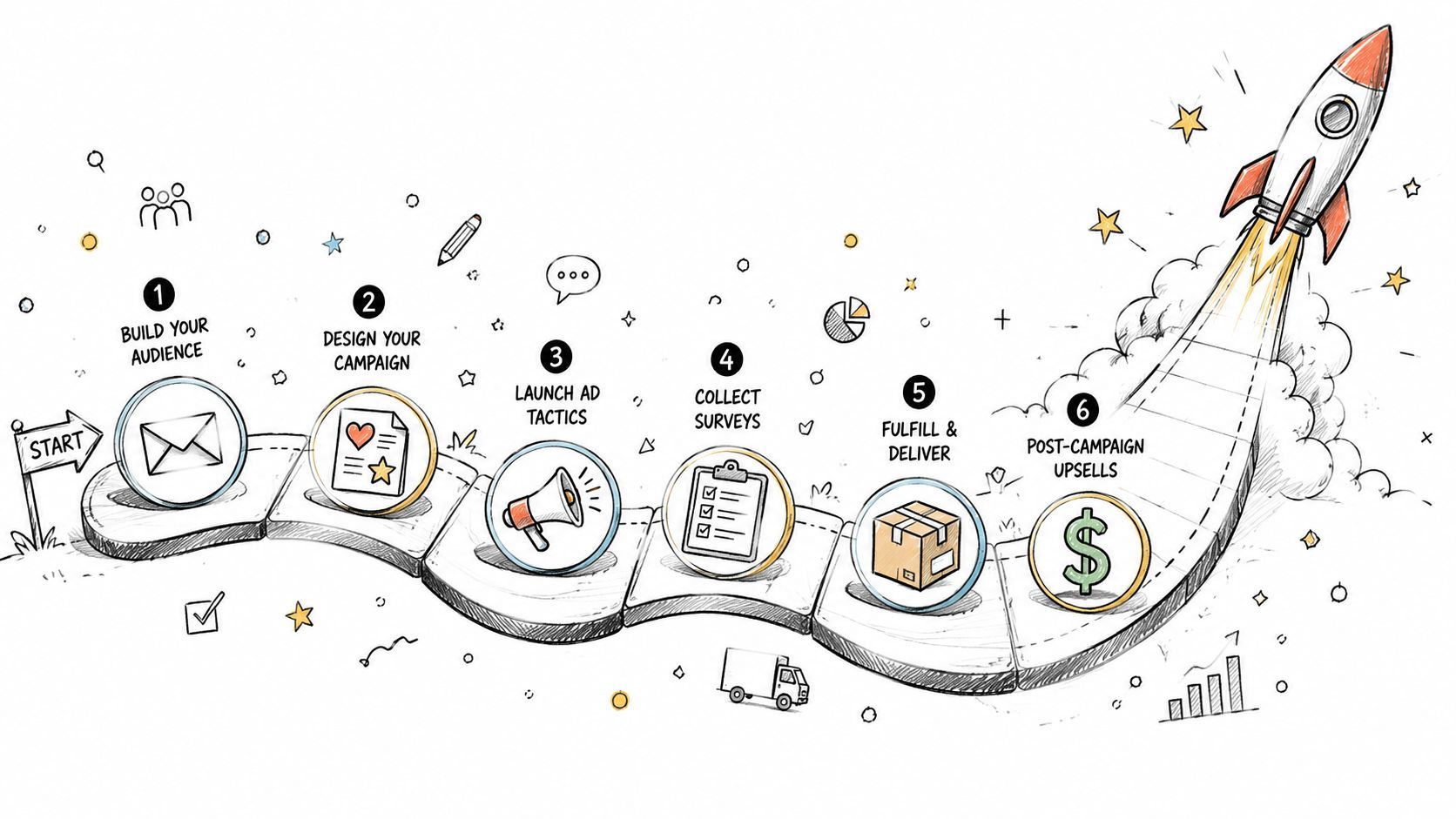
Master your new game strategy for Kickstarter. This guide covers pre-launch audience, campaign tactics, and post-campaign revenue. Launch successfully in 2026!
You're probably in the same spot most game creators hit right before the actual work starts. The prototype lands well in playtests. Friends tell you it's ready. The art direction finally feels coherent. Then the question shifts from “Is this game good?” to “How do I launch this without wasting the next year?”
That's where most campaigns go sideways. Creators treat pre-launch, campaign week, and fulfillment as separate jobs. They aren't. A strong new game strategy works as one connected system. Your reward structure affects fulfillment. Your fulfillment plan affects your campaign tiers. Your pledge manager needs affect how you collect data before launch. If those pieces don't line up, backers feel the friction even if they can't name it.
The teams that skip a cohesive planning and testing loop put themselves at a much higher risk of building in the dark. That's true for a tabletop campaign with minis and expansions, and it's just as true for a digital game with demo access, cosmetic rewards, and platform-specific delivery. The launch only looks smooth when the whole machine was designed to run together.
A lot of creators still believe a launch begins when the campaign page goes live. It doesn't. It begins when you decide what kind of game business you're building and what proof you need before asking strangers to fund it.
For tabletop teams, that usually means deciding whether the campaign is centered on one flagship box or a product line that can support expansions, accessories, and retail follow-up. For video game teams, it means figuring out whether the campaign is funding core production, audience validation, or a specific milestone like a polished demo. If you blur those goals together, your page gets muddy fast.
Practical rule: If a backer can't understand what their money unlocks in one pass, your campaign is carrying too many stories at once.
Studios that skip planning and testing loops run into the same problem. They don't know whether the risk is the mechanic, the audience, the message, or the production timeline. So they launch with guesswork. That's how good games end up with weak campaigns.
The smartest move early is to identify the one thing that could break the launch. For a board game, it might be setup friction, session length, or whether the hook is strong enough against crowded categories. For a video game, it could be whether the core interaction feels rewarding over repeated sessions.
If you're building a narrative-first title, this breakdown of mobile game development for narrative experiences is useful because it shows how platform, pacing, and player expectation shape your product before marketing ever starts.
That same discipline should shape your campaign planning. Build your first launch framework with a simple operating document, then turn it into a public campaign structure later. A practical starting point is this guide on how to create a Kickstarter campaign, especially if you need a clean checklist instead of another pile of disconnected advice.
A funded campaign usually comes from getting these three phases to support each other:
If phase three is an afterthought, phase one and two usually underperform. Backers pick up on uncertainty. They may love the game and still hesitate if delivery feels vague, add-ons feel improvised, or shipping looks like a future headache.

A week before launch, the warning signs are usually obvious to anyone who has run campaigns before. The trailer looks good, the page draft is half-finished, and the team is counting on launch-day traffic to do the heavy lifting. Then the critical problem appears. Nobody has a reliable list, nobody knows which message converts cold visitors, and the reward structure still ignores what fulfillment will cost later.
Pre-launch work fixes that. It is not a warm-up before the main campaign starts. It is where pricing, audience fit, add-ons, shipping expectations, and post-campaign operations get tested early enough to change course.
The strongest pre-launch audiences are built around a promise the team can deliver without scrambling after funding. That affects what you collect before launch and how you position it.
For a tabletop campaign, that might mean using a print-and-play sample to prove the core loop while keeping stretch goals conservative if manufacturing is already tight. For a video game, it might mean pushing players toward a demo, closed alpha, or wishlist action that reflects the actual launch path instead of vague hype. Teams that need a practical structure can study this guide on building a list of potential backers before your Kickstarter campaign launches.
Your email list still matters more than rented reach. Social platforms are useful for discovery, but email is where intent lives. It is also where you can segment future backers by retailer interest, deluxe tier interest, region, or platform preference, which makes the pledge manager and fulfillment plan easier to handle later.
A solid pre-launch stack usually includes:
An audience can inflate your vanity metrics. A community exposes the weak spots in your launch plan.
That is why Discord, closed playtest groups, convention demos, and private Steam playtests matter before launch. They do more than generate chatter. They show whether players understand the hook, whether your premium tier is attractive, and whether your future add-ons are interesting enough to survive contact with real budgets.
Use pre-launch conversations to collect signals like these:
| Signal | What it usually means |
|---|---|
| Repeated rules or feature questions | Your pitch is unclear or your onboarding is too dense |
| Strong response to one mechanic or mode | That feature should lead more of your messaging |
| Weak interest in premium extras | Your add-ons may create cost without increasing average pledge |
| Shipping questions show up early | Your campaign page will need clearer regional expectations |
| Fans describe the game in better language than your ads | Your copy should reflect their wording |
I treat this stage as campaign research and fulfillment research at the same time. If players keep asking for a neoprene mat, a mini expansion, or console keys in certain regions, that is not just marketing feedback. It affects SKU count, freight planning, pledge manager setup, and margin.
Paid ads, creator outreach, and social content are useful before launch if they answer one question. Does the right player understand why this game is worth backing?
Polish helps, but clarity wins. A rough prototype video with a sharp hook often outperforms prettier creative that hides the actual experience. I have seen board game campaigns get stronger results from a 20-second overhead gameplay clip than from a cinematic trailer, because backers could immediately see pace, interaction, and table presence. Video game campaigns face the same trade-off. If the footage does not communicate the core interaction fast, interest drops before your best features appear.
Use small tests to answer practical questions:
Messaging should also stay consistent across your landing page, email welcome flow, Discord, and creator pitch. That is where powerful brand narratives do real work. A clear story helps backers understand the game quickly and helps your team avoid the common pre-launch mistake of describing the project five different ways in five different channels.
A backer army is built through repeated proof. Show the game. Collect intent. Refine the promise. Then launch with an audience that already knows what it is buying, how it will be delivered, and why it should trust your team.
A campaign page doesn't fail because it lacks information. It fails because it presents information in the wrong order.
Backers don't arrive asking for your production roadmap first. They ask themselves three things almost immediately. Is this for me? Can this team deliver? Why should I pledge now instead of later?

For board games, that usually means showing the table experience before drowning people in component counts. For video games, it means making the fantasy legible fast. Not every backer needs every subsystem explained. They do need to know what kind of experience they're funding.
That's why powerful brand narratives matter. A campaign story isn't fluff. It's the frame that helps a visitor understand why your game deserves attention. This breakdown of powerful brand narratives is a good reference if your page currently reads like a feature dump.
A high-converting page usually follows a sequence like this:
Creators love stretch goals because they feel like momentum. Backers love them when they add visible value. Fulfillment partners hate them when they explode complexity.
Lean Startup discipline helps here. Build a focused MVP for the riskiest mechanic, instrument telemetry, and make sure core actions achieve a success rate over 70% with real players before you scale the promise. That approach keeps you from crowdfunding features that only sounded good in a design meeting.
A few page design rules hold up across both tabletop and video game campaigns:
A practical reference for structure and hierarchy is this article on Kickstarter campaign page design tips.
A campaign video still matters because it collapses trust-building into a short window. It doesn't need cinematic excess. It needs clarity, energy, and proof that the game exists in a meaningful form.
Here's a useful example format to study:
Reward design is where many creators accidentally introduce friction. Too many tiers create hesitation. Too few make the campaign feel thin. The best tier structures gently move people upward without making the entry point feel weak.
Don't design rewards around everything you can offer. Design them around the easiest decisions a backer can make quickly.
For a tabletop game, that might mean standard edition, deluxe edition, and a retailer tier, with add-ons handled later. For a video game, it might mean base key, soundtrack bundle, closed-beta tier, and a limited collector version. Each should answer a different buyer intent, not just stack more stuff on top.
Day six usually looks the same. Funding has slowed, the launch spike is gone, and the dashboard starts dictating your mood. Creators who treated launch as a single event get stuck here. Creators who planned the full campaign arc, including what happens after funding, usually stay in control because every update, ad, and comment answer serves a larger system.
Momentum in the middle comes from structure. Backers need to see that the project is progressing, that decisions are being made well, and that the campaign will not become a fulfillment mess later.
The best mid-campaign updates create a reason to return to the page and a reason to share it. They are not status dumps. They answer a buying question, reduce risk, or show meaningful progress.

For a tabletop campaign, that could be a refined solo mode, a component upgrade that does not create new SKUs, or a gameplay video showing how the revised rules cut downtime. For a video game campaign, it might be a combat breakdown, a polished UI pass, a platform decision with clear reasoning, or a short demo clip that proves the game loop is already fun.
Strong update angles usually fall into four groups:
The key is discipline. Every update should either help conversion now or reduce support friction later.
Broad awareness ads waste money in the middle. The better play is retargeting people who already visited, watched, clicked, or opened and then hesitated. Those audiences do not need an introduction. They need a reason to stop delaying the pledge.
For digital projects, that matters even more because players are used to infinite choice and short attention cycles, as noted earlier in the article. Creative that worked on launch day often loses force a week later. Replace the trailer thumbnail with gameplay proof, platform clarity, pricing logic, or a short social proof clip from real players.
A practical rotation looks like this:
| Audience | Best message |
|---|---|
| Page visitors who didn't pledge | Clarify reward value or launch urgency |
| Video viewers | Show gameplay proof or social proof |
| Email subscribers who didn't convert | Answer objections directly |
| Existing backers | Highlight add-on interest or referral-style sharing |
I usually judge mid-campaign ads with one question: what stopped this person from backing the first time? If the answer is uncertainty, show proof. If the answer is price, explain value. If the answer is timing, give them a concrete reason to act before the campaign ends.
Comments are public sales and support at the same time.
A fast, plain-language answer does more than help one backer. It signals that fulfillment will probably be handled well too. That matters because buyers are not only evaluating the game in the middle of the campaign. They are evaluating whether you look like a team that can collect addresses correctly, handle platform keys, manage regional shipping limits, and keep promises after the funding total is locked.
This is why the launch process has to be treated as one connected system. If reward logic is confusing in the comments, it will be worse in the pledge manager. If shipping questions pile up now, they will become support tickets later. Fixing those issues during the campaign protects conversion today and margins after the campaign closes.
Cross-promotions still work when audience overlap is real. Press still helps when there is a fresh angle. But the campaigns that hold momentum in the middle usually win on repeatable habits. They publish updates with a purpose, refresh ad creative for warm audiences, answer comments quickly, and make decisions that support fulfillment instead of creating new operational problems.
Most creators exhale when the campaign funds. That's understandable, but it's the wrong mental shift. Funding is not the finish line. It's the handoff from public selling to operational execution.
This phase decides whether your campaign becomes a sustainable business asset or a customer service problem.
A creator who thinks about fulfillment early will structure rewards differently from someone who doesn't. They'll reduce unnecessary SKU sprawl. They'll avoid vague bundle logic. They'll think ahead about shipping collection, tax handling, regional restrictions, and data cleanliness.
That's why the pledge manager is not just an after-campaign tool. It should influence your pre-launch planning.
The simplest way to think about it is this:
Kickstarter's native pledge management functions are like Amazon. They're broad, familiar, and basic. A dedicated pledge manager is like Shopify. It gives you a more flexible storefront and better control over the post-campaign customer journey.
That distinction matters because post-campaign behavior is not passive. Backers change addresses, upgrade rewards, add extras, ask split-shipment questions, and need reminders. If your system can't handle that cleanly, your team ends up rebuilding order logic by hand.
Creators often overcomplicate surveys. They ask for too much at once, bury critical choices, or create forms that feel like tax paperwork.
A good backer survey does four jobs:
For tabletop projects, sleeves, neoprene mats, expansions, acrylic tokens, and replacement packs often convert best. For video game campaigns, this may include soundtrack upgrades, cosmetic packs, art books, closed test access, or physical collector extras.
The reason this stage matters so much is simple. People who already backed are your warmest buyers. They've already crossed the trust barrier. If your post-campaign storefront is clear, some of them will continue buying. If it's clunky, they'll abandon the process halfway through.
A lot of creators still separate upsells from logistics in their own heads. That's a mistake. The cleaner your order management is, the safer it becomes to offer add-ons. The messier your data is, the more every additional product turns into risk.
The fee structure holds particular importance. PledgeBox is free to send the backer survey, including surveys for imported Kickstarter or Indiegogo backers, with $0 upfront, no setup fees, and no per-backer cost, and it only charges 3% on post-campaign add-on sales if there's any upsell according to PledgeBox's overview of its pledge book system. Put plainly, the survey itself is free to send, and the fee only applies if upsell revenue happens.
That model aligns with how creators work after funding. You're not paying to contact your own backers. You're paying when the system helps generate additional post-campaign sales.
Before the campaign launches, you should already know the rough fulfillment path. Not every line item, but the shape of it.
Use this checklist mindset:
A tabletop publisher shipping a standard edition, deluxe edition, and several accessories needs clean order mapping. A video game creator promising beta access, keys, merch, and art books needs the same discipline in a different format. Different products, same operational truth.
Fulfillment feels expensive when the campaign is messy. It feels manageable when the offer was designed around operational reality from the start.
This is why the best new game strategy isn't “market first, operations later.” It's one loop. Pre-launch informs the offer. The offer shapes the campaign. The campaign feeds a post-campaign system that protects revenue and delivery at the same time.
Creators who last beyond one campaign usually stop thinking in isolated milestones. They stop asking, “How do I get funded?” and start asking, “How do I build a launch system I can reuse?” That shift changes everything.
A coherent new game strategy turns scattered tasks into a single operating model. Your audience-building work gives you cleaner launch traffic. Your campaign design reduces confusion at checkout. Your post-campaign setup protects margins, improves backer experience, and gives you better data for the next release. That's true whether you're launching a card-driven skirmish game, a solo tabletop system, or a narrative video game with digital and physical rewards.
There isn't one perfect number. Start with an amount you can afford to treat as tuition for message testing, not guaranteed profit. In pre-launch, use ads to learn which hook attracts the right players. During the campaign, use them to retarget visitors, video viewers, and email subscribers who already showed intent.
Adding operational complexity that looks exciting on the campaign page but becomes painful in production. In tabletop, that often means too many component variants or premium extras that complicate packing. In video games, it can mean promising content branches, platform support, or cosmetic deliverables that stretch the team beyond the original production plan.
Yes. Advanced pledge managers are platform-agnostic, so you can export backer data from Indiegogo and continue with surveys, shipping collection, and post-campaign add-ons in a dedicated system.
That can be an advantage if the audience is clearly underserved. One example is WEGO strategy design, where players issue commands during a planning phase and then watch them resolve simultaneously. It remains overlooked even though it serves players who want deeper planning and less real-time pressure, while recent coverage notes that major publishers released fewer than 5 such titles in the last 12 months compared with 120+ real-time strategy releases, leaving a real content and product gap according to this discussion of WEGO turn-based strategy games. Niche doesn't mean small by default. It often means under-served and easier to position.
If your strategy title includes replay systems, don't just say “there's New Game+.” Explain why it matters to player choice. That's especially relevant for games with alternate routes and recruitable characters. In Triangle Strategy, New Game+ includes 30+ unique character recruitment paths, yet less than 15% of guides explain path-specific recruitment strategy, which shows how often creators and content teams miss the actionable layer players want, as discussed in this Triangle Strategy NG+ recruitment conversation.
If you want one system that connects pre-launch audience capture, live campaign support, and post-campaign surveys without charging upfront for the survey itself, take a look at PledgeBox. It's free to send backer surveys, and it only charges 3% of upsell revenue if there's any, which makes it a practical fit for creators who want Shopify-style control after crowdfunding instead of settling for an Amazon-style basic workflow.
PledgeBox
The All-in-One Toolkit to Launch, Manage & Scale Your Kickstarter / Indiegogo Campaign