 PledgeBox
US Postage Calculation for Crowdfunding Rewards
Master US postage calculation for crowdfunding rewards: weigh packages, handle dimensional weight, and build pledge rate tables.
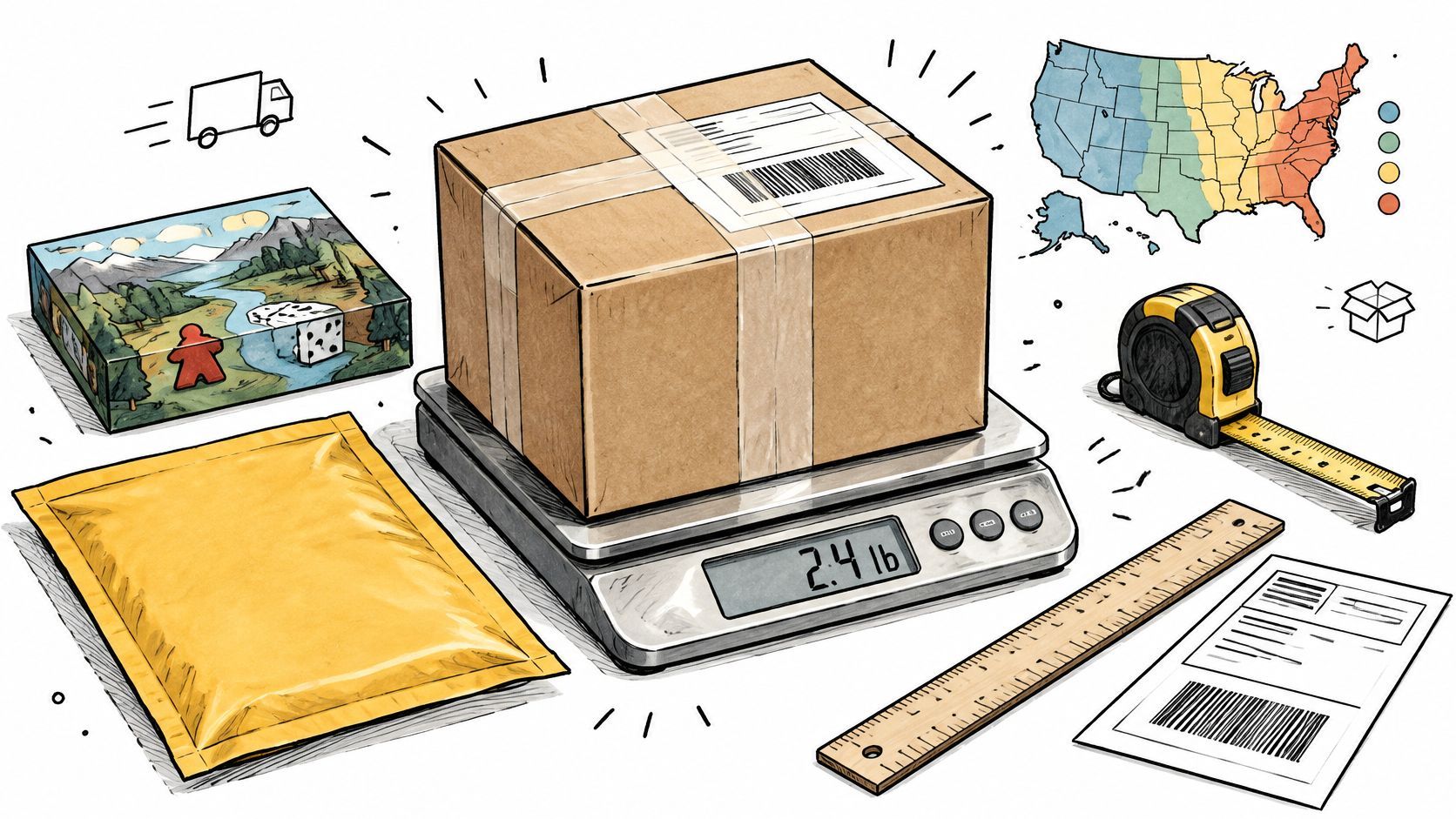
Master US postage calculation for crowdfunding rewards: weigh packages, handle dimensional weight, and build pledge rate tables.
You've priced your reward, your backers are asking what shipping will cost, and the only number on your spreadsheet is the product weight from the factory spec sheet. That's where crowdfunding margins disappear. USPS doesn't bill you for the game, book, or gadget alone. It bills you for the sealed box, with inserts, padding, tape, and empty space included.
Accurate US postage calculation starts with the packed volume your backer receives. A lightweight reward in an oversized carton can cost more than a heavier reward in a snug box, and a last inch of length can add a surcharge to every order. Measure first, choose packaging second, and set your shipping fee only after both numbers are settled.
Short answer: US postage for a reward depends on packed weight, longest side, girth, volume, and destination zone. Measure the sealed shipping box, not the product. If you price from a supplier's product weight, you're guessing at four of the five inputs.
| Input | How to get it | Limit or rule |
|---|---|---|
| Actual weight | Weigh the sealed, packed box | Domestic maximum 70 lb; round up to the next pricing increment |
| Length | Measure the longest side of the packed box | Length plus girth max 108 in (130 in for Ground Advantage) |
| Girth | 2 x height + 2 x width | Counts toward the combined length and girth limit |
| Volume | Length x width x height in cubic inches | 1 cubic foot = 1,728 cu in; above this, dimensional weight can apply |
| Dimensional weight | Length x width x height / 139 | Rounded up to the next whole pound; billed if greater than actual weight |
| Size surcharge | Measure length and volume against the bands | Ground Advantage: $4.50 for 22-30 in, $10 over 30 in, $21 over 2 cu ft |
Limits decide whether a reward can ship at all, so test them before you look up a rate. An oversized game box, a framed print, or a long poster tube can fail on length plus girth even when its weight looks harmless. Catching that at the packaging stage lets you resize the carton. Catching it after backers pay leaves you splitting shipments or absorbing a carrier change.
The USPS parcel size, weight and fee standards state that a domestic package generally cannot exceed 108 inches in combined length and girth, USPS Ground Advantage packages may reach 130 inches, and domestic packages may not weigh more than 70 pounds. The same standards define length as the longest dimension and, for rectangular parcels, girth as twice the height plus twice the width.
Write that combined figure somewhere visible for each reward. A box that's comfortably under the weight cap can still exceed the combined limit once corner protection is added, especially for flat, wide items. Width and height count twice in girth, so padding on those two dimensions moves the total faster than most creators expect.
Practical rule: If length plus girth is close to the cap, redesign the box, don't hope the counter accepts it.
Once a parcel passes 1 cubic foot, USPS may stop caring what your scale says. The USPS business guide to verifying postage explains that for Priority Mail, Ground Advantage, and Parcel Select parcels exceeding 1 cubic foot (1,728 cubic inches), USPS uses the greater of actual weight or dimensional weight, calculated as length × width × height ÷ 139 and rounded up to the next whole pound.
Run the worked example many board game creators recognize. A sealed box weighs 18 pounds and measures 20 × 15 × 12 inches. Its volume is 3,600 cubic inches, dimensional weight is about 25.9 pounds, and rounding up gives a 26-pound billing weight. You don't pay for 18 pounds. You pay for 26, on every backer order, because the carton held more air than product.
That same USPS guidance lists Ground Advantage add-ons of $4.50 for 22–30-inch parcels, $10 for parcels over 30 inches, and $21 for parcels over 2 cubic feet, according to the USPS business guide to verifying postage. Wait, don't stack those fees into your reward price by accident. Price them as a separate packaging decision. If trimming a box below the 22-inch band is possible, it may save more than negotiating a small discount on the carton itself.
Treat packaging design as part of US postage calculation, not as a warehouse afterthought. Board games, apparel bundles, toys, and gadget kits are vulnerable because protective foam, sleeves, and empty corners add volume faster than weight. A lighter package isn't necessarily cheaper if it occupies more space.
Compare three options for each main reward. A compact custom box usually wins when it keeps dimensional weight at or below actual weight. A flat-rate style box can simplify pricing when your product fits and weight is high relative to size. A snug stock box with less void fill is often the best compromise when custom tooling isn't justified.
Protection still matters, because a cheaper box that produces damaged rewards costs more in replacements and reshipping. For flat art and posters, the notes on delivery protection from Famous Movie Posters are a useful reminder to budget for rigid protection first, then measure the protected package. Don't remove necessary padding to chase a lower billing weight if it raises damage risk.
Before moving on, write six numbers on your pledge sheet for each reward: actual weight, length, width, height, girth, and volume. Add dimensional weight and billing weight beside them. Those figures drive every later decision, from service choice to the shipping fee a backer sees.
Measure the box as the carrier sees it. That means packed, sealed, and ready for a label, with bulges and tape included. A product carton inside a shipping carton is two boxes, and only the outer one counts.
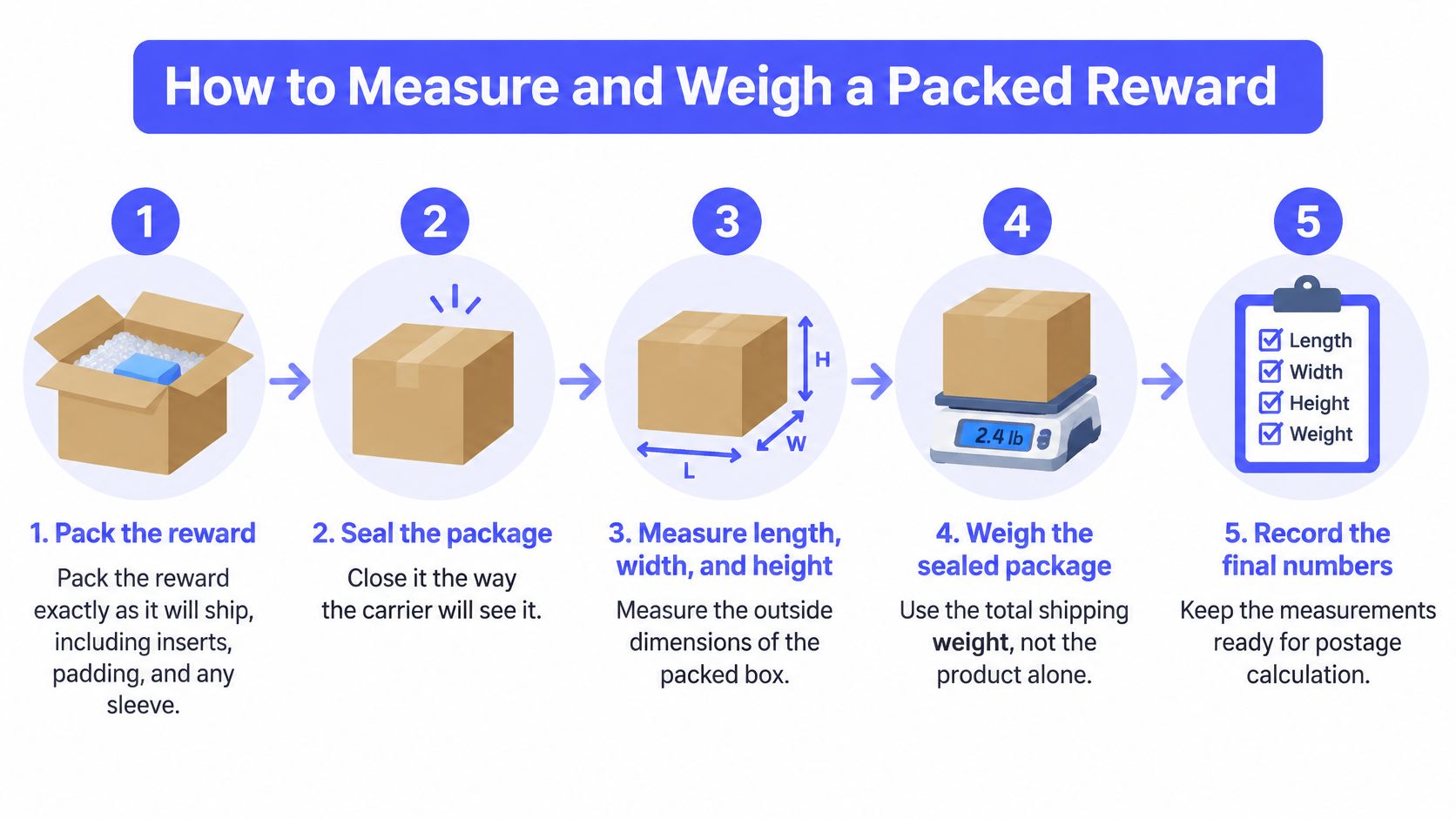
Pack the reward exactly as it will ship. Include inserts, padding, sleeves, thank-you cards, and any add-on that ships in the same box. The common slip is weighing a clean sample, then adding protective material during fulfillment and changing both weight and dimensions.
Weigh the sealed box. Use a postal scale for parcels or a kitchen scale for small mailers, and record ounces as well as pounds. Weighing before the insert goes in understates the total, and that error repeats across the whole print run.
Measure length, width, and height on the outside. Length is the longest side. Measure width and height at their widest and tallest points, catching bulges from bubble wrap or a slightly overfilled apparel bundle. Measuring the flat, empty carton gives you a smaller box than the one you'll ship.
Calculate girth and test the combined limit. For a rectangular box, girth is 2 × height + 2 × width. Add length and compare the result with the limit for the service you're considering. This is the step creators skip for posters, playmats, and framed items, which is why long rewards produce surprises.
Calculate volume in cubic inches. Multiply length × width × height and check whether the box passes the dimensional-weight threshold. Record the exact result, don't estimate from the product dimensions. One extra inch on each side multiplies through the whole calculation.
Calculate dimensional weight. Divide the cubic-inch volume by the carrier divisor and round up as required. Our detailed breakdown of dimensional weight pricing walks through why that rounded figure, not the raw result, belongs in your rate table.
Keep the larger figure as billing weight. Compare actual weight and dimensional weight side by side. If they're close, a small packaging change may flip which one controls the price, so rerun the numbers with your second-choice carton before you commit.
Say your sealed sample weighs 18 pounds and measures 20 × 15 × 12 inches. Girth is 2 × 12 + 2 × 15, which is 54 inches, and length plus girth is 74 inches. Volume is 3,600 cubic inches. Dimensional weight rounds to 26 pounds, so 26 pounds is the billing weight you take into the rate table.
Pack three samples, not one. If weights or bulges vary, price from the heaviest realistic pack, not the tidiest one.
Small rewards need the same discipline at ounce level. A padded mailer that's weighed without a backing card or sleeve can cross into the next pricing increment once it's packed properly. Record the scale reading and the rounded figure your rate chart uses, because backers pay based on the rounded figure.
Repeat the process for every distinct packed format, including tiers with add-ons. A base reward and a deluxe bundle aren't one shipping profile just because they share a product name. If the deluxe version needs a different box, it needs its own measurements and its own row.
Service, billing weight, and zone combine to produce the price. You can't choose a sensible shipping fee by picking a service name first and hoping the zone mix cooperates. Start with where your backers live, then test each service against your heaviest and largest profiles.
The USPS Domestic Mail Manual section on dimensional weight states that USPS divides domestic destinations into Zones 1 through 9, determined from the origin and destination ZIP Codes, and charges by zone rather than by ZIP Code alone. That means two backers in the same state can sit in different zones from your fulfillment point and cost different amounts to reach.
The same USPS manual confirms that Priority Mail, Priority Mail Express, USPS Ground Advantage, and Parcel Select may apply dimensional weight to eligible parcels above 1 cubic foot, with weight rounded upward to the next applicable pricing increment, according to the USPS Domestic Mail Manual section on dimensional weight. Changing service doesn't make an oversized, lightweight box cheap. Fix the box first, then compare services on the corrected billing weight.
One flat shipping fee per tier fails when your zone mix is wide. Nearby backers subsidize distant ones, and if your campaign draws more far-zone backers than expected, you absorb the gap. Group backers into zone bands instead, and price each band from the same billing weight so the fee tracks the actual cost pattern.
Pull the likely zone mix from pre-launch signups, past campaign addresses, or early survey data before choosing. Test your planned fee against the highest zone band you've promised to serve. If that band loses money, either raise that band's fee or change the service, but decide before backers check out.
Our guide to carrier selection criteria is worth reviewing when USPS isn't the only option for a heavy or oversized reward. Whatever you choose, refresh your rate table against the current USPS price list before the campaign closes, because a rate change between launch and fulfillment can erase a thin shipping margin.
One-off calculations don't scale to hundreds of backers. Turn them into shipping profiles: group rewards by packed format, measure one sample of each profile, then price each profile across the zone bands your backers use. Every tier and add-on combination then maps to a profile you have already measured.
| Reward type | Typical packed format | Check before pricing |
|---|---|---|
| Enamel pin or sticker set | Padded mailer | Weight rounding only |
| Hardcover book | Box sized to the book with padding | Girth on a thick spine |
| Board game | Large box with mostly empty volume | Dimensional weight and the 22-inch surcharge band |
| Apparel bundle | Medium box with folded layers | Weight rounding; volume if packed loosely |
| Gadget kit | Rigid box with foam inserts | 1 cu ft threshold and dimensional weight |
Small, flat rewards live or die on rounding. An enamel pin set or sticker pack in a padded mailer rarely triggers dimensional weight, but a backing card, extra sticker sheet, or thicker mailer can push it into the next weight increment. If you're producing the stickers themselves, it's easier to design decals with Custom Sticker Shop at a size that fits your chosen mailer than to resize packaging after printing.
Books and apparel sit in the middle. A hardcover's spine thickness drives girth, and corner padding adds up on all sides. Apparel bundles are forgiving on weight but punish loose packing, because folded layers with air between them can inflate volume enough to matter.
Board games and gadget kits need the closest attention. A game box is mostly empty volume by design, and a rigid foam insert for electronics protects well while consuming space. For those profiles, check the cubic-foot threshold, the length bands, and whether a slightly smaller outer carton changes the billing weight.
Your rate table needs one row per pledge tier, with columns for profile, actual weight, billing weight, zone-band rate, and the shipping fee shown to the backer. Add separate columns for declared-value insurance and any signature or oversize surcharge, so each tier total is complete rather than just base postage.
Say a $45 tier contains a board game in your measured game profile. Its row carries that profile's billing weight and a shipping fee for each zone band. A $120 tier adds an expansion, and the combined box now passes 22 inches. That tier gets its own row, its own billing weight, and the applicable surcharge included, because backers shouldn't face a second shipping charge later.
Rounding rule: Round postage figures up before they enter the survey, so the backer pays the final cost once.
I would price add-ons the same way. An add-on that ships inside the main box without changing its size may add only weight, while one that forces a larger carton changes the whole profile. Test the packed combination, don't assume the add-on rides free.
You're finished when you hold one sheet where every tier has a weight, a billing weight, and a shipping figure per zone band. If a tier can't be traced back to a measured sample, it isn't priced yet, no matter how tidy the spreadsheet looks.
Postage enters the backer's life after the campaign, when you collect addresses, reward choices, and any shipping or tax still due. The rate table you built has to survive that handoff intact. A correct spreadsheet with wrong survey settings still produces wrong charges.
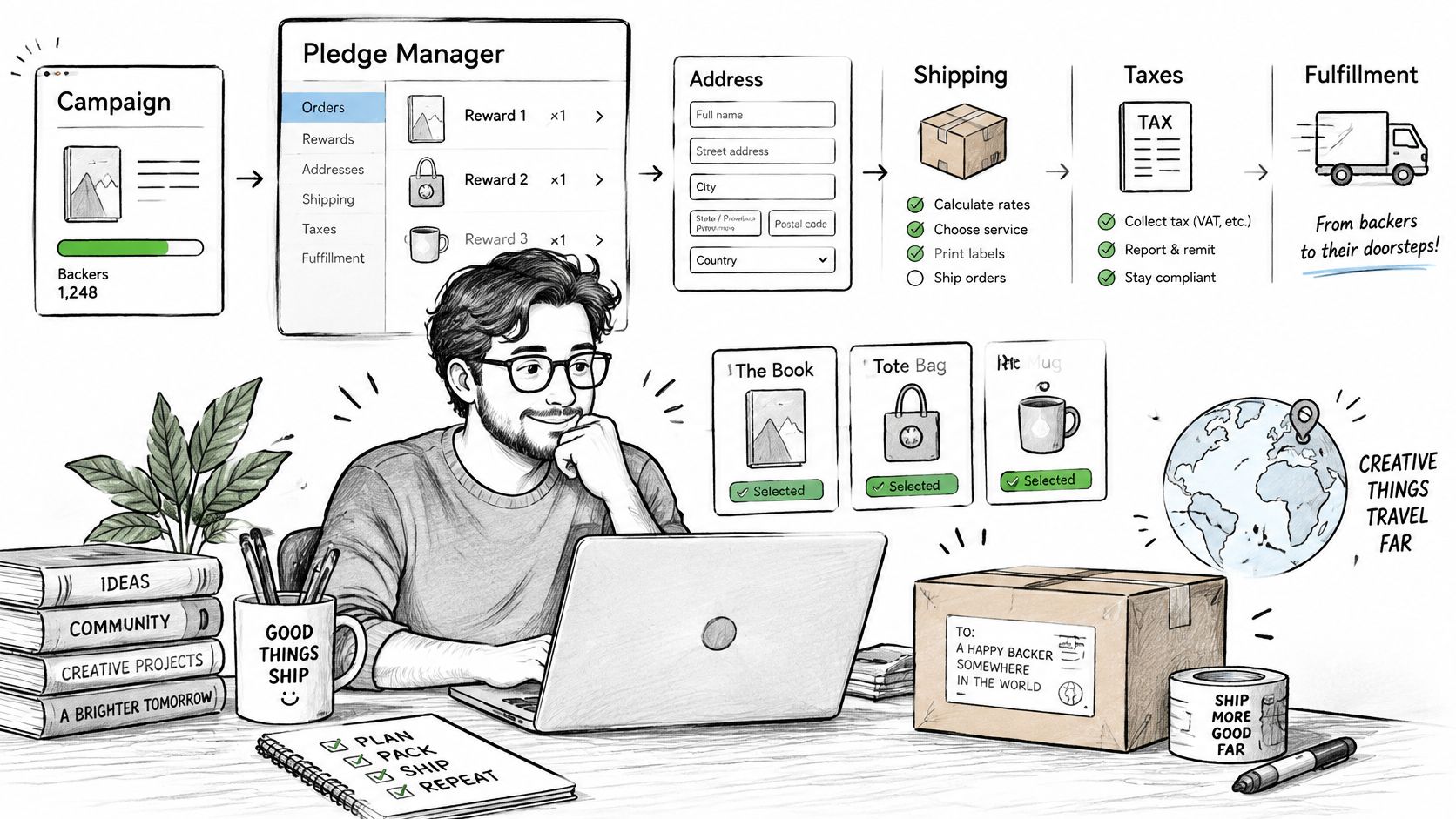
Think of Kickstarter's pledge manager as Amazon: a centralized, marketplace-style environment where the platform manages the transaction experience. The Kickstarter pledge manager help article says creators can set shipping after the campaign and choose either weight-based or flat-rate shipping, customized by region, item type, or reward level, collecting addresses, reward preferences, shipping costs, and applicable taxes.
That help article also states the tool has no upfront cost, but Kickstarter collects a 5% platform fee on applicable funds and Stripe charges roughly 3%–5% on the full payment including taxes, according to the Kickstarter pledge manager help article. Those fees apply to shipping you collect there, so include them when you judge whether a shipping fee covers your postage.
A configurable pledge manager works more like Shopify: your own branded storefront and survey flow, where you control products, variants, and how shipping and upsells are presented. It's free to send the backer survey when it only collects addresses and product choices, and we charge 3% only on additional payments collected through the survey, such as add-ons, reward upgrades, shipping fees, or tax. That structure rewards creators who separate the free information step from paid extras.
A backer can change a shipping address only while the order allows edits, and contacts you if the order is locked or shipped. That's why shipping figures must be right before the survey closes. Fixing an address is easy; re-collecting undercharged postage from hundreds of backers is not.
Set shipping fees before the campaign ends, while you can still change packaging, adjust a tier, or drop a region whose postage no longer works. Price the box the backer receives, not the product spec. A larger carton, extra void fill, or bundled add-on can push the sealed parcel into another volume band. Undercharge and you absorb the difference or ask backers for a second payment. Overcharge and the tier looks weaker beside competing campaigns.
The PledgeBox pricing page lists a 3% charge on additional payments collected through the survey, including add-ons, reward upgrades, shipping fees and tax; sending a survey is free when it collects only addresses and product choices. Payment-provider fees are separate from the platform fee and appear in your receiving account, so review that breakdown in your account terms rather than guessing.
A completed survey does not mean the reward has shipped. Your postage plan needs tracking, shipping notifications, and a process for address changes while orders remain editable. Backers can update addresses while orders allow edits; once locked or shipped, they contact you.
Do one thing today. Pick your best-selling reward, pack it exactly as it will ship, weigh and measure the sealed box, and run those figures through your rate table. Compare the result with the shipping fee planned for that tier. If they don't match, you have found the cheapest correction available before the campaign closes.
Measure packed rewards, build the zone-band table, then load those figures into a survey that is free to send and charges 3% only on additional payments. PledgeBox gives you a branded pledge manager for shipping fees, tax, add-ons, and upgrades.
PledgeBox
The All-in-One Toolkit to Launch, Manage & Scale Your Kickstarter / Indiegogo Campaign