 PledgeBox
Carrier Selection Criteria for Crowdfunding Fulfillment
Master carrier selection criteria for crowdfunding fulfillment with a weighted scoring matrix, testing tips and PledgeBox integration workflow.

Master carrier selection criteria for crowdfunding fulfillment with a weighted scoring matrix, testing tips and PledgeBox integration workflow.
A campaign can be funded, the rewards can be packed, and the fulfillment budget can still unravel because the selected carrier looked cheap on a spreadsheet. A missed handoff creates a tracking gap. A customs problem leaves backers asking where their rewards are. A return or address issue turns one parcel into a support thread, a replacement shipment, and an avoidable margin loss.
Crowdfunding fulfillment makes carrier selection unusually unforgiving. You're shipping a concentrated wave of orders, often across countries, with different reward sizes, service expectations, customs rules, and delivery addresses. The right carrier selection criteria therefore need to measure more than freight cost. They need to show whether a carrier can provide usable visibility, handle exceptions, integrate with your pledge manager, and protect the backer experience when the original plan meets reality.
A creator usually notices the carrier problem after the cartons have left the warehouse. The first wave of tracking numbers looks fine, then international parcels stop moving through customs. Some domestic packages arrive quickly, while remote-area deliveries sit without a clear status. Backers don't see the operational explanation. They see a campaign that promised fulfillment and a tracking page that hasn't changed.
That gap creates work in three places at once. Your fulfillment partner investigates shipments, your support team answers the same delivery questions repeatedly, and you decide whether replacing a parcel costs less than asking a backer to wait. A low headline rate can disappear quickly when the carrier lacks dependable scans, clear exception codes, or a practical claims process.

Price, reliability, and speed remain foundational. A classic UK survey of 365 firms using express parcel services found that 62% cited price, 58% cited reliable or guaranteed service, and 39% cited speed as selection criteria, as reported in an OECD round-table report available through Wayne State University. The pattern is useful for crowdfunding because it reflects actual buyer behavior, not an idealized checklist. Shipping cost affects your margin, but service dependability determines whether your fulfillment promise survives contact with the network.
Crowdfunding adds pressure that ordinary replenishment shipping often doesn't have. A retailer may spread orders across regular dispatches and refine the carrier mix over time. A campaign creator usually has a defined reward batch, a public delivery expectation, and backers who compare progress in community channels. A carrier that performs well for standard parcels may still be a poor fit for a launch with unusual dimensions, batteries, fragile components, or a concentrated international wave.
Practical rule: Choose the carrier that makes failures visible and manageable, not merely the carrier that produces the lowest initial quote.
A weighted matrix forces the team to decide what matters before a sales representative frames the conversation around price. For one campaign, customs capability may carry the greatest weight. For another, address validation, shipment tracking, and returns may matter more because the reward is valuable or difficult to replace.
The best choice may be one primary carrier, a regional mix, or different services for different reward profiles. What doesn't work is selecting one provider from a generic ranking and assuming the same service will suit every country, parcel type, and pledge tier.
Carrier comparisons go wrong before the first quote arrives. If one provider prices a compact reward using actual weight and another applies dimensional rules, their proposals may look comparable while describing different shipping economics. Start with a requirements brief that turns campaign assumptions into information a carrier can price and operate.
Begin with the backer survey or pledge export. Map countries, postal regions, remote destinations, and any location where a local delivery partner or special customs treatment may be necessary. Don't rely on a broad label such as “Europe” or “North America.” Carriers price and serve specific lanes, not campaign categories.
Next, estimate parcel volume by reward type and fulfillment wave. Separate single rewards, bundles, add-ons, and replacement units. Record when inventory will be ready, whether the warehouse will release everything together, and whether you'll need staged dispatches. A carrier that handles ordinary volume smoothly may struggle when a campaign creates a sharp operational peak.
Capture each package's packed length, width, height, actual weight, and protective materials. Dimensional weight can change the commercial result, so measure the finished shipping carton rather than the product box alone. Include fragile goods, lithium batteries, liquids, oversized board game boxes, and any item that needs special handling or documentation.
Use this shipping vendor selection guide for crowdfunding campaigns alongside your internal requirements sheet, then ask every candidate to quote against the same inputs.
Write the delivery promise by region and reward type. “Ships in June” isn't a carrier requirement. A useful brief states the intended dispatch window, the acceptable delivery window, the tracking event the backer should receive, and the escalation route when a parcel stops moving.
List customs and tax responsibilities before the quote review. Decide who supplies commercial invoices, who acts as importer where required, how VAT or other taxes will be collected, and what happens when a recipient refuses a parcel. Ask carriers to identify remote-area surcharges, fuel or handling fees, address corrections, returns, and brokerage charges in writing.
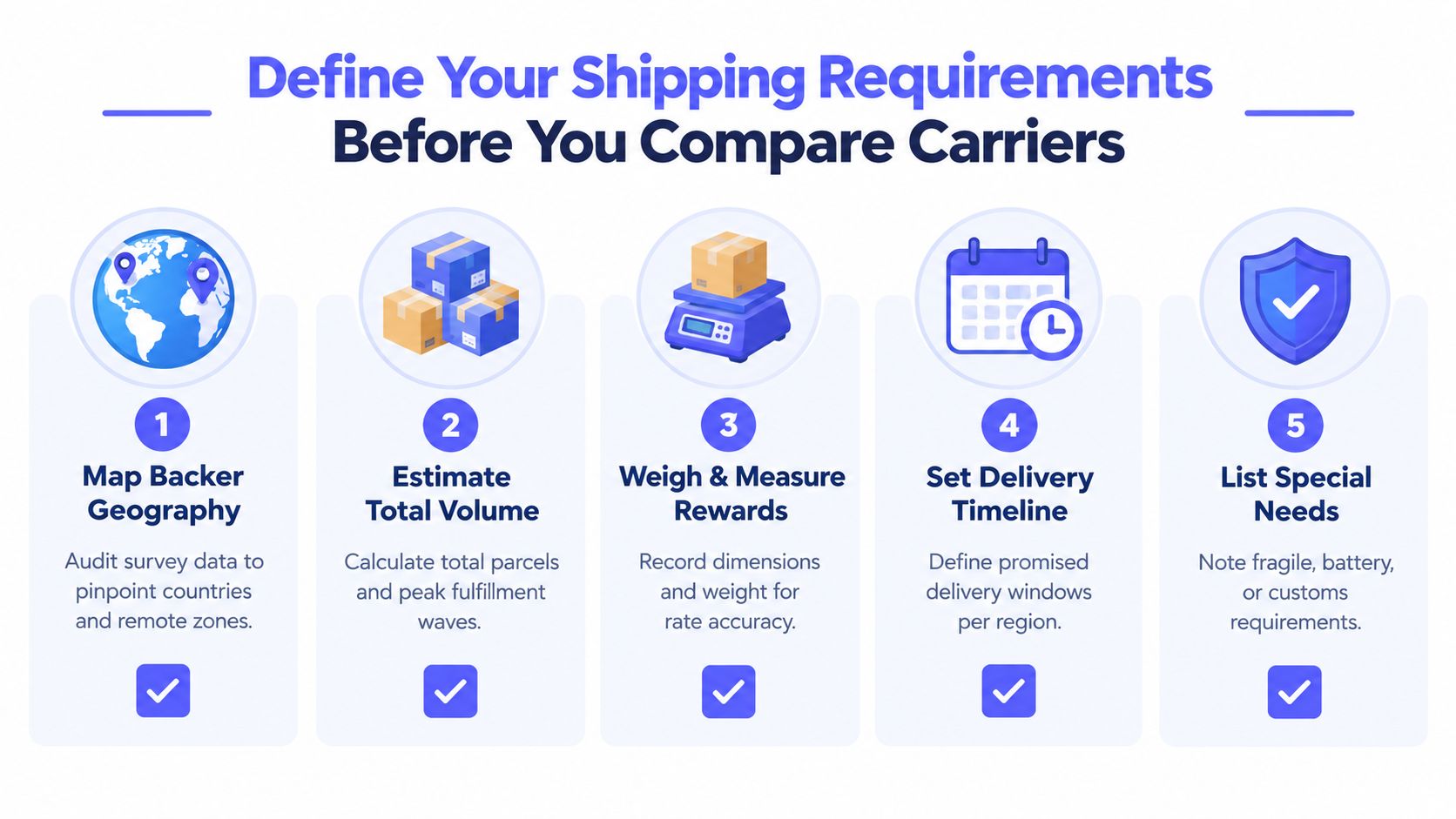
Your one-page brief should contain:
That document prevents apples-to-oranges comparisons. It also gives your warehouse, pledge manager, carrier account team, and support staff one shared operating reference.
A carrier quote is an input, not a decision. Score each provider against the same campaign requirements, then apply weights that reflect the cost of failure. A small rate advantage shouldn't outweigh unreliable tracking if every missing scan generates manual support work.
Research shows how carrier selection has expanded. In a 2022 project44 survey, real-time shipment visibility ranked as the third most important criterion, and 57.4% of shippers said visibility was a prerequisite for choosing a carrier. The requirement was reported at 68.4% in air freight, 62.0% among ocean shippers, and 57.1% among trucking shippers, according to project44's cited research in the Journal of Transportation Management. Academic work also identifies information sharing and environmental issues as additions to the traditional cost, reliability, and service-level criteria.
Use a consistent scale, such as a low-to-high internal score, but define what each score means before anyone rates a carrier. For visibility, a high score should require more than a tracking-number page. Check whether scans are timely, whether exception messages are understandable, whether tracking data can flow into your backer communications, and whether the carrier's API or export fits your fulfillment stack.
Cost deserves a careful definition. Include the quoted transport charge, dimensional rules, fuel or remote-area surcharges, customs handling, returns, address corrections, insurance, and replacement exposure. The carrier with the lowest base rate may have the highest landed cost once those items are included. For a deeper explanation of how package measurements affect pricing, use this guide to dimensional weight pricing.
Rate each area separately:
A creator, a freight forwarder, and a fulfillment agency may rank the same carrier differently. Recent multi-criteria research found that shippers emphasize financial stability, reliability, and document accuracy, while international freight forwarders place more weight on rates, space availability, reputation, and on-time performance, as discussed in the 2025 Central European Journal of Operations Research article. That difference matters when your team outsources fulfillment. The person selecting the carrier may not bear the same operational consequences as the campaign owner.
Use a matrix like this:
| Criteria | Weight | Carrier A Score | Carrier B Score |
|---|---|---|---|
| Total landed cost | |||
| Transit consistency | |||
| Tracking and visibility | |||
| Customs handling | |||
| Exception resolution | |||
| Returns and claims | |||
| Technology integration | |||
| Sustainability and collaboration |
Multiply each score by its weight, then review the unweighted scores as well. A high total can conceal a serious weakness in one critical lane. Set minimum thresholds for must-haves, such as tracking availability, battery handling, customs documentation, or integration reliability. Don't let a strong domestic price compensate for a failure in the international service your campaign depends on.
A spreadsheet predicts fit. Test shipments reveal it. Before committing the full reward batch, send representative parcels through the services you're considering and include the destinations most likely to expose weaknesses.
Use real packaging, real labels, and realistic customs documentation. A small-batch test should include ordinary destinations, remote addresses, and at least one lane where customs or handoff complexity is relevant. The test parcels described in the operational plan can be 10 to 20 parcels, but the exact count should fit the campaign and the regions you need to validate.
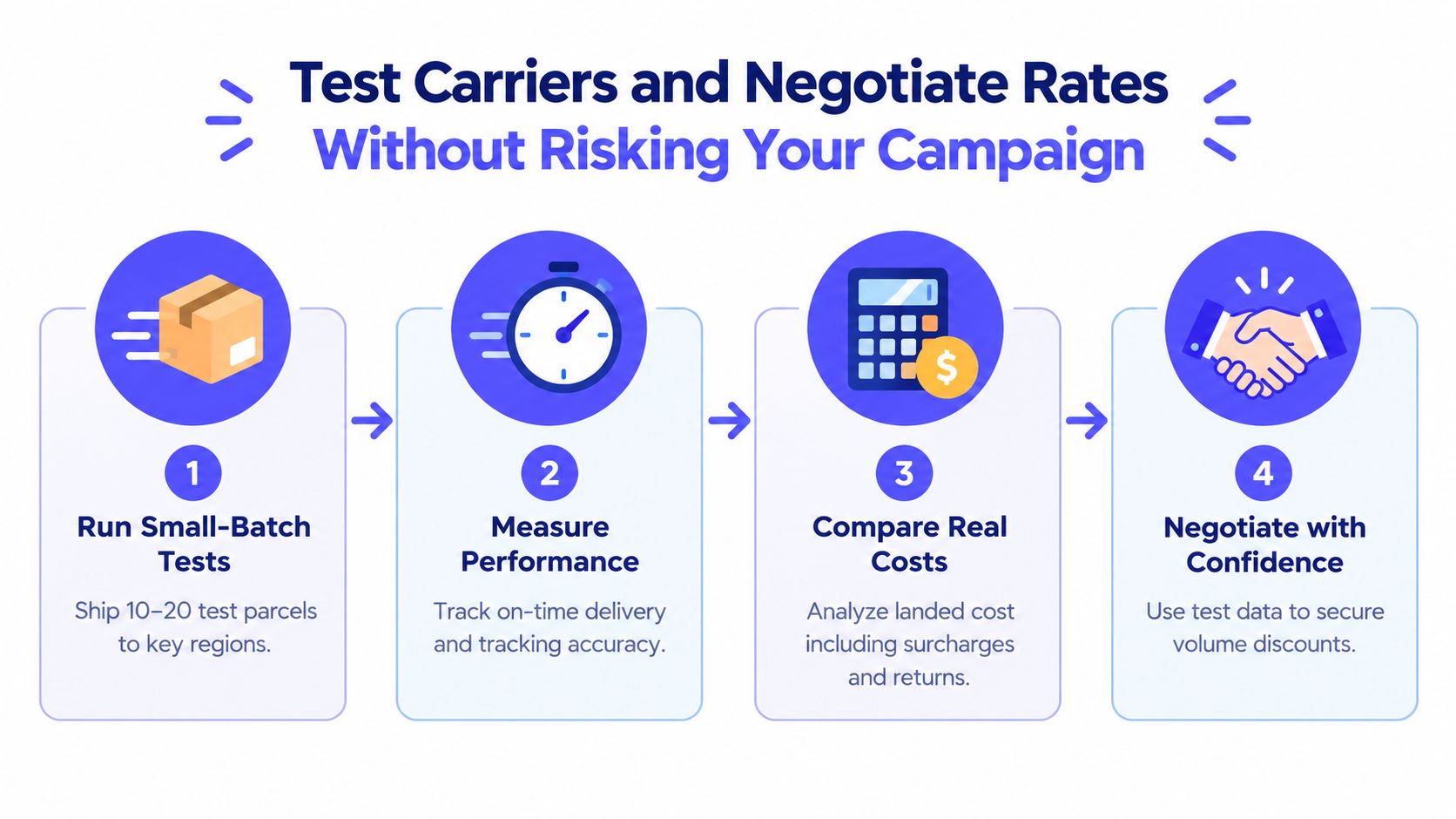
Record the pickup event, each meaningful scan, delivery timing, address issues, customs requests, damage, and the quality of the carrier's response. Don't only ask whether a parcel arrived. Ask whether your team knew what was happening while it was in transit.
Test the data path as well as the physical path. Confirm that labels generate correctly, tracking numbers map to the right backer orders, status updates can be imported, and exceptions can reach the people responsible for intervention. A carrier with excellent physical delivery but poor data can still create a support burden that your rate card won't show.
The research on disruption supports this broader approach. Carrier-selection literature identifies the ability to handle unexpected events, seasonality, flexibility, IT data capabilities, and shipment tracing as meaningful criteria, while newer models also include sustainability, technology, and specialized service. The University of Gothenburg research on freight carrier selection helps frame why a cheap or fast carrier can become the wrong choice when capacity tightens or exceptions spread.
Ask for a rate card that separates base rates from fuel, remote-area, residential, address-correction, customs, return, and claims-related charges. Request service definitions in plain language. “Priority” means little unless the carrier explains the pickup cutoff, transit expectation, tracking events, and remedy for a missed commitment.
Bring test results to the negotiation. Show the expected parcel profile, regional mix, dispatch waves, and the operational work created by exceptions. You can also split volume across a primary carrier and regional specialists when that improves resilience, but document who owns the data, claims, returns, and backer communications.
The cheapest option fails when its exceptions are expensive, opaque, and difficult to resolve.
Negotiate operational commitments, not just discounts. Secure named escalation contacts, data-transfer requirements, claims procedures, pickup windows, and a review process for the fulfillment wave. A carrier that won't discuss failure handling before launch is unlikely to become more responsive after thousands of labels are printed.
A carrier decision only saves money when its data and exception process work with your pledge manager and warehouse. Define the fields that must move from the backer survey to label creation: corrected address, package profile, destination, service level, customs information, and special handling instructions. Manual rekeying creates address errors and slows dispatch.
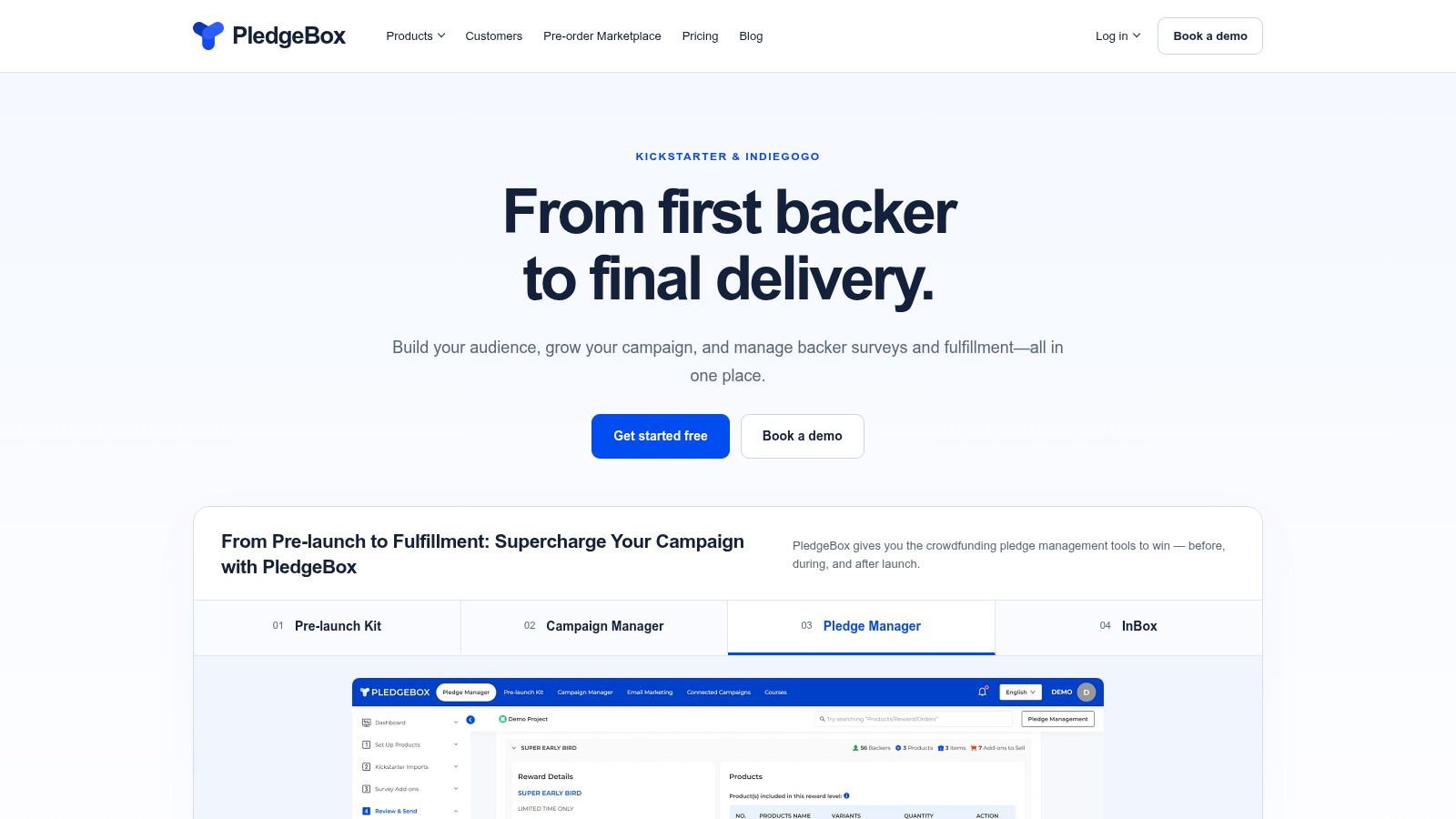
PledgeBox is free for sending the backer survey and charges 3% of upsell revenue if there's any, with no upfront, per-backer, or campaign fee on original pledge funds, according to the PledgeBox pricing page. Its workflow includes address validation, shipping-fee and tax collection, Stripe and PayPal payments, carrier connections, automatic shipment tracking, reports, and vendor exports.
Kickstarter's pledge manager operates inside Kickstarter and provides a defined fulfillment tool with no upfront cost. Kickstarter says it gathers backer addresses, reward preferences, taxes, and shipping costs closer to fulfillment time, as explained in its pledge manager help documentation.
PledgeBox provides a separate, more flexible operating layer for surveys, add-ons, late backer activity, shipping data, and fulfillment exports. That difference affects carrier integration. A controlled platform may simplify administration, while a separate merchant-focused system can give the fulfillment team more control over shipping rules and exports.
Map the workflow before opening the survey:
Kickstarter has a specific limitation. If shipping was charged during the live campaign, its pledge manager cannot be used, although the backer survey tool remains available. Kickstarter also deducts its usual fees from payments made inside the pledge manager, according to its pledge manager FAQ. Set the shipping-collection strategy before the campaign closes.
For warehouse handoffs, the Raccoon Transfers fulfillment guide can help document receiving, picking, packing, dispatch, and exception ownership. Keep carrier credentials, label rules, export fields, and escalation contacts in one operational document using this logistics integration guide, then run a test order from survey completion through tracking delivery. Record where data fails, who resolves the exception, and how the backer receives the update.
The final carrier decision should fit on a page your fulfillment lead can use during launch week. Review the weighted score, then challenge it with the exceptions your campaign is most likely to face. A carrier should meet the minimum standard for visibility, customs, packaging constraints, and data exchange before its price improves the total score.
Before signing or releasing inventory, confirm:
Use one primary carrier when it covers your important lanes, handles your package profile, and gives the team a consistent data and support process. Use a regional mix when local expertise, customs performance, or remote-area coverage materially improves the backer outcome. The mix only works if one team owns routing rules, tracking communication, claims, and returns.
Document why the decision was made. Save the matrix, rate card, test results, service assumptions, and approval owner. That record protects the campaign from last-minute substitutions based on an attractive quote that nobody has tested.
Finally, write the backer communication plan before dispatch. Tell people what tracking event they'll receive, where they can check status, what an exception means, and how to report an address or delivery problem. Carrier selection criteria are complete only when the warehouse, carrier, pledge manager, and support team can act on the same information.
PledgeBox gives crowdfunding teams a pledge manager for branded surveys, shipping and tax collection, add-on upsells, address validation, carrier integrations, and automatic shipment tracking. Visit PledgeBox to connect your carrier decision to a cleaner fulfillment workflow before rewards leave the warehouse.
PledgeBox
The All-in-One Toolkit to Launch, Manage & Scale Your Kickstarter / Indiegogo Campaign