 PledgeBox
How to Set Up Indiegogo Campaign: Step-by-Step Guide 2026
How to set up Indiegogo campaign from prelaunch to fulfillment: fees, rewards, review timing, launch week and backer surveys in one step-by-step guide.

How to set up Indiegogo campaign from prelaunch to fulfillment: fees, rewards, review timing, launch week and backer surveys in one step-by-step guide.
The most popular advice about crowdfunding is to set a low goal, publish a compelling page, and build momentum. That can produce a funded campaign that still can't pay its factory or ship its rewards.
If you're learning how to set up an Indiegogo campaign, start with the promises you'll have to finance. Your funding goal, reward prices, shipping rules, and fee assumptions form an operational contract with backers. Finalize those commitments before you spend money promoting the page.
| Phase | Timing | Key deliverables | Checkpoint |
|---|---|---|---|
| Idea and goal modeling | As a working allowance, roughly 8–12 weeks before launch | Landed-cost model, funding goal, funding model | Conservative case still covers fulfillment |
| Page and reward build | As a working allowance, 6–8 weeks out | Project draft, images, video, reward tiers with SKUs | Test checkout completes in every shipping region |
| Pre-launch audience capture | As a working allowance, 4–8 weeks out | Pre-launch page, email list, partner commitments | Opt-ins support a realistic day-one pledge count |
| Review submission | At least 7 days before launch | Required information completed, review request sent | Review approved and launch date set |
| Launch and first 48 hours | Launch day to hour 48 | Launch emails, social posts, press and community outreach | At least 2 contributions in the first 48 hours |
| Survey and fulfillment setup | Configured before launch, used after close | Pledge manager, backer survey, address and tax flow | Survey tested with real addresses and add-on payments |
The preparation ranges are working rules of thumb, not platform deadlines. A hardware project involving overseas manufacturing needs more lead time than a simple print or design project, particularly when certification, tooling, or packaging remains unresolved.
Start by drafting the reward architecture and shipping rules, then calculate the cost of honoring them. That cost determines the funding goal and whether the project is financially viable. Build the finished page around those decisions rather than writing attractive promises and pricing them afterward.
Use a campaign timeline template to put dependencies beside deadlines. Assign an owner to supplier quotes, checkout testing, creative approval, and launch communications so unfinished work doesn't disappear between teams.
For the wider coordination work, you can organize your launch with FOMOchat, particularly when product, marketing, and fulfillment teams need a shared checklist.
Practical rule: A phase is complete when its checkpoint passes, not when somebody marks the task finished.
Keep the table open while building. It's a checklist for deciding whether you're ready to move forward, not a reason to force an unfinished product onto an arbitrary launch date.
A lower funding goal isn't automatically safer. If it excludes freight, taxes, replacements, or the cash needed to start production, reaching it can leave you with obligations you can't afford.
According to Indiegogo's platform-upgrade guidance, its 2025 platform change moved new campaigns to Fixed Funding, with existing Flexible Funding campaigns potentially converted during the upgrade. Treat older tutorials that present both models as freely available choices with caution.
| Criterion | Fixed Funding | Flexible Funding |
|---|---|---|
| Funds if the goal is missed | Pledges returned to backers | Creator historically kept funds raised |
| Status for new campaigns | Default following the platform change | Being phased out; existing campaigns may be converted |
| Best fit | Projects that can't be built below the full goal | Historically, projects able to deliver a smaller version with partial funds |
| Main risk | Missing the goal means no funds for production | Obligation to deliver an underfunded product |
| Planning required | Production committed only against sufficient funding | Scenario plan for partial funding and reduced scope, without unilaterally reducing promised rewards |
Check the actual funding terms in your project dashboard before announcing the campaign. If an existing campaign's funding policy changes, explain what changed, what happens if the target is missed, and how backers' payments will be handled.
Don't place a nonrefundable production order merely because the displayed pledge total looks encouraging. Supplier deposits, payout availability, failed payments, and refund exposure belong in a cash-flow schedule separate from the headline target.
The distinction between an attractive goal and an affordable promise is the central decision:

Start with minimum viable production quantity, then add tooling, certification, packaging, freight, platform and payment costs, contingency, and post-campaign support. Separate fixed costs from costs that increase with each order.
Divide the total cash requirement by a realistic average pledge to estimate the backer count you need. Don't use the most expensive bundle as your average just because you'd prefer backers to choose it.
A workable model includes these layers:
The academic study published in PLOS ONE reported a 48% success rate in its analyzed sample, compared with 36% for general-purpose Kickstarter projects. Those are benchmarks, not forecasts for your campaign; your decision should rest on costs and a credible audience pipeline.
In its 2025 fee example, Indiegogo reported that $10,000 across 100 transactions incurred $500 in platform fees and $320 in payment-processing fees, leaving $9,180 before product costs. That represents an average transaction of $100, with a 5% platform fee and processing equivalent to 3% plus $0.20 per transaction.
That payout isn't profit. Manufacturing, packaging, freight, taxes, support, and refunds still need funding.
Calculate contribution at the reward-and-destination level:
Per-unit contribution = reward revenue − manufacturing − packaging − allocated platform fees − payment fees − expected refunds − taxes borne by the creator − destination shipping.
If shipping is collected separately, include that revenue and its corresponding costs. Don't count money collected for tax as spendable operating income.
Build a country-by-country landed-cost matrix with columns for product weight, packed dimensions, carrier service, dimensional-weight charges, VAT or GST, duties, address corrections, replacement shipments, and currency conversion. Record who pays each charge and when.
Indiegogo's getting-started guidance advises creators to research expenses, including shipping, and set the goal around the minimum needed to complete the project and fulfill rewards. Turn that advice into destination-specific decisions rather than a single worldwide shipping allowance.
Exclude regions where you can't quote delivery reliably or where landed cost destroys the margin. Worldwide availability sounds attractive, but an unprofitable destination doesn't become sustainable when more backers order from it.
Use a crowdfunding pricing strategy that ties discounts to contribution, not just perceived generosity. An early-bird reward still has to pay its share of fulfillment.
A funded campaign is financially viable only when the money left after deductions can pay for everything promised.
Stress-test conservative, base, and high-volume cases. Low demand can leave you below supplier minimums; high demand can require larger deposits, more storage, and additional support before you receive matching cash.
The go/no-go question is simple: If only the conservative scenario lands, can you still pay for every promised unit?
Build the page as a controlled purchasing workflow, not just a sales presentation. Backers need to understand what they're buying, what it costs to receive it, and what could delay delivery.
Define the project. Set the title, funding target, campaign duration, creator identity, and payout details. Confirm that the legal entity and payment information match the organization responsible for delivery.
Build rewards as concrete bundles. Assign SKUs, item weights, destination countries, and shipping-calculation rules. A bundle description should map cleanly to products your supplier and fulfillment partner can recognize.
Check the required item structure. Indiegogo's reward-creation guide states that rewards must contain at least one set item. Don't assume a persuasive reward description substitutes for the underlying item configuration.
Complete the campaign story and supporting information. Add images and a video showing the product, then finish risks, FAQs, and terms. Distinguish demonstrated features from work still in development, especially when prototypes differ from production units.
Set inventory limits and add-ons. Match availability to production capacity and decide which add-ons ship later. Explain separate shipment arrangements before backers commit, rather than surprising them during the survey.
Test checkout across shipping regions. Include a pledge with an add-on and, if offered, a discount code. Check the order total, destination eligibility, shipping calculation, payment flow, and confirmation message.
Freeze the tested version. Save a snapshot of the page and export or record reward settings. Later changes should trigger targeted retesting against that baseline.
The workflow is easier to manage when page building and checkout verification stay connected:
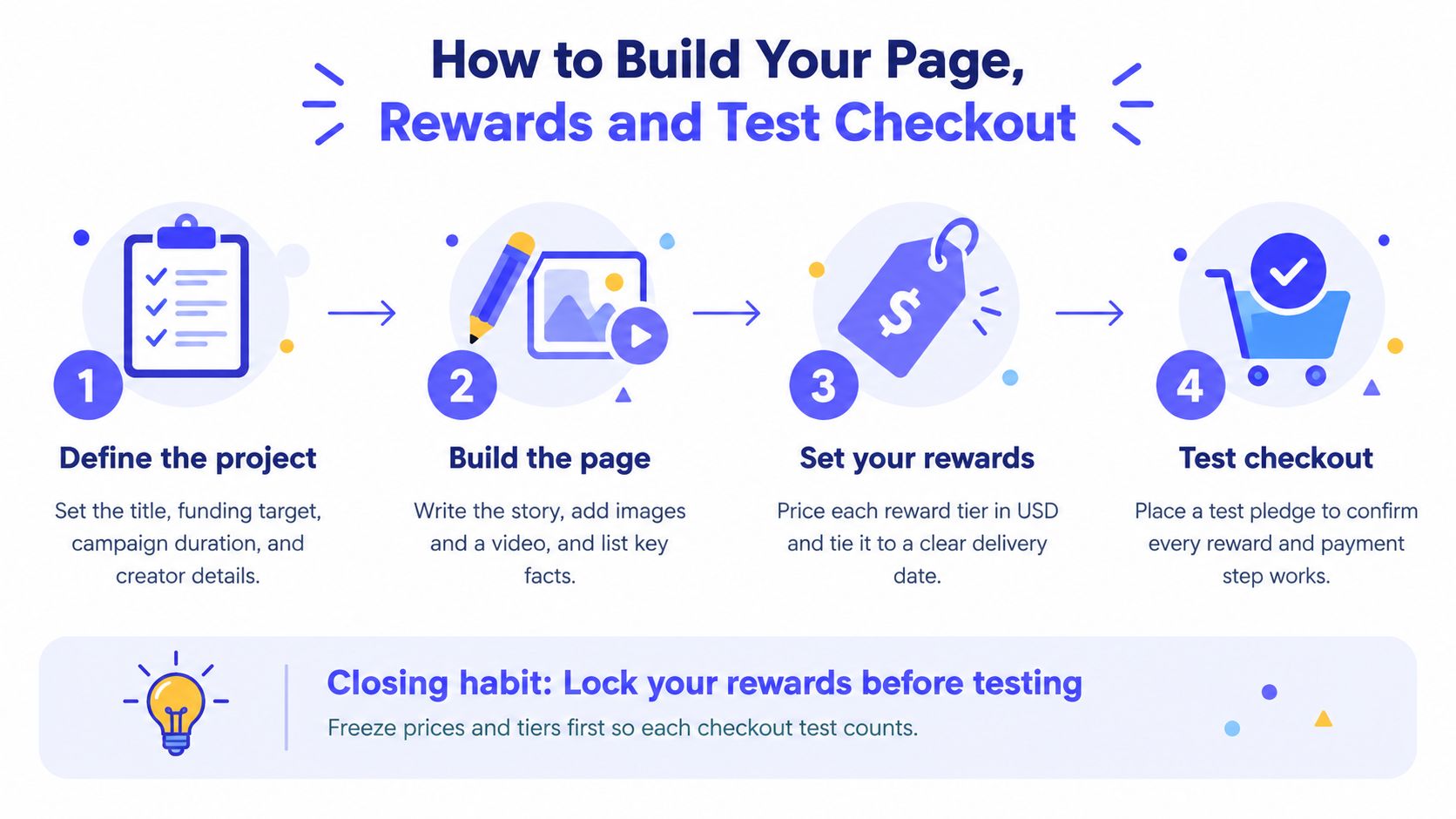
Say you've finished a hypothetical $79 bundle, complete with photography and delivery copy, but its shipping configuration omits a country you intend to serve. A test checkout reveals that the backer can't complete the order or receives an incorrect total.
The fix isn't merely adding a destination. You need to verify the carrier quote, package dimensions, tax treatment, and whether the bundle remains profitable there.
Every reward added late creates more combinations to test across destinations, add-ons, discounts, and inventory limits. Keep a change log with the setting changed, the reason, and the checkout cases that must be rerun.
Release habit: Lock prices and tiers before the final checkout pass. Reopen testing whenever a change affects what backers receive or pay.
Ask someone unfamiliar with the project to complete a test pledge without coaching. The build is finished when a stranger can choose a reward, understand the delivery terms, and complete checkout without asking you to explain the interface.
The pledge manager belongs in the same pre-launch contract as your funding goal and landed-cost model. The platform you choose decides who collects shipping, tax, and upsell revenue after the campaign closes, and switching later means migrating live order data mid-fulfillment.
Kickstarter's native Pledge Manager collects addresses, reward preferences, taxes, and shipping costs closer to fulfillment, with Kickstarter's usual fees deducted from payments made inside it. It works like a marketplace storefront, with the platform running checkout inside its own system, and it is not an interchangeable option for an Indiegogo campaign.
PledgeBox takes the independent-storefront approach: creators configure a branded survey and data workflow under their own account. Its Indiegogo pledge-manager workflow supports Stripe and PayPal, shipping integrations, Google Maps address validation, shipment tracking, and automated backer reminders. Confirm export access and data ownership before committing.
Sending a survey that only collects addresses and product choices is free. According to PledgeBox pricing, the platform's 3% charge applies to add-on sales collected during the survey, so a $100 upsell produces a $3 platform fee before payment-provider charges. Build that percentage into your upsell pricing before the page goes live, since add-on margins shrink further once Stripe or PayPal takes its cut on top.
Assign each obligation to a named owner before submitting:
Run the survey against real addresses before relying on it; validation rules reject edge cases a clean test address never exposes. Once the campaign closes, send the survey promptly, collect choices and payments, track nonresponders, and schedule reminders. Close the survey window before releasing later add-ons, then confirm destination counts and tax rules before placing supplier orders.
Complete the required information, submit the campaign for review, then schedule the public launch. Indiegogo's launch guidance requires a launch date at least 7 days after the review request and says review typically takes up to 3 business days.
Submit a finished campaign, not a nearly finished draft. Platform approval doesn't validate your margins, supplier reliability, or ability to deliver internationally.
Confirm eligibility, creator details, payout configuration, shipping plans, tax treatment, and refund terms. Have translations for your target markets, payment tests, logistics estimates, and launch creative ready before requesting review.
Use a separate pre-launch page to collect early interest while the campaign remains unpublished. Ask for information you'll really use, such as preferred reward, country, or product variant, rather than collecting email addresses without learning whether those people can buy.
Build audience capture around concrete invitations:
Set the required launch-day pledge count, then estimate how many genuinely interested opt-ins you need to support it. Use signals such as reward selections, replies, and explicit commitments rather than treating every subscriber as equally likely to pledge.
Keep a channel log recording where sign-ups came from and what those people selected. That lets you prioritize relevant communities and partners instead of chasing cheap but unqualified registrations.
Treat the mandatory review gap as a scheduling floor, not as your campaign preparation period.
Rehearse the launch email with a friend and test every destination link. If publishing across channels will distract the team, use iHatePosting to schedule social media posts, while keeping someone available to answer live questions.
Secure at least 2 contributions as an immediate visibility checkpoint: Indiegogo's first-48-hours guidance says new campaigns appear in search results for their first 48 hours, then need that contribution minimum to remain searchable. This is a discoverability threshold, not a meaningful funding target by itself.
The visibility window makes coordinated outreach more useful than waiting for marketplace traffic:
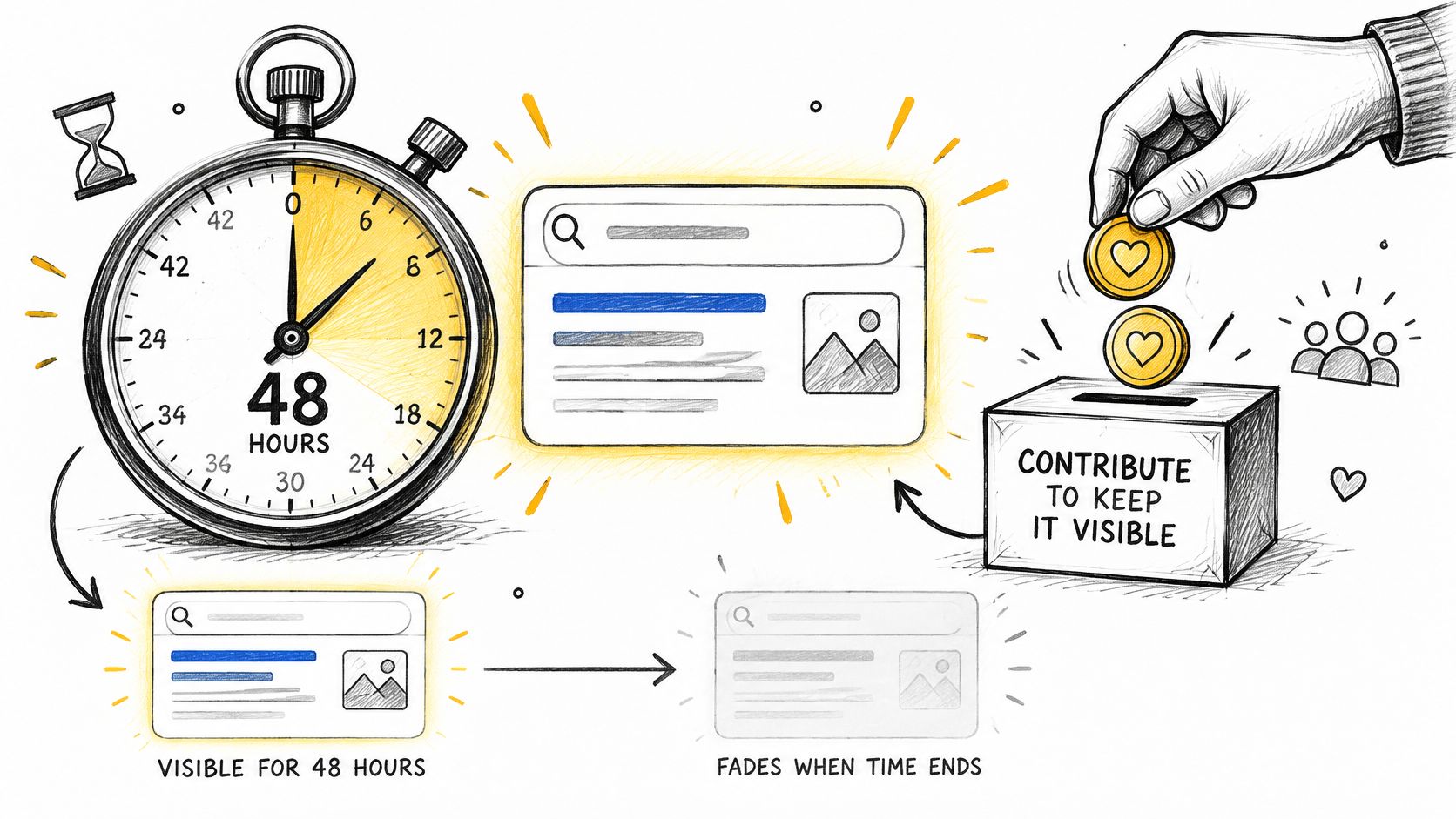
Have promotional emails, social posts, press messages, community announcements, and personal-network messages approved before publishing. A practical operating schedule is:
Watch which channels bring visitors who actually pledge. If people inspect a reward but abandon checkout, investigate shipping charges, unclear delivery terms, payment problems, or confusing bundle contents before changing the entire campaign.
Use this supporting video alongside your launch checklist:
If pledges stall, contact people who pre-committed and ask whether anything prevented checkout. Buying untargeted promotion before identifying the obstacle can send more visitors into the same problem.
Early backers demonstrate demand to later visitors and give you concrete questions to answer publicly. That momentum comes from preparation and responsive execution, not passive discovery.
PledgeBox offers branded backer surveys, add-on sales, shipping and tax collection, and fulfillment exports for Indiegogo creators. Visit PledgeBox before submitting your campaign to configure and test the post-campaign workflow alongside your rewards.
PledgeBox
The All-in-One Toolkit to Launch, Manage & Scale Your Kickstarter / Indiegogo Campaign