 PledgeBox
US Address Validation for Crowdfunding Fulfillment
Master US address validation for crowdfunding fulfillment. Learn ZIP+4, USPS CASS, APIs, and how pledge managers like PledgeBox keep shipping accurate

Master US address validation for crowdfunding fulfillment. Learn ZIP+4, USPS CASS, APIs, and how pledge managers like PledgeBox keep shipping accurate
Your fulfillment partner is ready for the address file, but you're still staring at rows that look almost right. A missing apartment number, a backer's recent move, and an unfamiliar warehouse address all need different decisions. Exporting them together with a single “validated” flag won't tell the warehouse which rewards are safe to release.
Consider a fulfillment batch containing a board game bound for an apartment building. The street name is spelled correctly, the ZIP Code matches, and the label prints without complaint. But the backer left out the apartment number. You've produced a usable label, not necessarily a usable delivery instruction.
That's an illustrative failure, not a reason to reject every imperfect address. The operational mistake is letting the same status cover a harmless abbreviation change and an unresolved delivery location. US address validation should decide what happens next, not merely make spreadsheet cells look consistent.
Crowdfunding creators should plan for a gap between collecting addresses and releasing rewards. Manufacturing schedules, staggered shipments, and backer edits make a survey response an input to fulfillment, not a permanent shipping authorization.
Separate the exceptions your team must resolve:
The practical cost isn't just postage. A failed shipment can require support work, replacement inventory, and another packing operation. For a reward with little margin left after production, that's a business problem rather than clerical cleanup.
Release rule: An address should leave the exception queue because someone resolved the delivery question, not because the export deadline arrived.
Use a three-stage control: validate at survey entry, before vendor export, and before label creation. Each checkpoint belongs to a different operational decision: collecting usable information, handing over current records, and authorizing dispatch.
Connect those checkpoints to your broader crowdfunding order fulfillment workflow, including who owns backer follow-up and who can release held orders. A validator without an exception owner just creates another unattended report.
Address quality also sits within a wider delivery operation. Peak Transport's resource on final mile delivery challenges and solutions is useful context when you're reviewing the handoff from warehouse preparation to delivery. Keep those questions separate: correcting an address doesn't replace checking the shipping service and delivery requirements.
A postal match is evidence about an address, not a promise that a parcel will reach its recipient. Understanding the underlying checks helps you distinguish useful validation from a polished autocomplete result.
The U.S. Post Office Department introduced the five-digit ZIP Code in July 1963, building on earlier city-zone identifiers. ZIP+4 followed in 1983, adding detail that could identify a city block or smaller delivery segment, as described in the Smithsonian Postal Museum's history of postal numbering.
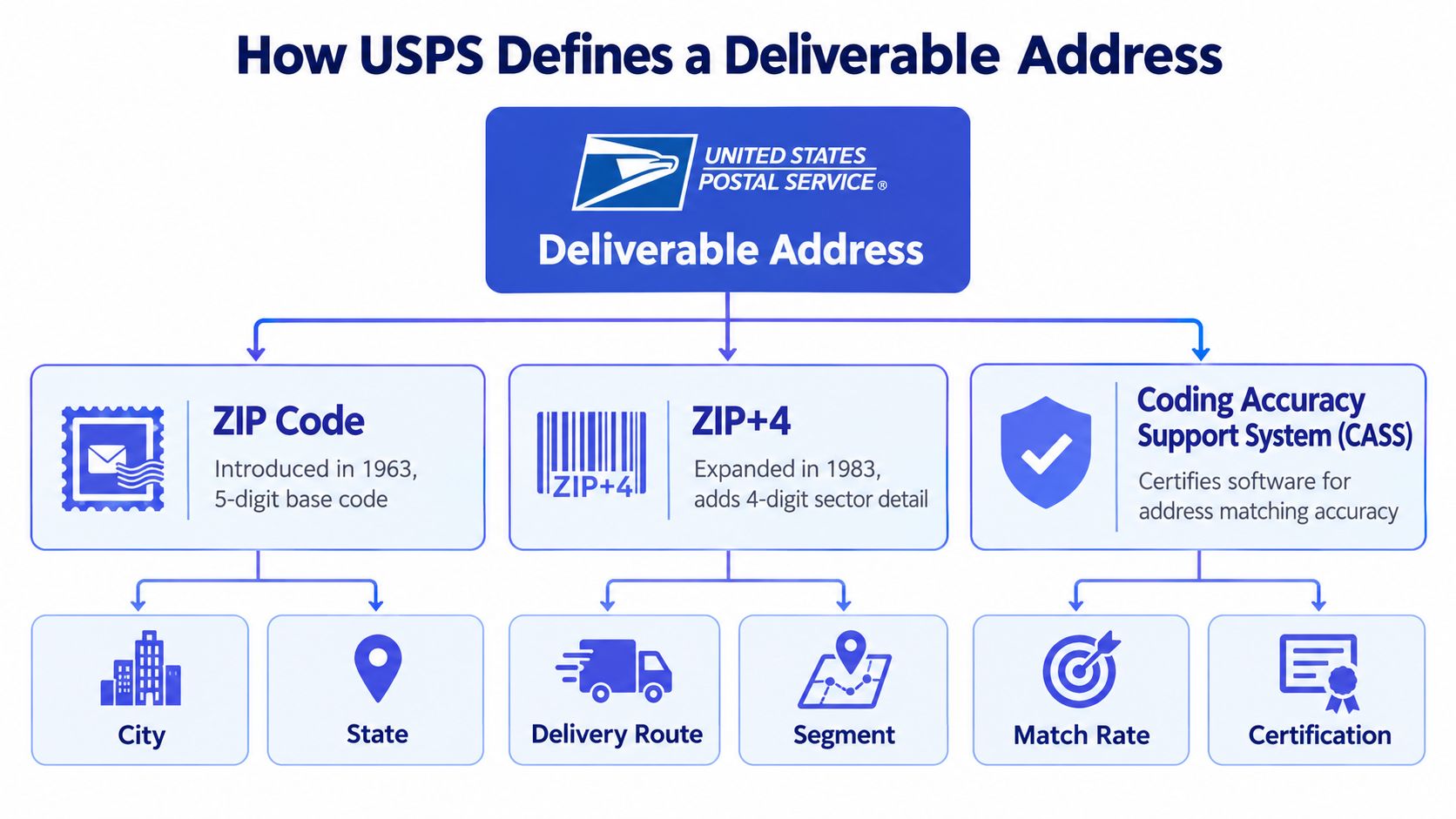
A ZIP Code places an address within structured postal geography. ZIP+4 narrows the match, but obtaining that extended code doesn't establish that every required part of the submitted destination is complete.
Coding Accuracy Support System certification, usually shortened to CASS, concerns address-matching and coding software. It isn't an individual parcel's delivery guarantee. Delivery Point Validation, or DPV, checks whether an address corresponds to an active delivery point in USPS address-management data. These are complementary controls, not interchangeable badges.
The scale matters. USPS reported 168.6 million delivery points in 2024, compared with 148.0 million in 2007, including city, rural, post-office-box, and highway-contract-route destinations in its delivery-point history. Your validator is matching against a maintained delivery network, not just checking whether a street name sounds plausible.
| Validation concept | Useful interpretation | Unsafe interpretation |
|---|---|---|
| ZIP Code match | The postal geography is consistent | The full destination is confirmed |
| ZIP+4 match | The address has a more specific postal match | Required unit information must be complete |
| CASS-certified software | The software meets postal coding requirements | Every address it processes is deliverable |
| DPV confirmation | The address matches an active delivery point | Every carrier and service can deliver every parcel |
Your fulfillment record should retain the underlying result rather than reducing everything to a green checkmark. A support agent needs to know whether the system standardized spelling, confirmed the primary location, or verified the complete delivery point.
The final shipping decision also needs the selected service and the actual address submitted for the label. Don't let a postal-data result stand in for a carrier-service check.
Choose the layer that gives your team actionable results with an implementation it can maintain. A technically capable API isn't useful if nobody maps its response codes into backer prompts and shipping holds.
USPS direct integration makes sense when you have engineering support and want postal-specific results close to the source. The documented Verify API corrects street-address errors, supplies ZIP and ZIP+4 information, and supports up to five lookups per transaction, according to the USPS Address Information API documentation. That transaction limit isn't a statement about total account throughput, so check current access terms and the endpoint you intend to implement.
A third-party evaluation might include Smarty, Lob, or Melissa. Treat those names as a shortlist, not a claim that their products return identical evidence. Ask each provider to demonstrate its current response to your own difficult records.
For an agency managing several campaigns, the evaluation should emphasize batch processing, status consistency, exception handling, and export integration. Enrichment only earns its place if someone uses it to make a fulfillment decision. Otherwise, you're paying to store extra columns.
BatchData's discussion of address standardization for real estate teams offers an adjacent perspective on address-data preparation. For crowdfunding, keep the purchasing question narrower: can your team distinguish a standardized address from an unresolved shipping destination?
Native pledge-manager tools reduce the integration burden. PledgeBox offers Google Maps-powered address validation, alongside vendor exports and shipment tracking. Treat map-assisted entry and postal delivery-point evidence as separate capabilities unless the platform explicitly exposes the latter.
| Approach | Cost Model | Lookup Depth | Engineering Effort |
|---|---|---|---|
| USPS direct | Confirm current access terms and budget for integration | Postal correction and confirmation supported by the selected endpoint | Build requests, response handling, prompts, and holds |
| Third-party API | Compare current contracts and usage terms | Evaluate postal results and any additional fields individually | Integrate the API and map results into campaign operations |
| Pledge-manager native | Evaluate the platform's payment model and included tools | Inspect visible statuses, correction prompts, and export fields | Configure the workflow and test exceptions |
For a contained hardware campaign with a developer available, direct integration may be reasonable. For a creator without engineering support, native validation is usually the more manageable starting point. Neither choice removes the need to test incomplete apartments, PO Boxes, and difficult exports before launch.
Build the workflow around normalization, parsing, postal matching, and delivery-point confirmation. These operations answer different questions, so store their outputs separately rather than overwriting the original address with a single preferred string.
Preserve the backer's entry before changing anything. Support needs to compare what the backer submitted with what the system suggested, especially when someone disputes a correction.
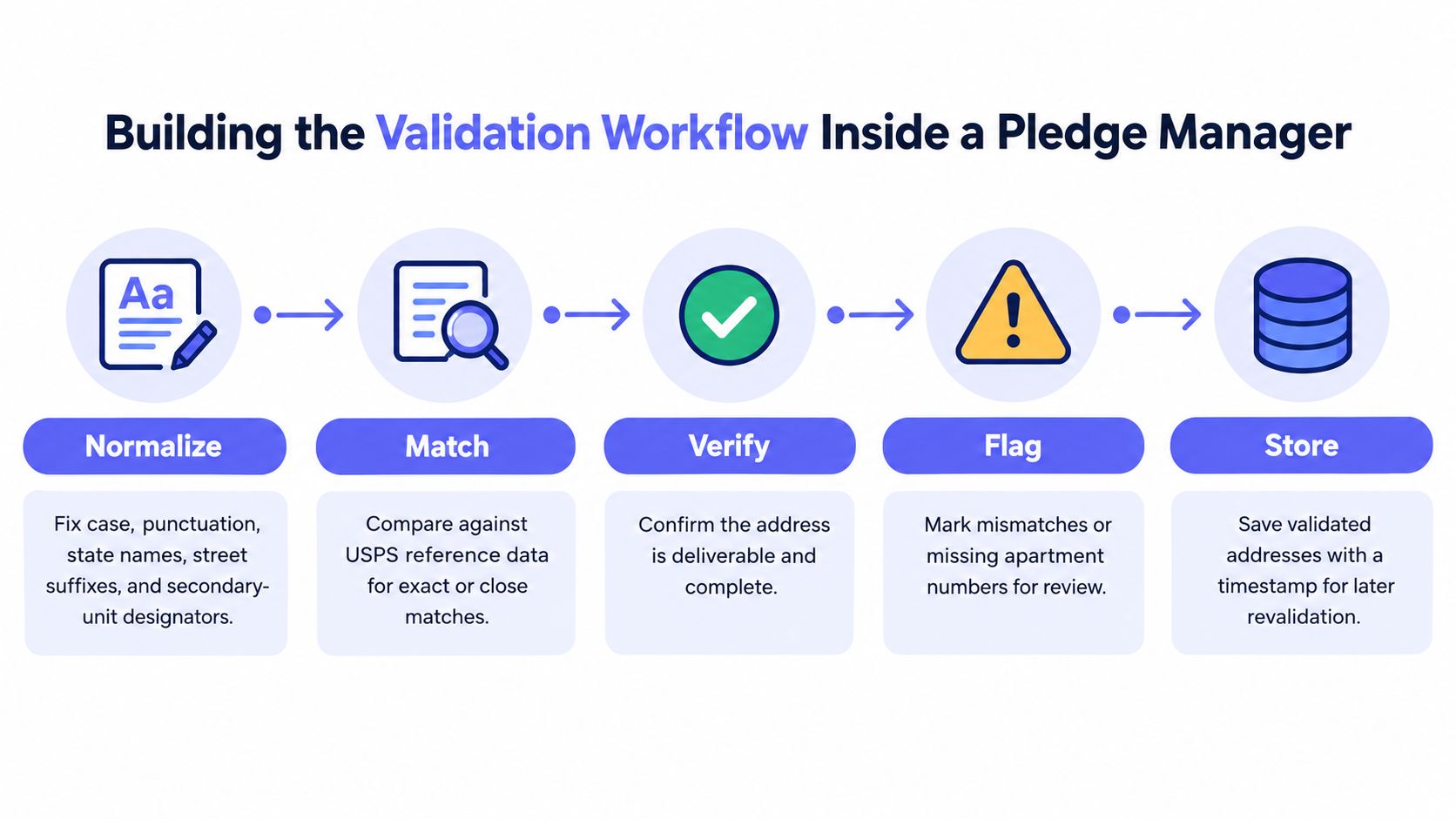
Normalize case, punctuation, whitespace, state names, street suffixes, and secondary-unit designators using postal conventions. Then parse the result into independent components: primary number, predirectional, street name, suffix, postdirectional, unit designator, unit value, city, state, and ZIP.
Use USPS Publication 28 as the implementation reference. It identifies 64 bytes/spaces as the optimum delivery-address storage recommendation for compatibility with its ZIP+4 database. Allocate sufficient capacity, test encoding, and don't truncate a unit identifier to satisfy a narrow downstream field.
The backer-facing form doesn't need to expose every parsed component. Keep entry understandable while retaining structured data behind it. Preserve leading zeros and avoid a parser that assumes every valid destination follows an ordinary street-address pattern.
Match the parsed record against ZIP+4 reference data and return a canonical mailing address. Apply DPV separately. DPV doesn't append missing elements or correct the address, so an unresolved result needs another action, not a guessed completion.
A useful operational record contains:
Store enough evidence that another team member can explain why an order was released without rerunning the entire investigation.
Treat queue ownership as part of the implementation. Decide who contacts the backer, who approves unusual but valid addresses, and who prevents unresolved records from entering the shipping file.
For a broader operational reference, doornoc's field operations data guide is a useful companion when organizing record ownership and handoffs. Keep your fulfillment-specific rule explicit: a data change must invalidate any approval that depended on the previous address.
Finally, test the exported file itself. A correct internal record is no protection if the vendor mapping drops the secondary address field.
A backer enters the building address for a hardware reward and skips the apartment field. The interface offers a standardized street name, the backer accepts it, and everyone assumes the problem is solved. This is the dangerous version of validation: the system corrected something visible while leaving the delivery question unanswered.
USPS API documentation distinguishes a confirmed primary address from a result that still needs an apartment, suite, or box number. It also cautions that confirmation doesn't necessarily mean delivery is available, as reflected in the USPS Addresses API specification.
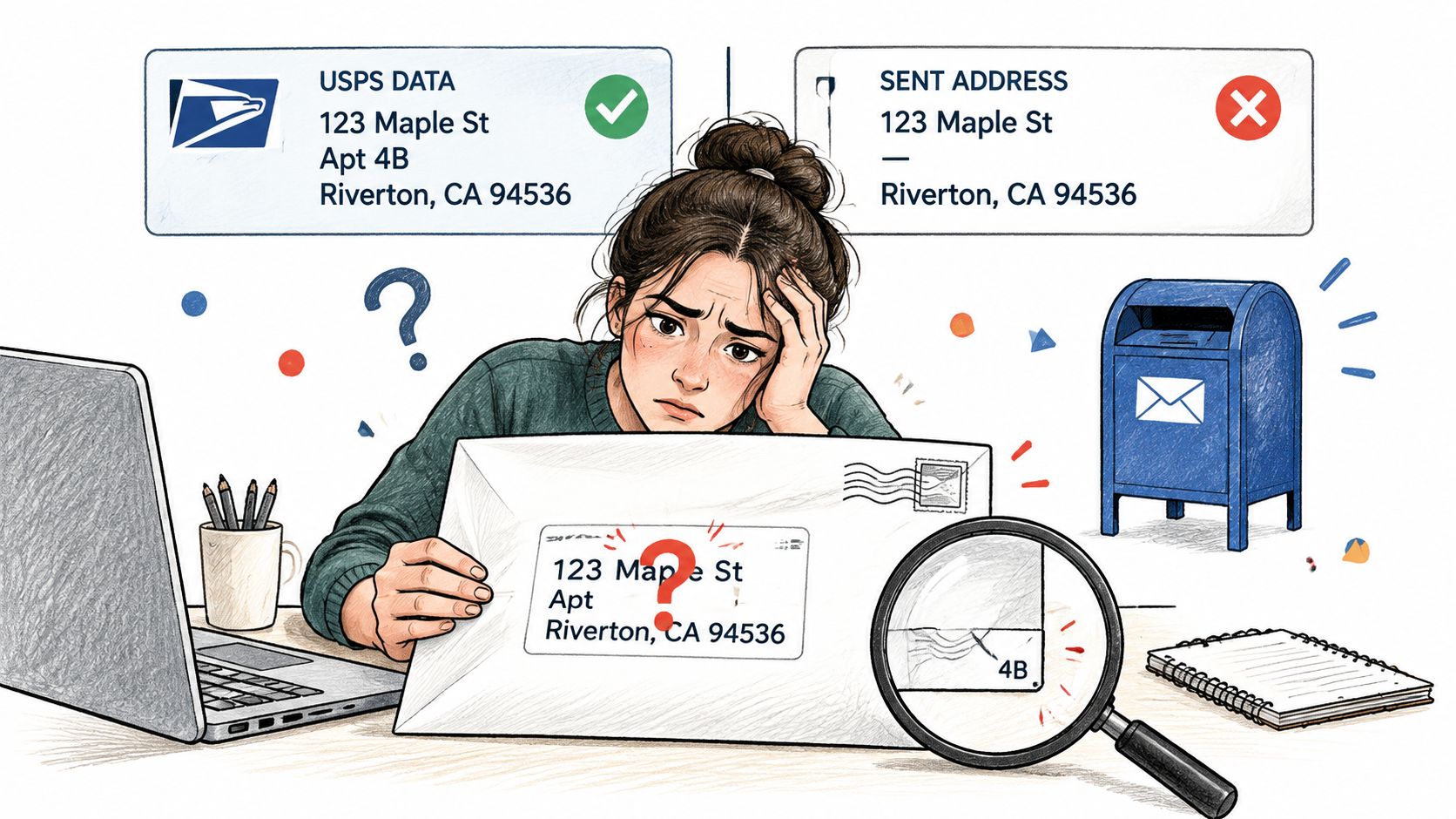
The correction prompt should identify the unresolved field. Tell the backer that the building was found and ask them to supply the apartment or suite information. Don't make them re-enter a street address the system already recognizes.
USPS requires secondary-unit designators where applicable and lists approved forms including APT, STE, FL, RM, and UNIT. Its secondary address unit designator guidance also says the pound sign shouldn't replace a known designator such as APT or STE.
Use a decision policy that keeps those distinctions visible:
Never invent an apartment number, copy one from a neighboring record, or assume the recipient's name will compensate for missing location data. A plausible completion is still an unsupported completion.
For board games and hardware, the relevant question is whether you can afford to send another physical reward if the first shipment fails. Use that question when deciding whether an unresolved unit should block dispatch.
Support prompt: We found your building address, but we still need your apartment or suite number before we can release your reward.
Measure primary-match rate separately from complete-DPV rate, clarification rate, and post-export returns. Otherwise, a report can look reassuring while your support team still has unresolved destinations waiting to ship.
An address approval belongs to a particular record at a particular time. Don't carry it indefinitely through manufacturing changes, backer edits, and separate fulfillment waves.
USPS distinguishes address-quality work from move updates. Its discussion of Move Update and NCOALink explains how change-of-address processing can identify moves and return a new address or an undeliverable status. That's different from correcting the format of an address a backer supplied.
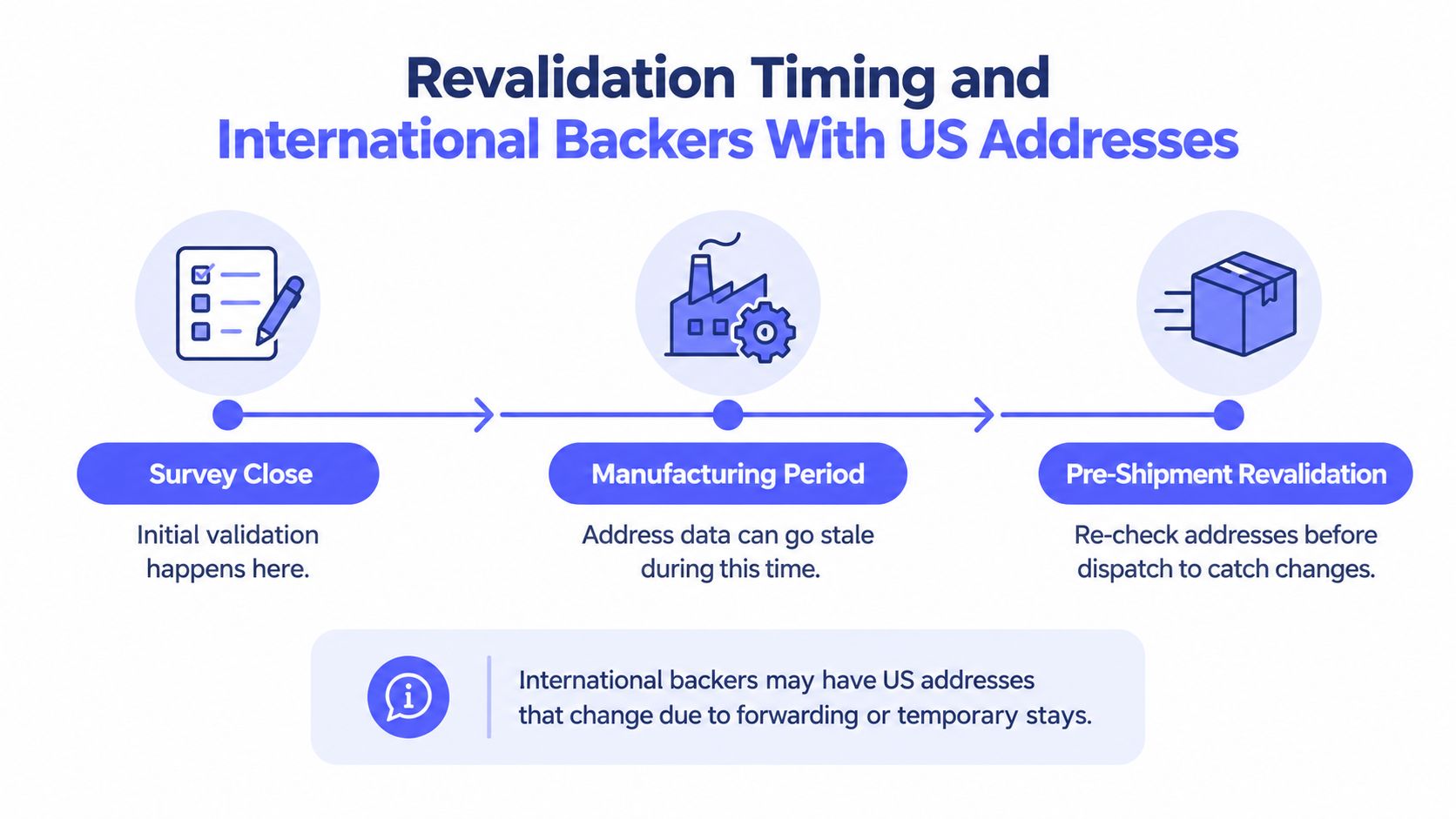
At survey entry, resolve problems while the backer is available to respond. Before vendor export, validate the latest saved address and separate unresolved orders from the release file. Before label creation, confirm that the approved version is still the version being shipped.
The last check shouldn't substitute a different destination. Handle move information through a documented process that addresses backer confirmation, privacy, and authorization. Postal correction and consent-sensitive address replacement are different decisions.
For split shipments, attach approval to the relevant shipment rather than treating an earlier dispatch as permission for every later parcel.
An international backer may provide a U.S. freight forwarder, reshipper, or warehouse address. Apply U.S. postal validation to that destination, but don't interpret a successful match as confirmation of the backer's forwarding arrangement.
Flag disclosed forwarding addresses for review. Ask the backer to confirm:
Don't strip an unfamiliar identifier merely because it looks unlike a residential apartment number. Have the backer confirm its purpose and preserve it in the appropriate field.
PO Boxes need a separate service check, not automatic rejection. Keep the destination type intact and verify compatibility with the intended shipping service. Apply equally careful handling to rural routes, military addresses, and Puerto Rico formats rather than forcing them through street-only assumptions.
For country-specific collection decisions beyond the U.S. destination, use this guide to international address validation alongside your shipping-provider requirements.
Kickstarter's pledge manager is like Amazon, and PledgeBox's pledge manager is like Shopify: a useful analogy for comparing an integrated platform checkout with a creator-configured survey and storefront. It's an analogy, not evidence that either provides the same postal validation controls.
PledgeBox is free to send the backer survey, with no setup, campaign, or per-backer fee. It charges 3% only on revenue collected through the survey when there's an upsell or other payment, including applicable add-ons, shipping, and taxes/VAT, never original Kickstarter or Indiegogo funds; without additional payment, the survey is free, according to PledgeBox pricing.
| Capability | PledgeBox | Kickstarter Pledge Manager |
|---|---|---|
| Address handling | Google Maps-powered validation | Address collection and confirmation |
| Operational tools | Vendor exports and automatic shipment tracking | Integrated reward and payment flow |
| Upfront cost | No setup fee | No upfront cost |
| Payment model | Survey-revenue fee described above | Usual Kickstarter fees on pledge-manager payments |
Kickstarter documents its costs and collection process in its pledge-manager setup guidance. Its backer flow combines rewards, add-ons, survey answers, address confirmation, and applicable payment.
Use the PledgeBox and Kickstarter pledge-manager comparison to assess customization needs. Before committing, test correction prompts, missing-unit holds, export mapping, and label-stage approval with your fulfillment partner. Choose around exception workload and configuration needs, not backer count alone.
PledgeBox offers backer surveys, Google Maps-powered address validation, and vendor exports to support your fulfillment handoff. Visit PledgeBox to configure your survey, then test an incomplete apartment address and a forwarding destination before releasing your shipping file.
PledgeBox
The All-in-One Toolkit to Launch, Manage & Scale Your Kickstarter / Indiegogo Campaign