 PledgeBox
Postal Address Validation API for Crowdfunding Fulfillment
Learn how a postal address validation API reduces failed deliveries, cleans backer surveys, and fits into your crowdfunding fulfillment stack

Learn how a postal address validation API reduces failed deliveries, cleans backer surveys, and fits into your crowdfunding fulfillment stack
You've closed the campaign, the comments have gone quiet, and now the work starts. Backers expect rewards, not excuses. What usually breaks the schedule isn't manufacturing alone. It's the ugly pile of addresses that looked fine in a survey and then exploded into returns, carrier exceptions, and support tickets once labels were printed.
A postal address validation API won't save a sloppy fulfillment process by itself. But if you run crowdfunding at any serious volume, it belongs in your stack right beside your pledge manager, shipping rules, and export workflow. Pick the wrong setup and your team spends launch momentum fixing apartments, rural routes, and bad postcodes by hand. Pick the right setup and you catch problems while the backer is still in the survey, not when cartons are already on pallets.
A campaign closes, surveys go out, and the spreadsheet fills quickly. Fulfillment review reveals the problem: missing unit numbers, swapped locality fields, incorrectly formatted postal codes, courier-incompatible PO boxes, and international addresses forced into a U.S.-style form. The survey looked complete. The orders were not ready to ship.
A submitted survey is customer input, not a shippable order. Treating every address as equally usable pushes avoidable work into picking, labeling, and customer support.
Practical rule: Fix an address while the backer is still typing it.
Use a postal address validation API as a logistics safeguard, not as a developer add-on. It should catch structural problems early, standardize fields where possible, and flag records that still require human review before the warehouse receives the export. It cannot resolve every delivery risk, but it can keep obvious defects out of the fulfillment queue.
Choose validation as part of the post-campaign stack: the pledge manager, survey flow, payment handling, and fulfillment export. A capable API will not repair a pledge manager that captures addresses poorly or hides corrections from your team. Decide where the prompt appears, which version of the address is stored, and whether the cleaned record reaches your warehouse export.
Cost and control belong in the same decision. Kickstarter Pledge Manager is like Amazon, a constrained checkout attached to the campaign. PledgeBox pledge manager is like Shopify, a more configurable standalone store model. PledgeBox is free to send the backer survey and only charges 3% of upsell if there's any. Kickstarter applies its usual 5% fee on applicable pledge manager payments, while Stripe charges a variable card-processing fee of roughly 3% to 5% on the full payment, including taxes, according to Kickstarter's fee guidance.
That makes validation one part of a wider operating choice. Compare the correction experience, stored data, export controls, and payment economics together. A free survey can still create expensive manual cleanup if the workflow sends bad addresses downstream.
A real Postal Address Validation API supports three separate jobs: structuring the record, checking postal support, and returning signals your fulfillment team can act on. Treat it as one component of the post-campaign stack, alongside the pledge manager, survey, payment flow, and warehouse export.
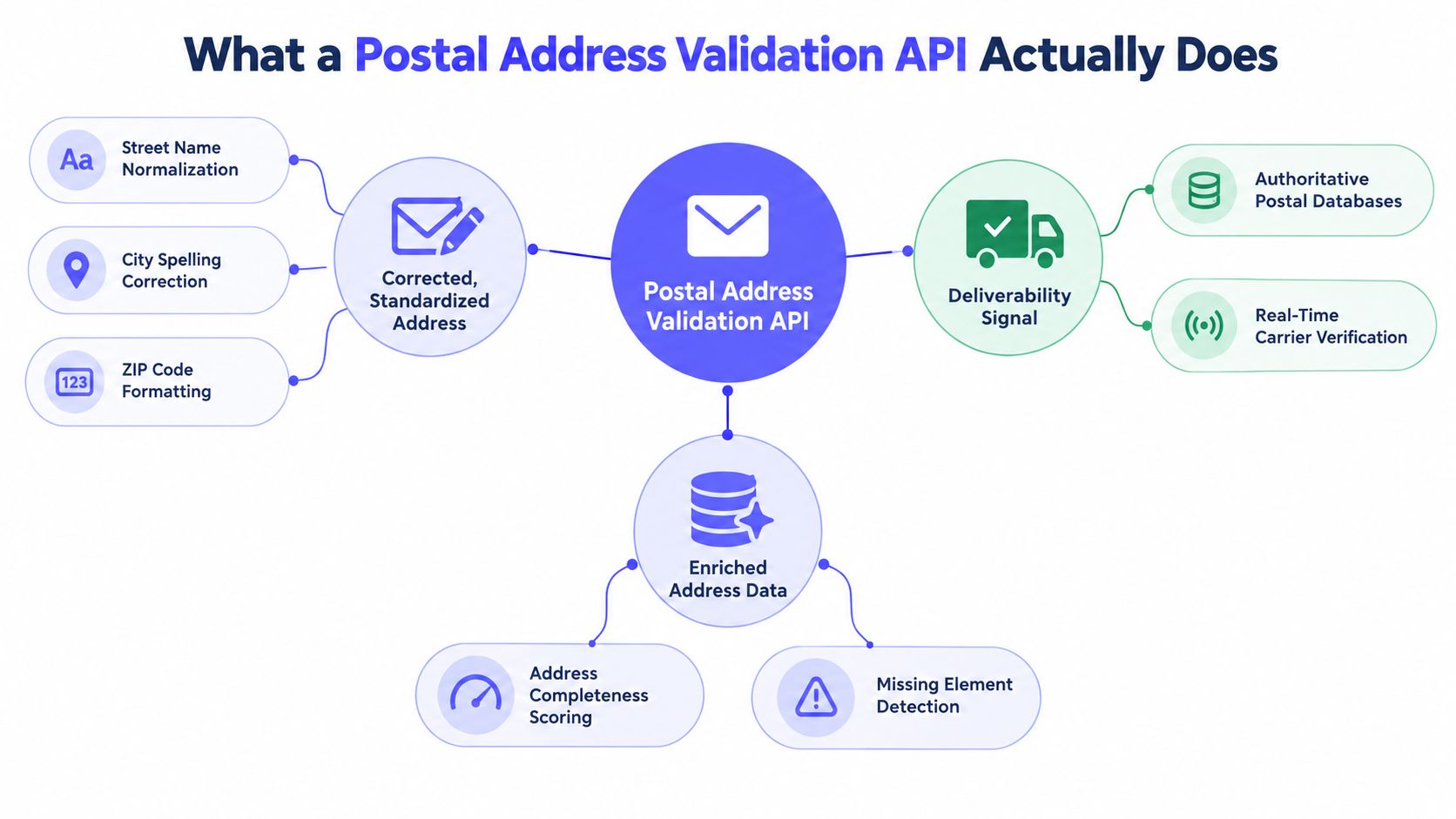
The API converts messy input into country-aware fields, including organization, premises, thoroughfare, locality, administrative area, postcode, and country. That structure matters when your survey feeds tax rules, shipping zones, or a warehouse file. The Universal Postal Union's S42 framework supports domestic and cross-border mail through Part A, which defines common address components, and Part B, which supplies country-specific templates.
A proper API applies published addressing rules rather than guessing at one universal format. The UPU's Address Verification API announcement describes checks against worldwide postal data, standardized format descriptions, and country-specific postcode rules based on S42, registered as ISO 19160-4.
A clean address can still fail at the delivery stage. Your API should distinguish a standardized record from one supported by postal reference data.
For U.S. flows, USPS Address Standardization corrects street-address errors and can return ZIP Code and ZIP+4. USPS states that ZIP+4 identifies a delivery point when street address, city, and state are supplied. Use that output as a control in the address workflow, not as proof that every parcel will arrive.
A useful response gives more than a green checkmark. Require statuses such as corrected, partially matched, ambiguous, or unverifiable, and preserve the original input for support tickets and audit trails.
Keep the cleaned fields available for downstream shipping logic. This Dotstore shipping rules tutorial shows how normalized postcode and regional data can drive shipping-rule execution. That control matters when the pledge manager charges for upsells or payment processing, because correcting an address after export costs staff time that the API should have prevented.
A polished demo proves very little. Actual assessment begins when backers submit multilingual addresses, missing apartment details, or incomplete rural records. Run those cases before you compare feature lists, because a form checker can reject obvious typos while leaving your fulfillment team with unresolved delivery risk.
A peer-reviewed geocoding study covering 3,615 addresses across 49 U.S. states found address-match rates ranging from 30% to 98%, mean positional differences of approximately 1,809 meters, 748 meters, 704 meters, and 228 meters across vendors, and census-tract agreement ranging from 85% to 98%. Treat those findings as a warning: a successful-looking match does not establish equal accuracy across providers.
| Criterion | What to Ask the Vendor | Red Flag |
|---|---|---|
| Formatting and standardization | How do you parse country-specific components, and do you return both raw input and normalized fields? | One global format, one output string |
| Geocoding quality | Do you expose confidence or match-quality signals for mapped results? | Latitude and longitude with no quality explanation |
| Postal-standard compliance | Which postal standards or national datasets inform formatting and checks? | “Our AI figures it out” |
| Carrier or postal coverage | How do you distinguish standardized records from records verified against postal reference data? | Single boolean “valid” |
| Latency in workflow | Can validation run at survey submission without creating a cleanup queue? | Batch-only workflow |
| Pricing | Do repeat validations or pre-export rechecks trigger punitive costs? | Pricing that discourages revalidation |
The extra criterion is explainability. Require failure states that tell operations whether an address was corrected, partially matched, ambiguous, or unverifiable. Preserve the original submission beside the normalized record, so support can see what the backer entered and what the API changed.
Cost control belongs in the same decision. Free surveys and a percentage fee on upsells create different incentives from a workflow that charges for every validation call. Choose an API that allows rechecks before export, rather than forcing staff to choose between an avoidable carrier ticket and another billable request.
Deutsche Post's 2025 address study found 13.1% of German customer addresses were unavailable or undeliverable, while only 2.2% contained major street, locality, or postal-code errors and 0.4% had incorrect house numbers. A clean-looking record can therefore fail for reasons that a basic form check will not expose.
Apply the same discipline to contact recovery. These real-time email validation tips can help keep survey communications reachable when you need a backer to correct an address.
A vendor who cannot explain failure states is selling cosmetic certainty.
A backer submits an apartment address, the survey accepts it, and the warehouse later receives a record the carrier cannot deliver. The fix starts with choosing the right container for address capture, corrections, billing, exports, and communication. The API supports that container. It does not replace it.
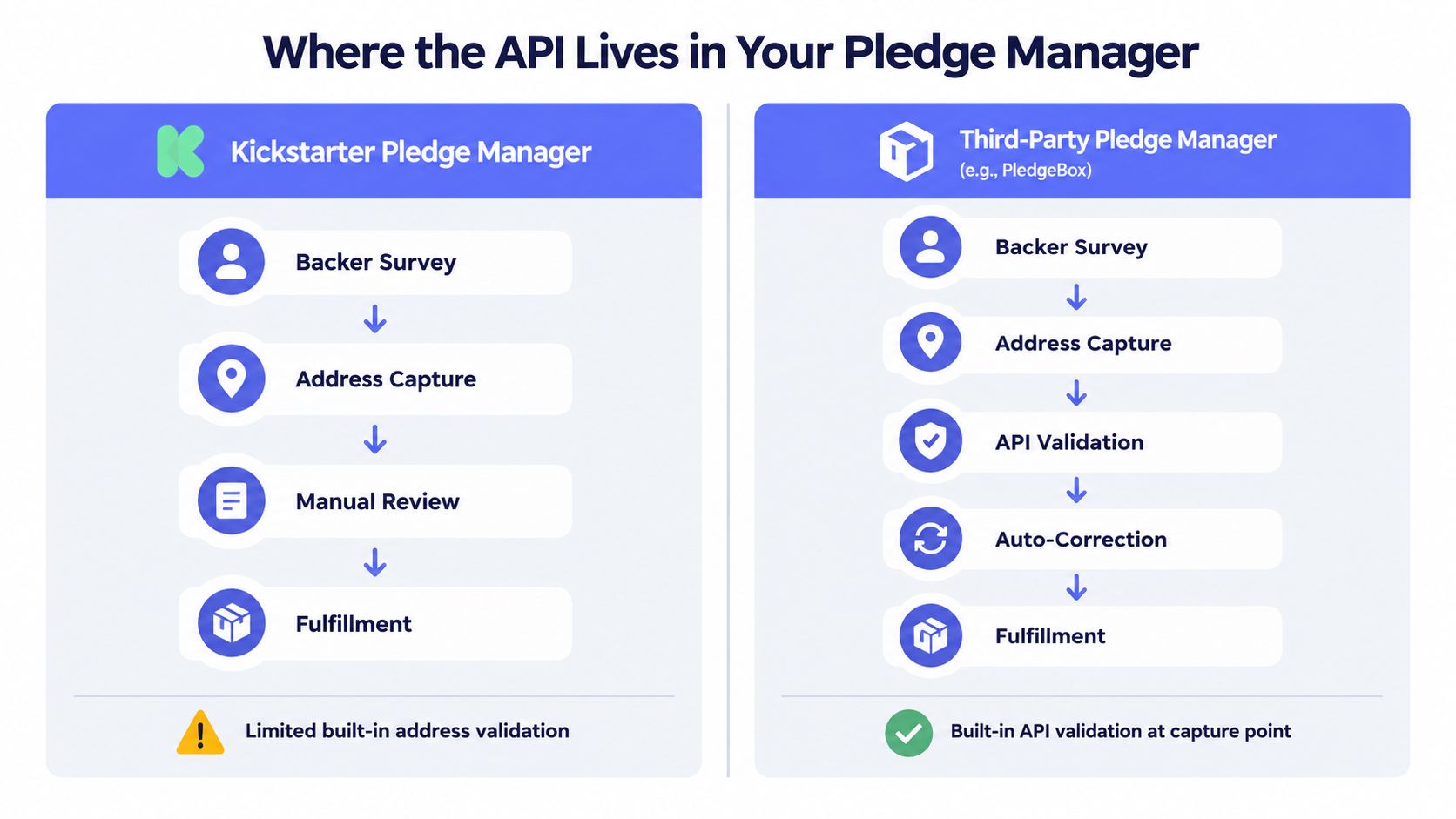
Kickstarter Pledge Manager is like Amazon. It stays close to the original campaign and suits straightforward post-campaign collection. Kickstarter says there is no upfront cost, but payments made through the manager carry the same 5% platform fee plus separate Stripe processing described earlier. It also supports finalizing shipping after the campaign with weight-based or flat-rate shipping.
PledgeBox pledge manager is like Shopify. It functions more like a configurable post-campaign storefront, combining branded surveys, add-ons, shipping collection, and validation in one workflow. PledgeBox's pricing details state that there is no setup fee, campaign fee, or per-backer fee. Backer surveys are free, while qualifying survey revenue, including add-ons, shipping fees, and taxes or VAT, incurs a 3% charge. A survey producing no additional revenue remains free.
Choose the container before choosing the API. A free survey with a percentage fee on upsells creates a different cost structure from a workflow that bills every validation call. Price the full stack, including payment processing, address checks, support time, and the cost of correcting bad exports.
At minimum, the validation layer should run during address entry, suggest corrections, and preserve both the backer's original text and the normalized record. It should also expose a clear status for operations, so staff can separate accepted addresses from records needing review. An API that only cleans a spreadsheet after the survey closes leaves preventable work for fulfillment.
Review this crowdfunding pledge manager overview to see how the manager fits into the wider post-campaign workflow. The recommendation is practical: use a pledge manager that controls capture, payments, corrections, and exports, then place postal address validation where it can stop bad data before packing begins.
If your team validates only once, you're doing half the job. Addresses change. Backers edit late. Reference data updates. You need validation at capture and again before export.
A clean workflow looks like this:
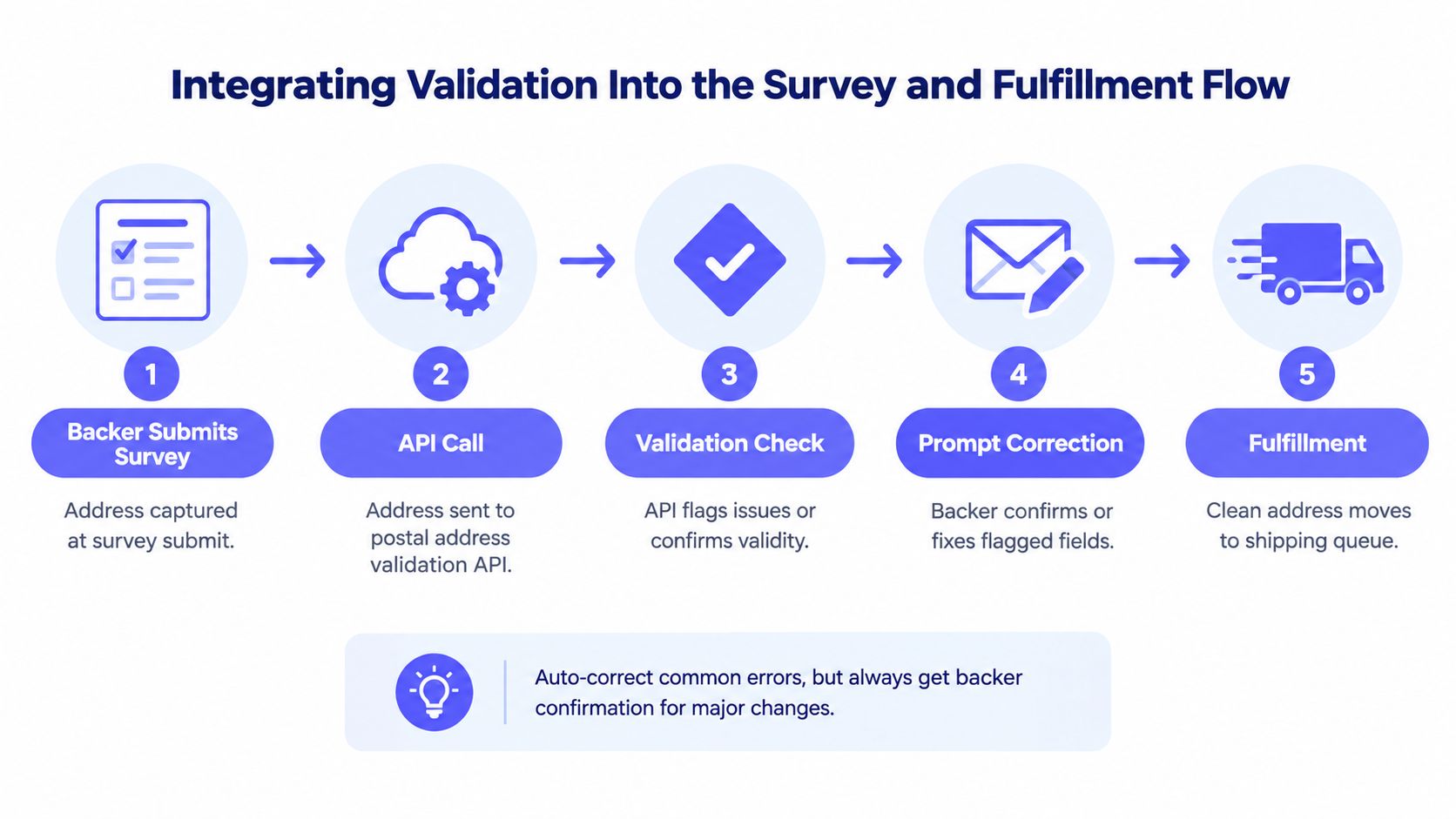
When the backer clicks submit, send the record to the validation layer immediately. If the response is ambiguous, partially matched, or unverifiable, stop the user and ask for confirmation. Don't rewrite anything important, especially apartment, building, or dependent-locality fields.
Store these fields every time:
A practical example of this embedded approach is Google Maps address validation in a backer survey workflow, where the check happens during data capture instead of after the spreadsheet already has problems baked in.
Here's a quick walkthrough of how that survey-stage logic works in practice:
Do it again right before you hand data to the warehouse, 3PL, or freight forwarder. This second pass catches edits made after the first submission and gives you a fresh validation timestamp tied to the exact export used for fulfillment.
Never export shipping data without a final validation pass on the actual outbound file.
That second validation should also preserve history. If a backer disputes a correction later, your team needs an audit trail showing the original entry, the standardized output, the status code, and when the record was last checked.
A backer enters a plausible address, the API returns “valid,” and the fulfillment file moves on. Weeks later, the carrier cannot complete delivery, the replacement costs money, and support handles the ticket. A green status confirms that software completed a check. It does not guarantee a parcel can reach a person.
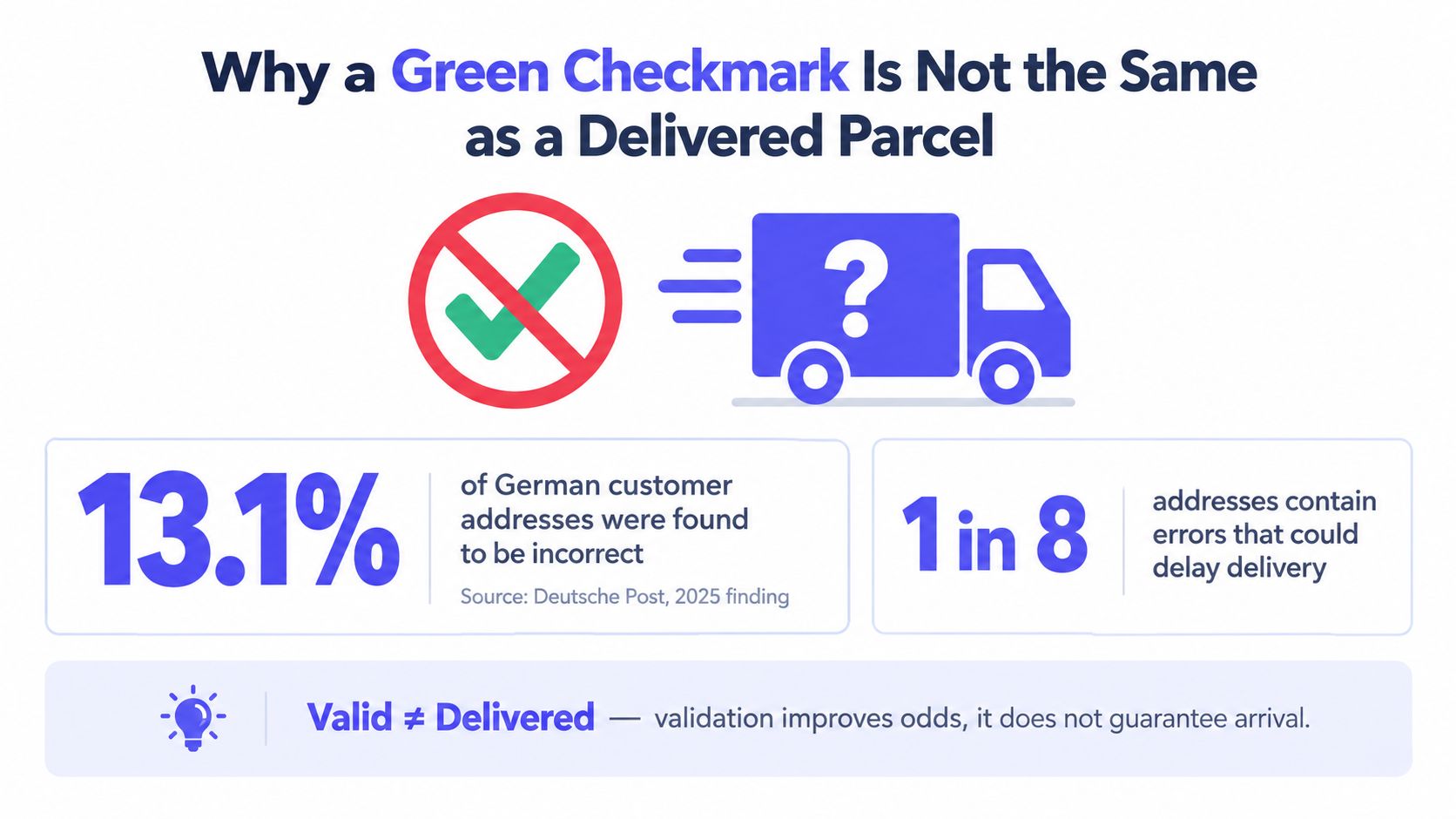
Deutsche Post's 2025 address study found 13.1% of German customer addresses were unavailable or undeliverable, while only 2.2% had major street, locality, or postal-code errors and 0.4% had incorrect house numbers. The gap matters. An address can look structurally correct and still fail in real delivery conditions.
People move, recipients become unreachable, and locations stop accepting mail. An API may identify a recognized street and number without proving that the named person currently receives parcels there. If your system reduces every result to “valid,” your operations team loses the information needed to decide what happens next.
U.S. shipments need status detail beyond simple standardization. USPS documentation describes corrections to submitted addresses and returns ZIP+4 data, while USPS-specific response models distinguish delivery confirmation quality. DPV confirmation value Y means the primary and applicable secondary number are confirmed as deliverable. S means the primary number is confirmed, but the secondary information is present and unconfirmed.
That distinction matters for a board game sent to an apartment building. Treating S like Y accepts building-level certainty when the unit number determines whether the parcel reaches the backer.
Give fulfillment clear statuses it can act on:
Poor address quality can reduce successful delivery by up to 14%, while better accuracy can increase first-attempt success by as much as 23%, with a median improvement of 5.4% across postal operators, according to the Universal Postal Union notes. Use those figures as a reason to demand useful status detail, not as permission to treat the API as a delivery guarantee.
Build the API into the wider post-campaign stack. Keep validation costs visible beside pledge-manager economics: surveys may be free, while upsells can carry a 3% fee, and Kickstarter charges 5% plus Stripe processing. Spend validation budget where it reduces reships, manual reviews, and carrier exceptions.
Green means the software finished a check. It does not mean your parcel will arrive.
Most address-validation advice is written as if every backer lives on a neat street with a number, city, state, and postcode. Crowdfunding doesn't work like that. You'll ship to apartment towers, campus housing, PO boxes, rural routes, dependent localities, and places where the useful location signal isn't captured by a conventional street line.
If your form uses one fixed field order for every country, you're causing avoidable errors. Global validation works when the system models country-specific components, preserves local-language text, and accepts that some countries need fields your default form doesn't even show.
That's exactly why the UPU's 2025 Digital Address Reference Model proposal calls for address-component classification, validation hierarchies that prioritize verifiable location data, digital-element integration, and fallback procedures when conventional addressing fails. That proposal signals the core issue clearly. Global address validation is an interoperability problem, not just a formatting problem.
Use this checklist when briefing a vendor or configuring your survey:
For teams shipping a broad international backer base, this guide to international address validation is useful because it focuses on what breaks when you move beyond domestic assumptions.
The short version is simple. Don't ask whether the API handles international addresses. Ask how it handles the international addresses that don't look like your own.
You can screen most address-validation vendors in one call if you stop asking marketing questions and start asking operational ones.
My recommendation is blunt. If you're shipping simple domestic rewards with limited upsells, Kickstarter's built-in route can be enough, and its manager uses the usual 5% platform fee with separate Stripe processing as noted earlier. If you want more control over the post-campaign stack, Kickstarter pledge manager is the like amazon and pledgebox pledge manager is like shopify. Also keep the economics straight: PledgeBox is free to send the backer survey and only charge 3% of upsell if there's any.
Pick the container and the validation approach in the same sitting. That's how you avoid paying twice, once in platform fees and again in support tickets.
If you want a post-campaign setup that captures addresses cleanly, validates them in the survey flow, and keeps fulfillment exports tighter, PledgeBox offers a pledge manager with built-in address-validation support alongside shipping, upsells, and backer surveys. It's a practical fit when you need the API to live inside the same workflow that collects late add-ons, shipping fees, and final delivery data.
PledgeBox
The All-in-One Toolkit to Launch, Manage & Scale Your Kickstarter / Indiegogo Campaign