 PledgeBox
Shipping Rates Going Up: Causes and Creator Fixes
Shipping rates going up in 2026? See the causes, benchmark rates, surcharges and pledge manager options that protect crowdfunding margins.

Shipping rates going up in 2026? See the causes, benchmark rates, surcharges and pledge manager options that protect crowdfunding margins.
The Shanghai Containerized Freight Index averaged 149% higher in 2024 than in 2023, according to UN Trade and Development. That isn't a surcharge a creator can comfortably hide inside a small contingency. It's a reminder that the shipping estimate you publish during a campaign and the invoice you receive at fulfillment can describe very different conditions.
For creators dealing with shipping rates going up, the solution isn't automatically to charge every backer more. First, separate the carrier's base rate from the other charges. Then identify the verified increase, reduce what you can, and decide who should pay the remainder.
Shipping rates rise when usable shipping capacity shrinks relative to demand, and when carriers add charges on top of the base price. More ships on paper don't necessarily mean more available space on your route.
The largest disruption is often lost effective capacity. Ships diverted from the Suez Canal around the Cape of Good Hope spend longer completing each voyage. That leaves fewer vessels available for their next scheduled departure, while congestion can keep additional ships and containers waiting.
A Xinde Marine News account gives September 2026 estimates of diversions absorbing roughly 5%–7% of the global containership fleet, equivalent to approximately 1.7–2.4 million TEU, with congestion tying up about 3.92 million TEU, around 11% of the fleet. Treat those estimates as a dated assessment, not a permanent capacity deduction, and don't add them together without checking for overlap.
The hierarchy below separates the underlying capacity problem from the charges creators ultimately see.
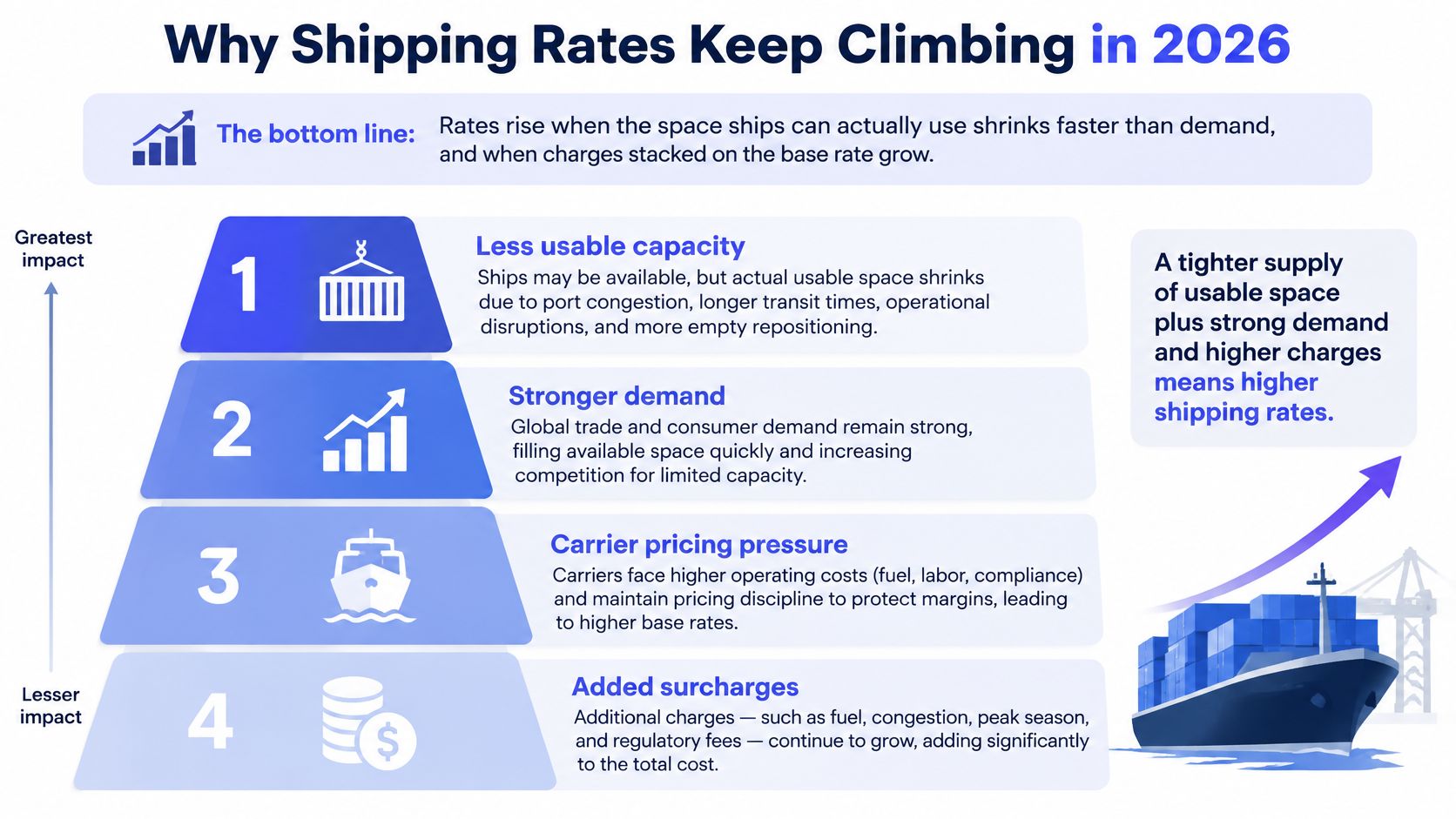
Demand can absorb available space quickly. Importers booking ahead of seasonal selling periods may compete for the same departures, even while another destination has spare capacity.
Think of a freight rate like a hotel price in a city with few rooms left. The building hasn't changed, but the price changes because more customers want the remaining rooms.
Equipment availability matters too. An empty container waiting at the wrong port can't carry your rewards, and delayed unloading extends the time before that container returns to circulation. Carriers can then change fuel, security, customs-related, or demand charges separately from their advertised freight rates.
For evidence of how quickly conditions can shift, New Zealand's Ministry of Foreign Affairs and Trade reported that global shipping rates nearly doubled between late April and July 2024. Policy changes deserve their own review alongside freight, particularly for campaigns affected by new U.S. tariffs on China.
A quote is a snapshot of one lane in one month, not a permanent price.
A benchmark's job is to put your quote in the right neighborhood, then let the details decide. The historical composite moved from about US$1,420–1,429 per container in 2019 to US$10,377 at the September 2021 peak, with the May 2025 reference at US$2,076, according to the World Bank freight-rate analysis summarizing Drewry figures.
Freight benchmark rates by period and lane
| Benchmark | Period | Rate | Context |
|---|---|---|---|
| Composite container rate | 2019 average | About US$1,420–1,429 per 40-foot container | Pre-pandemic baseline |
| Composite container rate | September 2021 | US$10,377 per 40-foot equivalent unit | Record peak, about seven times the 2019 average |
| Composite container rate | May 2025 | US$2,076 per 40-foot container | 46% above the 2019 average |
| Shanghai Containerized Freight Index | 2024 annual average | 2,496 points | 149% higher than 2023 |
| Shanghai to South Africa | 2024 average | US$5,426 per TEU | Nearly tripled |
| Shanghai to West Africa | 2024 average | US$5,563 per TEU | Up 137% |
| Asia to North Europe | Week ending 23 October 2026 | US$3,698 per FEU | Up 6.8% in one week |
| Asia to Mediterranean | Week ending 23 October 2026 | US$4,442 per FEU | Up 5.8% in one week |
The composite rows draw on the World Bank and Drewry figures above, and the Shanghai index and African-route rows come from UN Trade and Development's annual reporting. The two weekly lane readings reproduce Xeneta's week-ending 23 October 2026 assessment of Far East-to-Europe spot rates, reported by Hellenic Shipping News, and they describe market direction on that trade rather than any carrier's offer to you.
Match the benchmark to your destination lane first. Carriers price the balance of demand, equipment, and available departures route by route, so a global composite can look calm while your specific corridor runs hot.
Units trip people up here. Index points and dollar prices measure different things, and a TEU (a twenty-foot equivalent unit) is a different quantity from an FEU (a forty-foot equivalent unit). Neither resembles the per-parcel charge a single backer pays, so a creator palletizing cartons for a fulfillment center reads this table differently from someone comparing postage.
The September 2021 peak shows how sharply freight can move between campaign planning and fulfillment. The more useful figure for a current quote is the gap between May 2025 and the 2019 baseline: a lane priced well above its own history deserves a question, while a moderate premium over pre-pandemic rates may be where the market sits.
A large gap from a comparable lane is reason to investigate a stale or padded quote, though it proves nothing by itself. Ask whether the quote bundles terminal handling, inland transport, documentation, or insurance that the index leaves out. The headline freight figure is one line of the bill, and the charges stacked around it, plus who ends up paying them, decide your real margin. Once you can isolate the increment a benchmark verifies, a pledge manager lets you re-quote only that piece before fulfillment rather than repricing the entire campaign.
Before drawing firm conclusions, request the contract equivalent for your actual shipment size, sailing window, and service scope. A quote covering more services will sit above a spot-market reference for honest reasons.
The base freight rate is only one line of the bill. Your landed-cost worksheet should distinguish the product's cost from the transportation, clearance, tax, and delivery charges required to get it into a backer's hands.
That distinction matters because carriers can change the fee structure without making a comparable change to the advertised base rate. Parcel-cost reporting published by Yahoo Finance says FedEx made or announced more than 50 pricing changes in the first half of 2025; the same reporting projects ground costs 43.3% above the January 2018 baseline in Q4 2026, up 5.8% year over year, and express costs up 13.8% year over year.
Landed cost components and when to re-quote them
| Cost component | What triggers it | Re-quote before fulfillment? |
|---|---|---|
| Base freight | Lane, carrier and booking month | Yes, once the quote validity date passes |
| Fuel surcharge | Fuel price moves and carrier index updates | Yes, check at each booking window |
| Dimensional weight | Bulky cartons billed on volume | Yes, after the final packed size is measured |
| Customs duties and VAT | Destination rules, tariffs and tax changes | Yes, before production is locked, then confirm before shipment |
| Delivery-area surcharge | Remote, rural or restricted postcodes | Yes, for every postcode on the backer list |
| Demand or peak surcharge | Peak season and tight capacity | Yes, for late-backer shipments |
| Last-mile delivery | Final carrier leg in the destination country | Reconfirm for the selected service level and region |
Use the invoice layout below as a prompt to ask for an itemized quote rather than an unexplained total.
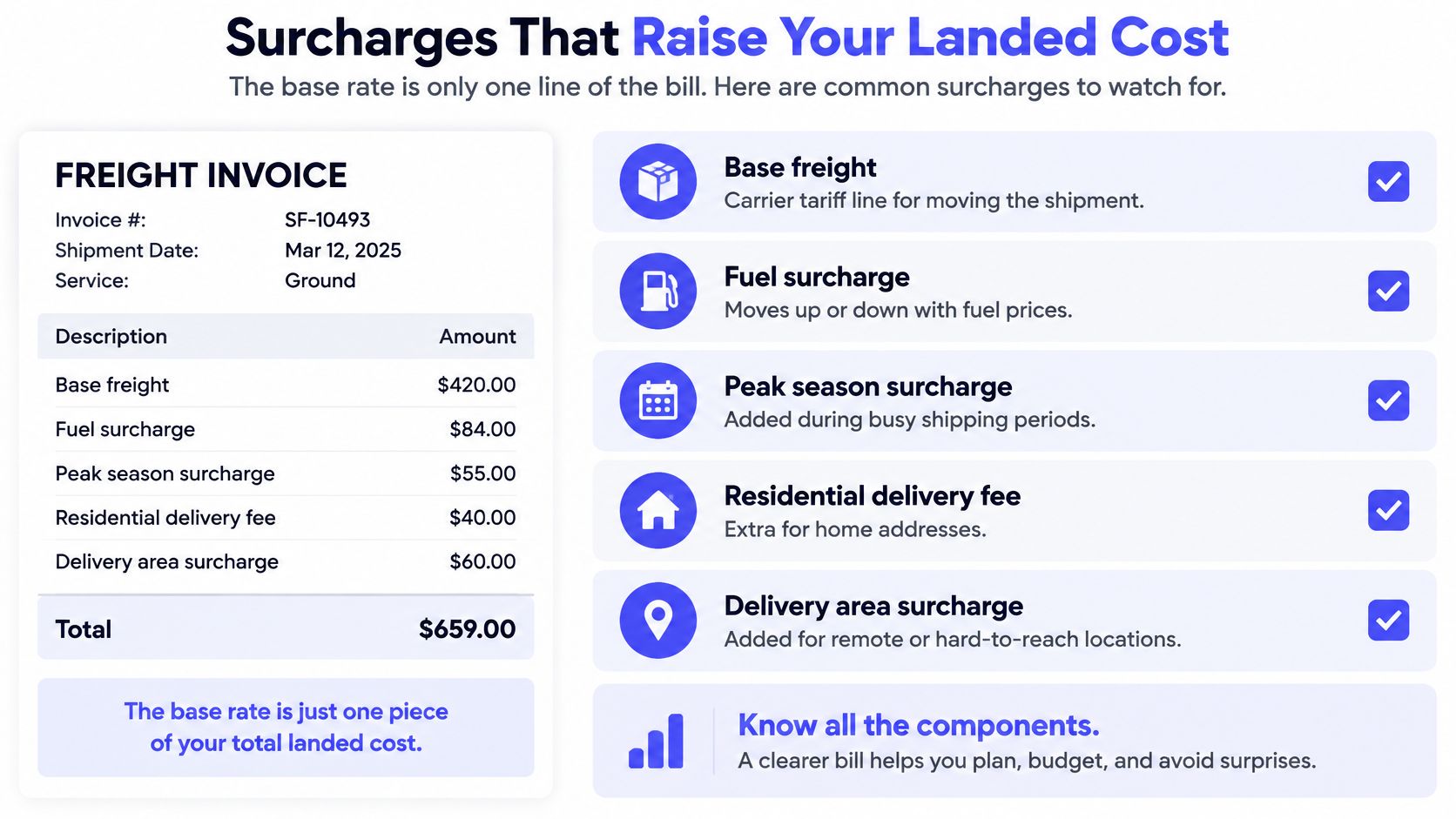
Base freight pays for the quoted movement. Fuel follows the carrier's applicable adjustment, while dimensional weight changes the billable weight when a carton occupies substantial space relative to its actual weight.
Say you're shipping a moderately heavy board game in a bulky carton. The carrier may charge using the carton's calculated dimensional weight rather than the weight you measured on a scale. Ask which calculation and rounding rules apply.
Customs duties and VAT require destination-specific treatment. Delivery-area fees depend on the postcode, demand charges depend on the shipping window, and last-mile delivery covers the final carrier leg. Check for overlapping charges before adding them to your international shipping fee worksheet.
For creators also replenishing marketplace inventory, AgentCentral's guide to plan China-to-FBA shipping with MCP workflows provides a separate planning resource. Keep those commercial replenishment costs distinct from reward fulfillment.
A negotiated discount on base freight won't necessarily preserve margin if accessorial charges increase faster.
The quote you signed is not always the bill you pay.
A pledge manager is where a shipping increase becomes a collectible amount. When the carrier's final bill runs above the quote you built the campaign around, the survey is the tool that lets you charge each backer only the verified difference on their order, rather than re-invoicing the whole list.
The two options organize that collection differently. The Kickstarter pledge manager works like a marketplace checkout: the platform hosts the flow, and Kickstarter's pledge-manager overview describes no upfront cost, address and reward-preference collection, eligible post-campaign purchases, and shipping configured by weight or flat rate. The PledgeBox pledge manager is creator-configured: branded surveys that collect shipping fees, VAT/tax, add-ons and reward upgrades, with address validation and shipment tracking on the fulfillment side.
Kickstarter and PledgeBox pledge managers compared
| Criteria | Kickstarter pledge manager | PledgeBox pledge manager |
|---|---|---|
| Model | Platform-hosted marketplace checkout | Creator-configured survey and pledge manager |
| Upfront cost | No upfront cost | No upfront fee and no campaign fee |
| Fees on pledge-manager payments | Kickstarter fees apply to payments made through the tool | Survey free to send; 3% only on additional survey payments, none if no additional payment |
| Shipping fee setup | Weight-based or flat-rate, adjusted by region, item type or reward level | Shipping fees and VAT collected through the survey |
| Add-ons and upgrades | Offered after the campaign | Add-ons and reward upgrades through the survey |
| Post-campaign sales to new customers | Eligible rewards open to new customers after the campaign | Late backer pre-orders through a pre-order marketplace |
| Address and tracking tools | Address collection; confirm tracking workflow | Address validation, shipment tracking and shipping exports |
PledgeBox is free to send the backer survey and only charges 3% of upsell if there's any. Its pricing policy applies that 3% to additional survey payments, including add-ons, reward upgrades, shipping, and tax or VAT, with no fee on original Kickstarter or Indiegogo funds and no percentage charge when there's no additional payment.
That has a direct consequence for a shipping re-quote. If you collect a shipping top-up through the survey, the percentage applies to the top-up itself, so a small verified increment stays a small cost. Collect nothing extra, and the survey costs nothing.
Keep campaign fees separate from post-campaign collection costs. Kickstarter's fee explanation states that a successfully funded campaign carries a 5% Kickstarter fee, with payment processing generally about 3%–5%; unsuccessful campaigns pay no Kickstarter fee.
That campaign calculation does not replace checking the terms on a particular pledge-manager payment. Build your comparison around which funds pass through each tool, then confirm any applicable processing charges before setting a collection amount.
Order changes matter too. Kickstarter's pledge-manager guidance explains that upgrades and add-ons update survey questions and can change shipping before checkout. For campaigns on another platform, review the Indiegogo pledge-manager workflow before importing backers.
Judge each tool by the cost and workflow for collecting the balance your backers owe, with the headline percentage as one input among several.
Start by testing the final packed carton. Packaging is a cost lever you control before asking a carrier for concessions, and it can affect both parcel pricing and the amount of warehouse or container space you need.
Don't remove protective material blindly. A smaller package only helps if it still survives handling and protects the reward. Compare the complete packed shipment, not an empty replacement box.
For example, say a hardware reward fits into a smaller carton after you redesign its insert. Measure the packed sample, weigh it, and rerun the carrier calculation before deciding whether a backer adjustment is still necessary. Then test the revised protection before approving production packaging.
Cost-control rule: Compare the complete fulfillment route, not the cheapest individual shipping leg.
Choose a named owner for these checks. Someone should approve the packed sample, someone should verify the address file, and someone should sign off on the final all-in booking.
The difficult question isn't how much shipping increased. It's who should pay when costs change after pledges are collected.
Don't assume every increase belongs on the backer's invoice. Your campaign promises, remaining margin, available delivery options, and applicable consumer obligations all matter. Document the decision before opening a new payment request.
Use the fulfillment discussion to agree on both the financial threshold and the message backers will receive.
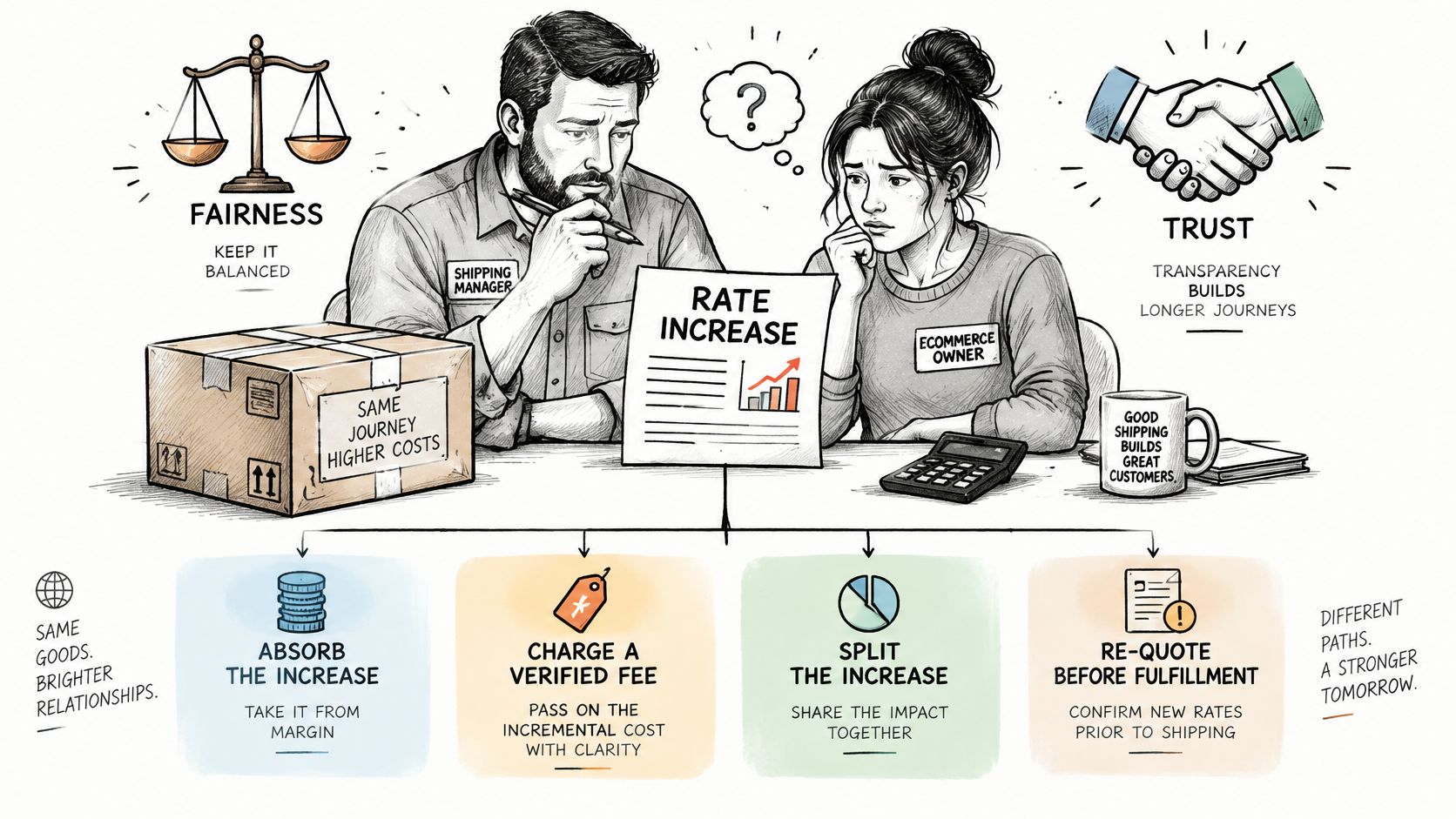
| Option | When it can make sense | Trust and fairness trade-off |
|---|---|---|
| Absorb the increase | Remaining reward margin can cover it | Protects the original backer expectation but reduces your financial cushion |
| Collect a verified incremental balance | The documented shortfall exceeds your agreed threshold | Preserves fulfillment funding but creates an unexpected expense for backers |
| Offer economy or consolidated delivery | A cheaper service still meets acceptable delivery needs | Reduces the balance but may change speed, tracking, or convenience |
| Delay shipment | A defined delay has a credible operational benefit | Avoids an immediate charge but extends waiting and doesn't guarantee cheaper freight |
Don't apply an international shortfall to unaffected domestic orders just because a flat adjustment is easier to administer. Separate backers by destination and service, and charge only costs attributable to their fulfillment group.
For a modest reference point, the USPS postage-price notice describes proposed 2026 changes of approximately 6.6% for Priority Mail and 7.8% for Ground Advantage. Those service averages aren't a quote for a particular parcel.
Illustrative calculation, not a USPS tariff: suppose a campaign budgeted US$30 to ship a 2 kg parcel, and its actual quoted cost rose by 7.8%. The incremental amount would be about US$2.34 per backer, or US$2,340 across 1,000 backers. This is a hypothetical application of the percentage, not a claim that USPS prices parcels by that formula.
Compare the absolute shortfall with the margin remaining on each reward. A percentage alone doesn't tell you whether collecting an adjustment is financially sensible after payment fees and support work.
International orders need a broader review because freight, fuel, customs duties, tariffs, and VAT can change together. A tariff change after manufacturing starts can leave a creator without enough remaining margin to absorb the difference.
Use the video as a discussion aid while preparing the survey and payment workflow.
PledgeBox's backer survey is free to send; its 3% applies only to additional survey payments, with no charge if there are none. Configure the adjustment workflow so no backer is charged until the quote is confirmed and the threshold is met.
PledgeBox offers backer surveys and post-campaign collection for shipping balances, taxes, add-ons, and upgrades. Visit PledgeBox to prepare your destination groups and survey workflow, then request only the shipping increment you've verified and approved.
PledgeBox
The All-in-One Toolkit to Launch, Manage & Scale Your Kickstarter / Indiegogo Campaign