 PledgeBox
A Complete Review of Kickstarter for Creators in 2026
Get our complete review of Kickstarter, from its fees and success rates to post-campaign management. Learn how to fund and fulfill your project successfully.
Get our complete review of Kickstarter, from its fees and success rates to post-campaign management. Learn how to fund and fulfill your project successfully.
In our experience, Kickstarter is still a crowdfunding powerhouse. It offers creators incredible visibility and a brand name that backers trust. But getting funded is just the beginning. True success hinges on what happens after the campaign ends, and that's where Kickstarter’s own tools can leave you stranded. A smart post-campaign strategy isn't just a nice-to-have; it's absolutely essential.

Since it first appeared, Kickstarter has completely changed the game for how creative ideas get funded. It's grown into a massive force in the crowdfunding world, but its marketplace model comes with both massive opportunities and some serious challenges, especially for creators thinking about long-term growth.
The numbers don't lie—the platform's scale is enormous. By January 2025, Kickstarter had raked in over $8.53 billion in total pledges, with a staggering $7.86 billion going to successfully funded projects. But here’s the reality check: the overall success rate for campaigns sits around 41.98%. That means most projects fail to fund, which tells you that you need more than just a good idea to succeed.
To give you a clearer picture, here’s a quick rundown of what Kickstarter offers.
| Feature | Kickstarter's Approach |
|---|---|
| Model | All-or-nothing funding. You keep the money only if you hit your goal. |
| Fees | 5% platform fee + payment processing fees (3-5%). |
| Audience | Massive, built-in community of serial backers actively looking for new projects. |
| Project Focus | Creative projects across 15 categories like tech, games, art, and design. |
| Post-Campaign | Basic survey tool for collecting addresses. Limited upsell or shipping management. |
| Discovery | High potential for organic discovery if your project gains traction. |
This table shows that while Kickstarter is great for getting eyes on your project and securing initial funds, it leaves a lot of the heavy lifting for you to figure out afterward.
Think of Kickstarter as the world’s biggest, most exciting flea market. It’s a bustling marketplace where you can launch your product and tap into a huge, ready-made audience that loves discovering new things. It provides a trusted, standardized way for people to back your project.
But once the market closes—once your campaign ends—its usefulness drops off sharply. This is especially true for complex projects with lots of moving parts.
This is where a dedicated pledge manager like PledgeBox comes in. It acts as your operational backend, kind of like your own personal Shopify store. It gives you the control you need to manage backer information, handle tricky shipping logistics, and even bring in extra revenue after the campaign is over. The best part? PledgeBox is free to send your backer survey and only charges 3% of the upsell if there's any. It’s a powerful, no-risk tool to add to your post-campaign arsenal.
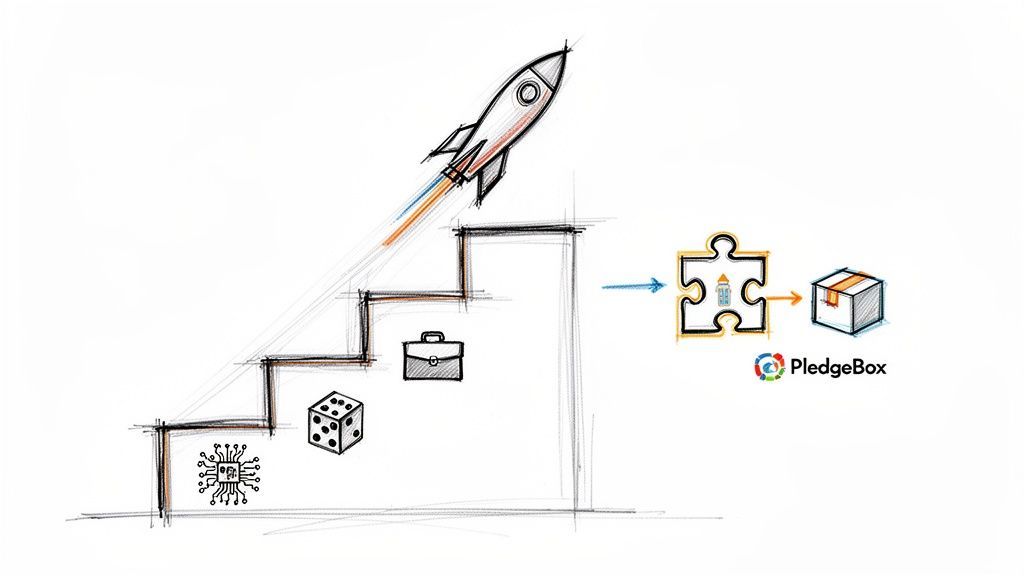
From what we've seen, success on Kickstarter boils down to mastering three key stages:
To figure out if Kickstarter is the right fit, it’s worth seeing how it stacks up against other options out there. For a look at different ways to grow and monetize your work, check out some of the best platforms for content creators in 2026. If you're weighing different crowdfunding models, you might also find our guide on Kickstarter-type websites helpful. This review will walk you through everything Kickstarter, helping you decide if it’s the right launchpad for your project.

Before you even think about launching, you need to get a firm grip on how money moves through the Kickstarter ecosystem. At its core, the platform runs on an "all-or-nothing" funding model. This means you only get to collect the pledged funds if you hit—or surpass—your campaign goal before the clock runs out.
Fall short by even a single dollar, and no money changes hands. No one gets charged. This model is a safety net for everyone involved. Backers aren't on the hook for a project that's underfunded and likely to fail, and creators aren't left struggling to deliver rewards without enough cash.
This high-stakes setup means you have to be incredibly strategic with your funding goal. The number you set needs to be realistic enough to hit, but also high enough to cover every single cost of bringing your project to life—from manufacturing to shipping and everything in between.
So, you've successfully funded your campaign. Congratulations! But don't expect to see 100% of that money land in your bank account. Kickstarter automatically deducts two main fees from your total haul.
Remember, these fees only kick in if you reach your goal. If your campaign doesn't make it, you pay nothing. This structure directly impacts your budget, as you need to plan on roughly 8-10% of your total funds vanishing right off the top. For a deeper dive, check out our guide on how much Kickstarter takes from your campaign.
Let's make this concrete. Say you run a killer campaign and successfully raise $50,000. Here’s a quick look at what your payout might actually be:
As you can see, a pretty big chunk of your funding disappears before you can even touch it. This is a classic rookie mistake. Many first-time creators forget to build these fees into their funding goal and end up scrambling for cash when it's time to start production and shipping.
When you're mapping out a Kickstarter campaign, it’s critical to know the lay of the land. The platform is a massive, diverse ecosystem, but not all creative categories perform the same. A quick look at any review of Kickstarter data shows that certain types of projects consistently soak up the vast majority of backer attention and, more importantly, funding.
The numbers don't lie. Look across Kickstarter’s categories, and you'll see a huge difference in success rates and backer excitement. Projects in the Games, Design, and Tech categories have sprinted ahead of the pack, making up a combined 28.85% of all successfully funded projects in the platform’s history.
In Q1 2023 alone, these three powerhouses pulled in significantly more cash than any other category, cementing their status as the go-to project types for backers everywhere. This isn't just a random trend—it tells us that backers are drawn to projects that offer tangible, cool, and innovative products. You can dive deeper into the numbers with PledgeBox's Q1 2023 Kickstarter overview.
So, what's the secret sauce? It all comes down to backer psychology. Let's break down why these three categories absolutely crush it.
The Games category, especially tabletop games, is the undisputed king of Kickstarter. It’s not uncommon to see these campaigns blow past the million-dollar mark, powered by passionate, ready-made communities that are always looking for the next big box to add to their shelves.
What makes them so magnetic?
Right behind Games, you'll find the Design and Tech categories. These projects speak to a different kind of backer—the early adopter, the problem-solver, the person hunting for clever gadgets that make life better or more interesting.
These categories win because they offer a crystal-clear value proposition: a new product that is smarter, more beautiful, or more functional than what’s already out there. Backers are essentially pre-ordering a slice of the future, and they’re excited to pay for that privilege.
Think about projects like a minimalist smart wallet, a next-gen home device, or an brilliantly engineered travel backpack. These are the kinds of ideas that take off. Success here usually boils down to a few key things:
Now, if your project doesn't fit into one of these big three categories, don't panic. It simply means you need a more focused strategy to find and rally your unique audience. Success is absolutely possible in every category, from comics to music to film, but knowing where the big money flows gives you a realistic benchmark for your own campaign goals.
A successful campaign is almost never a happy accident. Behind every big funding total is a ton of meticulous planning and execution broken down into three distinct phases. Thinking about your project in terms of a Pre-Launch, Live Campaign, and Post-Campaign framework is how you turn an overwhelming goal into a series of manageable steps. Any serious review of kickstarter success stories will show this roadmap in action.
The journey from a cool idea to a fully funded project usually follows this predictable path, and the most successful creators are the ones who absolutely nail each stage.

This process shows how the top categories—like Games, Design, and Tech—build momentum that carries them all the way through to a successful finish and, eventually, fulfillment.
Let’s be clear: the work you do before your campaign goes live is the single most important factor in its success. Launching to an empty room is a recipe for disaster. Your only job right now is to build a crowd before you open the doors.
A huge part of this pre-launch framework often involves running a successful influencer marketing campaign to generate buzz and pull in those first crucial backers. Getting your prototype into the hands of a trusted voice in your niche can drive a ton of high-quality traffic right to your pre-launch page.
The second you hit that "launch" button, the race is on. This phase is typically a 30-day sprint of intense communication, promotion, and engagement. Your job is to keep the fire you started in pre-launch burning bright all the way to the finish line.
Key moves during this phase include:
Your campaign funded. You’re done, right? Not even close. This is where the real work begins, and it’s a phase that many creators tragically underestimate. Delivering on your promises is what builds your reputation and turns one-time backers into fans for life.
The biggest challenge here is wrangling the complex logistics of getting rewards to hundreds or even thousands of people. Kickstarter’s built-in survey tool is extremely basic and simply isn't enough for collecting all the info you need. This is where a pledge manager becomes an absolutely essential part of your toolkit.
Think of Kickstarter like Amazon—a great marketplace to sell your product. A dedicated pledge manager like PledgeBox is your Shopify—it’s your own powerful backend for managing customer relationships, handling complex orders, and growing your business after the initial sale.
A robust pledge manager lets you:
That last point is huge. Many creators generate an additional 10-20% in funding after the campaign ends just from these upsells. Best of all, PledgeBox is free to send the backer survey and only charges 3% of the upsell revenue if there is any. This makes using a pledge manager a no-risk, high-reward decision that professionalizes your entire fulfillment process.
The moment your Kickstarter campaign successfully funds is an incredible feeling. But this milestone also marks the start of what is often the most demanding part of your entire project: fulfillment. This is where your reputation as a creator is truly made or broken. Any experienced creator offering a review of Kickstarter will tell you a smooth post-campaign process is just as vital as the funding drive itself.
Unfortunately, this is where Kickstarter's native tools start to show their limitations. The built-in survey system is fine for the simplest projects—say, delivering a single digital reward. But for anything more complex with physical products, different reward tiers, or international shipping, it quickly becomes a major bottleneck.
To really get why there's a gap, an analogy helps. Think of Kickstarter's pledge manager as Amazon. It's a massive, powerful marketplace that's fantastic for attracting new customers and making that initial sale. But once the transaction is done, Amazon's interest in your relationship with that customer pretty much ends. You get a basic order sheet, and you're left on your own.
In contrast, a dedicated pledge manager like PledgeBox is your Shopify. It’s your own private, powerful backend—a specialized platform built not just to process an order, but to manage your entire post-sale operation. It helps you nurture backer relationships and even increase your overall funding. It gives you the control and flexibility needed to run a professional fulfillment operation.
You wouldn't try to run a serious e-commerce business just from the Amazon seller dashboard. The same logic applies here. For a serious crowdfunding campaign, you need a tool built for the job.
Relying only on Kickstarter's basic surveys can create a whole mess of logistical headaches. The system is notoriously rigid. For example, once a backer submits their survey, they can't edit their own address. If someone moves between the survey and your shipping date—which happens all the time—it creates a major problem you have to solve manually.
Here are a few critical tasks that are difficult or impossible with Kickstarter's default tools:
A dedicated pledge manager is designed specifically to solve these problems. It acts as the essential bridge connecting your campaign's successful funding to your product's final delivery.
The core value of a pledge manager is transforming post-campaign logistics from a chaotic mess of spreadsheets into a controlled, automated process. It professionalizes your operation and protects your profit margins.
With a tool like PledgeBox, you can build a customized survey that gives you complete control. This allows you to segment backers, charge precise shipping based on weight and location, handle complex tax rules, and let backers update their own information.
Critically, it unlocks a new stream of revenue. Backers get a seamless, store-like experience where they can purchase more add-ons, often boosting your total funds raised. It’s standard practice for experienced creators, who frequently see a 10-20% lift in funding after the campaign has ended.
To see the difference clearly, let's compare the features of Kickstarter's native surveys with a dedicated pledge manager like PledgeBox. The table below highlights the key functionalities you'll need for a smooth post-campaign phase and shows where each platform stands.
| Feature | Kickstarter Native Surveys | PledgeBox Pledge Manager |
|---|---|---|
| Backer Surveys | ✅ Basic, one-time submission | ✅ Advanced, with logic & segmentation |
| Address Updates | ❌ Not allowed by backers | ✅ Self-service for backers |
| Post-Campaign Upsells | ❌ Not supported | ✅ Built-in, store-like experience |
| Shipping Collection | ✅ Basic, flat-rate only | ✅ Advanced, based on weight & location |
| VAT/Tax Calculation | ❌ Not supported | ✅ Automated and customizable |
| Customer Support | ❌ Creator's responsibility | ✅ Dedicated support team |
| Pricing Model | ✅ Free | ✅ Free to send the backer survey, 3% fee on upsell revenue only |
As you can see, while Kickstarter gets you started, a pledge manager is built to handle the real-world complexities of fulfillment, saving you time, money, and countless headaches.
The best part is the business model. PledgeBox is completely free to use for sending your backer survey. The platform only takes a small 3% fee on the extra funds you raise from any upsells. This makes it a genuinely risk-free tool. If you don't sell any add-ons, you pay nothing but still get all the powerful survey and data management features.
So, after digging into this review of Kickstarter, what’s the final call? Is it the right place for your project?
There’s no denying it—Kickstarter is an absolute powerhouse for launching a creative idea. Its massive, built-in audience and trusted brand name give you a level of instant credibility and reach that’s almost impossible to build from scratch. For creators with a compelling product, especially in the Games, Design, or Tech categories, Kickstarter is an incredible launchpad.
The "all-or-nothing" model can feel intimidating, but it's actually a brilliant risk-reduction tool. It proves there's a market for your idea and ensures you have the capital you need before you enter production, protecting both you and your backers from a project that fizzles out. This structure also forces you into a level of meticulous planning that’s just good discipline for any entrepreneur.
But that strength is also tied to its biggest downsides. Kickstarter is fiercely competitive. With thousands of projects live at any given moment, you need significant pre-launch work and a polished marketing campaign just to get noticed. Plus, the platform’s fees—a combined 8-10% between Kickstarter and payment processing—will take a noticeable bite out of your final funding total.
Kickstarter isn't a one-size-fits-all platform. Here’s a quick breakdown of how different creators should think about it:
Ultimately, a successful campaign isn't just about hitting a funding goal. True success is defined by what happens after the confetti settles—a flawless fulfillment process that turns one-time backers into loyal fans for life. This is where Kickstarter’s role as a marketplace fades, and your own operational skills take center stage.
The best way to think of Kickstarter is like Amazon. It's a fantastic place for the initial sale. But to manage your business effectively post-sale, you need a tool like Shopify. This is exactly the role a pledge manager fills in the crowdfunding world.
This makes tools like PledgeBox a non-negotiable part of a professional and profitable strategy. Remember, PledgeBox is free to send your backer survey and only charges 3% of any new revenue you generate from upsells. It's a no-risk way to handle logistics and actually boost your final funding.
So, is Kickstarter right for you? Absolutely—if you treat it as the powerful starting line it is, not the entire race.
Diving into the world of crowdfunding always brings up a ton of questions. As you're doing a review of Kickstarter and figuring out if it’s the right platform for you, you're bound to have a few. Let's get you some quick, clear answers to the most common ones we hear from creators.
It's actually pretty straightforward. If your campaign doesn't hit its funding goal by the deadline, no money ever changes hands. This is the heart of Kickstarter's "all-or-nothing" model. Backers aren't charged, you don't receive any funds, and you owe zero fees to Kickstarter.
While it's easy to feel disappointed, a failed campaign is far from a total loss. Think of it as invaluable, real-world market feedback. It might tell you the funding goal was a bit too ambitious, the marketing didn't quite land, or the product idea itself needs another round of polish.
Plenty of wildly successful creators have a failed campaign in their rearview mirror. They just used it as a learning experience to come back even stronger.
This is a classic rookie mistake: assuming you'll pocket 100% of the funds you raise. The reality is that once your campaign succeeds, you have to account for fees. Kickstarter takes a 5% platform fee, and their payment processor, Stripe, charges an additional fee that's usually around 3-5% of the total funds raised.
So, if you raise $10,000, you should realistically expect to receive somewhere between $9,000 and $9,200. It's absolutely critical to build these costs directly into your funding goal from the start. That way, you'll have enough capital for production and fulfillment without any nasty surprises.
For anything more complex than a simple digital download, the answer is almost always a resounding yes. Kickstarter’s built-in survey tool is extremely basic. It just isn't built to handle the real-world headaches of fulfillment, especially if you have physical products, lots of reward tiers, or backers all over the globe.
A pledge manager is a purpose-built tool designed to handle all your post-campaign logistics. It's what lets you:
Here’s a good way to think about it: Kickstarter is like Amazon—an incredible marketplace to make the initial sale. A dedicated tool like PledgeBox's pledge manager is like Shopify—it's your own powerful backend for managing all your operations, building lasting customer relationships, and actually growing your revenue post-campaign.
Using a dedicated tool like this makes your whole fulfillment process more professional. It saves you from logistical nightmares and, most importantly, protects your profit margins.
Pledge manager costs can vary, but some models are incredibly friendly for creators. For example, PledgeBox is completely free to use for sending your backer survey. You get full access to all its powerful data management and survey-building tools without paying a dime.
The platform only takes a small 3% fee on new money you generate from upsells—that means any add-ons or upgrades your backers decide to buy after the campaign has already ended. It's a performance-based model, so there’s absolutely no risk. If you don't generate any extra revenue through the pledge manager, you don't pay anything. This makes it an essential, cost-effective tool for any serious creator.
Take the guesswork out of your post-campaign process. With PledgeBox, you can create powerful backer surveys, manage shipping and taxes with ease, and boost your funding with upsells. Get started for free today and see why over 8,000 creators trust PledgeBox for professional fulfillment.
PledgeBox
The All-in-One Toolkit to Launch, Manage & Scale Your Kickstarter / Indiegogo Campaign