 PledgeBox
How Much Does Kickstarter Take? A Guide: 'how much does kickstarter take'
Curious about crowdfunding costs? Learn how much does kickstarter take, from platform fees to hidden charges, so you can budget for a successful campaign.
Curious about crowdfunding costs? Learn how much does kickstarter take, from platform fees to hidden charges, so you can budget for a successful campaign.
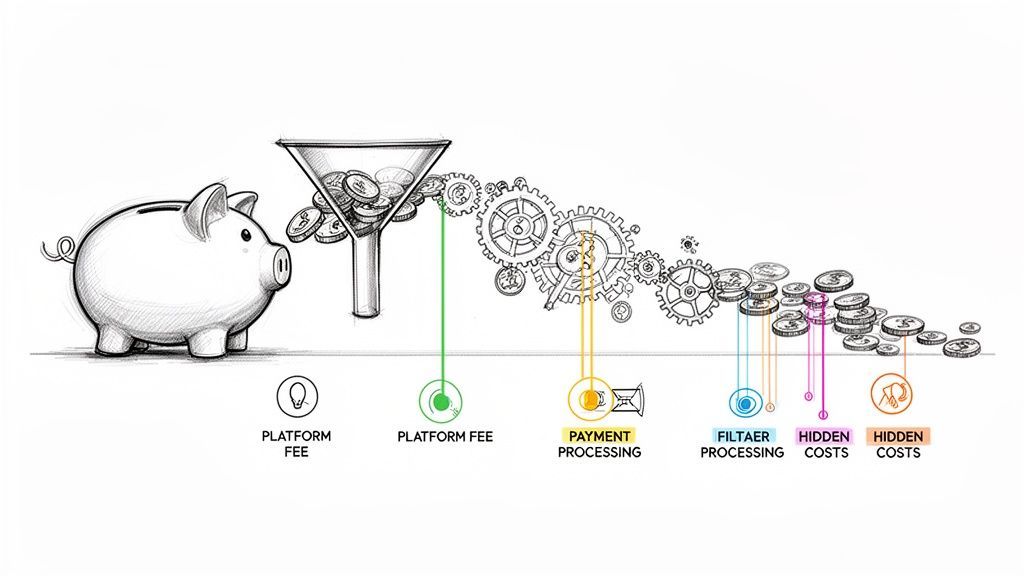
So, you're wondering, "how much does Kickstarter actually take?" The short answer is a 5% platform fee and another slice for payment processing. All in, you should budget for about 8-10% of your total funds raised to go toward fees.

Getting a handle on the real cost of a successful Kickstarter is the first, and most critical, step toward building a budget that won’t fall apart later. While that 8-10% figure is a good starting point, it's actually made up of two distinct fees that every creator needs to account for.
If you don't bake these deductions into your financial plan from day one, you could turn a wildly successful campaign into a fulfillment nightmare. It's a classic rookie mistake.
At its core, Kickstarter runs on an "all-or-nothing" funding model. This is key. It means you only get paid—and more importantly, you only pay fees—if your campaign hits its funding goal.
If your project falls short, no money ever changes hands. Backers aren't charged a dime, and you don't owe Kickstarter a penny. This setup protects everyone involved: backers don’t fund a project that’s dead on arrival, and you aren’t on the hook to deliver an underfunded dream.
This model creates a high-stakes environment, for sure. But once you cross that finish line, the fee structure kicks in, and your final payout will be less than the amount you raised.
So, where does that 8-10% come from? It’s not a single charge. It’s two separate costs that are automatically pulled from your funds before they ever land in your bank account.
To make it even clearer, here’s a quick breakdown of the main costs you need to plan for.
This table breaks down the main fees every creator must account for when their Kickstarter campaign is successfully funded.
| Fee Type | Standard Rate | What It Covers |
|---|---|---|
| Kickstarter Platform Fee | 5% of Total Funds Raised | Access to the platform, community, discovery tools, and creator support. |
| Payment Processing Fee | ~3% + $0.20 per Pledge | The cost of securely processing credit and debit card payments from backers worldwide. |
Keep in mind that these are the only fees you’ll face during the campaign.
After the campaign ends, you'll need to think about managing your backers. While Kickstarter has a basic survey tool, most seasoned creators use a dedicated pledge manager. For instance, comparing Kickstarter's native tool to a platform like PledgeBox is like comparing a free blog to a full e-commerce store. Kickstarter gets the basic job done, but PledgeBox is a powerful, customizable platform built to manage backers and boost your revenue.
A huge difference is that PledgeBox is free to send your backer survey and only charges 3% on any additional funds you raise through upsells. This turns a simple survey process into a whole new opportunity for sales.
That 8-10% figure you hear about isn't a single fee that Kickstarter pockets. It's actually a blend of two different costs that get sliced off your total funds before the money ever lands in your bank account. Getting a grip on these two fees is the first step to accurately budgeting your project.
Think of it like this: Kickstarter provides the busy, high-traffic marketplace where millions of shoppers (backers) can discover your project. For that prime real estate and visibility, they take a commission. Then, a separate company steps in to handle the nitty-gritty of securely processing thousands of credit card payments from all over the world. They take a small cut for their work, too.
First up is Kickstarter’s own platform fee. This one is simple: it’s a flat 5% of the total funds you successfully raise. If you don't hit your funding goal, you don't pay a dime.
You can think of this as the price of admission. It covers the essential services that make Kickstarter so powerful:
For a creator, this fee buys you a ticket to a pre-existing community that’s hungry for new ideas. That’s a massive head start compared to trying to build an audience entirely from scratch.
The other piece of the puzzle comes from payment processing. Kickstarter doesn't handle the credit card transactions themselves; they partner with Stripe, a global payment processing giant. For every single pledge they process for your campaign, Stripe takes a fee, which is deducted right alongside Kickstarter's.
These fees are a bit more complex because they’re made of two parts: a percentage and a small fixed amount. The rates also change depending on the size of the pledge.
Kickstarter's fee model is refreshingly simple, but it has a real impact on your budget. At its core is the flat 5% platform fee on a successful campaign. But once you layer on Stripe's processing fees—typically 3% + $0.20 for most pledges—the costs add up.
Let's imagine a common scenario: on a $10,000 campaign, you'd owe $500 for the platform fee, plus roughly $320 in processing fees. That’s a total of $820, or 8.2% of your funds, gone right off the top. You're left with $9,180 before you've even thought about taxes, shipping, or making the rewards. You can find more crowdfunding stats over at Search Logistics.
Once your campaign clock runs out, your job shifts from fundraising to fulfillment. This is where post-campaign tools become absolutely essential. Kickstarter gives you a basic survey system, but specialized pledge managers offer way more power and flexibility.
Think of Kickstarter’s native tools like an all-in-one TV/VCR combo from the 90s—it handles the basics but it's a closed, rigid system. A pledge manager like PledgeBox is more like a modern, customizable smart home system—a powerful, flexible toolkit designed to help you manage backers efficiently and actually grow your business.
This difference is huge for your budget. While Kickstarter’s fees are a fixed cost, your post-campaign management doesn't have to be. For example, PledgeBox is completely free to send your backer survey and only charges 3% of upsell if there's any. This approach can help offset those initial campaign fees and give your final profit a serious boost.
You can learn more about the entire process in our detailed guide on how Kickstarter works.
At first glance, the math seems pretty straightforward. You take your total funds raised, subtract Kickstarter's 5% fee and Stripe’s processing costs, and the rest is yours to make your project happen. Right?
If only it were that simple. That quick calculation misses several "hidden" costs that can take a huge bite out of your budget long after the confetti settles. These are the expenses that catch so many first-time creators by surprise, forcing them into a financial scramble when they should be focused on fulfillment.
These costs aren't technically charged by Kickstarter, but they're a direct result of running a campaign. Knowing what they are ahead of time is the key to a smooth, stress-free fulfillment process.
The first surprise usually hits just a few days after your campaign wraps up. You'll quickly learn that not every dollar pledged will actually make it to your bank account. A certain percentage of payments will simply fail to go through, creating what we call dropped pledges.
This isn't a scam; it happens for everyday reasons. A backer's credit card might have expired, they might not have enough funds, or their bank's fraud system gets a little too protective. Kickstarter gives backers seven days to fix their payment information, but a surprising number never do.
As a rule of thumb, you should expect 3% to 5% of your total pledges to be dropped. For a $50,000 campaign, that’s a potential shortfall of $1,500 to $2,500 you'll never see, even though it was part of your final funding number.
This is a critical number to bake into your budget from day one. If your profit margins are already thin, losing up to 5% of your funding before you even start can be a major setback. Always build this buffer into your financial plans.
Another post-campaign cost comes from managing the human side of crowdfunding. No matter how perfect your project is, you will almost certainly get requests for refunds. Production delays, a backer's personal financial situation changing, or just plain old buyer's remorse can all lead to refund requests.
On top of that, you have chargebacks. While rare, a chargeback happens when a backer disputes the transaction directly with their credit card company. This can lead to a forced refund and sometimes even a penalty fee from the payment processor. Having a clear and fair refund policy on your campaign page helps, but you should still set aside a small contingency fund just in case.
If you're shipping to backers around the world, your finances get a lot more complicated. Two big factors come into play here: currency conversion fees and international taxes.
Getting VAT wrong can be a catastrophic financial mistake. To really get a handle on this, check out our deep dive on the unseen costs of Kickstarter and the VAT dilemma. We've seen otherwise successful projects get completely derailed by miscalculating their tax obligations.
This is also where a powerful pledge manager becomes an absolute game-changer. Think of the Kickstarter pledge manager as the like Amazon—it’s a simple, rigid marketplace. A dedicated tool like the PledgeBox pledge manager is like Shopify; it gives you a flexible, powerful platform to manage all these post-campaign complexities.
Best of all, PledgeBox is free to send your backer survey and only charges 3% of upsell if there`s any. This lets you accurately collect VAT and shipping fees after the campaign without any upfront cost, turning a massive financial headache into a smooth, manageable process.
Understanding the percentages is one thing, but seeing how they actually chew into your funding goal is where it gets real. Let’s stop talking theory and start running the numbers for a few common campaign sizes. This will give you a clear, repeatable formula you can use for your own project.
For these examples, we'll stick to the two main deductions: Kickstarter's 5% platform fee and an estimated 3.2% for payment processing. I like using 3.2% as a conservative average because it accounts for the mix of pledge sizes and that little fixed fee per transaction that can add up.
A $10,000 goal is a classic starting point for first-time creators or smaller projects like zines, enamel pins, and indie comics. It might not seem like a massive amount, but the fees still take a noticeable bite.
After these first cuts, your estimated net payout is $9,180. And remember, this is before accounting for any dropped pledges, potential refunds, or, you know, the cost of actually making and shipping your rewards.
Hitting $50,000 is a huge win, typically for projects like tabletop games, cool tech gadgets, or ambitious apparel lines. While the percentages don't change, the dollar amount of the fees starts to feel much more significant at this level.
In this scenario, your estimated net payout is $45,900. Watching over $4,000 evaporate right off the top is a stark reminder of why a detailed budget is non-negotiable. You can get a head start by looking into a solid budgeting proposal sample.
But the standard fees aren't the whole story. This is just the beginning of the deductions you need to plan for.

These sneaky, often-overlooked costs like dropped pledges, refunds, and taxes can easily shave off another 5-10% of your total funds. Budgeting accurately isn't just important; it's essential for survival.
For a massive project—think an elaborate board game with tons of miniatures or a major hardware launch—a $250,000 campaign is a game-changer. But the fees at this level are so large they could fund a smaller project all on their own.
Here, your estimated net payout is $229,500.
Seeing over $20,000 vanish before you've even ordered a single component is a truly sobering moment. At this scale, the financial complexity grows exponentially, which is why many successful creators start looking into outsourcing accounting services to keep things from getting out of hand.
This is also where your post-campaign tools really matter. Using Kickstarter’s native survey tool is fine, but it’s like a one-size-fits-all solution—simple, but rigid. A specialized pledge manager is much more powerful and customizable.
Critically, a tool like PledgeBox is free for sending the backer survey and only charges 3% of upsell if there`s any. This is a brilliant way to claw back some of those initial platform fees by generating fresh revenue after your campaign has already ended.
To give you a quick snapshot of how these fees scale, here's a table breaking down the numbers for a few different funding levels. It really puts the impact into perspective.
| Funding Goal | Estimated Kickstarter Fee (5%) | Estimated Processing Fee (~3.2%) | Total Estimated Fees | Estimated Net Payout |
|---|---|---|---|---|
| $10,000 | $500 | $320 | $820 | $9,180 |
| $25,000 | $1,250 | $800 | $2,050 | $22,950 |
| $50,000 | $2,500 | $1,600 | $4,100 | $45,900 |
| $100,000 | $5,000 | $3,200 | $8,200 | $91,800 |
| $250,000 | $12,500 | $8,000 | $20,500 | $229,500 |
| $500,000 | $25,000 | $16,000 | $41,000 | $459,000 |
As you can see, the total fees grow in direct proportion to your success. What starts as a few hundred dollars can quickly turn into tens of thousands, making it absolutely crucial to factor these costs into your funding goal from day one.

Once the champagne pops and the campaign clock hits zero, the real work begins. You've successfully raised the funds, but now you have to switch hats from fundraiser to project manager. Your new mission is fulfillment, and that journey starts with collecting critical information from your backers—shipping addresses, reward choices, and all the little details needed to get your product into their hands.
This post-campaign phase is a make-or-break moment. The tools you choose here can have a massive impact on your workload, your backers' happiness, and even your final profit margin. While Kickstarter gives you a basic, built-in survey tool, many experienced creators turn to a more powerful solution called a pledge manager. Understanding the difference is key to a smooth and successful fulfillment process.
Kickstarter's native survey tool is a straightforward, no-frills option. It gets the job done for simple projects. You can send one survey per reward tier, but here's the catch: once a backer hits "submit," their answers are locked in. This can create major headaches for more complex campaigns.
Pledge managers, on the other hand, are specialized third-party platforms built to handle the chaos of post-campaign management. They come loaded with features that make your life easier:
This is where the experience for both you and your backers really starts to diverge.
To really grasp the difference, think of it this way. Kickstarter pledge manager is the like amazon. It’s an integrated part of a massive, one-size-fits-all marketplace. It’s simple and familiar, but it’s also a closed, rigid system. You have very little control over the experience—what you see is what you get.
A dedicated pledge manager like PledgeBox is like shopify. It's a powerful, customizable platform designed from the ground up to help you manage your backers and grow your business. You get total control over the process, from branding your surveys and setting up complex shipping rules to offering upsells. It’s a professional toolkit built for commerce, not just basic data collection.
This isn't just a philosophical difference; it has a direct impact on your bottom line.
While Kickstarter’s fees are a fixed cost, your post-campaign management doesn't have to be another big expense. This is where a platform like PledgeBox really shines, especially when you're trying to figure out "how much does Kickstarter take" from your total earnings.
The core benefit is simple: PledgeBox is free to send your backer survey. There are no setup fees, no per-backer fees, and no charge for just collecting shipping addresses and reward choices from your original backers.
PledgeBox only charges a fee when it helps you make more money. Specifically, there is a 3% charge on any new funds you raise through the platform. This includes revenue from:
This model transforms your fulfillment phase from a cost center into a new revenue opportunity. Instead of just managing data, you’re actively boosting your profits. That extra cash can help offset Kickstarter’s initial platform fees and make your project far more successful in the long run. It’s a strategic choice that empowers you to maximize every dollar you’ve earned.
Getting a handle on all the costs is your first big win. But knowing how much does Kickstarter take is only half the battle. The other half is actually doing something about it—using smart tactics to offset those deductions and keep more of the money you raise.
It all starts with a rock-solid budget that accounts for every single fee, from Kickstarter’s cut right down to the shipping labels. But the real magic happens when you stop thinking of the post-campaign phase as just a chore for collecting addresses. It's a goldmine.
That window of time right after your campaign ends? That's your golden opportunity. Kickstarter’s built-in survey tool gets the job done for basic info, but it’s a static, one-and-done deal. A dedicated pledge manager, on the other hand, can actively make you more money and help you claw back some of those initial platform fees.
Here's a simple way to think about it. The Kickstarter pledge manager is like Amazon—it’s integrated and simple, but the rules are rigid. A tool like the PledgeBox pledge manager is like Shopify—it's a powerful, customizable platform built from the ground up to help you sell more.
Here's the kicker: PledgeBox is free to send your backer survey and only charges 3% on new funds you raise from things like add-ons and upgrades. This completely changes your financial picture. By offering compelling extras and opening a late pledge store, you can generate a whole new stream of revenue that pads your profit margin directly.
A detailed budget is your best defense against nasty financial surprises. You need to price your rewards strategically so that after every single fee and deduction is taken out, you still have enough cash left for production and shipping. A classic rookie mistake is forgetting to build in a buffer for things that will go wrong, like dropped pledges or returns.
Once you have all your costs mapped out, applying proven strategies to save money in business can make a huge difference to your campaign's bottom line.
Let's look at the numbers. Kickstarter’s 5% platform fee plus the 3-5% for payment processing means you're looking at a total hit of around 8%. This is where your post-campaign strategy really matters. Kickstarter's built-in survey tool has no extra fee, but it also has no upside. A platform like PledgeBox, with its 3% fee only on new sales, massively cuts your overhead as you scale. With integrated payment and shipping tools, creators can use upsells to supercharge their ROI—a model trusted by over 8,000 campaigns since 2019. You can dive deeper into platform comparisons over on Fundpop.
By transforming fulfillment from a cost center into a profit center, you actively reclaim the funds deducted by initial platform fees. This strategic shift is what separates campaigns that merely break even from those that build a sustainable business.
Once you start digging into the financial side of a Kickstarter campaign, a few common questions always pop up. Let's tackle them head-on so you know exactly what to expect.
Yes, you absolutely do. Tax authorities like the IRS view the money you raise on Kickstarter as income. The good news is that you can—and should—deduct all your project-related expenses. This includes everything from manufacturing and shipping costs to the fees Kickstarter takes.
My strong recommendation? Talk to a tax professional. Seriously. Navigating tax law is tricky, and getting it right from the start will save you massive headaches later on.
It's a common occurrence, so don't panic. After your campaign ends, Kickstarter gives backers a 7-day window to fix any payment problems. If their card issue isn't resolved in time, their pledge is simply "dropped," meaning you won't receive those funds.
It’s a smart move to budget for this. A good rule of thumb is to expect 3-5% of your total pledges to be dropped. Factoring this into your financial forecast will give you a much more realistic picture of your final payout.
Once your campaign successfully funds and that 7-day payment window closes, Kickstarter kicks off the transfer process. Be prepared to wait a bit, as it can take up to two weeks for the funds to land in your bank account.
Remember, the amount you receive will already have the 5% platform fee and all the Stripe payment processing fees taken out.
After the campaign, you step into the world of post-campaign management. Think of the Kickstarter pledge manager as the like amazon of the crowdfunding space—it's integrated and familiar, but also quite rigid. In contrast, a tool like the PledgeBox pledge manager is like Shopify—a powerful, flexible platform designed to help you grow your business.
What's really critical here is the cost. PledgeBox is free to send your backer survey and only charges 3% of upsell if there`s any.
Ready to streamline your fulfillment and boost your post-campaign profits? PledgeBox offers a powerful, intuitive toolkit to manage your backers, sell add-ons, and simplify shipping—all with no upfront costs. Learn more and get started for free today at PledgeBox.com.
PledgeBox
The All-in-One Toolkit to Launch, Manage & Scale Your Kickstarter / Indiegogo Campaign