 PledgeBox
10 Best Tools for Creators on Kickstarter in 2026
Discover the 10 best tools for creators in 2026. Our guide covers the crowdfunding lifecycle, from pre-launch to fulfillment, for your Kickstarter campaign.
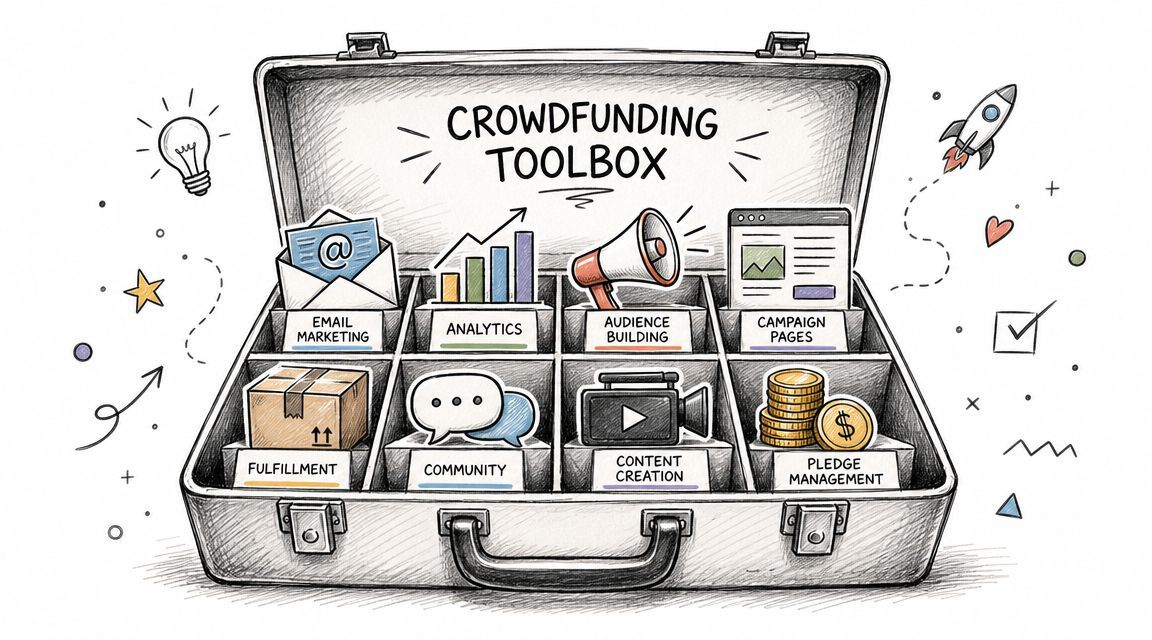
Discover the 10 best tools for creators in 2026. Our guide covers the crowdfunding lifecycle, from pre-launch to fulfillment, for your Kickstarter campaign.
Launching a crowdfunding campaign feels simple right up until you realize how many moving parts sit behind the page. You need a way to validate demand, build an email list, manage live traffic, track conversions, collect surveys, charge shipping, handle add-ons, export fulfillment data, and answer backers when something breaks. Most creators don't fail because the idea is weak. They fail because the workflow is.
That's why the best tools for creators aren't just editing apps or design software. This stack spans the full lifecycle from pre-launch to fulfillment. Mainstream creator advice usually centers on editing, design, AI writing, and social management, but crowdfunding teams need something more operationally complete. That broader workflow view matches how creator tooling has evolved into an end-to-end system across creation, publishing, and measurement, as noted in Sprout Social's creator tools framework.
For Kickstarter creators, the most expensive mistakes usually happen after funding. If you're still piecing together spreadsheets and disconnected SaaS tools, you're creating support debt for your future self. This guide focuses on practical stack choices that hold up in real campaigns, especially if you're managing physical rewards, add-ons, taxes, and shipping. If you're also exploring funding partners beyond the platform itself, this list of crowdfunding investors in the United States is a useful side path.

A campaign can fund in 20 minutes and still create months of operational mess. The trouble usually starts after the celebration, when backers need surveys, shipping gets charged, add-ons have to stay organized, and fulfillment files need to match what customers bought. PledgeBox earns its place here because it covers that middle-to-late stretch of the crowdfunding lifecycle better than a patchwork stack.
It combines pre-launch lead capture, campaign analytics, email marketing, pledge management, and fulfillment prep in one system. That reduces handoffs, which matters more than feature count once a project has real volume. Every extra export, CSV cleanup, or tool switch creates support work later.
PledgeBox is built for the operational side of crowdfunding. That means branded surveys, add-on sales, VAT and tax collection, shipping fees, late pledges, address checks, vendor exports, and tracking updates all sit in the same workflow.
The practical distinction is control. A native pledge manager keeps you close to the original platform flow, which is fine for simple campaigns. A specialized system gives you more room to manage variants, merchandising, post-campaign revenue, and fulfillment data with fewer workarounds. If you want a clearer view of how that compares to another creator-focused option, the PledgeBox vs. Gamefound comparison for crowdfunding creators is a useful reference.
Practical rule: If your campaign includes physical rewards, judge the pledge manager by how it handles money, addresses, exports, and support load, not just by whether it can send a survey.
Its pricing model is also straightforward. Sending the backer survey is free, and fees apply only if upsells generate revenue. That structure keeps early downside low, which I like for creators testing a new product line or running a campaign without much room for software overhead.
PledgeBox fits teams that want one operating layer from pre-launch through fulfillment, especially tabletop projects, gadget launches, and agencies running multiple campaigns at once. The data controls matter too. Once shipping addresses, tax records, and payment details start moving between systems, fewer connections usually means fewer mistakes.
The trade-off is specialization. It is strongest for Kickstarter and Indiegogo workflows, so it makes less sense if your business depends on a broader range of crowdfunding models. And if your campaign does a lot of upsell volume, that fee structure stops being a footnote and becomes part of your margin math.

BackerKit is the safe pick when you want a mature crowdfunding workflow with lots of documentation and fewer surprises. It works as both a crowdfunding platform and a post-campaign system for projects that launched elsewhere, which gives creators flexibility if they don't want to commit to a single path too early.
Where BackerKit earns its reputation is process maturity. The pledge manager, add-ons, pre-order store, backer surveys, email tools, and delivery support all sit inside a familiar ecosystem that many creators and agencies already know how to use. That lowers operational risk, especially if your team values established workflows over experimentation.
BackerKit makes the most sense for teams that want a widely adopted post-campaign standard with transparent published pricing. If you like comparing fee schedules before making a decision, that transparency is useful. Some creators are happy to pay more for predictability, especially when the project is large enough that process mistakes cost more than software fees.
The trade-off is straightforward. If you didn't crowdfund on BackerKit, pledge manager fees can be less attractive. Its marketing and ad support also isn't something to assume you'll get automatically.
BackerKit is strong when you want a proven system. It's less compelling if you're optimizing hard for fee efficiency or tighter control over the full stack.
Website: BackerKit

Gamefound is built with tabletop DNA, and that shows in the product. If you're publishing a board game, miniature line, or expansion-heavy campaign, its pledge manager and late-pledge storefront flow feel native to the way tabletop backers buy.
For that niche, Gamefound often feels more natural than a general-purpose crowdfunding setup. Add-ons, stretch content, and post-campaign shopping are central to the experience rather than bolted on later. The open pledge manager also gives creators room to use it after funding elsewhere.
This is the platform I'd look at first for tabletop creators who care about category fit and native audience alignment. Discovery is stronger when your campaign speaks the language the platform already understands. That can save a lot of education and funnel cleanup.
Its weakness is the mirror image of that strength. If you're launching consumer tech, hardware accessories, or something outside tabletop culture, the built-in audience fit may not help much.
Website: Gamefound

Kickbooster solves one problem well. Referral tracking for crowdfunding.
That sounds narrow, but it's one of those channels that gets chaotic fast if you try to manage it manually. Affiliate links, attribution disputes, partner payouts, influencer tracking, fraud checks, and invoicing can eat a surprising amount of time during a live campaign.
Kickbooster works best when you already know referral traffic fits your product. It gives you a cleaner system for managing creators, affiliates, and promoters without turning your campaign into an accounting exercise. The marketplace can also help if you don't already have relationships in place.
The caution here is quality control. A marketplace gives you access, not guaranteed results. You still need to vet partners, messaging quality, and whether their audience matches your product.
Referral programs work best when the offer is easy to explain and the conversion path is short. If your campaign needs a long technical education before someone backs, affiliate traffic usually gets harder to scale efficiently.
Website: Kickbooster

LaunchBoom is more operating method than software tool. That's why some teams love it and others don't need it. If you want a structured process for validating a product before putting serious money behind ads, LaunchBoom's test-first approach is the main appeal.
This is often the right answer for creators who have product confidence but weak go-to-market discipline. Campaigns don't usually fail because someone forgot a page section. They fail because the offer, pricing, audience, or messaging was never properly tested before scaling.
LaunchBoom covers pre-launch validation, list growth, media buying, creative strategy, and campaign support across multiple crowdfunding platforms. That range is valuable if you want one partner helping from concept testing through launch execution.
The downside is typical agency reality. Pricing depends on scope, and you need to go through consultation. If your budget is small or your product still needs fundamental refinement, an agency framework can feel heavy.
Website: LaunchBoom

Jellop is a live-campaign advertising specialist. If your pre-launch setup is solid and you need a team that understands crowdfunding paid traffic during the pressure window of a live Kickstarter, Jellop is usually on the shortlist.
Its value is specialization. Campaign ads aren't the same as standard ecommerce ads. The timing, social proof dynamics, funding momentum, and platform conversion behavior all change how you buy traffic and interpret results.
Jellop is most useful when you already have enough campaign readiness to justify active ad scaling. That means strong creative, solid landing-page logic, a campaign page that converts, and enough budget to support learning and optimization. If those basics are weak, a specialist ad partner can't rescue the whole funnel.
The company's official partner positioning on Kickstarter adds confidence, but creators should still pressure-test economics and attribution expectations before signing. A specialist is only worth it if your margins and average pledge structure can support paid acquisition.
Website: Jellop

Funded Today is for creators who want a broader agency package instead of a narrower ad specialist. Paid media, PR, cross-promotions, influencer work, creative support, and campaign education all sit under the same roof.
That breadth is the reason to hire them. If your internal team is thin and you need outside help across multiple growth channels, a broader agency can keep your launch from becoming a series of disconnected contractors.
Bundled support sounds attractive, but it only pays off if responsibilities are clearly defined. Ask who controls ad accounts, who owns creative assets, how reporting works, and what success looks like in practical terms. The more channels an agency touches, the more important execution clarity becomes.
This kind of setup tends to fit products with broad appeal and decent paid-media potential. If your niche is very technical or your differentiation takes a long time to explain, broad growth packages can struggle unless the strategic narrative is strong.
Website: Funded Today

Prelaunch.com is a demand-testing tool, and that's exactly how you should treat it. Not as proof that a campaign will succeed, but as a faster way to test product messaging, pricing, and willingness to act before launch.
That makes it useful for creators who are still unsure about positioning. A lot of Kickstarter pages are built around what the founder wants to say, not what the buyer needs to hear. Testing helps close that gap before launch day turns your mistakes into public data.
Prelaunch.com is strongest when paired with disciplined traffic sourcing and clean hypotheses. If you bring weak traffic or muddy offers into the system, your answers won't help much. The tool can sharpen decisions, but it can't fix strategic confusion on its own.
If you're still early, these Kickstarter pre-launch planning ideas are a practical complement because they force you to think about the audience-building workflow, not just test outputs.
Good validation tools don't replace judgment. They give you a clearer read on whether your current story and pricing deserve a bigger bet.
Website: Prelaunch.com

Easyship matters because shipping is where crowdfunding optimism often collides with math. Creators obsess over launch assets, then discover later that packaging assumptions, duties, and regional carrier choices can wreck margin and delay delivery.
Easyship gives creators practical infrastructure for rate shopping, label creation, tax and duty handling, and shipping guidance. That's especially useful for first-time teams moving from funded campaign to actual fulfillment.
Post-campaign operations are still underserved in most best tools for creators roundups. General creator advice usually focuses on content production basics, while the harder work of surveys, shipping data, taxes, add-ons, and fulfillment gets much less attention, as highlighted in this analysis of the operational gap in creator tool coverage.
That's why a shipping platform like Easyship can be more valuable than another marketing app once funding closes. If you need a broader look at fulfillment software options, this guide to shipping software for small businesses is also useful.
Website: Easyship

ShipStation is the practical choice for creators shipping in-house with a small team. If you already have orders flowing from a pledge manager and need a system for bulk labels, automation rules, and carrier rate shopping, it does the warehouse-side work well.
This is less of a strategic launch tool and more of an execution tool. That's exactly why it belongs on this list. Once a campaign funds, the team that can turn pledge data into clean shipping operations usually has the calmer support inbox.
ShipStation works best for teams that want to manage pick, pack, and ship operations themselves, or at least control that process closely. It's not a fulfillment partner. It's the software layer that helps your team run fulfillment with fewer manual steps.
The broader reason this matters is adoption. In analytics and business intelligence, average employee usage remains much lower than leader-reported growth in intent, and tools see better adoption when they prioritize self-service, embedded workflows, onboarding, and data quality, according to BARC's BI and analytics adoption findings. ShipStation fits that lesson well when teams need operational software people can use day to day.
The best fulfillment tool is usually the one your ops lead can run without building a parallel spreadsheet just to compensate for the software.
Website: ShipStation
| Tool | Core features ✨ | UX & Support ★ | Pricing / Value 💰 | Ideal for 👥 | Standout / Unique points 🏆✨ |
|---|---|---|---|---|---|
| PledgeBox 🏆 | Pre-launch pages, campaign analytics, inbox email, branded pledge manager, Stripe/PayPal, shipping integrations | ★★★★★, AI setup, 24/7 GPT + human support, mobile backer portals | 💰 Free start; no upfront/per-backer/campaign fees; 3% on add-on sales | 👥 Kickstarter & Indiegogo creators, hardware, tabletop, agencies | 🏆 All-in-one workflow, privacy-first data, fast AI setup, Backer Tester & pre-order marketplace |
| BackerKit | Pledge manager, add-ons, pre-order store, email, delivery support | ★★★★, established workflows, extensive help resources | 💰 Published fee schedule; higher fees if not on BackerKit | 👥 Creators needing clear fees & proven pledge management | Transparent pricing, extensive docs & support |
| Gamefound | Open pledge manager, late-pledge storefronts, tabletop audience, Adfound | ★★★★, tabletop-optimized UX for backers | 💰 Published fees; fixed + % per transaction model | 👥 Board game & tabletop creators | Native tabletop discovery, strong late-pledge UX |
| Kickbooster | Referral links, fraud controls, affiliate marketplace, automated payouts | ★★★, reduces affiliate admin, marketplace options | 💰 Performance-based (creator sets commissions); marketplace fees apply | 👥 Campaigns seeking referral/affiliate growth | Automated affiliate payouts, fraud controls, marketplace access |
| LaunchBoom | Pre-launch validation, media buying, creative, coaching & full-service agency | ★★★★, process-driven, consultative support | 💰 Bespoke pricing; consult required (not for very small budgets) | 👥 Creators wanting end-to-end agency & scaling | Test-validate-scale playbooks, cross-platform support |
| Jellop | Live paid-traffic management, attribution, real-time dashboards | ★★★★, deep Kickstarter specialization & benchmarks | 💰 Performance fees (commission model; ~guidance %) | 👥 Creators with sizable daily ad budgets | Official Kickstarter ad partner; strong attribution analytics |
| Funded Today | Paid media, PR, influencers, page & video creative | ★★★, bundled agency services; variable outcomes | 💰 Bespoke pricing; vet scope, margins & ad control | 👥 Creators seeking bundled growth + PR | Multi-channel creative + PR + paid media offering |
| Prelaunch.com | Demand & price testing, reservation mechanics, A/B tests, AI insights | ★★★★, validation-focused UX; free tier available | 💰 Free tier; paid plans for larger tests/features | 👥 Creators validating demand, messaging, pricing pre-launch | Fast willingness-to-pay tests and reservation intent mechanics |
| Easyship | Rate shopping, label creation, tax/duty tools, fulfillment guides | ★★★★, crowdfunding guides; scales to 3PL | 💰 Carrier costs + tiered features; premium features paid | 👥 Creators managing shipping/fulfillment post-campaign | Crowdfunding-specific shipping calculators, tax/duty tools |
| ShipStation | Integrations with pledge managers, bulk labels, automations, rate shopping | ★★★★, robust automation; clear tiered pricing | 💰 Tiered US pricing; 30-day trial; add-ons may increase costs | 👥 Teams doing in-house pick/pack or small-scale fulfillment | Strong integrations, bulk label & automation rules for scaling |
The best tools for creators aren't the ones with the longest feature list. They're the ones that remove friction at the exact stage where your campaign is most fragile. For some teams, that's pre-launch validation. For others, it's live-campaign traffic. For many Kickstarter creators, it's what happens after funding, when surveys, add-ons, taxes, address cleanup, and fulfillment suddenly become the core business.
That broader view matters because the market for digital content creation tools keeps expanding. Grand View Research valued the global digital content creation market at USD 32.28 billion in 2024 and projected 13.9% CAGR from 2025 to 2030. More tools will keep showing up. That doesn't mean your stack should keep growing with them.
In practice, tool sprawl is one of the fastest ways to lose control of a crowdfunding operation. Every extra handoff creates another opportunity for mismatched data, broken reporting, delayed support, or bad exports. That's why I push creators to think in systems, not subscriptions. One tool for validation, one for traffic if needed, one core post-campaign system, and one shipping layer is usually a healthier setup than stitching together six partial solutions.
Security deserves more weight in that decision than most creators give it. As creator stacks expand with more connected SaaS tools and automation, ownership, privacy, and access control become more important, especially when backer addresses, tax details, and payment-linked records are involved. That's one reason creator-specific security is emerging as its own category in Bitdefender's discussion of creator tools and protection. For crowdfunding teams, privacy-first handling shouldn't be an afterthought.
If you want the simplest decision path, start with your bottleneck. If your launch isn't validated, fix that first with a tool like Prelaunch.com or a process partner like LaunchBoom. If traffic is your main gap, look at Jellop, Funded Today, or Kickbooster depending on channel strategy. If your biggest risk sits after the campaign, build around a pledge manager first.
For most physical-product campaigns, that's where PledgeBox stands out. It covers the operational middle that many creators underestimate, and it does it without asking for upfront, per-backer, or campaign fees. The survey is free to send, and the platform only charges 3% on upsell revenue if you generate any. That pricing structure lines up well with how creators want to manage risk.
A smart stack won't make a weak campaign strong. But it will stop a strong campaign from falling apart after funding.
If you want one platform that can carry your campaign from pre-launch lead capture to backer surveys, upsells, late pledges, and fulfillment exports, take a serious look at PledgeBox. It's one of the few tools built for the full crowdfunding lifecycle, and the pricing is unusually friendly for creators: free to send surveys, with only a 3% fee on upsell revenue if there is any.
PledgeBox
The All-in-One Toolkit to Launch, Manage & Scale Your Kickstarter / Indiegogo Campaign