 PledgeBox
Postage Calculator USPS
Master the postage calculator usps for your 2026 crowdfunding campaign. Estimate domestic & international shipping costs & integrate with PledgeBox.
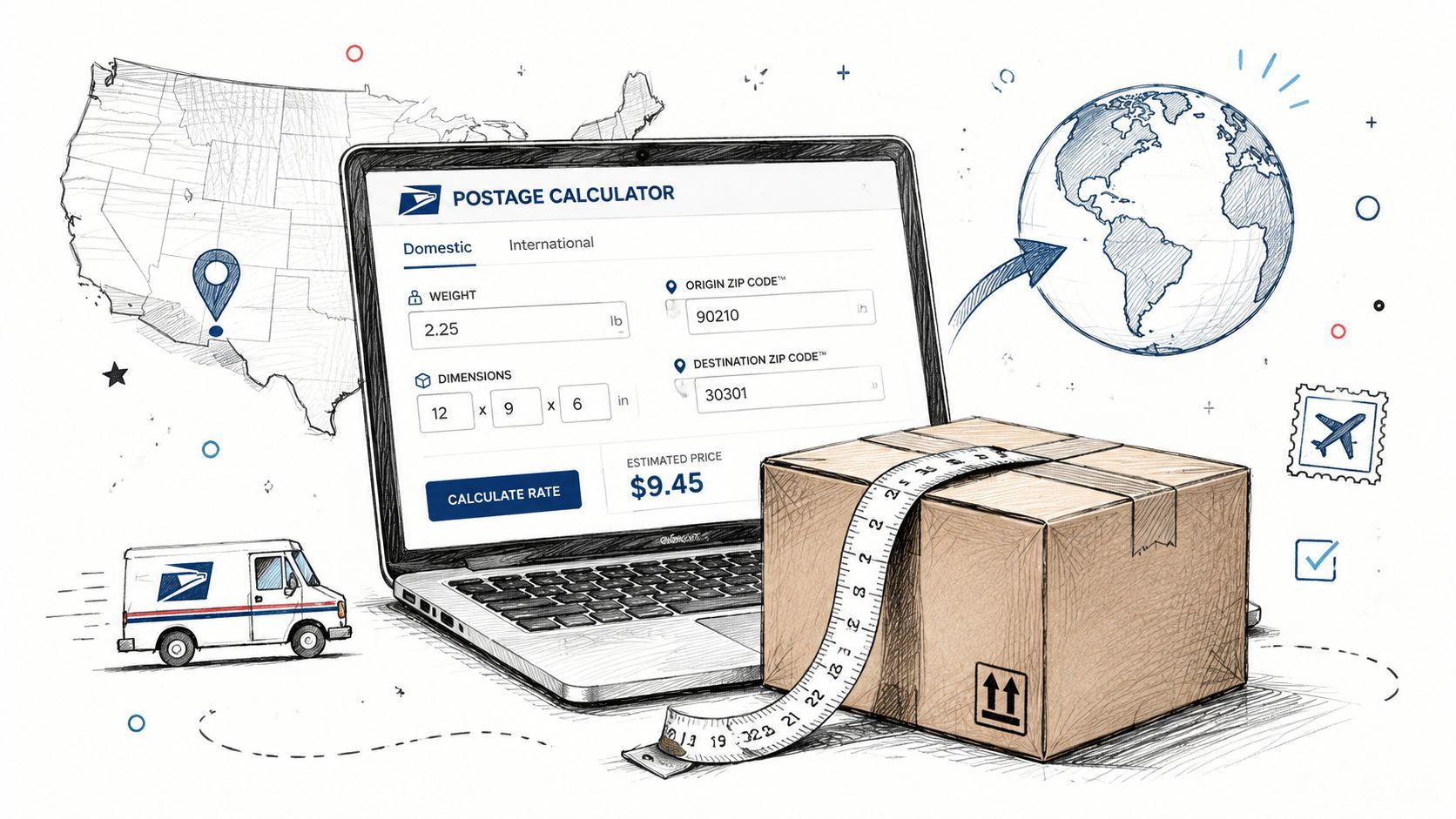
Master the postage calculator usps for your 2026 crowdfunding campaign. Estimate domestic & international shipping costs & integrate with PledgeBox.
Your campaign funded. Backers are excited. Then the spreadsheet opens, and shipping becomes the part that can hurt you fastest.
Most first-time creators use the USPS calculator like a label-price checker. That's too narrow. For a Kickstarter campaign, the USPS postage calculator is a budgeting tool first. You're not trying to answer, “What does this one box cost?” You're trying to answer, “Can I ship every reward tier, to every region I promised, without burning the margin I thought I had?”
That's why the details matter. Box size matters. Weight break rules matter. Where the package starts and ends matters. Whether you're looking at retail or commercial pricing matters. If you skip those details, the calculator still gives you a number. It just might be the wrong number for your campaign.
A normal online store can adjust as it goes. A crowdfunding campaign usually can't. You've already sold the reward. You've already set expectations. If shipping comes in higher than expected, the money doesn't appear from nowhere. It comes out of your margin, your production buffer, or your own pocket.
That's why I tell creators to treat shipping as part of product design. If your reward needs a bigger box, that changes fulfillment cost. If a deluxe edition pushes you into a heavier shipment class, that changes what you can safely charge. If you're offering international delivery without checking the operational reality, you're taking on risk you may not even see yet.
The first mistake is estimating from the item alone instead of the packed reward. A board game that weighs one amount on its own often ships at a different weight once you add inserts, protective wrap, the outer carton, and the label.
The second mistake is using a single sample shipment and assuming the rest will behave the same way. Campaigns rarely work like that. You may have a core reward, a collector tier, add-ons, and regional differences. Shipping gets messy as soon as one backer adds another item.
Practical rule: If you haven't packed a real sample and run it through your shipping assumptions, you don't have a shipping estimate. You have a guess.
The USPS calculator is useful because it forces you to enter the variables that affect postage. But it doesn't manage your campaign for you. It won't tell you that your chosen box is inefficient. It won't warn you that your survey setup is too simplistic for multiple reward combinations. It won't absorb the cost if your pricing assumptions were thin.
Use it for three jobs:
Crowdfunding creators don't lose control because shipping is unknowable. They lose control because they wait too long to model it.
The official USPS guidance says you can calculate postage from your computer by entering the size, shape, weight, and ZIP Code of the mailing, and that the calculator covers domestic, international, and discount mail. The interface also asks for the mailing ZIP Code, destination ZIP Code, item value, and planned mailing date, which tells you immediately that postage depends on more than weight alone, as shown in the USPS Postal Bulletin guidance.

If you're new to this, don't start with every reward. Start with one representative package. Say you're shipping a boxed board game from Los Angeles, ZIP Code 90001, to a backer in New York City, ZIP Code 10001. Your packed reward is 10 x 8 x 4 inches and weighs 1 lb.
The calculator asks for details in a sequence that mirrors how carriers price shipments. Go field by field.
Origin ZIP Code
Enter where the package ships from. Use your warehouse, fulfillment partner, or home workshop if that's the point of origin.
Destination ZIP Code
Use the backer's delivery ZIP Code. For planning, test several common destinations, not just one.
Mailing date
Enter the date you expect to ship. Rates and service options depend on timing.
Package shape and size
Don't wing this. Measure the outer package, not the product inside it.
Weight
Weigh the fully packed parcel. If you only weigh the game box and forget cushioning and carton weight, your estimate will be off.
Item value
This matters operationally because the interface considers declared value as part of the pricing workflow.
For a Kickstarter creator, one sample quote isn't enough. I'd run the calculator at least three ways for the same reward:
That gives you a more realistic range before you publish shipping fees.
If you want a second benchmark while you're comparing options, the Material Handling USA shipping calculator is a useful cross-check for general shipping planning, especially when you're still pressure-testing package assumptions.
Don't trust memory for dimensions. Put the reward in its actual shipper, seal it, then measure the outside.
The USPS calculator works best when your packaging is already disciplined. Before you use it, do this:
The phrase postage calculator USPS moves beyond being just a search term and integrates into your operating process. The calculator gives you the baseline. Your packaging discipline makes that baseline trustworthy.
A lot of confusion starts right after the calculator returns a price. Creators assume the number on screen is the number they'll pay in fulfillment. Sometimes it is. Often, it isn't.
A common gap in the USPS calculator ecosystem is that many pages don't clearly explain which pricing tier a user is seeing, especially USPS Retail or Commercial, even though that distinction matters if you need predictable landed cost rather than a single label price, as noted by ShipStation's USPS calculator discussion.
Retail pricing is what many people associate with walking into a post office and paying at the counter. Commercial pricing usually appears when you buy postage through shipping software or a fulfillment workflow tied to online labels. If you budget using one tier and fulfill using another, your numbers may be directionally right but operationally misleading.
That matters most when you're trying to answer practical questions like these:
The number on the label is only one part of fulfillment cost. Packaging labor and packaging design can wipe out a rate advantage quickly.
| USPS Service | Best For... | Pricing Model | Key Benefit |
|---|---|---|---|
| Ground Advantage | Standard rewards that aren't urgent | Retail or Commercial, depending on how postage is purchased | A practical choice for many non-express shipments |
| Priority Mail | Faster delivery for higher-priority rewards | Retail or Commercial, depending on buying channel | Better fit when speed or handling matters more |
| Priority Mail Flat Rate | Dense items that fit standard USPS flat rate packaging | Retail or Commercial, depending on buying channel | Useful when the box format works in your favor |
This table isn't a promise that one service always wins. It's a reminder that service selection depends on the actual reward, the packaging, and the buying channel.
What works is building your campaign model around the pricing tier you expect to use in real fulfillment. If your plan is to buy labels online through a shipping platform or fulfillment partner, budget from that reality.
What doesn't work is grabbing one visible USPS quote and using it as a universal rule for all reward tiers.
A few decisions make this cleaner:
The practical takeaway is simple. Cheap postage isn't the same as cheap fulfillment. If you're running a campaign with multiple reward sizes, the right question is not “What's the lowest USPS price?” It's “Which shipping setup gives me a predictable total cost per backer?”
A package can look light and still ship expensively. That's where creators get surprised.
Weight is obvious, so everyone checks it. Package volume is less obvious, so it gets ignored until the shipping bill lands. If your collector box uses oversized packaging, thick inserts, or void fill to protect components, dimensions can matter as much as scale weight.

Creators often design premium presentation first and shipping carton efficiency second. That's understandable. It's also expensive.
If you're shipping a game with foam inserts, sleeves, stretch-goal extras, and a decorative outer box, your final carton may become much larger than the product itself. That can change which shipping option makes sense, even before you look at destination.
If you need a practical way to think about cubic packaging impact while testing carton choices, this cubic calculator for shipping helps frame how volume changes your planning.
There's another detail that matters when you ship lots of small packages. For Priority Mail, USPS rounds weight up. Packages under 0.5 lb are rounded up to 0.5 lb, and after that the weight rounds to the nearest pound. A package weighing 2 lb 8 oz is billed as 3 lb, according to ShippingEasy's explanation of USPS Priority Mail calculator behavior.
That's not a minor technicality for crowdfunding. If you have many rewards clustered near a break point, a small packaging change can push the billed weight higher across a large batch of shipments.
Use a simple check before locking packaging:
A short explainer can help if your team needs a visual reset on the moving parts:
Global shipping is where creators should slow down and get more deliberate. The USPS calculator can quote international shipments, but the operational challenge is bigger than the quote itself.
International rewards usually bring more friction around customs documentation, delivery variability, address formatting, and backer expectations when fees or import handling appear after dispatch. You don't need to panic about that. You do need to avoid bundling all international backers into one flat assumption.
If you can't explain your international shipping policy in one clean paragraph on your campaign page, it probably isn't defined well enough yet.
For global backers, treat each country group as a separate planning problem. Some campaigns decide to support fewer destinations well rather than many destinations poorly. That's often the smarter move.
Running the USPS calculator for one reward is manageable. Running shipping logic across hundreds of backers, multiple reward tiers, add-ons, split shipments, and late address changes is where manual methods start to break.
In such circumstances, a pledge manager becomes operational, not optional. The native Kickstarter survey flow is a bit like Amazon. It's straightforward and standardized. A dedicated pledge manager is more like Shopify. You get more control over how the post-campaign experience is structured, how shipping gets charged, and how different backer combinations are handled.

The practical move is to convert your calculator work into shipping profiles. Instead of thinking in one-off labels, think in repeatable rules:
This matters because the backer survey is where your estimate becomes a collected amount. If the structure is too simple, you either undercharge or create manual cleanup later.
If you're building that workflow, PledgeBox's shipping cost guide is relevant because it focuses on using packed weight, dimensions, and carrier rules when setting shipping logic for surveys.
A pledge manager helps in three places that creators routinely underestimate.
First, it keeps shipping tied to actual reward selection instead of broad assumptions. Second, it gives you a cleaner way to charge after the campaign once packaging and destination realities are clearer. Third, it reduces spreadsheet drift, which is where fulfillment errors start multiplying.
One option in this category is PledgeBox. It's free to send the backer survey and only charges 3% of upsell if there's any, which makes it workable for creators who want to collect shipping and test post-campaign add-ons without upfront survey cost. That's the practical reason many creators compare the Kickstarter pledge manager to Amazon and a more configurable pledge manager to Shopify.
You may also need to think beyond postage into tax and payment flow, especially if your campaign sells internationally or works through multiple entities. In that case, this overview of a merchant of record is worth reading before you finalize your post-campaign setup.
Manual shipping management feels cheaper right up until your backer list gets complicated.
Before you send surveys, lock these decisions:
Most fulfillment problems don't start in the warehouse. They start in the survey settings.
The USPS calculator gives you the starting number. Your job is to turn that number into a system.
A predictable fulfillment budget comes from combining several decisions that reinforce each other. You pack real samples. You test actual destinations. You separate retail-looking quotes from the rates and workflows you expect to use in fulfillment. You avoid vague “worldwide shipping” promises unless your survey structure can support them cleanly.
Creators get in trouble when they treat shipping as a line item. It behaves more like a chain of decisions.
A different box changes packed dimensions. A different insert changes billed weight. A new stretch goal changes the carton plan. A last-minute add-on changes whether one parcel still makes sense. Once you accept that, you stop looking for one perfect quote and start building a workable model.
Use this checklist before you lock anything in:
If your shipping plan feels a little conservative, that's usually healthier than making a promise you can't support later. Backers can tolerate a clear shipping policy. They react badly to surprise charges, long delays caused by fulfillment chaos, or reward tiers that were priced on hopeful assumptions.
A budgeting template also helps. If you need a practical framework for organizing fulfillment costs alongside the rest of your campaign planning, this budgeting proposal sample is a useful reference point.
The value of the USPS postage calculator isn't the quote on the screen. It's the discipline it forces on your campaign. It pushes you to define package reality, shipping scope, and collection logic before those decisions get expensive.
If you want a cleaner post-campaign workflow, PledgeBox gives creators a way to send backer surveys for free, collect shipping with more control than the native Kickstarter setup, and only pay a 3% fee on upsell revenue when upsells happen.
PledgeBox
The All-in-One Toolkit to Launch, Manage & Scale Your Kickstarter / Indiegogo Campaign